Market Summary
Executive Summary and Market Analysis
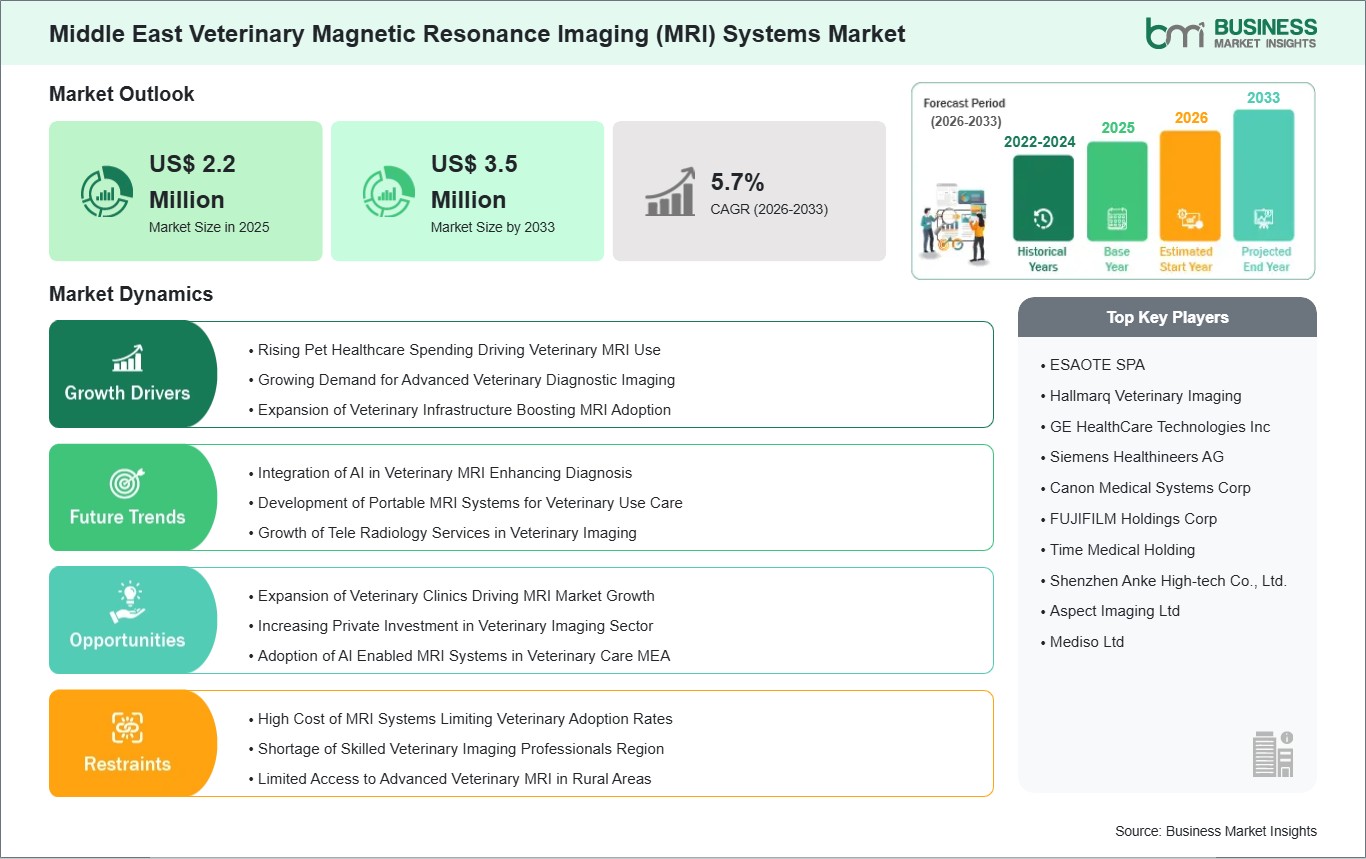
The Middle East Veterinary Magnetic Resonance Imaging (MRI) Systems Market exists as a specialized market segment that currently experiences rapid development through increasing spending on companion animal healthcare and the ongoing modernization of veterinary facilities throughout the area. The Gulf Cooperation Council (GCC) countries demonstrate increasing demand for MRI and other advanced imaging technologies because pet ownership grows and people become more aware of animal welfare and preventive diagnostic methods. Veterinary hospitals and specialty clinics that treat difficult cases drive the adoption of Veterinary MRI because these facilities require precise imaging for neurology and orthopedics, and soft tissue assessment. The region experiences business expansion because pet owners spend more on premium veterinary services, which humanize their pets. Veterinary institutions have begun to adopt high-field and low-field MRI diagnostic systems because these technologies enhance their diagnostic capabilities and enable them to offer new services. The market expansion depends on international veterinary chains and specialty referral centers, which use advanced imaging technologies to strengthen their market presence. The market is expanding through technological advancements because MRI systems now exist that operate with less equipment and need less power while delivering a more compact design and better performance. The Middle East region benefits from these innovations because they help organizations that face space constraints and high operational expenses to choose their equipment. The veterinary industry benefits from increased partnerships between clinics and imaging providers because they create MRI diagnostic access for smaller practices without requiring extensive financial commitments. The market experiences significant restrictions because veterinary clinics face difficulties in acquiring and maintaining MRI systems, which results in limited usage by smaller clinics. The existing shortage of veterinarians who can interpret advanced imaging remains the main obstacle that prevents organizations from using their installed systems to their maximum potential. The market maintains its steady growth because veterinary medical facilities keep expanding while new specialties emerge and animal healthcare in the Middle East shifts toward advanced diagnostic technologies.
Segment Analysis
Middle East Veterinary Magnetic Resonance Imaging (MRI) Systems Market Segmentation
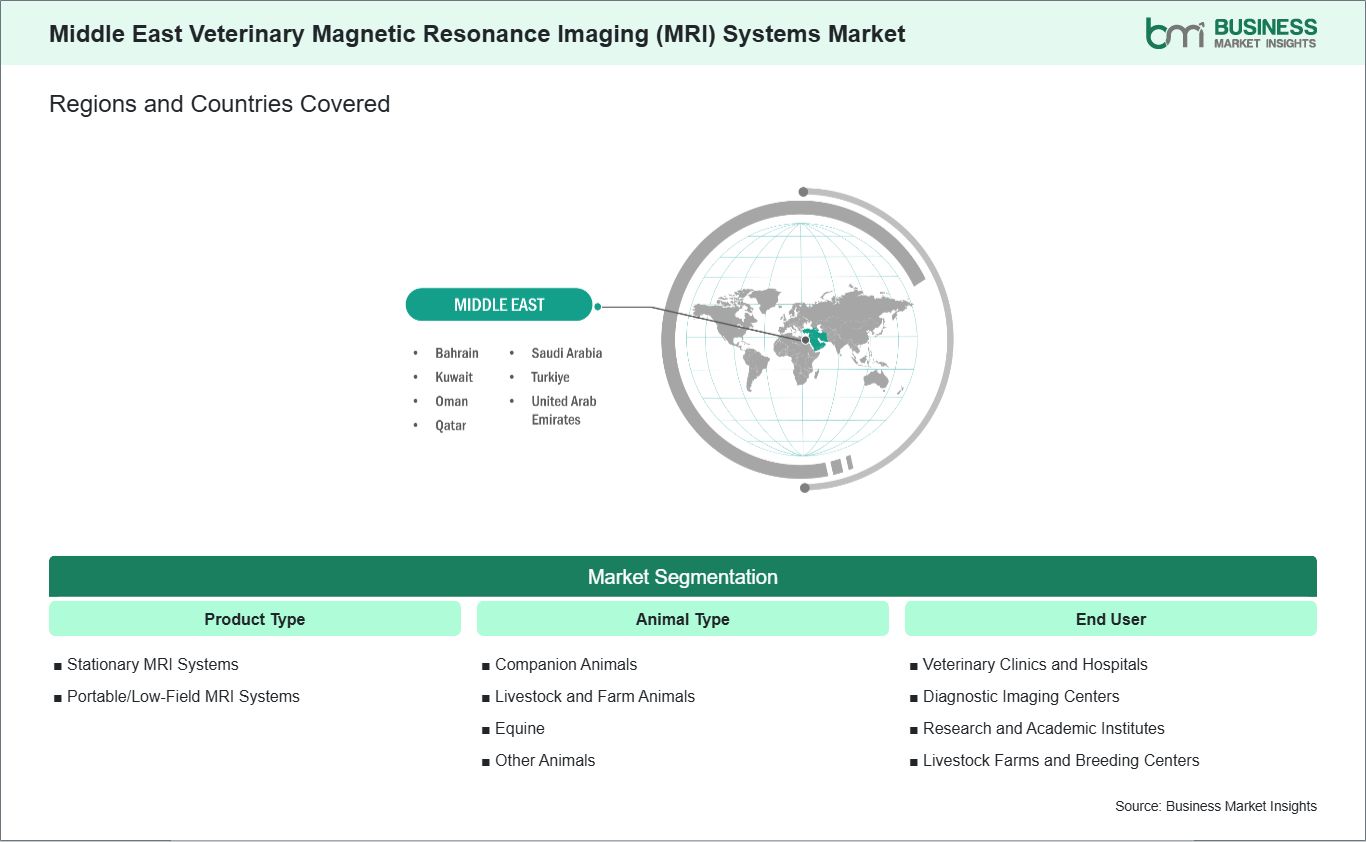
Key segments that contributed to the derivation of the Middle East veterinary magnetic resonance imaging (MRI) systems market analysis are product type, animal type, and end user.
- By product type, the veterinary magnetic resonance imaging (MRI) systems market is segmented into stationary MRI systems, portable/low-field MRI systems. The stationary MRI systems segment dominated the market in 2025.
- Based on animal type, the veterinary magnetic resonance imaging (MRI) systems market is categorized into companion animals, livestock and farm animals, equine, others. The companion animals segment dominated the market in 2025.
- In terms of end user, the veterinary magnetic resonance imaging (MRI) systems market is categorized into veterinary clinics and hospitals, diagnostic imaging centers, research and academic institutes, livestock farms and breeding centers. The veterinary clinics and hospitals segment dominated the market in 2025.
Market Forces
Middle East Veterinary Magnetic Resonance Imaging (MRI) Systems Market Drivers and Opportunities
Rising Pet Healthcare Spending Driving Veterinary MRI Use
The increasing veterinary expenses for pet healthcare in the Middle East region drive more people to adopt veterinary MRI technology. The UAE, Saudi Arabia and Qatar experience higher companion animal care costs, which urban households need to cover. The new trend encourages veterinary clinics to acquire new diagnostic imaging systems, which can identify animal diseases at their first stages with high accuracy.
Pet owners are becoming more aware of advanced medical treatments, which forces clinics to improve their imaging systems. The veterinary hospitals in Dubai and Riyadh now use MRI systems to improve their diagnostic capabilities, which require high-resolution imaging to make clinical decisions about neurological and orthopedic conditions that require advanced imaging technology.
The Middle East now has better access to advanced MRI technology because veterinary hospitals are establishing more partnerships with international equipment manufacturers. The partnerships enable training programs, installation services and maintenance capabilities which help private clinics and large veterinary health facilities in the region to adopt complex imaging systems.
Expansion of Veterinary Clinics Driving MRI Market Growth
The expansion of veterinary clinics across the Middle East is playing a key role in driving the growth of the veterinary MRI systems market. Rapid urban development in countries such as Saudi Arabia, the UAE, and Kuwait is supporting the establishment of modern veterinary facilities equipped with advanced diagnostic technologies to meet rising animal healthcare demands.
These newly established clinics are increasingly focusing on expanding their diagnostic portfolios to include MRI systems for accurate imaging of soft tissue and neurological conditions in animals. The trend is particularly visible in metropolitan areas where pet ownership is high and demand for specialized veterinary care continues to rise steadily across urban centers regionally overall.
Furthermore, private investment in veterinary healthcare infrastructure is strengthening the availability of advanced imaging equipment across the region. As clinics scale their operations, there is a growing emphasis on integrating MRI systems into diagnostic workflows, improving clinical efficiency and supporting higher standards of animal healthcare delivery overall across region.
Size and Share Analysis
Middle East Veterinary Magnetic Resonance Imaging (MRI) Systems Market Size and Share Analysis
The Middle East veterinary magnetic resonance imaging (MRI) systems market is experiencing steady growth, with market size and share analysis reflecting evolving treatment preferences and competitive dynamics among key players. The report evaluates important subsegments categorized within product type, animal type, and end user, highlighting their respective contributions to market performance.
By product type, the stationary MRI systems subsegment dominated the market in 2025, driven by higher image quality, greater throughput, and widespread adoption in hospitals for comprehensive diagnostic imaging.
Based on animal type, the companion animals subsegment dominated the market in 2025, driven by increasing pet ownership and rising demand for advanced diagnostic imaging in routine veterinary care.
In terms of end user, the veterinary clinics and hospitals subsegment dominated the market in 2025, driven by the widespread adoption of x-ray systems for comprehensive diagnostic and treatment services.
Report Coverage
Middle East Veterinary Magnetic Resonance Imaging (MRI) Systems Market Report Coverage and Deliverables
The "Middle East Veterinary Magnetic Resonance Imaging (MRI) Systems Market Size and Forecast (2022–2033)" report provides a detailed analysis of the market covering below areas:
- Market size and forecast at regional and country levels for all market segments covered under the scope
- Market trends, as well as drivers, restraints, and opportunities
- Market analysis covering key trends, regional framework, major players, regulations, and recent developments
- Market concentration, heat map analysis, prominent players, and recent developments for the Market
- Detailed company profiles, including SWOT analysis
Geographic Insights
Middle East Veterinary Magnetic Resonance Imaging (MRI) Systems Market Geographic Insights
The geographical scope of the Middle East Veterinary Magnetic Resonance Imaging (MRI) Systems Market report is divided into UAE, Saudi Arabia, Bahrain, Oman, Kuwait, Qatar, and Turkiye. Turkiye held the largest share in 2025.
The Middle East veterinary MRI systems market shows gradual growth through advanced diagnostic imaging adoption, which proceeds unevenly because pet ownership increases and people spend more on companion animals and veterinary healthcare facilities in GCC countries and Turkiye begin their modernization process. The Saudi Arabian market controls the highest market share among the UAE, Saudi Arabia, Bahrain, Oman, Kuwait, Qatar and Turkiye because Vision 2030 healthcare investments drive veterinary hospital growth and high-field MRI systems become more accessible in referral centers and specialty clinics. The UAE market maintains strong growth because private veterinary networks operate advanced systems, and pet owners increasingly treat pets as family members, and the country serves as a medical tourism center, which provides high-quality animal healthcare. The Qatari and Kuwaiti markets grow at a moderate pace because people adopt pets after they reach their disposable income level, and because elite veterinary facilities receive funding, although their market sizes fall short of those in Saudi Arabia and the UAE. Bahrain and Oman operate as specialized markets that expand their market reach through urban veterinary hospitals that develop MRI capabilities, while their veterinary imaging adoption process advances at a slower speed because they lack imaging infrastructure and depend on imported machines. GCC countries experience market expansion through rising demand for neurological and musculoskeletal companion animal diagnostics, together with growing pet preventive care knowledge and broader pet insurance market availability. The main obstacles to progress include expensive equipment and insufficiently trained veterinary radiologists, and the need for shared human imaging systems, which veterinarians use for their medical work. The veterinary MRI market in Turkiye stands as the most developed and advanced market among all regional markets because the country possesses an advanced veterinary education system and a robust domestic market that manufactures and repairs imaging equipment, and because it serves as a central referral point for three major regions. The country has a higher concentration of veterinary teaching hospitals and specialty clinics equipped with mid- to high-field MRI systems, along with greater adoption of advanced modalities such as 3T imaging and hybrid human-veterinary scanning setups. The company maintains its dominant position through cost efficiency, the growing pet population in urban areas like Istanbul and Ankara and the rising investments in veterinary diagnostic services. The veterinary MRI market in the Middle East serves as the main market for Turkiye because the country possesses advanced structural systems, extensive MRI facilities and similar technologies.
Industry Activity
Recent Developments
The Middle East Veterinary Magnetic Resonance Imaging (MRI) Systems Market is evaluated by gathering qualitative and quantitative data post primary and secondary research, which includes important corporate publications, association data, and databases. A few of the key developments in the Middle East veterinary magnetic resonance imaging (MRI) systems market are:
- In April 2024, Canon Medical Systems, announced the commercial release of the Vantage Galan 3T / Supreme Edition MRI system, featuring AI-driven Altivity software, improved scan speed, and enhanced workflow automation to improve MRI efficiency and patient comfort across global clinical imaging markets.
- In July 2025, Esaote announced the Vet-MR Grande ELITE, a next-generation veterinary MRI system developed in collaboration with veterinary clinics worldwide, featuring improved imaging performance, workflow optimization, and sustainability-focused design.
Trust & Transparency
Research Methodology
The market analysis combines proprietary research with secondary data from government agencies, company disclosures, regulatory filings, industry databases and expert interviews. Market estimates are validated through data triangulation, cross-market benchmarking and analyst
review.
View Full Research Methodology
Key Sources Referred:
American College of Veterinary Radiology (ACVR)World Small Animal Veterinary Association (WSAVA)British Veterinary Association (BVA)International Veterinary Radiology Association (IVRA)American Veterinary Medical Association (AVMA)European College of Veterinary Diagnostic Imaging (ECVDI)World Organisation for Animal Health (WOAH / OIE)Veterinary Imaging & Radiation Oncology Society (VIROS)