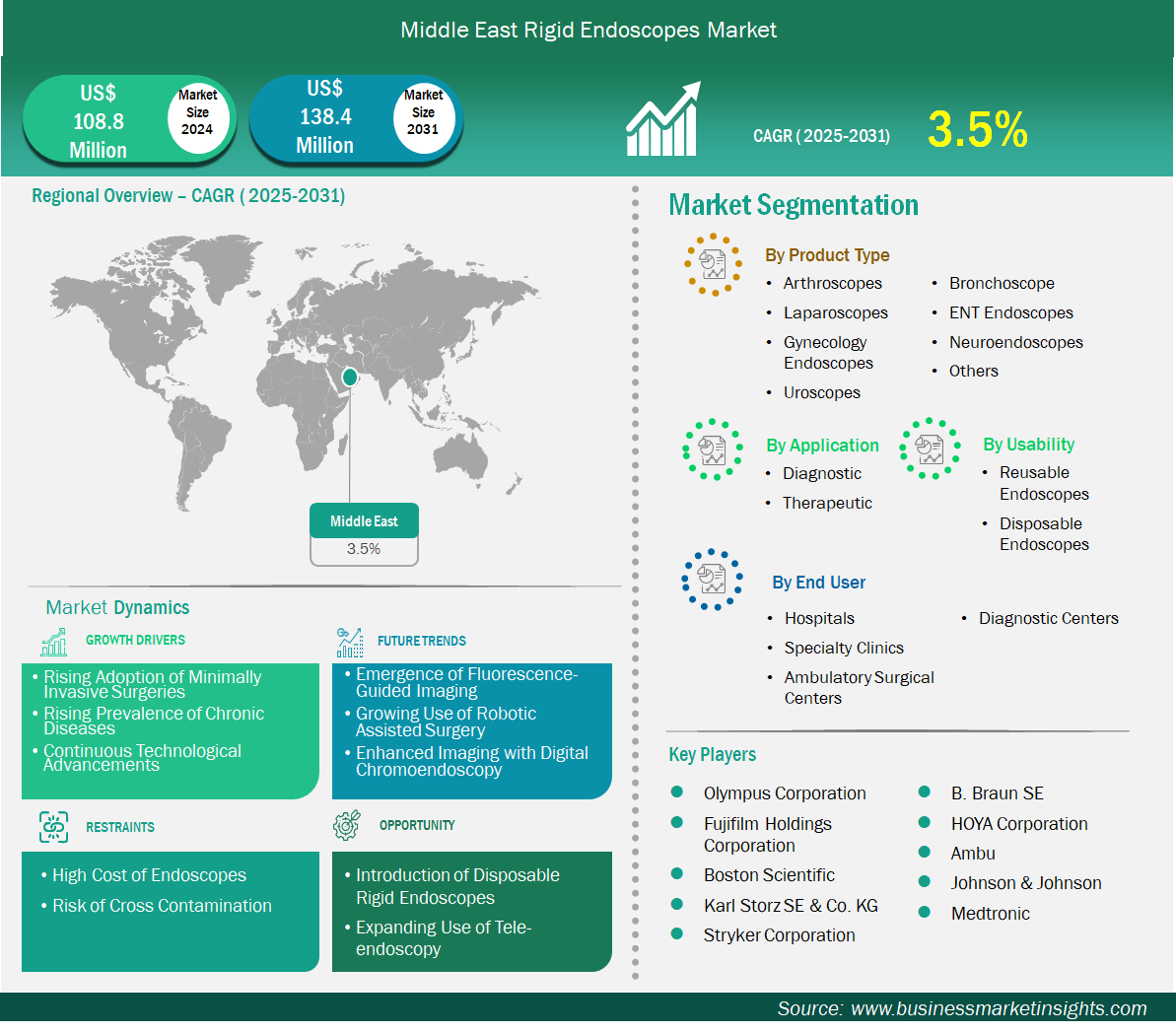
The Middle East rigid endoscopes market size is expected to reach US$ 138.4 million by 2031 from US$ 108.8 million in 2024. The market is estimated to record a CAGR of 3.5% from 2025 to 2031.
Executive Summary and Middle East Rigid Endoscopes Market Analysis:
The Middle East rigid endoscopes market is poised for growth, driven by an increase in surgical demand, healthcare modernization, and patients' increasing inclination towards minimally invasive procedures. Countries across the Middle East, including Saudi Arabia, the UAE, Egypt, and Jordan, are investing in advanced surgical technologies to improve outcomes and achieve fast recovery times. Rigid endoscopes are primarily utilized in medical specialties such as orthopedics, gynecology, and ENT, particularly amongst hospitals that want high-quality images along with durable instruments. Private hospitals in the area have been able to acquire advanced medical technology, while public facilities are still behind and are using rudimentary imaging technology. Saudi Arabia is leading the Middle East rigid endoscopes market, leveraging its Vision 2030 reforms to transform surgical care and attract global medtech partnerships. With the addition of outpatient surgery and precision medicine, rigid endoscopy is becoming ingrained in the surgical care delivery. The market is expected to grow further owing to the availability of skilled professionals, strong regulatory frameworks and rising number of cancers in this region.
Middle East Rigid Endoscopes Market Segmentation Analysis:
Key segments that contributed to the derivation of the rigid endoscopes market analysis are product type, usability, application, and end user.
- By product type, the rigid endoscopes market is segmented into laparoscopes, arthroscopes, uroscopes, gynecology endoscopes, ENT endoscopes, bronchoscopes, neuroendoscopes and others. The laparoscopes segment dominated the market in 2024.
- By usability, the rigid endoscopes market is segmented into reusable endoscopes and disposable endoscopes. The reusable endoscopes segment dominated the market in 2024.
- By application, the rigid endoscopes market is segmented into diagnostic and therapeutic. The diagnostic segment dominated the market in 2024.
- By end user, the market is segmented into hospitals, specialty clinics, ambulatory surgical centers, and diagnostic centers. The hospitals segment held the largest share of the market in 2024.
Middle East Rigid Endoscopes Market Outlook
Rigid endoscopes are becoming essential tools in this region due to their sturdy structure, high-definition technology, and reusable characteristics. Major growth driver for this market is ongoing investments in health care infrastructure, notably in Saudi Arabia and the UAE. Governments are investing in new hospitals, surgical centers, and medical cities as part of their aim to become health care leaders with an aim to prefer minimally invasive technologies. Furthermore, alliances with global MedTech firms are enabling localized production and training to develop accessible supply chains and skills in local markets. Medical universities and hospitals are adding endoscopic procedures to surgical training to ensure an adequate supply of skilled labor. As digitalization and AI-enabled diagnosis and imaging become routine, rigid endoscopy increasingly serves as a platform for precision surgery, improving clinical and operational outcomes throughout the Middle East.
Middle East Rigid Endoscopes Market Country Insights
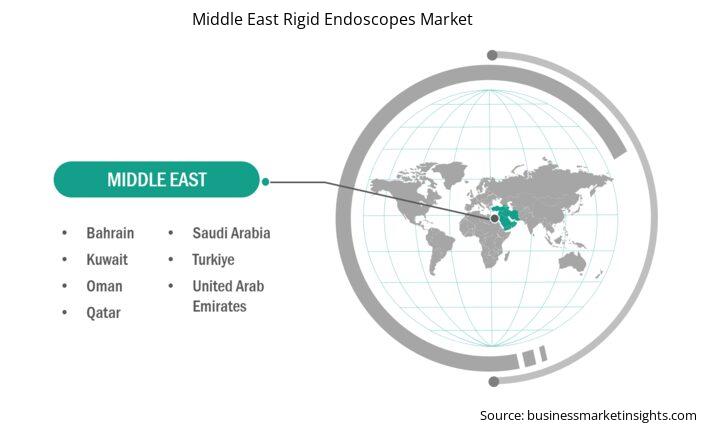
Based on country, the Middle East rigid endoscopes market is segmented into the UAE, Saudi Arabia, Bahrain, Oman, Kuwait, Qatar, and Turkiye. Saudi Arabia held the largest share in 2024.
Saudi Arabia is the largest country in the Middle East and Africa for rigid endoscopes, driven by the educational healthcare agendas of Vision 2030 and investment in surgical modernization. The country is building new medical cities and updating hospitals with better rigid endoscopic platforms. These new updates are primarily expanding across Riyadh, Jeddah, and Dammam. The public hospitals have become familiar with the use of rigid endoscopes, such as the orthopedic rigid endoscope to complete high-volume hip and knee procedures in surgery, funded by the government and other centralized purchases. Strong private institutions are applying more creativity, with robotic-assisted surgical systems and incorporating AI into their imaging and tools. Medical universities and research centers are actively involved in clinical trials and device evaluative processes. The surgical workforce in Saudi Arabia is talented and well educated. There is a higher purpose to endorse their Vision 2030. This factor has placed Saudi Arabia as a dominant country for rigid endoscopes market in Middle East.
Middle East Rigid Endoscopes Market Company Profiles
Olympus Corporation, Fujifilm Holdings Corporation, Boston Scientific, Karl Storz SE & Co. KG, Stryker Corporation, B. Braun SE, HOYA Corporation, Ambu A/S, Johnson & Johnson, and Medtronic are among the key players operating in the market. These players adopt strategies such as expansion, product innovation, and mergers and acquisitions to stay competitive in the market and offer innovative products to their consumers.
Middle East Rigid Endoscopes Market Research Methodology:
The following methodology has been followed for the collection and analysis of data presented in this report:
Secondary Research
The research process begins with comprehensive secondary research, utilizing both internal and external sources to gather qualitative and quantitative data for each market. Commonly referenced secondary research sources include, but are not limited to:
- Company websites, annual reports, financial statements, broker analyses, and investor presentations
- Industry trade journals and other relevant publications
- Government documents, statistical databases, and market reports
- News articles, press releases, and webcasts specific to companies operating in the market
Note: All financial data included in the Company Profiles section has been standardized to US$. For companies reporting in other currencies, figures have been converted to US$ using the relevant exchange rates for the corresponding year.
Primary Research
Business Market Insights conducts a significant number of primary interviews each year with industry stakeholders and experts to validate and analyze the data and gain valuable insights. These research interviews are designed to:
- Refine findings from secondary research
- Enhance the expertise and market understanding of the analysis team
- Gain insights into market size, trends, growth patterns, competitive dynamics, and future prospects
Primary research is conducted via email interactions and telephone interviews with industry experts across various markets, categories, segments, and sub-segments in different regions. Participants typically include:
- Industry stakeholders: Vice Presidents, business development managers, market intelligence managers, and national sales managers
- External experts: Valuation specialists, research analysts, and key opinion leaders with industry-specific expertise
Key Sources Referred:
- The World Bank
- World Health Organization (WHO)
- Center for Disease Control and Prevention (CDC)
- American Society for Gastrointestinal Endoscopy
- European Society of Gastrointestinal Endoscopy
- World Endoscopy Organization
- Society of American Gastrointestinal and Endoscopic Surgeons
- Global Cancer Observatory
- Company website
- Company annual reports
- Company investor presentations
Middle East Rigid Endoscopes Market Strategic Insights
Middle East Rigid EndoscopesMarket Report Highlights
| Report Attribute | Details |
| Market size in 2024 | US$ 108.8 Million |
| Market Size by 2031 | US$ 138.4 Million |
| CAGR (2025 - 2031) | 3.5% |
| Historical Data | 2021-2023 |
| Forecast period | 2025-2031 |
| Segments Covered |
By Product Type
|
|
Regions and Countries Covered
|
|
| Middle East | UAE, Saudi Arabia, Bahrain, Oman, Kuwait, Qatar, Turkiye |
| Market leaders and key company profiles |
|
Middle East Rigid Endoscopes Market Country and Regional Insights