Market Summary
Executive Summary and Market Analysis
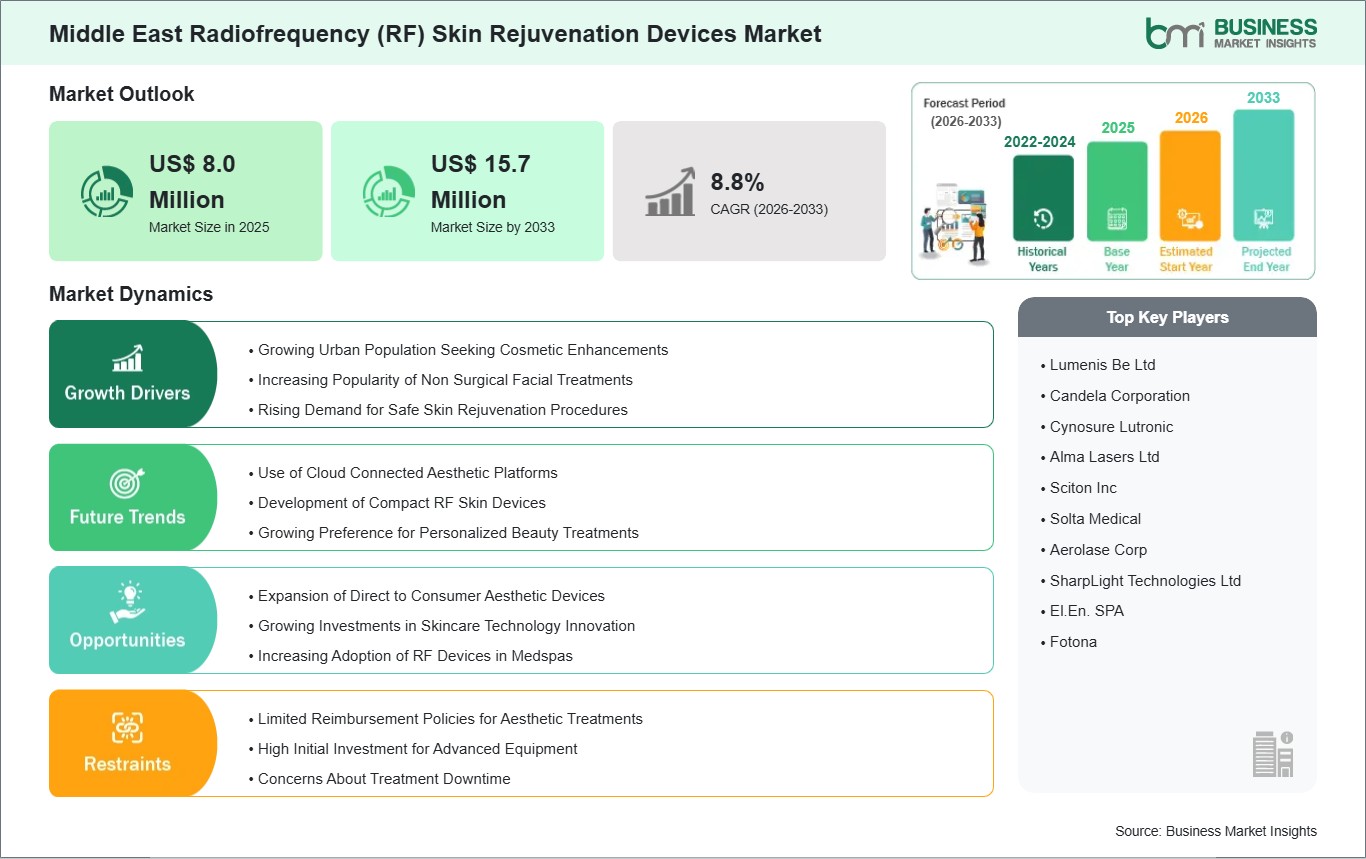
The Middle Eastern RF skin rejuvenation devices industry is experiencing consistent growth due to the rise in the number of people preferring non-invasive beauty treatments and growing awareness of innovative skin rejuvenation devices. In the United Arab Emirates, Saudi Arabia, and Qatar, the demand for RF devices is heavily dependent on the increasing awareness regarding beauty aesthetics, societal pressure through social media platforms, and cultural acceptance of preventive skincare and anti-aging treatments. RF-based devices have been gaining popularity in dermatological clinics and medspas because of their ability to offer skin tightening, wrinkle reduction, and scar correction without causing any discomfort to patients. This trend makes RF-based devices popular among dermatologists who prefer non-invasive treatments over invasive ones for skin tightening. Some of the factors that are fueling growth within the RF skin rejuvenation devices market include rapid growth in aesthetic clinics and medspas, significant healthcare investments, availability of internationally qualified dermatologists, and medical tourism. Patients in the Gulf region tend to prefer RF skin tightening devices over other skin treatments available at cosmetic surgery clinics. Nevertheless, the industry is constrained by some factors, such as the expensive nature of sophisticated RF devices that would deter their use by small-sized clinics and independent operators. Furthermore, regulatory issues and expertise in operating the equipment can hinder the rapid diffusion of the technology. Regardless, there is a growing demand for less intrusive beauty procedures, and this will fuel the development of RF skin tightening devices in the Middle East.
Segment Analysis
Middle East Radiofrequency (RF) Skin Rejuvenation Devices Market Segmentation
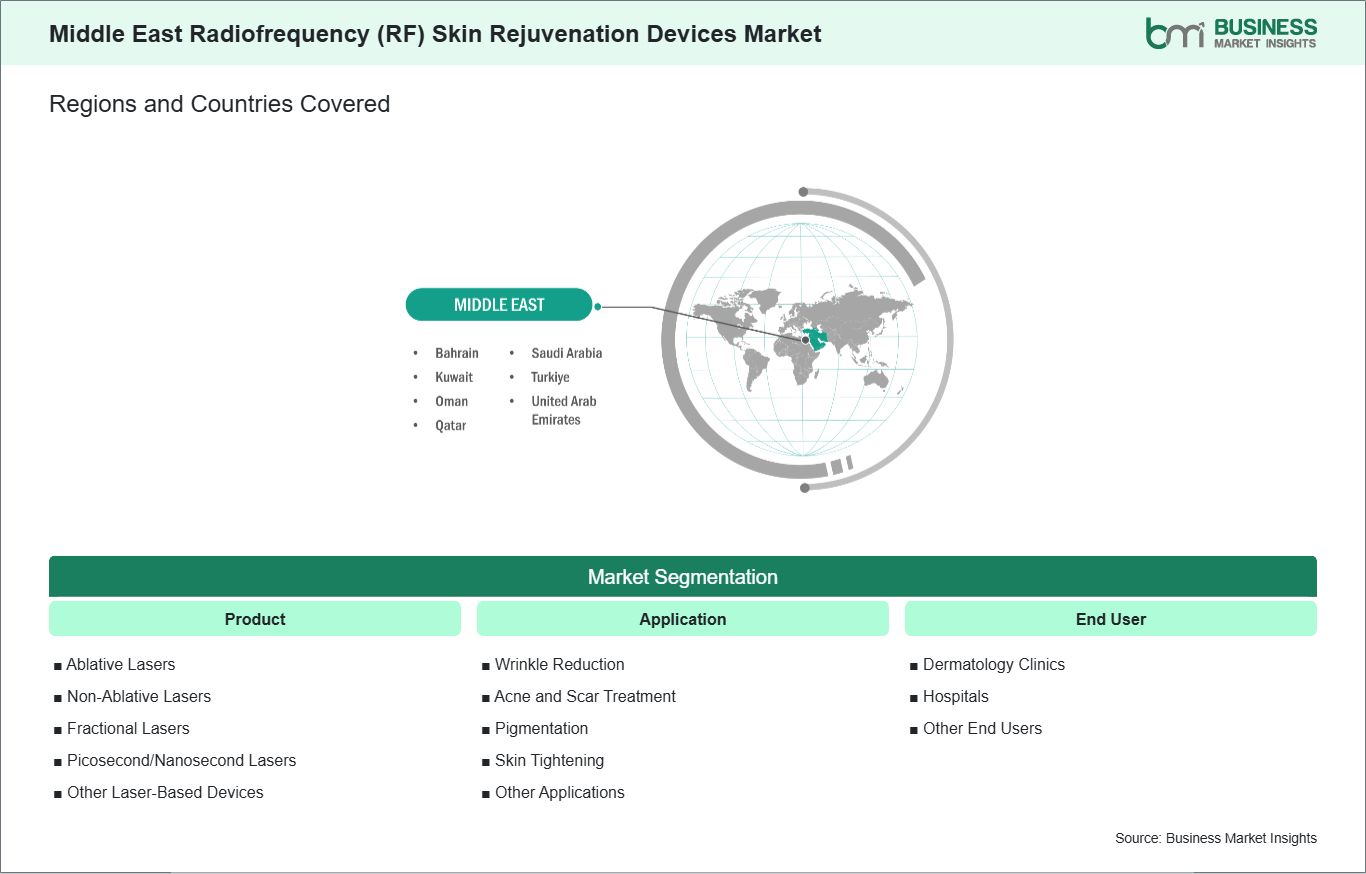
Key segments that contributed to the derivation of the Middle East radiofrequency (RF) skin rejuvenation devices market analysis are product, application and end user.
- By product, the radiofrequency (RF) skin rejuvenation devices market is segmented into ablative lasers, non-ablative lasers, fractional lasers, picosecond/nanosecond lasers, and other laser-based devices. The non-ablative lasers segment dominated the market in 2025.
- Based on application, the radiofrequency (RF) skin rejuvenation devices market is categorized into wrinkle reduction, acne and scar treatment, pigmentation, skin tightening, and other applications. The wrinkle reduction segment dominated the market in 2025.
- In terms of end user, the radiofrequency (RF) skin rejuvenation devices market is categorized into dermatology clinics, hospitals, and other end users. The dermatology clinics segment dominated the market in 2025.
Market Forces
Middle East Radiofrequency (RF) Skin Rejuvenation Devices Market Drivers and Opportunities
Growing Urban Population Seeking Cosmetic Enhancements
There is a noticeable growth in the use of radiofrequency-based skin rejuvenation devices in the Middle East owing to rapid urbanization in key cities like Dubai, Riyadh, and Doha. The development of an urban culture is making people conscious about aesthetics, especially for those employed who value their appearance. Moreover, the Middle East has a young population, coupled with increased globalization through social media channels, which leads to a rise in RF-based skin tightening and wrinkle removal procedures.
Urban dwellers in the Middle East have become more interested in undergoing minimal cosmetic surgery as it enables fast recovery with immediate results. RF devices used for skin rejuvenation are being embraced more than ever before by the urban residents who seek non-surgical anti-aging treatments. The emergence of luxury spas and wellness centers in affluent urban areas has also contributed significantly to the trend.
Lastly, medical tourism in the city of Dubai has been a critical driver of RF skin rejuvenation devices. The influx of international visitors to the country for aesthetic treatment has resulted in the widespread adoption of energy-based technologies. The combination of urban affluence, lifestyle shifts, and wellness-oriented consumption is making RF devices a key growth driver in the regional aesthetics ecosystem.
Expansion of Direct to Consumer Aesthetic Devices
The direct-to-consumer segment for aesthetic devices in the Middle East is expanding as at-home skincare technology becomes more accessible. Consumers are increasingly interested in portable RF-based devices that offer convenience and privacy, particularly for skin tightening and facial rejuvenation. This trend is being shaped by rising digital literacy and growing trust in user-friendly beauty technologies.
E-commerce platforms and specialty beauty retailers are playing a crucial role in widening access to RF skin rejuvenation devices. Urban consumers in markets such as the UAE and Saudi Arabia are showing strong preference for premium at-home aesthetic solutions, driven by busy lifestyles and the desire for self-managed skincare routines. This shift is gradually complementing clinic-based treatments rather than replacing them.
At the same time, aesthetic brands are investing in targeted marketing strategies that emphasize safety, ease of use, and professional-grade results for home-use RF devices. Influencer-led promotions and social media campaigns are strengthening consumer confidence in these products. As a result, direct-to-consumer adoption is emerging as a parallel growth channel alongside traditional clinical demand in the regional RF skin rejuvenation devices market.
Size and Share Analysis
Middle East Radiofrequency (RF) Skin Rejuvenation Devices Market Size and Share Analysis
The Middle East radiofrequency (RF) skin rejuvenation devices market is experiencing steady growth, with market size and share analysis reflecting evolving treatment preferences and competitive dynamics among key players. The report evaluates important subsegments categorized within product, application and end user, highlighting their respective contributions to market performance.
By product, the non-ablative lasers subsegment dominated the market in 2025, driven by increasing consumer preference for minimally invasive skin rejuvenation procedures with reduced downtime and improved safety profiles.
Based on application, the wrinkle reduction subsegment dominated the market in 2025, driven by the rising demand for anti-aging treatments and growing awareness regarding aesthetic skin enhancement procedures.
In terms of end user, the dermatology clinics subsegment dominated the market in 2025, driven by the increasing availability of advanced aesthetic treatment solutions and the growing number of patients seeking specialized skincare services.
Report Coverage
Middle East Radiofrequency (RF) Skin Rejuvenation Devices Market Report Coverage and Deliverables
The "Middle East Radiofrequency (RF) Skin Rejuvenation Devices Market Size and Forecast (2022–2033)" report provides a detailed analysis of the market covering below areas:
- Market size and forecast at regional and country levels for all market segments covered under the scope
- Market trends, as well as drivers, restraints, and opportunities
- Market analysis covering key trends, regional framework, major players, regulations, and recent developments
- Market concentration, heat map analysis, prominent players, and recent developments for the Market
- Detailed company profiles, including SWOT analysis
Geographic Insights
Middle East Radiofrequency (RF) Skin Rejuvenation Devices Market Geographic Insights
The geographical scope of the Middle East Radiofrequency (RF) Skin Rejuvenation Devices Market report is divided into UAE, Saudi Arabia, Bahrain, Oman, Kuwait, Qatar, Turkiye. Turkiye held the largest share in 2025.
There are significant variations in the adoption rate of Middle East RF skin rejuvenation devices within Gulf Cooperation Council (GCC) nations and Turkiye, owing to the increasing awareness levels regarding aesthetic procedures, the increasing numbers of dermatology clinics and the usage of non-surgical skin tightening procedures. The UAE is seen as one of the key centers for innovations and medical tourism due to the wide penetration of premium aesthetic procedures, along with the presence of advanced clinic facilities and a robust presence of international medical device suppliers. Following the UAE, Saudi Arabia emerges as one of the key adopters of this technology, with increasing youth populations, rising cosmetic consciousness and an increasing presence of private healthcare centers and medspas due to increased healthcare reforms in the country. On the other hand, Qatar and Kuwait are witnessing steady adoption rates of this technology that are mainly centered around wealthy individuals living in major metropolitan cities in the region. On the other hand, Turkey becomes the leading regional player owing to its sizable patient population, robust medical aesthetics industry, solid domestic manufacturing infrastructure, and its role as a hub for cosmetic procedures. Besides this, competitive pricing, expertise of dermatologists, and a high number of procedures also contribute to making Turkey the leading RF skin rejuvenation devices market in the region, ahead of GCC countries.
Industry Activity
Recent Developments
The Middle East Radiofrequency (RF) Skin Rejuvenation Devices Market is evaluated by gathering qualitative and quantitative data post primary and secondary research, which includes important corporate publications, association data, and databases. A few of the key developments in the Middle East radiofrequency (RF) skin rejuvenation devices market are:
- In July 2024, Heka Trading, announced that it introduced Lumenis aesthetic devices in the UAE market, including advanced skin rejuvenation systems such as Geneo X and triLift, strengthening access to RF and energy-based skin tightening technologies in the Middle East aesthetics sector.
- In March 2022, Emblation Limited, announced that it launched its Swift® Microwave Therapy system in the Middle East, expanding availability of its energy-based dermatology platform across clinics in the UAE through a regional distribution partnership with Neomed Trading, enabling dermatologists to treat benign skin lesions using advanced microwave RF-based technology.
Trust & Transparency
Research Methodology
The market analysis combines proprietary research with secondary data from government agencies, company disclosures, regulatory filings, industry databases and expert interviews. Market estimates are validated through data triangulation, cross-market benchmarking and analyst
review.
View Full Research Methodology
Key Sources Referred:
Medicines and Healthcare products Regulatory Agency (MHRA – UK)American Society for Laser Medicine and SurgeryEuropean Academy of Dermatology and VenereologyWorld Health Organization (WHO)International Society for Dermatologic SurgeryAmerican Society of Plastic SurgeonsNational Medical Products Administration (NMPA)International Society of Aesthetic Plastic SurgeryCompany WebsitesCompany Annual ReportsCompany Investor Presentations