Market Summary
Executive Summary and Global Market Analysis
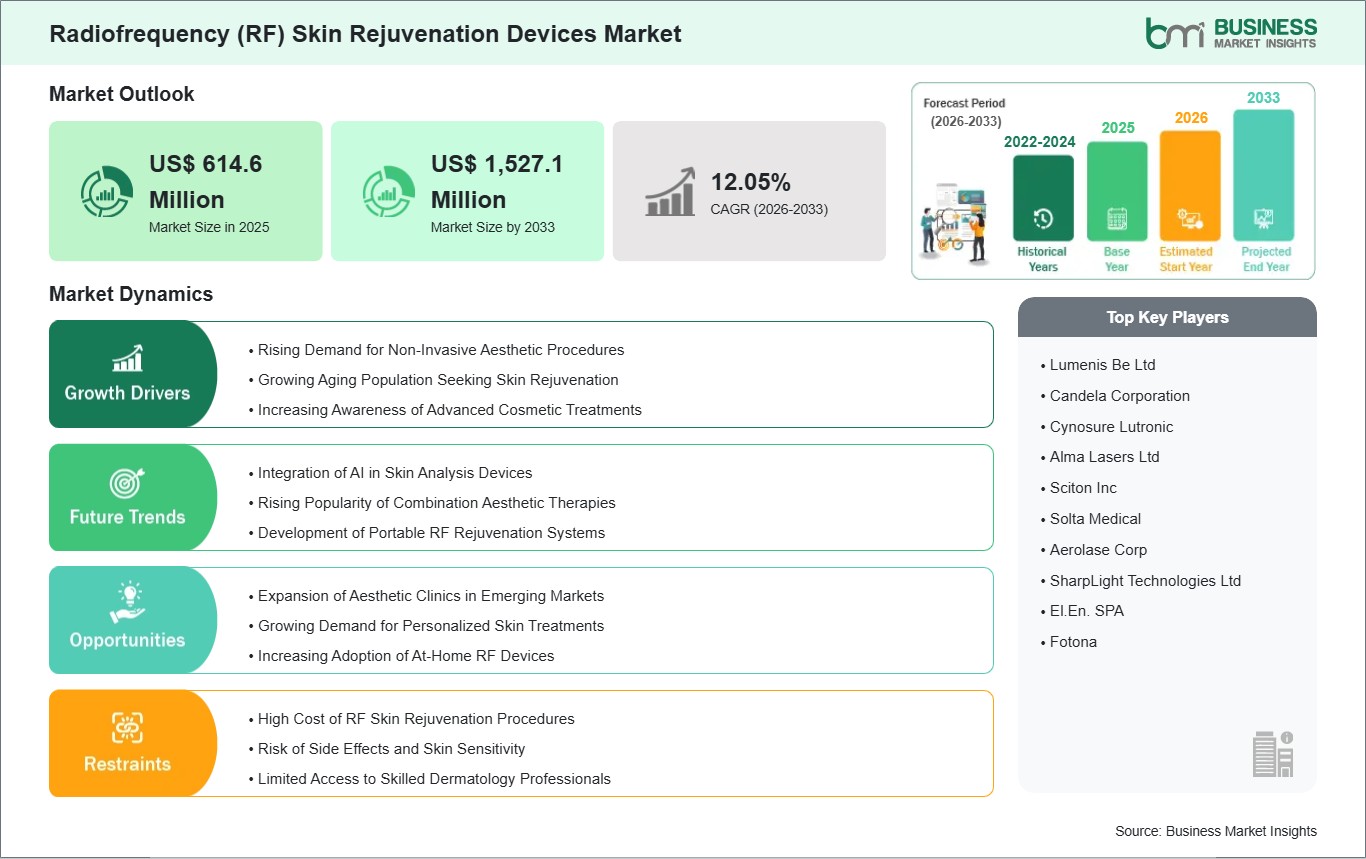
The global Radiofrequency (RF) Skin Rejuvenation Devices Market is showing sustained growth, as aesthetic medicine is moving more and more toward non-invasive and barely intrusive cosmetic approaches. RF-based technologies are getting a lot of traction across dermatology clinics, aesthetic centers, and medical spas, mainly because they can tackle a range of skin issues, including wrinkles, skin laxity, acne scarring, pigmentation irregularities, and facial contour refinement, with relatively limited recovery time. Also , people are becoming more aware of skin well-being and overall appearance, so the push for preventative anti-aging regimens is getting stronger. This mix keeps fueling market expansion in both established markets and emerging economies. Technological innovation is still a big competitive driver here. Companies are putting more effort into upgraded RF systems that blend fractional delivery mechanisms, microneedling add-ins, temperature monitoring, and adjustable therapy settings to boost accuracy and patient safety. At the same time, combination protocols are getting more popular, where RF sessions are paired with laser, ultrasound, or regenerative aesthetic procedures, and this pairing is basically reinforcing procedure volume across regions. Plus, medical aesthetics is expanding among men, and among younger age groups too, which is widening the pool of potential patients for RF skin rejuvenation services. Even with these good market conditions, some issues still slow or shape industry growth a bit. Advanced RF systems need a high capital investment, so smaller clinics and independent practitioners may hesitate, especially in markets where budgets are tight. Also, worries around treatment safety, practitioner competence, and sometimes inconsistent clinical results are still key concerns. On top of that, regulatory compliance obligations and extra attention about device effectiveness and complications after treatment are pushing manufacturers to lean more heavily into clinical validation, better operator training, and stronger patient safety improvements across their full product ranges.
Segment Analysis
Radiofrequency (RF) Skin Rejuvenation Devices Market Segmentation
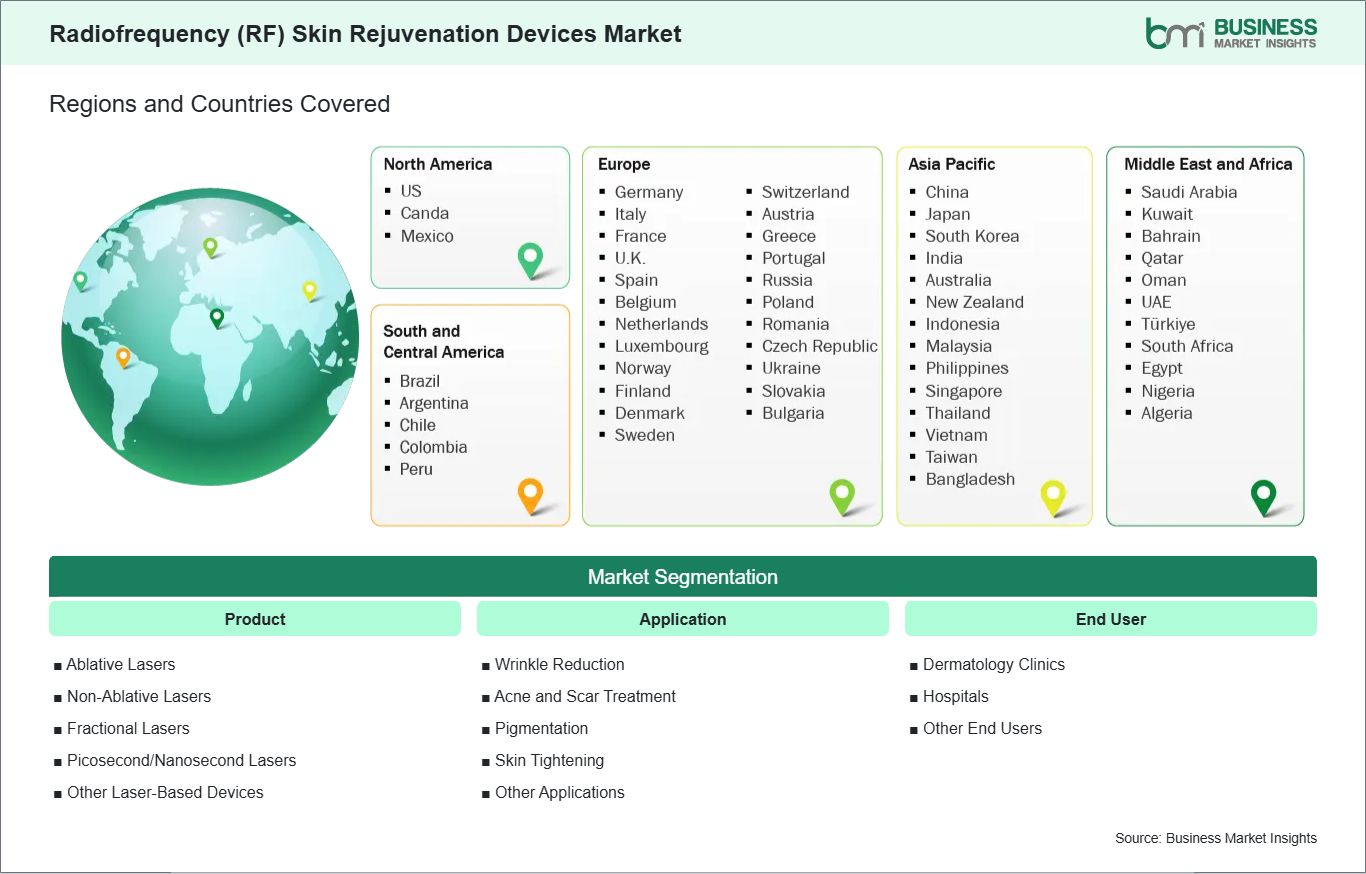
Key segments that contributed to the derivation of the radiofrequency (RF) skin rejuvenation devices market analysis are product, application and end user.
- By product, the radiofrequency (RF) skin rejuvenation devices market is segmented into monopolar RF devices, bipolar RF devices, RF microneedling devices, multipolar RF devices, and other radiofrequency (RF) devices. The monopolar RF devices segment dominated the market in 2025.
- Based on application, the radiofrequency (RF) skin rejuvenation devices market is categorized into wrinkle reduction, acne and scar treatment, pigmentation, skin tightening, and other applications. The wrinkle reduction segment dominated the market in 2025.
- In terms of end user, the radiofrequency (RF) skin rejuvenation devices market is categorized into dermatology clinics, hospitals, and other end users. The dermatology clinics segment dominated the market in 2025.
Market Forces
Radiofrequency (RF) Skin Rejuvenation Devices Market Drivers and Opportunities
Rising Demand for Non-Invasive Aesthetic Procedures
As more and more people become interested in non-invasive aesthetic treatments throughout Africa, their preference for procedures requiring less recuperation or lower risk continues to grow. Radiofrequency skin rejuvenation devices are increasingly being utilized in countries such as South Africa, Egypt, Morocco and Kenya by urban dwellers who are becoming familiar with advanced dermatological techniques for skin tightening, wrinkle reduction and acne scar reduction through the use of this technology. The rise of digital beauty trends and social media content has created even more interest among younger demographics in having procedures performed to enhance their appearance.
Healthcare providers located throughout major urban areas in Africa have also observed an increase in patients who prefer to see gradual and natural results from their cosmetic enhancement procedures rather than having them done surgically. Aesthetic clinics in major urban areas such as Johannesburg, Cairo, Lagos, and Nairobi are now expanding their service offerings to include RF-based facial contouring and collagen stimulation services for patients with various skin types. This trend is especially relevant in African markets where many patients want to decrease the risk of complications due to pigmentation of their skin from the technologies they use.In addition to these trends, the increase in disposable income among middle-class consumers is resulting in them spending more money on cosmetic wellness services.
Expansion of Aesthetic Clinics in Emerging Markets
The rapid expansion of aesthetic clinics across emerging African economies is contributing significantly to the adoption of radiofrequency skin rejuvenation devices. Private dermatology centers, cosmetic studios, and wellness clinics are increasingly investing in energy-based treatment systems to address growing consumer demand for non-surgical cosmetic procedures. Countries such as Nigeria, Ghana, Kenya, and Tanzania are witnessing increased establishment of specialized skincare clinics in urban commercial centers, supported by improving healthcare infrastructure and rising beauty consciousness among consumers.
South Africa remains one of the region’s most developed aesthetic markets, with established cosmetic treatment networks and growing medical tourism activity supporting device utilization. At the same time, North African countries including Egypt and Morocco are attracting investments in modern dermatology facilities equipped with advanced RF technologies for skin tightening and anti-aging applications. Many clinics are adopting multifunctional platforms that allow providers to perform multiple procedures using a single system, improving operational efficiency and treatment profitability.
Furthermore, international aesthetic device manufacturers are strengthening distribution partnerships and clinical training initiatives throughout Africa. The availability of trained practitioners and broader awareness of minimally invasive procedures are expected to support continued expansion of RF skin rejuvenation services beyond major metropolitan areas.
Size and Share Analysis
Radiofrequency (RF) Skin Rejuvenation Devices Market Size and Share Analysis
The radiofrequency (RF) skin rejuvenation devices market demonstrates steady growth, with size and share analysis highlighting evolving trends and competitive dynamics among key players. The report examines subsegments categorized within product, application and end user, offering insights into their contribution to overall market performance.
By product, the monopolar RF devices subsegment dominated the market in 2025, driven by its superior deep tissue penetration and high effectiveness in non-invasive skin tightening and anti-aging treatments.
Based on application, the wrinkle reduction subsegment dominated the market in 2025, driven by the rising demand for anti-aging treatments and growing awareness regarding aesthetic skin enhancement procedures.
In terms of end user, the dermatology clinics subsegment dominated the market in 2025, driven by the increasing availability of advanced aesthetic treatment solutions and the growing number of patients seeking specialized skincare services.
Report Coverage
Radiofrequency (RF) Skin Rejuvenation Devices Market Report Coverage and Deliverables
The "Radiofrequency (RF) Skin Rejuvenation Devices Market Size and Forecast (2022-2033)" report provides a detailed analysis of the market covering below areas:
- Market size and forecast at global, regional, and country levels for all the key market segments covered under the scope
- Market trends, as well as drivers, restraints, and opportunities
- Market analysis covering key trends, global and regional framework, major players, regulations, and recent developments
- Market concentration, heat map analysis, prominent players, and recent developments for the Market
- Detailed company profiles, including SWOT analysis
Geographic Insights
Radiofrequency (RF) Skin Rejuvenation Devices Market Geographic Insights
The geographical scope of the Radiofrequency (RF) Skin Rejuvenation Devices Market report is divided into North America, Asia Pacific, Europe, Middle East & Africa, and South & Central America. North America held the largest share in 2025.
The RF (Radiofrequency) Skin Rejuvenation Devices Market is affected by the regional differences based on consumer knowledge, advanced infrastructure design and the degree of acceptance of non-invasive cosmetic treatment. North America has a predominance of demand for the RF Skin Rejuvenation Device. The RF Skin Rejuvenation Device has been adopted by numerous countries and is an important part of personal aesthetics expenditure as there are many dermatological and cosmetic facilities in the United States and Canada. Other factors contributing to this high demand for RF Skin Rejuvenation Devices in the United States and Canada include the large population of baby boomers continuing to seek out anti-aging options, increased spending on personal aesthetics and an established number of ultrasound and cosmetic treatment facilities. In Europe, the RF Skin Rejuvenation Device market represents a significant share of the European economy due to its rapidly increasing demand resulting from an increasing preference for using minimally invasive procedures for skin rejuvenation, large numbers of elderly individuals and a growing need for technologically advanced aesthetic devices in Germany, France, Italy and the United Kingdom. Asia-Pacific continues to experience growth in the RF Skin Rejuvenation Device. There is growing disposable income and an increasing awareness of beauty and wellness in the younger generations. Growth is happening in Asia from countries such as China, Japan, Singapore and India that continue to expand a medical aesthetics industry along with growth due to strong influences from social media and various cosmetic beauty trends. The Middle East and Africa are beginning to develop as the RF Skin Rejuvenation Device market continues to grow rapidly in the GCC countries with an increase in investment in the development of aesthetic cosmetic facilities and a growing interest in aesthetic premium services throughout the Middle East. South America and Central America continue to show positive growth trends for RF Skin Rejuvenation Devices as awareness of non-invasive procedures for skin rejuvenation continues to grow.
Industry Activity
Recent Developments
The Radiofrequency (RF) Skin Rejuvenation Devices Market is evaluated by gathering qualitative and quantitative data post primary and secondary research, which includes important corporate publications, association data, and databases. A few of the key developments in the radiofrequency (RF) skin rejuvenation devices market are:
- In August 2025, Cynosure Lutronic announced that its XERF monopolar radiofrequency skin rejuvenation system received FDA clearance in the United States.
- In November 2025, Venus Concept Inc. announced FDA 510(k) clearance for its Venus NOVA platform, a multi-application system integrating radiofrequency-based technologies for non-invasive skin and body treatments including skin tightening and wrinkle reduction.
- In February 2023, Candela announced the launch of the FDA-cleared Profound Matrix™ System, a next-generation radiofrequency skin rejuvenation platform designed for wrinkle reduction, skin tightening, and collagen regeneration treatments.
Trust & Transparency
Research Methodology
The market analysis combines proprietary research with secondary data from government agencies, company disclosures, regulatory filings, industry databases and expert interviews. Market estimates are validated through data triangulation, cross-market benchmarking and analyst
review.
View Full Research Methodology
Key Sources Referred:
Medicines and Healthcare products Regulatory Agency (MHRA – UK) American Society for Laser Medicine and Surgery European Academy of Dermatology and Venereology World Health Organization (WHO) International Society for Dermatologic Surgery American Society of Plastic Surgeons National Medical Products Administration (NMPA) International Society of Aesthetic Plastic Surgery Company Websites Company Annual Reports Company Investor Presentations