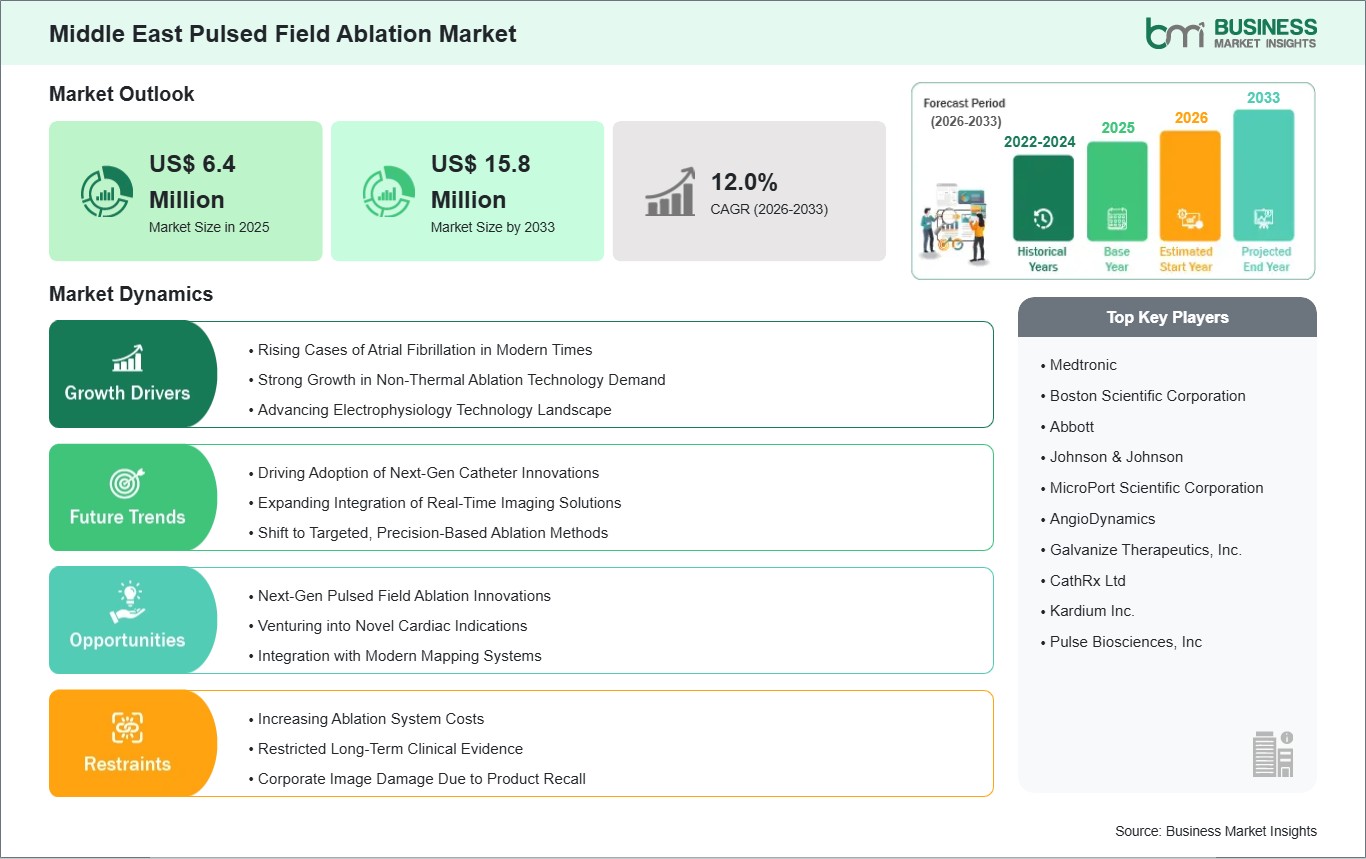
The Middle East pulsed field ablation market size is expected to reach US$ 15.8 million by 2033 from US$ 6.4 million in 2025. The market is estimated to register a CAGR of 12.0% from 2026 to 2033.
The Middle Eastern market for pulsed field ablation is becoming one of the most promising segments in the realm of modern cardiac medicine due to the rising awareness of the importance of arrhythmias and the necessity of conducting minimally invasive treatments that would pose fewer risks to patients. The growing number of cases of atrial fibrillation and other serious conditions in which the rhythm of the heart becomes impaired has led to the emergence of new technological solutions that promise more precise, less invasive, and faster procedures. The ability of the PFA technology to ensure tissue-selective ablation without harming healthy cells is in line with the region’s priorities in healthcare improvement and innovation.
Modern electrophysiology labs, mapping systems, and imaging platforms are being installed in healthcare facilities within the Middle East region, allowing them to integrate PFA procedures into their practice. Pilot projects and training courses aimed at equipping cardiologists with relevant skills have been introduced as well. Cooperation with foreign device suppliers helps increase the level of adoption and allows clinics to obtain high-quality equipment needed for performing PFA procedures. The rising awareness about clinical applications, investments in infrastructure, and focus on patient safety imply that the PFA market of the Middle East region is expected to grow at a moderate pace. This growth would be driven by early adopters establishing standards for other markets across the region.

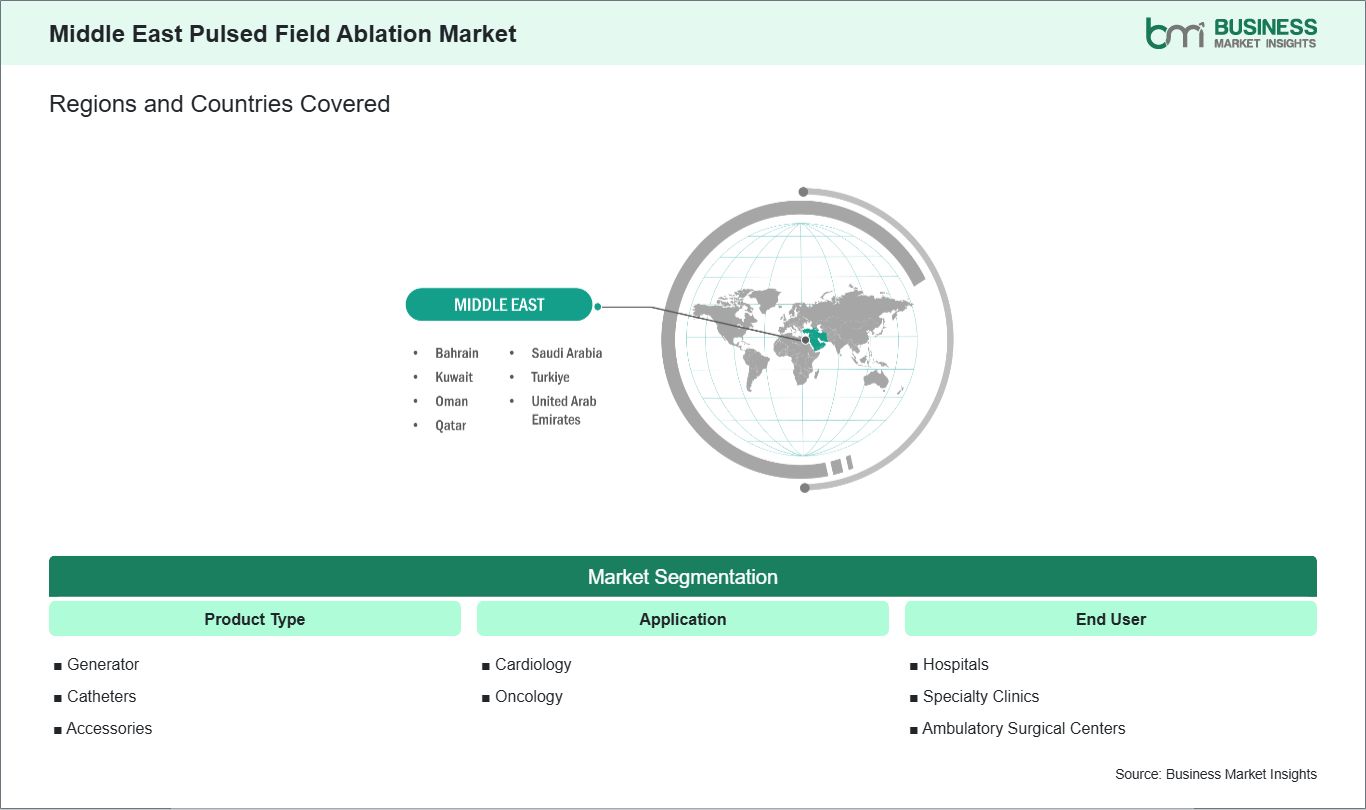
Key segments that contributed to the derivation of the Middle East pulsed field ablation market analysis are product type, application, and end user.
Atrial fibrillation (AFib) is a growing health concern across the Middle East, with lifestyle changes and urbanization contributing to increased prevalence. Sedentary routines, dietary shifts, and rising rates of cardiovascular risk factors such as diabetes and hypertension have amplified the number of individuals experiencing irregular heart rhythms. Hospitals and clinics are observing a higher volume of AFib cases, which has prompted cardiologists to explore more effective treatment options beyond medication. The condition’s impact on quality of life and its association with stroke and heart failure have made early detection and intervention a priority.
Electrophysiology departments in urban centers such as Dubai, Riyadh, and Doha are having more patients being referred for procedural treatment as awareness about AFib grows among both healthcare professionals and patients. Traditional approaches, including medication and thermal ablation, but there is a clear trend toward safer, minimally invasive alternatives. Clinicians are increasingly emphasizing procedures that reduce recovery time and lower complication risks, responding to the demand for improved patient outcomes.
In this context, pulsed field ablation (PFA), which promises accuracy and selectivity, is gaining popularity. There is an interest on the part of cardiologists from the Middle East in safer procedures that involve treating only the cardiac tissues without affecting other surrounding tissues. With the growing number of hospitals adopting PFA technology, patient awareness and confidence levels are gradually rising.
Technological innovation is reshaping how pulsed field ablation is applied in the Middle East. Modern PFA systems are designed to deliver energy in a way that selectively targets cardiac tissue, reducing damage to surrounding organs. These developments make the procedure safer and more efficient, aligning well with the growing focus on minimally invasive cardiology in regional hospitals. Clinicians are now able to perform complex procedures with greater accuracy, which has improved patient outcomes and procedural confidence.
Design improvements, such as more flexible catheters and enhanced visualization tools, are helping electrophysiologists navigate complex heart anatomy more effectively. Advanced mapping systems allow for precise targeting of arrhythmogenic tissue, which is especially useful for patients with persistent or recurrent AFib. Hospitals in major cities are increasingly adopting these next-generation platforms, integrating them into standard care pathways for cardiac arrhythmias.
Beyond hardware enhancements, software and digital integration are playing a key role in shaping the next generation of PFA. Real-time imaging, lesion assessment, and workflow automation streamline procedures and improve safety for both patients and clinicians. These innovations, coupled with ongoing professional training and adoption in specialized cardiac centers, are establishing pulsed field ablation as a cornerstone of modern electrophysiology in the Middle East.

The Middle East pulsed field ablation market demonstrates steady growth, with size and share analysis highlighting evolving trends and competitive dynamics among key players. The report evaluates important subsegments categorized within product type, application, and end user, highlighting their respective contributions to overall market performance.
By product type, the catheters subsegment dominated the market in 2025. Catheter devices offer improved procedural efficiency, reduced risk of complications, and real-time control for electrophysiologists, making them a crucial component for effective PFA therapy and a key revenue driver for manufacturers.
In terms of application, the cardiology subsegment dominated the market in 2025. The leadership of cardiology applications is attributed to the rising prevalence of atrial fibrillation and other cardiac arrhythmias, growing preference for non-thermal and tissue-selective ablation techniques, and increasing awareness among healthcare providers about the clinical benefits of PFA.
Based on end user, the hospitals subsegment dominated the market in 2025. Hospitals maintain a stronghold due to their established cardiology and electrophysiology departments, access to advanced PFA systems, trained physicians and clinical staff, and the capability to perform specialized cardiac procedures with comprehensive patient monitoring and post-procedure care.
| Report Attribute | Details |
|---|---|
| Market size in 2025 | US$ 6.4 Million |
| Market Size by 2033 | US$ 15.8 Million |
| CAGR (2026 - 2033) | 12.0% |
| Historical Data | 2022-2024 |
| Forecast period | 2026-2033 |
| Segments Covered | By Product Type
|
|
Regions and Countries Covered
| |
| Middle East | UAE, Saudi Arabia, Bahrain, Oman, Kuwait, Qatar, Turkiye |
| Market leaders and key company profiles |
|
The "Middle East Pulsed Field Ablation Market Size and Forecast (2022–2033)" report provides a detailed analysis of the market covering below areas:
The geographical scope of the Middle East pulsed field ablation market report is divided into: the UAE, Saudi Arabia, Bahrain, Oman, Kuwait, Qatar, and Turkiye. Turkiye held the largest share in 2025.
Turkiye is the dominant player in the Middle East pulsed field ablation market due to its advanced cardiac care infrastructure, strong investment in healthcare innovation, and proactive adoption of cutting-edge technologies. The country faces a growing burden of atrial fibrillation and related arrhythmias, creating a critical need for minimally invasive procedures that prioritize precision, safety, and faster recovery. PFA’s non-thermal, tissue-selective mechanism allows clinicians to ablate target cardiac tissue while preserving surrounding structures, improving patient outcomes and reducing procedural complications a priority in Turkiye’s leading hospitals.
Market acceptance has received an additional boost as a result of the creation of specialized electrophysiology laboratories, cardiac-mapping equipment, and advanced imaging devices that enable more complicated ablations. Programs of clinician training have been established at medical institutions so that the clinicians receive training on using PFA treatments, while partnerships with technology companies ensure global exchange of ideas and compliance with standards. Although the PFA market is witnessing advancements, the high expenses associated with PFA devices have confined their usage to only urban tertiary care hospitals in the country.The shortage of electrophysiologists makes it impossible to incorporate PFA devices in other cities. However, considering the government’s interest in introducing modern cardiac treatments and ensuring safety during procedures, Turkiye will remain the main driving force behind the uptake of PFA in the Middle Eastern region.

The Middle East pulsed field ablation market is evaluated by gathering qualitative and quantitative data post primary and secondary research, which includes important corporate publications, association data, and databases. A few of the key developments in the Middle East pulsed field ablation market are:
The Middle East Pulsed Field Ablation Market is valued at US$ 6.4 Million in 2025, it is projected to reach US$ 15.8 Million by 2033.
As per our report Middle East Pulsed Field Ablation Market, the market size is valued at US$ 6.4 Million in 2025, projecting it to reach US$ 15.8 Million by 2033. This translates to a CAGR of approximately 12.0% during the forecast period.
The Middle East Pulsed Field Ablation Market report typically cover these key segments-
The historic period, base year, and forecast period can vary slightly depending on the specific market research report. However, for the Middle East Pulsed Field Ablation Market report:
The Middle East Pulsed Field Ablation Market is populated by several key players, each contributing to its growth and innovation. Some of the major players include:
The Middle East Pulsed Field Ablation Market report is valuable for diverse stakeholders, including:
Essentially, anyone involved in or considering involvement in the Middle East Pulsed Field Ablation Market value chain can benefit from the information contained in a comprehensive market report.
Please tell us your area of interest
(Market Segments/ Regions and Countries/ Companies)