Market Summary
Executive Summary and Market Analysis
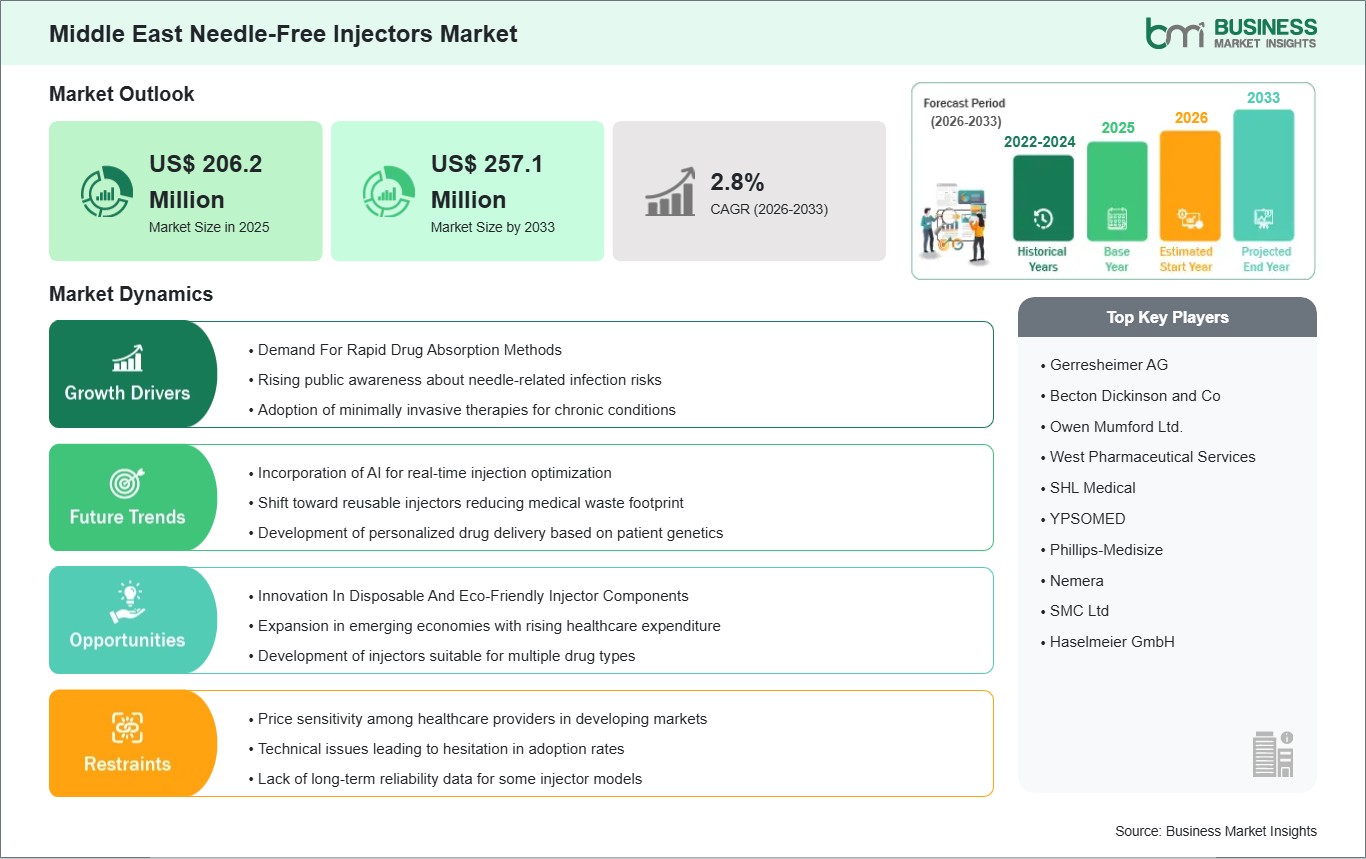
Nations such as Saudi Arabia, the UAE, Qatar, Bahrain, Kuwait, and Oman are expanding hospital networks, modernizing outpatient care, and investing in public health programs, creating an environment conducive to needle-free adoption. Multinational medical device manufacturers are entering through strategic partnerships, and local distributors are focusing on cost-effective solutions. Adoption is driven by clinical evidence demonstrating reduced needle-stick injuries, improved patient adherence, and operational efficiency during high-volume vaccination campaigns and biologic therapy administration. Regulatory environments are stringent in the GCC, with agencies in Saudi Arabia and the UAE requiring alignment with international standards, robust clinical trials, and post-market surveillance, while smaller states offer accelerated pathways for pilot programs. Decision-makers assess devices based on total cost of ownership, including consumables, training, maintenance, and workflow integration. Innovation trends emphasize disposable and reusable injectors, ergonomic designs, digital tracking for adherence, and multi-drug compatibility, ensuring flexibility across healthcare applications. Pilot programs and hospital-led demonstrations are critical in validating clinical and operational benefits, shaping procurement strategies across public and private institutions. The market reflects a technology-driven and regulatory-conscious environment, where device reliability, clinical validation, and operational efficiency define competitive positioning and adoption potential.
Segment Analysis
Middle East Needle-Free Injectors Market Segmentation
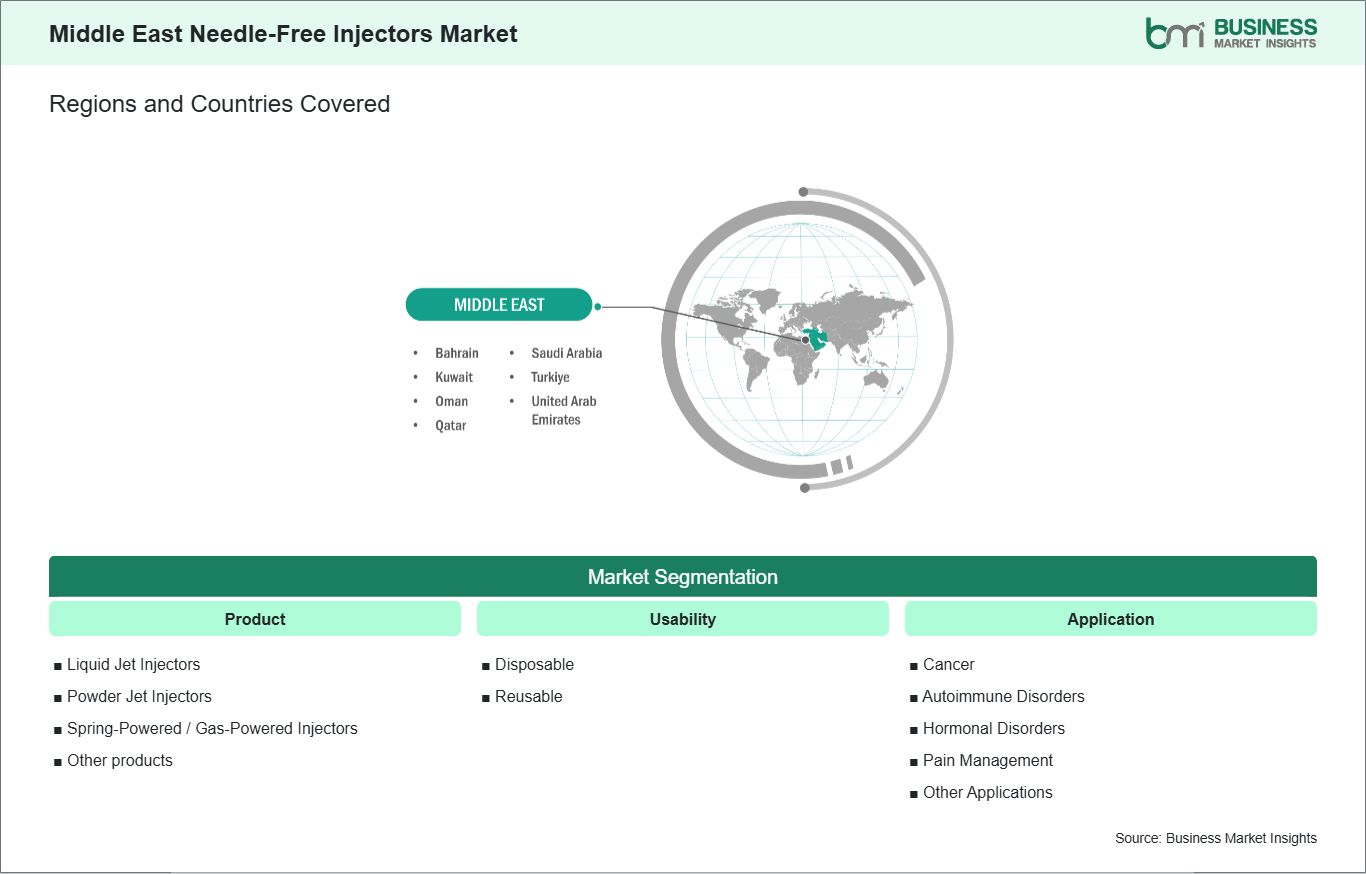
Key segments that contributed to the derivation of the Middle East needle-free injectors market analysis are product, usability, and application.
- By product, the needle-free injectors market is segmented into liquid jet injectors, powder jet injectors, spring-powered / gas-powered injectors, and other products. The liquid jet injectors segment dominated the market in 2025.
- Based on usability, the needle-free injectors market is categorized into disposable and reusable. The disposable segment dominated the market in 2025.
- In terms of application, the market is classified into cancer, autoimmune disorders, hormonal disorders, pain management, and other applications. The autoimmune disorders segment dominated the market in 2025.
Market Forces
Middle East Needle-Free Injectors Market Drivers and Opportunities
Demand For Rapid Drug Absorption Methods
Patients with diseases such as diabetes, cardiovascular disorders, and autoimmune conditions require the prompt onset of medication action. Needle-free injectors are emerging as a preferred option, as their high-velocity jet systems enable faster absorption of drugs compared to traditional subcutaneous injections, improving efficacy and patient experience. Countries such as Saudi Arabia, the UAE, and Qatar are modernizing healthcare infrastructure and adopting technologies that enhance treatment outcomes. Hospitals and specialty clinics are integrating needle-free devices to optimize drug delivery for time-sensitive therapies, particularly in outpatient care and emergency settings. These devices reduce the reliance on needles, lower patient anxiety, and allow for precise dosing, which is crucial for rapid drug effect in critical care scenarios. The preference for fast-acting delivery systems aligns with regional healthcare goals to improve patient satisfaction and adherence. By providing a quick onset of action with minimal discomfort, needle-free injectors support clinician objectives and patient expectations. As the Middle East continues to invest in advanced healthcare technologies and patient-centered treatment models, demand for needle-free injectors offering rapid drug absorption is expected to grow across hospitals, clinics, and home-care settings.
Innovation In Disposable And Eco-Friendly Injector Components
Sustainability and hygiene are shaping medical device adoption, driving innovation in disposable and eco-friendly needle-free injector components. Single-use injectors reduce cross-contamination risks, support infection control protocols, and simplify handling for healthcare professionals. Manufacturers are focusing on biodegradable or recyclable materials to address environmental concerns while maintaining safety and efficacy standards. Healthcare institutions in countries such as the UAE, Saudi Arabia, and Kuwait are promoting green initiatives and integrating eco-friendly solutions into procurement policies. Disposable needle-free injectors align with these objectives, offering a convenient, hygienic, and sustainable option for hospitals and home-based care. They reduce the need for sterilization procedures and minimize medical waste risks, supporting operational efficiency in high-volume treatment settings. Innovation in component design enhances patient and provider experience. Ergonomically designed injectors with eco-conscious materials provide comfort, portability, and ease of use while meeting environmental goals. As sustainability gains priority in healthcare policies and corporate social responsibility programs, disposable and eco-friendly needle-free injectors are expected to see higher adoption, contributing to the modernization of medical device offerings and improved patient outcomes across the region.
Size and Share Analysis
Middle East Needle-Free Injectors Market Size and Share Analysis
The Middle East Needle-free Injectors Market demonstrates steady growth, with size and share analysis highlighting evolving trends and competitive dynamics among key players. The report examines subsegments categorized within product, usability, and application, offering insights into their contribution to overall market performance.
By product, the liquid jet injectors subsegment dominated the market in 2025, driven by their ability to deliver fast, accurate, and pain-free doses, making them ideal for both hospital and home-based therapy.
Based on usability, the disposable subsegment dominated the market in 2025, driven by the focus on hygiene, infection control, and convenience in hospitals, clinics, and home-care settings.
In terms of application, the autoimmune disorders subsegment dominated the market in 2025, driven by the need for frequent, long-term injections where patient comfort, adherence, and safety are essential for effective disease management.
Report Coverage
Middle East Needle-Free Injectors Market Report Coverage and Deliverables
The "Middle East Needle-free Injectors Market Size and Forecast (2022–2033)" report provides a detailed analysis of the market covering below areas:
- Middle East Needle-free Injectors Market size and forecast at regional and country levels for all market segments covered under the scope
- Middle East Needle-free Injectors Market trends, as well as drivers, restraints, and opportunities
- Middle East Needle-free Injectors Market analysis covering key trends, regional framework, major players, regulations, and recent developments
- Industry landscape and competition analysis covering market concentration, heat map analysis, prominent players, and recent developments for the Middle East Needle-free Injectors Market
- Detailed company profiles, including SWOT analysis
Geographic Insights
Middle East Needle-Free Injectors Market Geographic Insights
The geographical scope of the Middle East Needle-free Injectors Market report is divided into UAE, Saudi Arabia, Bahrain, Oman, Kuwait, Qatar, and Turkiye. Turkiye held the largest share in 2025.
Turkiye is the leading market for needle-free injectors in the region, propelled by expansive hospital modernization projects, large-scale immunization programs, and surging integration of home- and outpatient-based therapies. Saudi Arabia demonstrates strong adoption in urban hospitals, specialty clinics, and corporate healthcare facilities, emphasizing technological sophistication, digital integration, and patient comfort. Qatar and Bahrain show high adoption in government hospitals, supported by pilot programs validating workflow efficiency and device reliability. Kuwait and Oman represent steadily growing markets, where public health initiatives, preventive care campaigns, and private hospital adoption drive early-stage penetration. Across the region, localized training programs, robust after-sales support, and reliable distributor networks are critical to successful device integration, particularly in smaller states. Urban hospitals serve as reference centers, creating benchmarks that influence adoption in secondary and peripheral healthcare facilities. Variations in regulatory requirements, procurement mechanisms, and healthcare infrastructure across countries necessitate tailored market strategies. Saudi Arabia dominates in scale and technology-driven adoption, and other Middle Eastern countries offer opportunities through pilot programs, public health initiatives, and focused operational deployment, highlighting the importance of region-specific commercialization strategies.
Industry Activity
Recent Developments
The Middle East Needle-free Injectors Market is evaluated by gathering qualitative and quantitative data post primary and secondary research, which includes important corporate publications, association data, and databases. A few of the key developments in the Middle East needle-free injectors market are:
- In November 2025, the UAE Ministry of Health and Prevention (MOHAP) introduced a needle‑free nasal spray influenza vaccine, offering a painless alternative to traditional flu shots as part of the seasonal vaccination programme. The vaccine is registered and deployed at public and private healthcare facilities to broaden immunization options and increase uptake. The needle‑free format aims to reduce needle phobia — particularly among children and adults wary of injections — and strengthen community protection. This product launch marks an integration of non‑needle delivery technology into national preventive care.
- In October 2025, PharmaJet signed a distribution agreement with ATR (an affiliate of EVA Pharma) at CPHI Frankfurt to supply Tropis intradermal needle‑free injection systems for routine polio vaccination in Egypt and surrounding markets. The collaboration includes technology transfer and manufacturing provisions, aiming to increase access and promote the adoption of needle‑free delivery across the Middle East. This agreement is part of a larger effort to embed needle‑free immunization solutions into national programmes. It supports reduced vaccine hesitancy and enhanced regional manufacturing capacity.
Trust & Transparency
Research Methodology
The market analysis combines proprietary research with secondary data from government agencies, company disclosures, regulatory filings, industry databases and expert interviews. Market estimates are validated through data triangulation, cross-market benchmarking and analyst
review.
View Full Research Methodology
Key Sources Referred:
World Health Organization (WHO)Organisation for Economic Cooperation and Development (OECD)The World Bank GroupWorldometerThe LancetInternational Bar AssociationInternational Trade Administration