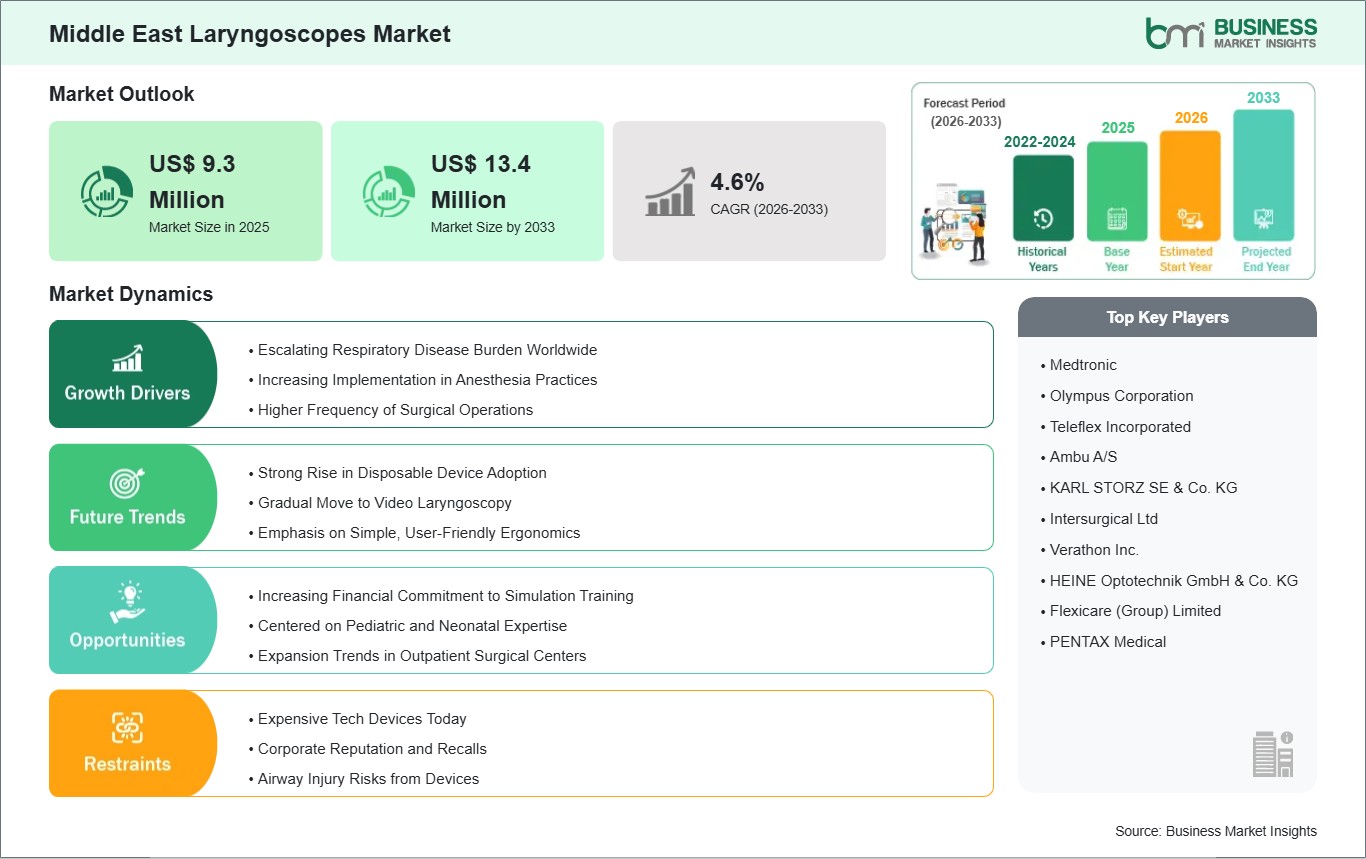
The Middle East laryngoscopes market size is expected to reach US$ 13.4 million by 2033 from US$ 9.3 million in 2025. The market is estimated to record a CAGR of 4.6% from 2026 to 2033.
The market for laryngoscopes in the Middle East is characterized by a healthcare environment that is undergoing rapid modernization. Advanced clinical functionalities have been incorporated in hospitals and emergency rooms, making them more equipped to handle complex medical situations. Laryngoscopes are essential devices in ensuring smooth airway management during anesthesia, emergency medicine, and intensive care. They are in high demand in line with the increase in surgical procedures, as well as complicated critical cases in the region. The market trend suggests that the use of conventional direct laryngoscopes is slowly giving way to advanced visualization laryngoscopes.
Enhancing and developing the infrastructure related to healthcare, which includes the construction of new hospitals, the development of intensive care units, and the provision of emergency medical services. The increasing emphasis on improving patient safety and adopting modern anesthesia techniques is contributing to the rising popularity of airway management devices. In addition, the increasing prevalence of respiratory diseases, traumatic injuries, and lifestyle-related illnesses is driving the demand for laryngoscopes.
The growth of this market is being hampered by the unequal availability of sophisticated medical devices. High-performance laryngoscopes are mainly available in urban health care organizations with superior facilities, whereas small and under-resourced hospitals still use traditional laryngoscopes owing to procurement problems and financial difficulties. Relying on foreign-made health care tools is also creating an imbalance in terms of cost and availability issues in this market segment.

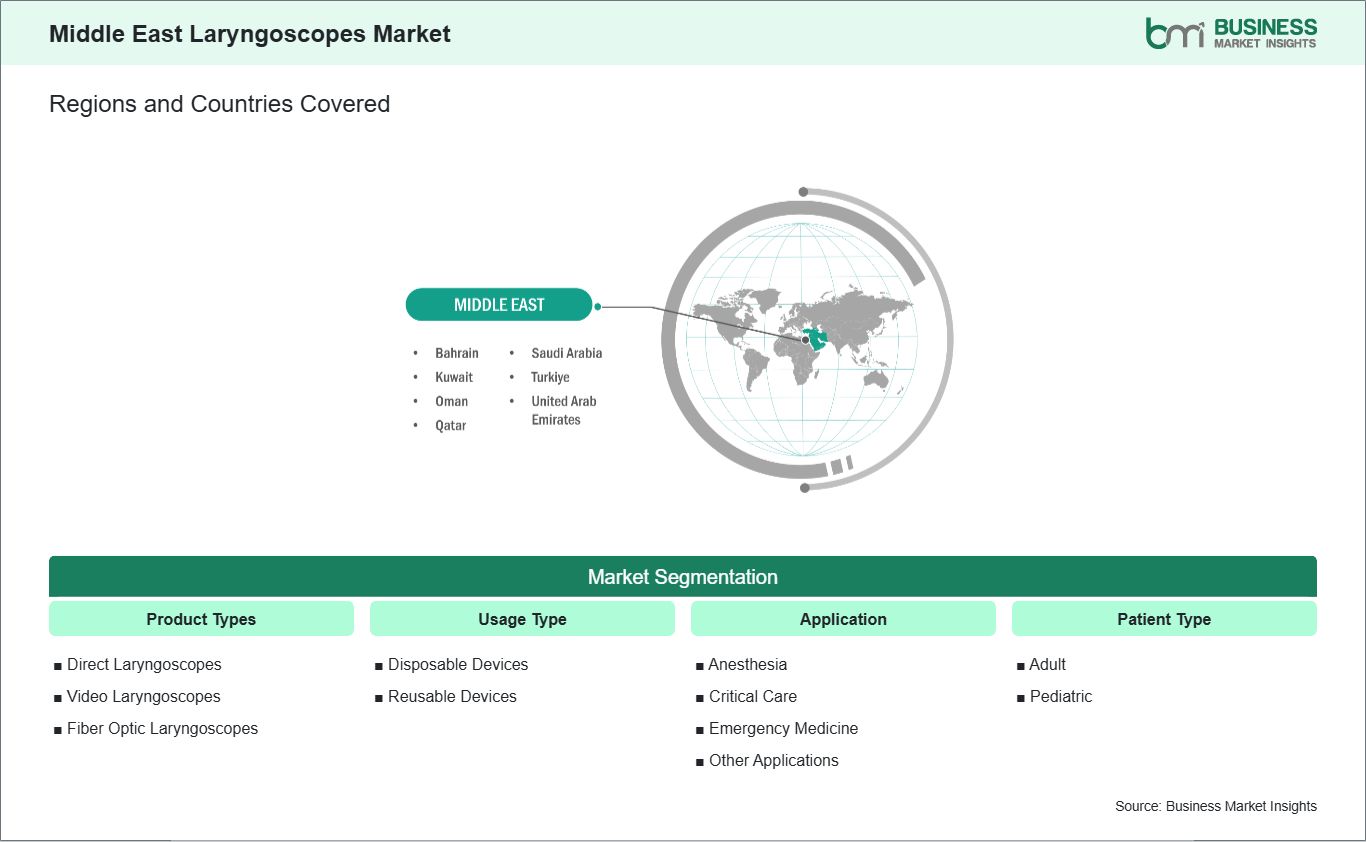
Key segments that contributed to the derivation of the Middle East laryngoscopes market analysis are product type, usage type, application, patient type, and end user.
The number of respiratory disease cases in the Middle East keeps increasing steadily due to exposure to certain environmental conditions and lifestyle factors. Dust storms are common in several Middle Eastern nations, like Saudi Arabia, the United Arab Emirates, and Kuwait, leading to problems with air pollution and exacerbating respiratory illnesses such as asthma and chronic bronchitis. In major cities like Riyadh and Dubai, it is common for patients to present with airway obstruction emergencies requiring laryngoscopes.
Other than environmental factors, there are certain lifestyle factors affecting the increase in respiratory health problems. One of these factors is smoking in the form of waterpipes, which has been found in a few populations of the Middle East, slowly contributing to chronic diseases such as chronic obstructive pulmonary disease. There are also other respiratory health risks from growing obesity and metabolic diseases among Middle Eastern individuals that become evident during surgeries and critical illness situations.
Respiratory infections have continued to exert a strain on health systems, particularly during outbreak periods. Such illnesses as the flu and pneumonia could very rapidly progress to respiratory failure, which in turn means that rapid airway management will become necessary and will hence play a crucial role for hospitals in the Middle East. Laryngoscope management plays a crucial role in such scenarios.
Healthcare institutions across the Middle East are increasingly prioritizing simulation-based training as a core component of clinical education. Hospitals and medical universities in countries like Saudi Arabia, the UAE, and Qatar are developing dedicated simulation centers where clinicians can safely practice airway management techniques. These controlled environments allow repeated hands-on training in intubation without exposing patients to unnecessary risk, improving both confidence and procedural accuracy.
This growing focus on simulation is closely linked to broader healthcare modernization efforts in the region. Medical education systems are shifting toward competency-based training, where clinicians must demonstrate proficiency in critical procedures such as airway management before independent practice. As a result, simulation programs are increasingly incorporating realistic airway scenarios and modern laryngoscope systems, ensuring that training closely reflects real clinical conditions.
Furthermore, medical institutions have ensured that training facilities match the equipment utilized during operations and emergency situations in terms of technology. This ensures smooth transitions between simulation and reality for clinicians. The focus on structured training programs with technological integration has positively impacted readiness for airway management while facilitating the adoption of modern laryngoscope technology throughout the Middle Eastern health care industry.
The Middle East Laryngoscopes market demonstrates steady growth, with size and share analysis highlighting evolving trends and competitive dynamics among key players. The report evaluates important subsegments categorized within product type, usage type, application, patient type, and end user, highlighting their respective contributions to overall market performance.
By product type, the video laryngoscopes subsegment dominated the laryngoscopes market in 2025. This is driven by the increasing demand for enhanced airway visualization, improved first-pass intubation success rates, and reduced complications in difficult airway management, making them a key revenue driver for manufacturers and supporting strong adoption in clinical practice.
In terms of usage type, the disposable devices subsegment led the market in 2025. The dominance of disposable devices is attributed to the growing emphasis on infection control, prevention of cross-contamination, and the operational convenience of eliminating reprocessing and sterilization requirements in high-volume healthcare settings.
Based on application, the anesthesia subsegment held the largest share in 2025. Hospitals and surgical centers widely rely on laryngoscopes during anesthesia procedures for airway management and intubation, supported by the rising number of surgeries and the increasing use of advanced airway management techniques.
In terms of patient type, the adult subsegment dominated the market in 2025. This is driven by the higher prevalence of surgical procedures, critical care admissions, and chronic respiratory conditions among adults, resulting in greater demand for airway management devices in this population group.
By end user, the hospitals subsegment held the largest share in 2025. Hospitals maintain leadership due to their advanced infrastructure, availability of skilled healthcare professionals, high patient inflow, and strong capability to perform complex surgical and emergency procedures requiring laryngoscopy.
| Report Attribute | Details |
|---|---|
| Market size in 2025 | US$ 9.3 Million |
| Market Size by 2033 | US$ 13.4 Million |
| CAGR (2026 - 2033) | 4.6% |
| Historical Data | 2022-2024 |
| Forecast period | 2026-2033 |
| Segments Covered | By Product Types
|
|
Regions and Countries Covered
| |
| Middle East | UAE, Saudi Arabia, Bahrain, Oman, Kuwait, Qatar, Turkiye |
| Market leaders and key company profiles |
|
The "Middle East Laryngoscopes Market Size and Forecast (2022-2033)" report provides a detailed analysis of the market covering below areas:
The geographical scope of the Middle East Laryngoscopes market report is divided into: the UAE, Saudi Arabia, Bahrain, Oman, Kuwait, Qatar, and Turkiye. Turkiye held the largest share in 2025.
The Turkiye market remains highly significant in the Middle Eastern laryngoscopes market owing to its fairly developed health sector and effective blending of public and private hospitals. Turkiye is known to be a central hub for conducting surgeries and providing emergency care, which consequently leads to the demand for airway devices in the operating theaters and ICUs. There is an increased use of technologically advanced laryngoscope devices in the country's hospitals, especially in the metropolitan tertiary hospitals.
The procurement framework within the nation is also witnessing centralization, with large hospital chains and health establishments dictating purchasing volumes. Such an environment has compelled vendors to introduce products that incorporate both reusable technology and disposable attachments. Cost concerns still prevail, particularly in medium-sized hospitals, creating a need for conventional laryngoscopes in addition to the high-end laryngoscopes. Turkiye's leading position is further strengthened due to its status as not only a large-scale clinical market but also an indicator of device adoption trends in the surrounding Middle Eastern and Eurasian healthcare systems.

The Middle East Laryngoscopes market is evaluated by gathering qualitative and quantitative data post primary and secondary research, which includes important corporate publications, association data, and databases. A few of the key developments in the Middle East Laryngoscopes market are:
The Middle East Laryngoscopes Market is valued at US$ 9.3 Million in 2025, it is projected to reach US$ 13.4 Million by 2033.
As per our report Middle East Laryngoscopes Market, the market size is valued at US$ 9.3 Million in 2025, projecting it to reach US$ 13.4 Million by 2033. This translates to a CAGR of approximately 4.6% during the forecast period.
The Middle East Laryngoscopes Market report typically cover these key segments-
The historic period, base year, and forecast period can vary slightly depending on the specific market research report. However, for the Middle East Laryngoscopes Market report:
The Middle East Laryngoscopes Market is populated by several key players, each contributing to its growth and innovation. Some of the major players include:
The Middle East Laryngoscopes Market report is valuable for diverse stakeholders, including:
Essentially, anyone involved in or considering involvement in the Middle East Laryngoscopes Market value chain can benefit from the information contained in a comprehensive market report.
Please tell us your area of interest
(Market Segments/ Regions and Countries/ Companies)