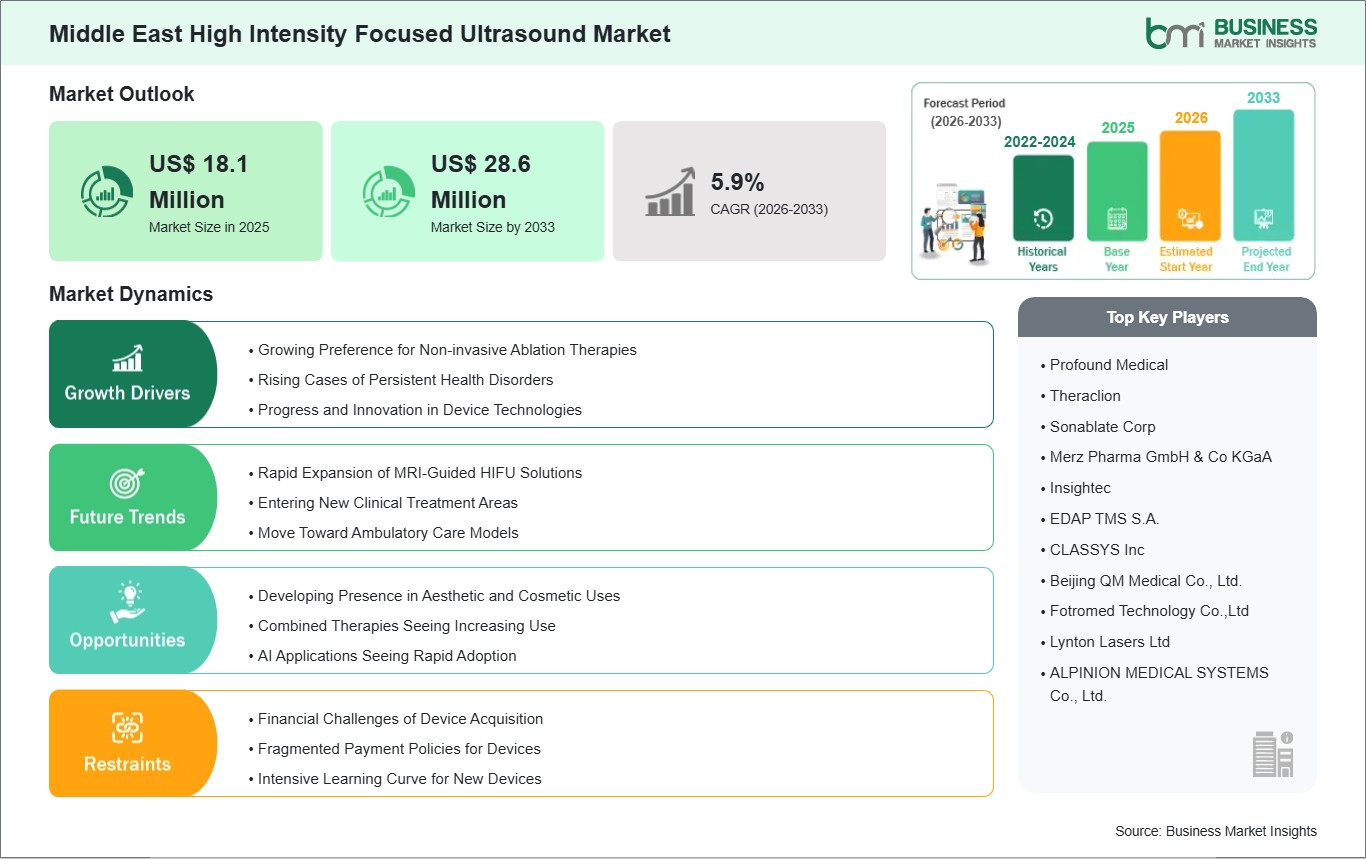
The Middle East high intensity focused ultrasound market size is expected to reach US$ 28.6 million by 2033 from US$ 18.1 million in 2025. The market is estimated to register a CAGR of 5.9% from 2026 to 2033.
The Middle East High Intensity Focused Ultrasound market is witnessing progressive growth as healthcare systems in the region embrace advanced, minimally invasive technologies. Rising awareness among patients and clinicians about non-surgical treatment options is a key driver, especially for oncology, urology, and women’s health applications. Major urban centers are investing in specialized medical facilities, equipped with advanced imaging and energy-based devices, to meet increasing demand for high-precision therapies that reduce recovery time and improve patient outcomes. The market is also supported by government initiatives in some countries to modernize healthcare infrastructure and position the region as a hub for medical tourism, encouraging providers to adopt state-of-the-art technologies. However, adoption across the region faces challenges, including limited access to advanced diagnostic and therapeutic equipment in smaller cities, uneven clinician training, and varying insurance coverage frameworks. Additionally, the high cost of device procurement and ongoing maintenance can slow uptake in emerging markets within the region. The Middle East presents significant opportunities for growth as clinical expertise, patient acceptance, and healthcare modernization converge, positioning HIFU as a key component of minimally invasive treatment strategies in the region.

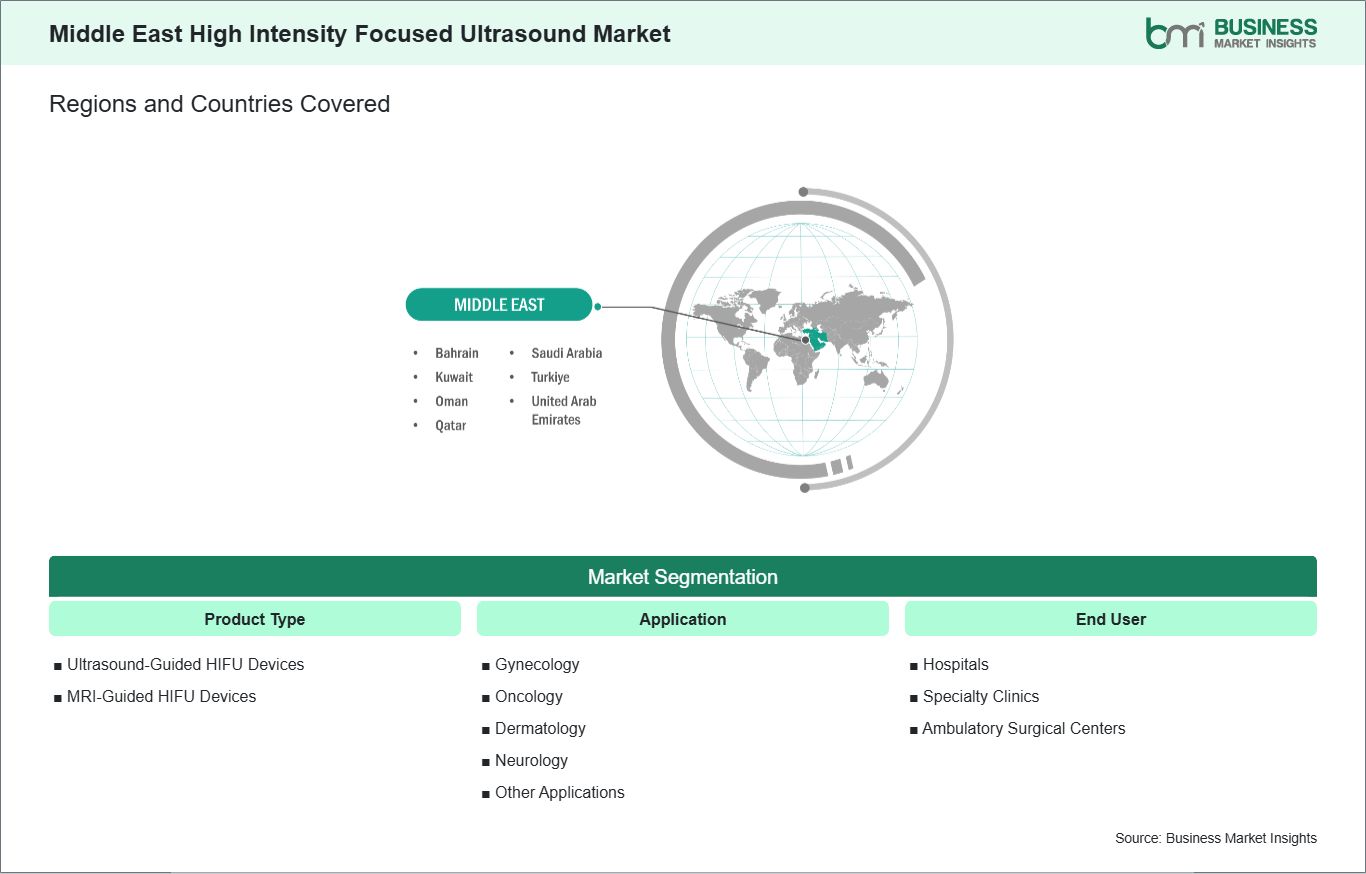
Key segments that contributed to the derivation of the Middle East high intensity focused ultrasound market analysis are product type, application, and end user.
Healthcare providers in the Middle East are increasingly embracing non‑invasive ablation therapies such as High Intensity Focused Ultrasound (HIFU) as a modern alternative to traditional surgical procedures. Hospitals and medical centers are using HIFU to treat conditions like fibroids, localized tumors, and other targeted tissue abnormalities, allowing physicians to deliver precise therapy without the need for incisions. The minimally invasive nature of the technology improves patient comfort, reduces recovery time, and lowers procedural risk, making it an attractive option in both established and emerging healthcare facilities.
Clinicians are integrating advanced imaging techniques with HIFU to enhance the precision and safety of treatments. Real-time ultrasound or MRI guidance allows medical teams to carefully monitor tissue response during ablation, preserving surrounding healthy structures. This precision has encouraged adoption in specialties such as oncology, urology, and gynecology, where non-invasive alternatives are increasingly sought after alongside conventional treatment methods.
In addition, training programs and collaborative initiatives are helping build familiarity with HIFU across regional hospitals. Workshops and professional exchanges allow practitioners to gain hands-on experience with focused ultrasound, enabling more healthcare providers to integrate it into routine treatment pathways. As clinical expertise grows, non-invasive ablation therapies are becoming an increasingly accepted component of patient care in the Middle East.
HIFU is also gaining popularity in the aesthetic and cosmetic sector across the Middle East. Dermatology and wellness clinics are offering treatments for non-surgical skin tightening, facial lifting, and body contouring. These procedures appeal to clients who seek effective, minimally invasive cosmetic solutions that require little to no downtime, aligning with the region’s growing interest in advanced beauty and wellness technologies.
Aesthetic practitioners are integrating HIFU with other non-invasive modalities, such as radiofrequency and laser therapies, to create comprehensive rejuvenation programs. By combining multiple approaches, clinics can address a range of concerns, including skin laxity, fine lines, and texture irregularities, providing tailored treatment plans that meet diverse client needs and preferences.
Consumer awareness is helping drive the adoption of HIFU in cosmetic applications. Prospective clients are increasingly informed about non-surgical aesthetic options, often researching procedures and outcomes before visiting clinics. As education around focused ultrasound grows, HIFU is gradually establishing itself as a widely accepted choice for non-invasive cosmetic enhancement in the Middle East’s beauty and wellness landscape.

The Middle East high intensity focused ultrasound market demonstrates steady growth, with size and share analysis highlighting evolving trends and competitive dynamics among key players. The report evaluates important subsegments categorized within product type, application, and end user, highlighting their respective contributions to market performance.
By product type, the ultrasound-guided HIFU devices subsegment dominated the market in 2025. This is driven by the recurring need for precise and reliable imaging during HIFU procedures, which ensures accurate targeting and effective ablation of tissues, making these devices a key revenue driver for manufacturers and sustaining consistent demand in clinical settings.
In terms of application, the gynecology subsegment led the market in 2025. The dominance of gynecology applications is attributed to the rising prevalence of uterine fibroids and adenomyosis, growing adoption of non-invasive treatment methods, and increasing awareness among healthcare providers of HIFU’s effectiveness in providing safe, minimally invasive therapeutic options for women’s health conditions.
Based on end user, the hospitals subsegment held the largest share in 2025. Hospitals maintain leadership due to their well-established gynecology and surgical departments, access to advanced HIFU equipment, trained medical staff, and the capability to perform complex procedures while providing comprehensive patient care.
| Report Attribute | Details |
|---|---|
| Market size in 2025 | US$ 18.1 Million |
| Market Size by 2033 | US$ 28.6 Million |
| CAGR (2026 - 2033) | 5.9% |
| Historical Data | 2022-2024 |
| Forecast period | 2026-2033 |
| Segments Covered | By Product Type
|
|
Regions and Countries Covered
| |
| Middle East | UAE, Saudi Arabia, Bahrain, Oman, Kuwait, Qatar, Turkiye |
| Market leaders and key company profiles |
|
The "Middle East High Intensity Focused Ultrasound Market Size and Forecast (2022–2033)" report provides a detailed analysis of the market covering below areas:
The geographical scope of the Middle East High Intensity Focused Ultrasound market report is divided into: the UAE, Saudi Arabia, Bahrain, Oman, Kuwait, Qatar, and Turkiye. Turkiye held the largest share in 2025.
Turkiye dominates the Middle East HIFU market due to its advanced healthcare infrastructure, robust clinical expertise, and strategic focus on medical innovation. Leading hospitals in cities like Istanbul, Ankara, and Izmir have integrated HIFU systems into oncology, urology, and gynecology departments, reflecting the country’s commitment to minimally invasive treatment solutions. Turkiye’s strong medical tourism sector has further accelerated adoption, as international patients seek high-quality, non-invasive procedures at competitive costs. The market is supported by active collaboration between hospitals and technology providers, as well as specialized training programs that enhance physician proficiency in HIFU applications. Regulatory frameworks in Turkiye are generally favorable, encouraging hospitals to invest in innovative therapeutic devices while maintaining patient safety. Challenges remain, particularly regarding access disparities between urban hospitals and rural healthcare centers, and the need to expand reimbursement mechanisms to improve affordability for all patient segments. Turkiye’s leadership in technology adoption, clinical expertise, and medical tourism positions it as a central driver of HIFU growth in the Middle East, setting a benchmark for other countries in the region and shaping market trends across borders.

The Middle East high intensity focused ultrasound market is evaluated by gathering qualitative and quantitative data post primary and secondary research, which includes important corporate publications, association data, and databases. A few of the key developments in the Middle East High Intensity Focused Ultrasound market are:
The Middle East High Intensity Focused Ultrasound Market is valued at US$ 18.1 Million in 2025, it is projected to reach US$ 28.6 Million by 2033.
As per our report Middle East High Intensity Focused Ultrasound Market, the market size is valued at US$ 18.1 Million in 2025, projecting it to reach US$ 28.6 Million by 2033. This translates to a CAGR of approximately 5.9% during the forecast period.
The Middle East High Intensity Focused Ultrasound Market report typically cover these key segments-
The historic period, base year, and forecast period can vary slightly depending on the specific market research report. However, for the Middle East High Intensity Focused Ultrasound Market report:
The Middle East High Intensity Focused Ultrasound Market is populated by several key players, each contributing to its growth and innovation. Some of the major players include:
The Middle East High Intensity Focused Ultrasound Market report is valuable for diverse stakeholders, including:
Essentially, anyone involved in or considering involvement in the Middle East High Intensity Focused Ultrasound Market value chain can benefit from the information contained in a comprehensive market report.
Please tell us your area of interest
(Market Segments/ Regions and Countries/ Companies)