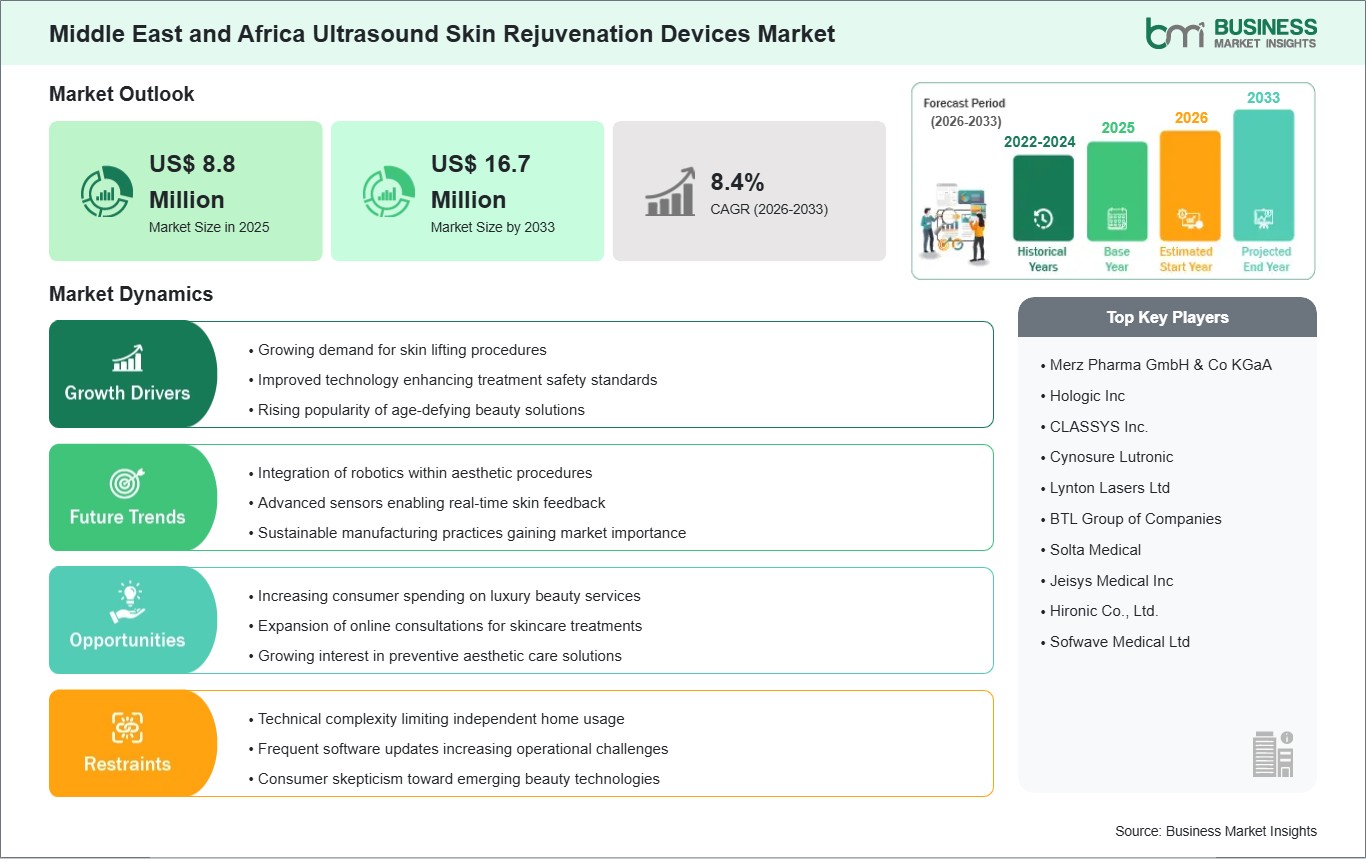
The Middle East and Africa ultrasound skin rejuvenation devices market size is expected to reach US$ 16.7 million by 2033 from US$ 8.8 million in 2025. The market is estimated to record a CAGR of 8.4% from 2026 to 2033.
The Middle East and Africa ultrasound skin rejuvenation devices market is witnessing accelerated expansion, driven by rising demand for non-invasive aesthetic procedures, increasing investment in private dermatology infrastructure, and growing consumer focus on advanced skin enhancement solutions. Ultrasound-based technologies are increasingly being adopted for skin tightening, facial lifting, and collagen stimulation across premium clinics and medspas, reflecting a broader shift toward energy-based, outpatient cosmetic treatments. Trends in urban centers show an increased interest in highly sophisticated and technological aesthetics, thanks to increased disposable incomes in certain markets, as well as increasing awareness of global beauty standards. The development of the market is heavily dependent on the fast expansion of private healthcare systems and especially metropoles, where aesthetic medical care is starting to become a lucrative sub-industry. Increasingly, aesthetic clinics are incorporating multipurpose ultrasound systems into their services in order to provide added value and make processes more efficient. Additionally, medical tourism is making a contribution in this regard, especially in rich countries from the Gulf, with patients coming from overseas to receive advanced, minimally invasive cosmetics procedures using dermatological devices. In terms of supply, the main trend can be seen in manufacturers entering new geographies via distributors, offering local clinical training, and emphasizing premium positioning of products. There is demand for devices that are highly performative and have energy management and combination therapy capabilities. However, uneven regulatory frameworks and disparities in healthcare infrastructure across the region continue to influence adoption rates and market penetration. Competitive intensity is rising as both international and regional players compete on technology differentiation, service support, and pricing flexibility. Overall, the market reflects a dual-structure environment where highly developed urban centers drive premium adoption, while emerging economies contribute incremental growth through gradual expansion of private aesthetic healthcare services.

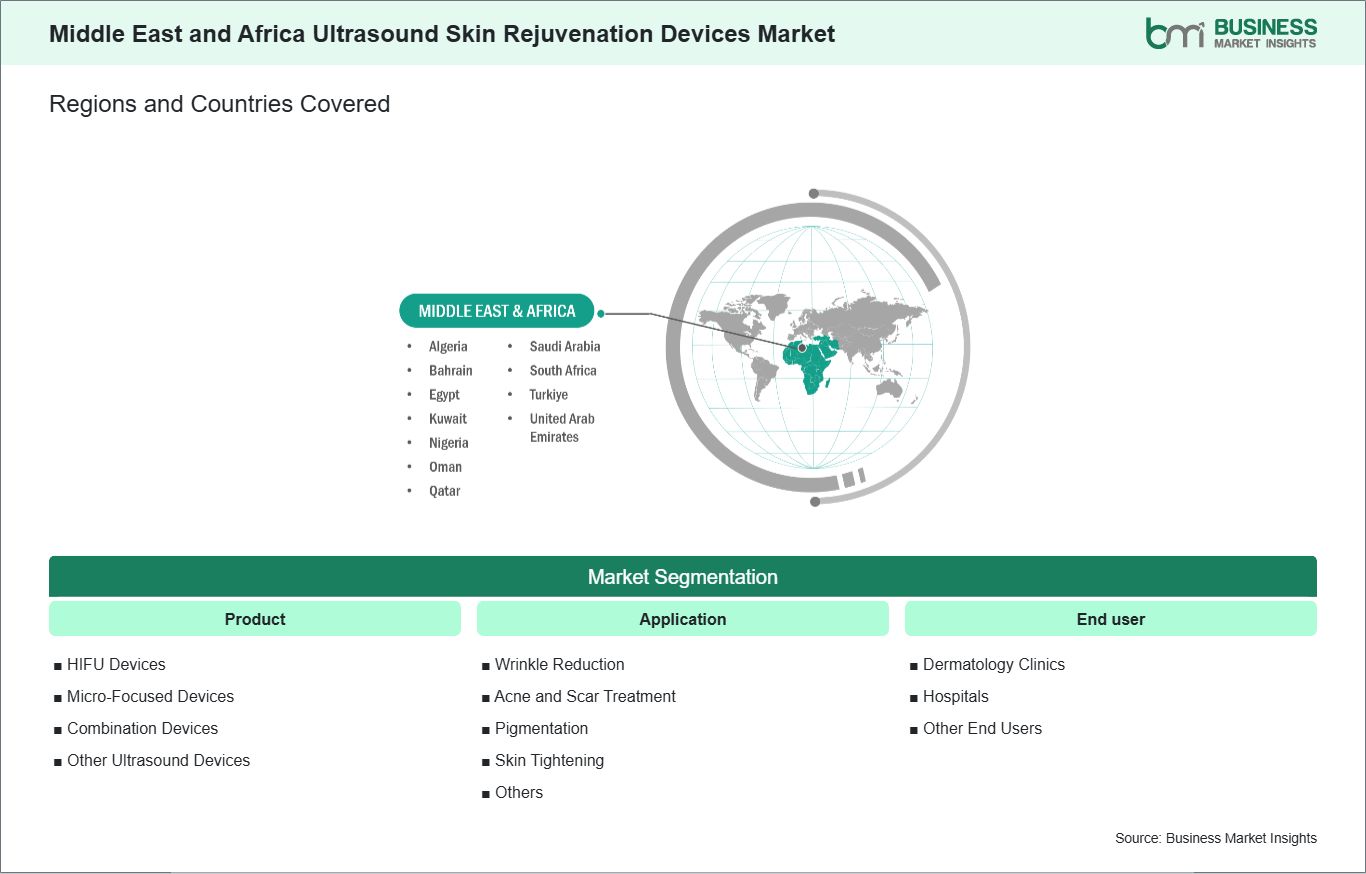
Key segments that contributed to the derivation of the Middle East and Africa ultrasound skin rejuvenation devices market analysis are product, application, and end user.
The Middle East and Africa ultrasound skin rejuvenation devices market is witnessing strong growth, largely driven by increasing patient preference for treatments with minimal downtime and rapid recovery. The consumers of these healthcare sectors have chosen non-invasive aesthetic processes through which they can continue their daily activities right after the process. HIFU treatments are preferred by the patients of dermatology clinics and luxury med-spas of Dubai, Abu Dhabi, and Riyadh for the reason that there is no need of any surgery or time-off from daily work routines to get their skin tight.
In African aesthetical hot spots such as Egypt and Morocco, the attractiveness of skin rejuvenation using ultrasound treatment is increasing even for people from middle and high economic levels. In urban centers such as Cairo and Casablanca, for instance, clinics are promoting ultrasound treatment as lunchtime procedures. The promotion works perfectly for middle-class working individuals as well as women between ages 30 and 55. With increased knowledge about skin treatments, skin care centers are adopting ultrasound equipment for use along with other non-invasive techniques such as chemical and laser treatments.
There is a steady increase in demand in Sub-Saharan Africa markets like South Africa, Nigeria, and Kenya due to increasing development of the healthcare infrastructure by the private sector as well as increasing popularity of cosmetic dermatology procedures. This trend is being witnessed in metropolitan areas like Johannesburg, Lagos, and Nairobi, where there is a steady increase in the use of portable ultrasound technology in boutique aesthetic facilities. This is mainly attributed to the short period of recovery that these procedures require. Thus, procedures that can be carried out within a short time in one sitting are highly favorable in this case.
The demand for non-surgical facial contouring is rapidly increasing across the Middle East and Africa region, driven by strong cultural emphasis on facial aesthetics and youthful appearance. Patients within GCC countries like the UAE and Saudi Arabia are demanding facial contouring procedures including jaw contouring, cheek lifts, and skin tightening without having to go through invasive surgeries. High-end dermatology clinics are now using ultrasound systems because of their effectiveness at achieving natural and safe facial sculpting results.
In North Africa, specifically in Egypt and Morocco, the growing consciousness about aesthetic procedures and access to high-end dermatology services have resulted in the popularity of facial contouring techniques. Clinics in Cairo and Marrakesh are making use of ultrasound machines to tackle issues such as sagging skin, premature signs of aging, and lack of facial contouring, especially among young and middle-aged people. Moreover, social media pressure and exposure to international beauty trends have further encouraged people to opt for methods that can make their faces symmetrical without resorting to surgery.
As Sub-Saharan Africa becomes more urbanized, along with the increasing prevalence of aesthetic clinics in the private sector, there has been an increase in non-surgical facial contouring services. Some of the cities leading the trend towards increased adoption are Johannesburg, Lagos, and Nairobi, where there has been an increase in spending on personal grooming due to the middle class. The reason why ultrasound equipment is gaining popularity among the others is that it can treat different facial zones in one sitting, like the jawline and neck.

The Middle East and Africa ultrasound skin rejuvenation devices market demonstrates steady growth, with size and share analysis highlighting evolving trends and competitive dynamics among key players. The report examines subsegments categorized within product, application, and end user, offering insights into their contribution to overall market performance.
By product, the HIFU devices segment dominated the market in 2025, driven by strong uptake of energy-based facial contouring technologies that deliver non-invasive lifting without surgical intervention in Middle East and Africa.
Based on application, the wrinkle reduction segment dominated the market in 2025, driven by heightened demand for preventive aesthetic care addressing early and moderate signs of facial aging.
In terms of end user, the dermatology clinics segment dominated the market in 2025, driven by concentration of advanced aesthetic equipment and specialist expertise within urban clinical hubs.
| Report Attribute | Details |
|---|---|
| Market size in 2025 | US$ 8.8 Million |
| Market Size by 2033 | US$ 16.7 Million |
| CAGR (2026 - 2033) | 8.4% |
| Historical Data | 2022-2024 |
| Forecast period | 2026-2033 |
| Segments Covered | By Product
|
|
Regions and Countries Covered
| |
| Middle East and Africa | Turkiye, the UAE, Saudi Arabia, Bahrain, Oman, Egypt, South Africa, Algeria, Nigeria, Kuwait, Qatar |
| Market leaders and key company profiles |
|
The "Middle East and Africa Ultrasound Skin Rejuvenation Devices Market Size and Forecast (2022-2033)" report provides a detailed analysis of the market covering below areas:
The geographical scope of the Middle East and Africa ultrasound skin rejuvenation devices market report is divided into Turkiye, the UAE, Saudi Arabia, Bahrain, Oman, Egypt, South Africa, Algeria, Nigeria, Kuwait, Qatar. Turkiye held the largest share in 2025.
Within the Middle East and Africa ultrasound skin rejuvenation devices market, Türkiye stands as the dominant market, driven by its highly developed aesthetic medicine ecosystem, strong private dermatology infrastructure, and globally recognized medical tourism industry. Major cities such as Istanbul, Ankara, and Izmir serve as key hubs for advanced cosmetic procedures, attracting both domestic and international patients seeking high-quality yet cost-competitive non-invasive treatments. Türkiye’s strategic geographic position bridging Europe, the Middle East, and Central Asia further strengthens its role as a regional aesthetic medicine hub. United Arab Emirates represents a premium, innovation-led market characterized by luxury dermatology clinics, high medical tourism inflows, and early adoption of advanced ultrasound-based skin rejuvenation technologies. Saudi Arabia is a major growth driver, supported by rapid healthcare transformation initiatives, expanding private sector investment, and increasing acceptance of aesthetic procedures among younger populations. South Africa demonstrates steady demand driven by a relatively mature private healthcare sector and growing interest in non-surgical cosmetic treatments among urban consumers. Egypt reflects emerging adoption supported by expanding dermatology services and rising aesthetic awareness in metropolitan regions. Nigeria and Kenya represent early-stage but evolving markets, where increasing urbanization, growth of private wellness clinics, and rising middle-class demand are gradually supporting adoption of aesthetic technologies. Across the region, while Türkiye remains the dominant market due to its scale, medical tourism strength, and clinic sophistication, other countries contribute to overall growth through expanding healthcare infrastructure, rising cosmetic awareness, and gradual penetration of advanced ultrasound-based rejuvenation systems.

The Middle East and Africa ultrasound skin rejuvenation devices market is evaluated by gathering qualitative and quantitative data post primary and secondary research, which includes important corporate publications, association data, and databases. A few of the key developments in the Middle East and Africa ultrasound skin rejuvenation devices market are:
The Middle East and Africa Ultrasound Skin Rejuvenation Devices Market is valued at US$ 8.8 Million in 2025, it is projected to reach US$ 16.7 Million by 2033.
As per our report Middle East and Africa Ultrasound Skin Rejuvenation Devices Market, the market size is valued at US$ 8.8 Million in 2025, projecting it to reach US$ 16.7 Million by 2033. This translates to a CAGR of approximately 8.4% during the forecast period.
The Middle East and Africa Ultrasound Skin Rejuvenation Devices Market report typically cover these key segments-
The historic period, base year, and forecast period can vary slightly depending on the specific market research report. However, for the Middle East and Africa Ultrasound Skin Rejuvenation Devices Market report:
The Middle East and Africa Ultrasound Skin Rejuvenation Devices Market is populated by several key players, each contributing to its growth and innovation. Some of the major players include:
The Middle East and Africa Ultrasound Skin Rejuvenation Devices Market report is valuable for diverse stakeholders, including:
Essentially, anyone involved in or considering involvement in the Middle East and Africa Ultrasound Skin Rejuvenation Devices Market value chain can benefit from the information contained in a comprehensive market report.
Please tell us your area of interest
(Market Segments/ Regions and Countries/ Companies)