Market Summary
Executive Summary and Market Analysis
The Middle East and Africa (MEA) surgical robots market is emerging as a strategically important segment within the region‘s healthcare modernization efforts. Growth is primarily driven by government-backed hospital infrastructure development, rising healthcare expenditure, and increasing adoption of minimally invasive procedures in high-complexity specialties such as urology, oncology, cardiothoracic, and gynecology. The market is concentrated in urban centers with established tertiary and academic hospitals, where procedural volumes justify the high capital investment required for robotic systems. Adoption in private hospitals is particularly notable, as they aim to differentiate their services through advanced surgical technology and attract medical tourists from within and outside the region. Leading global manufacturers such as Intuitive Surgical, Medtronic, and CMR Surgical have established strong distribution networks and local service centers to ensure timely technical support and surgeon training. Key factors driving adoption include the need for improved surgical precision, reduced operative complications, enhanced post-operative recovery, and alignment with international accreditation standards. However, barriers remain in the form of high upfront costs, limited trained robotic surgeons, and uneven healthcare infrastructure in certain African markets. Procurement decisions are increasingly influenced by long-term operational efficiency, multi-specialty versatility of the robotic platforms, and integration with hospital information systems. In addition, regional efforts to attract medical tourists and enhance hospital branding are driving competitive investment in robotic technologies. Overall, the MEA surgical robots market is strategically poised for growth, with adoption focused on urban tertiary centers and private hospitals that emphasize technological excellence, patient safety, and operational optimization.
Segment Analysis
Middle East and Africa Surgical Robots Market Segmentation
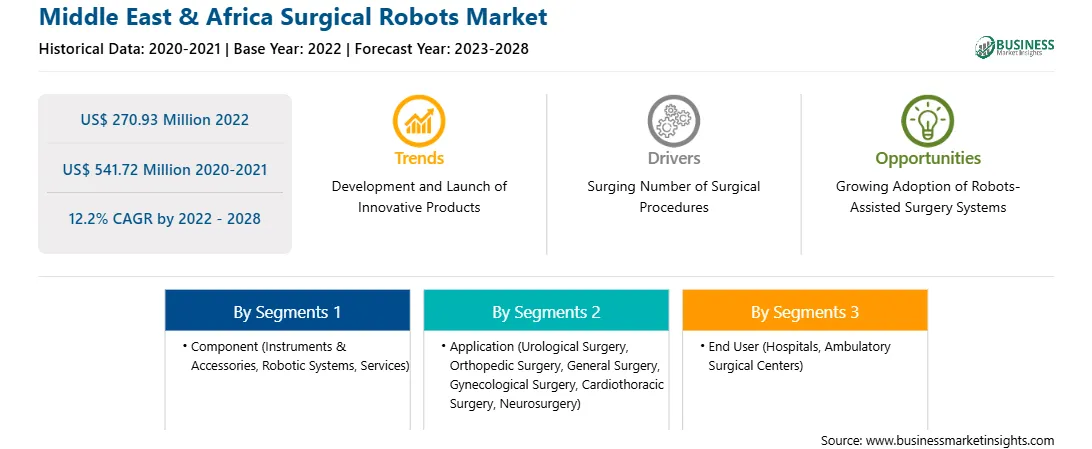
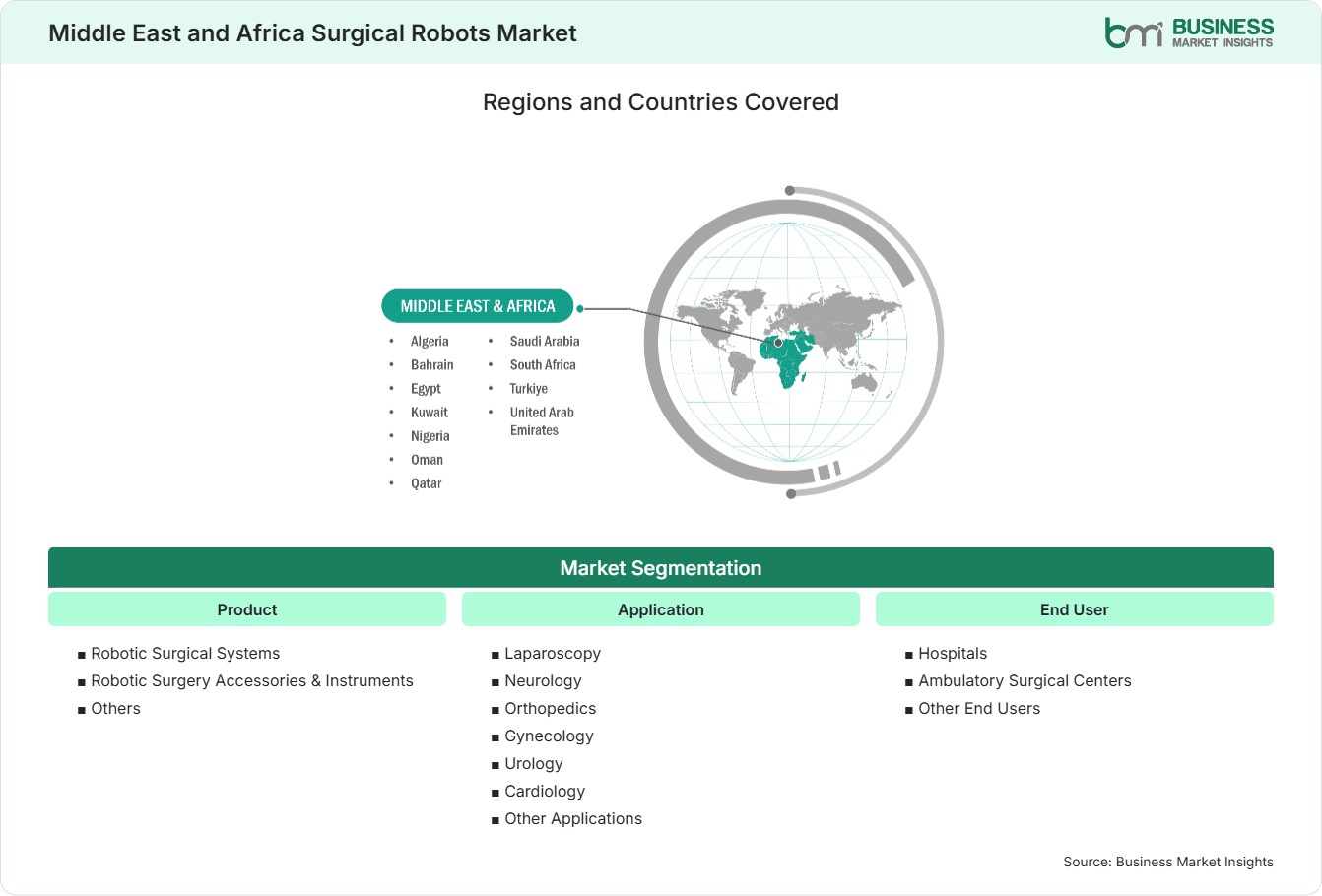
Key segments that contributed to the derivation of the Middle East and Africa Surgical Robots Market analysis are product, application, and end user.
- By product, the surgical robots market is segmented into robotic surgical systems, robotic surgery accessories & instruments and others. The robotic surgery accessories & instruments segment dominated the market in 2025.
- In terms of application, the surgical robots market is categorized into laparoscopy, neurology, orthopedics, gynecology, urology, cardiology and other applications. The laparoscopy segment dominated the market in 2025.
- Based on end user, the surgical robots market is classified into hospitals, ambulatory surgical centers and other end users. The hospitals segment dominated the market in 2025.
Market Forces
Middle East and Africa Surgical Robots Market Drivers and Opportunities
Integration with AI analytics
In the Middle East and Africa (MEA) surgical robots market, integration with AI‑based analytics is an emerging strategic trend that is shaping how healthcare providers approach surgical planning and performance evaluation. Hospitals in economically advanced markets such as United Arab Emirates, Saudi Arabia, and Qatar are beginning to integrate AI‑powered analytics with robotic platforms to gain deeper insights into procedural data, patient risk profiles, and long‑term outcomes. This integration helps surgeons and administrators move beyond traditional metrics toward predictive and prescriptive insights that can improve surgical precision and operational decision‑making. Healthcare systems in South Africa and Egypt are also engaging with AI analytics as part of broader digital transformation efforts. By linking surgical robots to data repositories and clinical decision support systems, these institutions are enabling real‑time analysis of performance indicators across teams and procedures. Surgeons can review anonymized analytics dashboards that highlight trends such as instrument motion patterns, procedure durations, and comparative outcomes. This analytical layer supports performance benchmarking and continuous learning key priorities for facilities seeking to elevate surgical quality in highly competitive regional markets. Moreover, integration of AI analytics is driving cross‑institutional collaboration throughout the MEA region. Medical centers with advanced robotics programs are partnering with technology vendors and academic institutions to co‑develop analytics modules tailored to local disease burdens and procedural mixes. For example, analytics features that support urology or colorectal surgery may be optimized differently in Gulf markets versus African referral centers based on case prevalence. These region‑specific analytics initiatives are helping to embed AI not merely as a technical add‑on, but as a core component of surgical strategy and quality management across the Middle East and Africa.
AI-driven autonomous functions
AI‑driven autonomous functions are the next frontier in surgical robotics for the Middle East and Africa, representing a shift from surgeon‑assisted automation toward systems capable of semi‑independent execution of defined tasks. In technologically progressive cities such as Dubai, Riyadh, and Doha, leading hospitals are evaluating robotic platforms that incorporate machine learning and computer vision to perform auxiliary tasks such as camera navigation, suture assistance, and tool positioning under surgeon supervision. These autonomous capabilities aim to reduce procedure time and cognitive load, ultimately improving consistency and allowing clinicians to focus on high‑value decision‑making. Emerging markets within the MEA region, including Nigeria, Kenya, and Morocco, are also expressing interest in AI‑driven functions, particularly those that enhance procedural safety and reduce variability. Although fully autonomous surgery remains a long‑term objective, incremental innovations such as AI‑guided instrument stabilization and automated wound closure support are gaining traction because they can be integrated into existing workflows with limited disruption. Hospitals in these regions view AI‑enhanced robotics as a means to bridge gaps in surgical expertise and support broader efforts to improve access to advanced care. In addition, collaborative research hubs in the MEA are beginning to explore how autonomous functions can be tailored to local clinical requirements. Partnerships between medical universities and technology firms are focusing on region‑specific training datasets that reflect local patient anatomies and disease presentations, which are essential for reliable autonomous performance. These initiatives are particularly active in Gulf Cooperation Council nations where investment in medical innovation is a strategic priority. As AI‑driven autonomous functions evolve, they are expected to transform surgical practice in the Middle East and Africa by enhancing safety, efficiency, and access to advanced surgical care.
Size and Share Analysis
Middle East and Africa Surgical Robots Market Size and Share Analysis
The Middle East and Africa Surgical Robots Market demonstrates steady growth, with size and share analysis highlighting evolving trends and competitive dynamics among key players. The report examines subsegments categorized within product, application, and end user, offering insights into their contribution to overall market performance.
By product, the robotic surgery accessories & instruments segment dominated the market in 2025, driven by the recurring and high demand for consumable, procedure‑specific tools that must be regularly replaced as robotic surgical volumes increase.
In terms of application, the laparoscopy segment dominated the market in 2025, driven by the rising adoption of minimally invasive laparoscopic robotic procedures across the region, offering enhanced precision and favorable patient recovery outcomes.
Based on end user, the hospitals segment dominated the market in 2025, driven by their advanced infrastructure, high surgical volumes, and substantial investment in robotic technologies to improve quality of care and surgical outcomes.
Report Coverage
Middle East and Africa Surgical Robots Market Report Coverage and Deliverables
The "Middle East and Africa Surgical Robots Market Size and Forecast (2022-2033)" report provides a detailed analysis of the market covering below areas:
- Middle East and Africa Surgical Robots Market size and forecast at regional and country levels for all market segments covered under the scope
- Middle East and Africa Surgical Robots Market trends, as well as drivers, restraints, and opportunities
- Middle East and Africa Surgical Robots Market analysis covering key trends, regional framework, major players, regulations, and recent developments
- Industry landscape and competition analysis covering market concentration, heat map analysis, prominent players, and recent developments for the Middle East and Africa Surgical Robots Market
- Detailed company profiles, including SWOT analysis
Geographic Insights
Middle East and Africa Surgical Robots Market Geographic Insights
The geographical scope of the Middle East and Africa Surgical Robots Market report is divided into Turkiye, the UAE, Saudi Arabia, Bahrain, Oman, Egypt, South Africa and Africa, Algeria, Nigeria, Kuwait, and Qatar. Turkiye held the largest share in 2025.
Country-level dynamics within the MEA region reveal heterogeneous adoption patterns shaped by healthcare infrastructure, economic capacity, and government priorities. Turkiye now serves as the dominant market in the region, with robotic systems extensively deployed in tertiary hospitals and specialized medical centers. Adoption is driven by a combination of public healthcare modernization initiatives, high procedural volumes, and robust investment in advanced surgical technologies across metropolitan centers like Istanbul and Ankara. Hospitals leverage robotic platforms primarily for urology, oncology, cardiothoracic, and gynecological procedures, aiming to improve surgical precision, enhance patient outcomes, and strengthen institutional reputation. United Arab Emirates continues to show significant adoption in Dubai and Abu Dhabi, supported by medical tourism, international hospital accreditation, and smart hospital infrastructure development. Qatar integrates robotics within state-funded specialty hospitals, focusing on high-complexity surgeries aligned with national health priorities. Egypt and South Africa show selective adoption in metropolitan private hospitals and leading tertiary centers, often relying on partnerships with international manufacturers to train surgeons and maintain systems. Smaller African markets, such as Kenya and Nigeria, are gradually introducing robotic surgery in pilot programs within urban hospitals, primarily targeting high-demand specialties. Across the MEA region, adoption is influenced by hospital capital availability, surgeon expertise, patient demand, and regulatory frameworks. Turkey‘s leadership establishes a benchmark for regional deployment, while other countries follow phased, strategic adoption patterns driven by infrastructure readiness and healthcare modernization objectives. Overall, the MEA surgical robots market presents a heterogeneous but strategically advancing landscape, with urban tertiary centers leading adoption and emerging markets progressively expanding access to robotic-assisted procedures.
Industry Activity
Recent Developments
The Middle East and Africa Surgical Robots Market is evaluated by gathering qualitative and quantitative data post primary and secondary research, which includes important corporate publications, association data, and databases. A few of the key developments in the Middle East and Africa Surgical Robots Market are:
- In January 2026, NAFDAC (Nigeria‘s regulatory authority) approved the MicroPort Toumai robotic surgical system for clinical use, making Nigeria the first West African country to formally authorise a robotic platform for patient care. The clearance follows successful early procedures at NISA Premier Hospital in Abuja, demonstrating safety and performance of the multi‑arm laparoscopic robot. This regulatory milestone paves the way for broader adoption of robotic surgery across Nigeria and potentially other African health systems. It marks a major step toward integrating sophisticated robotic surgery in African hospitals.
- In October 2025, the MicroPort Toumai endoscopic surgical robot obtained its European CE mark and reached over 100 global commercial orders, including installations and clinical use in the Middle East and North Africa. These international approvals (CE certification) are important because many MEA countries consider CE‑cleared devices as reference standards when evaluating products for local regulatory submission and hospital usage. The growing Toumai® footprint in the region supports clinical confidence and accelerates future product registrations. This milestone reflects rising regional integration of advanced robotic platforms.
Trust & Transparency
Research Methodology
The market analysis combines proprietary research with secondary data from government agencies, company disclosures, regulatory filings, industry databases and expert interviews. Market estimates are validated through data triangulation, cross-market benchmarking and analyst
review.
View Full Research Methodology
Key Sources Referred:
World Health Organization (WHO)
Organisation for Economic Cooperation and Development (OECD)
The World Bank Group
Worldometer
The Lancet
International Bar Association
International Trade Administration