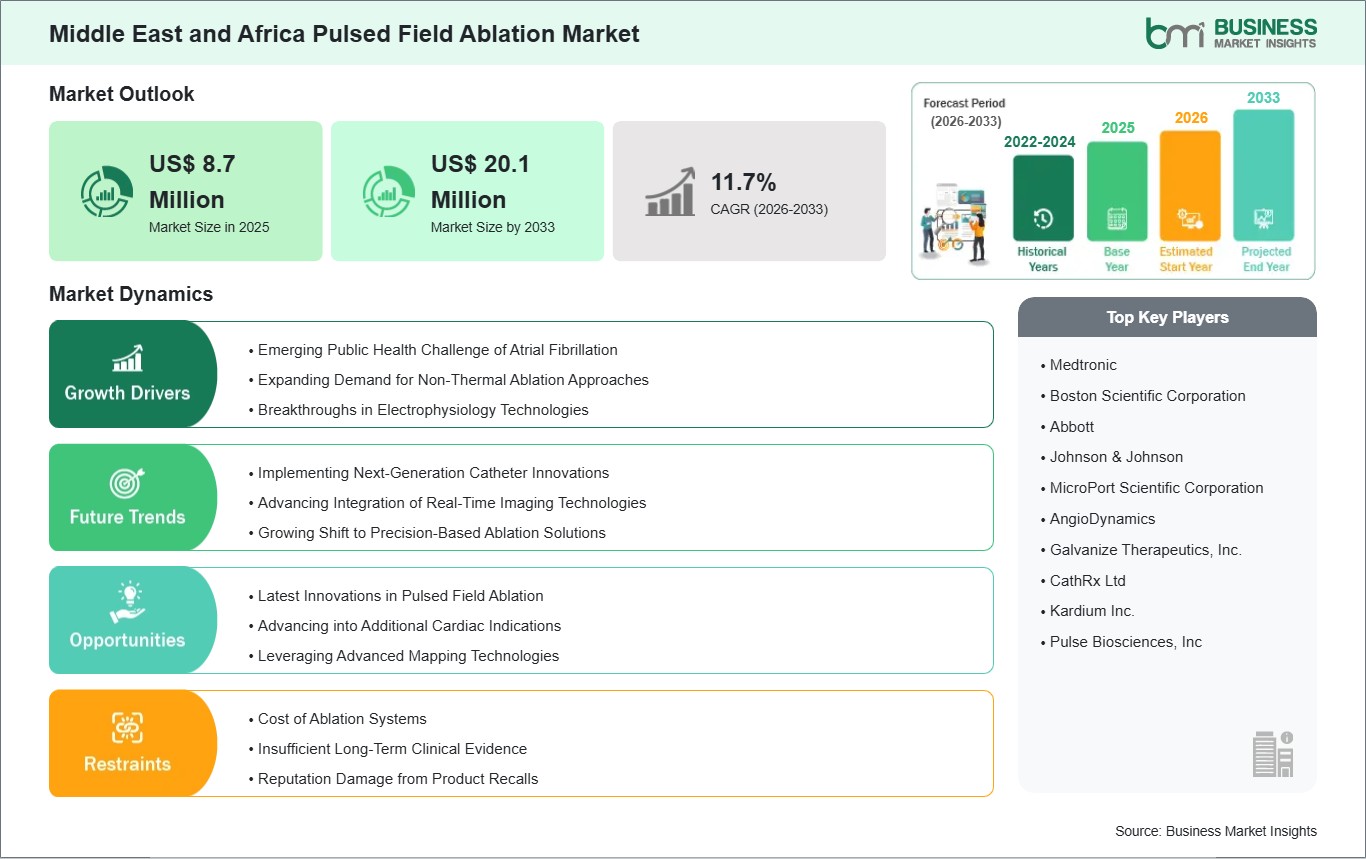
The Middle East and Africa pulsed field ablation market size is expected to reach US$ 20.1 million by 2033 from US$ 8.7 million in 2025. The market is estimated to register a CAGR of 11.7% from 2026 to 2033.
The MEA pulsed field ablation market represents a rapidly developing market segment that reflects the development of the healthcare industry in the region, with many hospitals currently looking for novel approaches to deal with arrhythmia. The main factor behind the growth of the market is the increasing incidence rate of atrial fibrillation, along with awareness regarding the inadequacies of traditional methods of thermal ablation. Pulsed field ablation represents a safe, fast procedure with minimized side effects due to its non-thermal nature and the ability to affect a single target tissue area only.
Investments in electrophysiology labs equipped with up-to-date equipment and imaging tools are expected to drive the development of the market in the region. Pilot studies aimed at the training of cardiologists and procedures based on the use of PFA have already been introduced into practice. Cooperation with foreign medical technology firms will facilitate the spread of PFA among the region's early adopters. However, adoption remains constrained by high procedural and equipment costs, which limit availability primarily to tertiary and private hospitals. A shortage of trained electrophysiologists also restricts broader implementation across smaller healthcare centers. The focus on improving cardiac care infrastructure, combined with increasing clinician awareness of advanced, minimally invasive therapies, points to a gradual expansion trajectory for the PFA market in the Middle East & Africa.

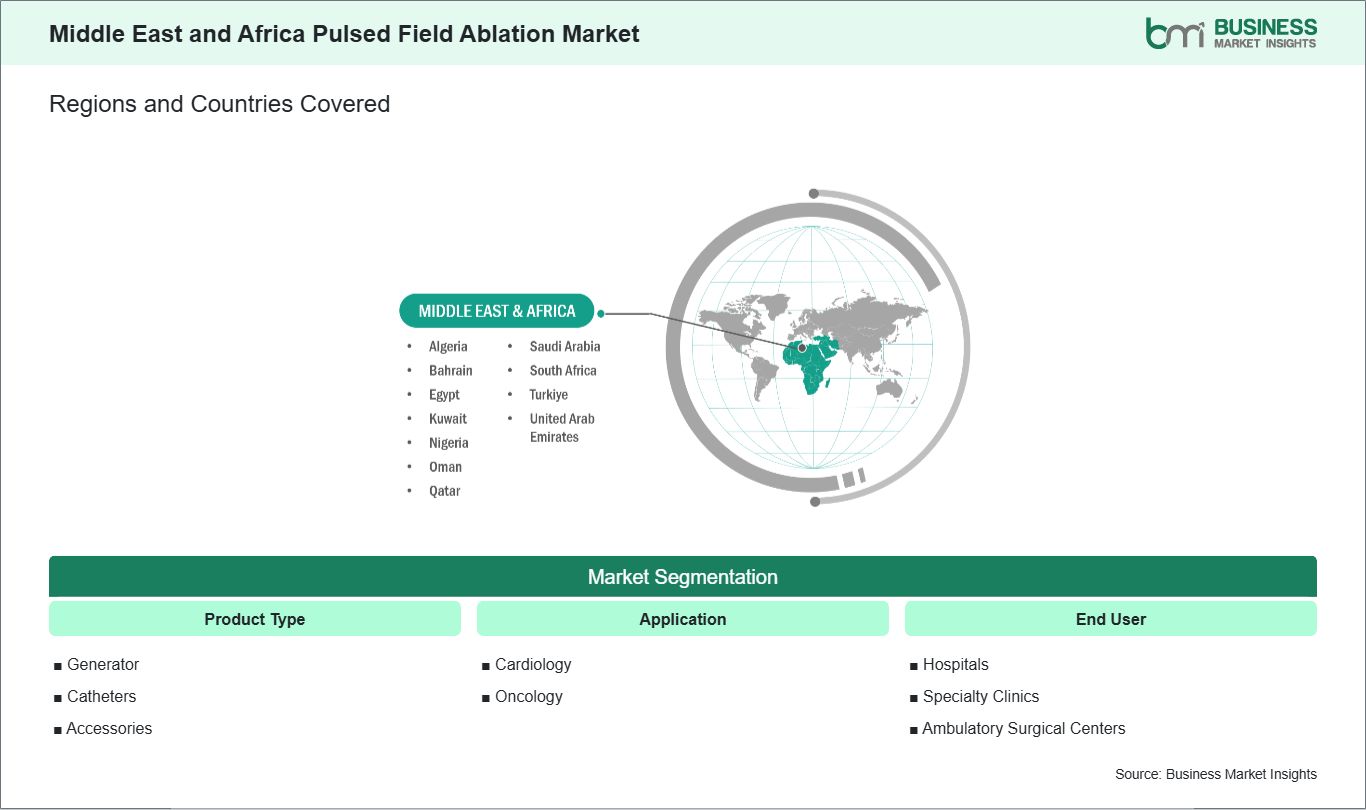
Key segments that contributed to the derivation of the Africa pulsed field ablation market analysis are product type, application, and end user.
Atrial fibrillation (AF) is driven by changing demographics, lifestyle shifts, and rising cardiovascular risk factors. Urbanization, sedentary habits, and increasing prevalence of obesity, diabetes, and hypertension have contributed to a surge in arrhythmia cases across both high-income Gulf countries and lower-resource African nations. The healthcare systems in these regions are facing mounting pressure to provide timely diagnosis, treatment, and long-term management of AF, particularly given the elevated risk of complications such as stroke and heart failure if left untreated.
The MEA region shows great differences in terms of healthcare infrastructure development, as modern cardiac centers are typically found in large cities, while patients from rural regions cannot receive specialized electrophysiology treatment. There is a need for scalable and high-quality solutions that could cater to patients regardless of where they live. With an increasing number of cases, healthcare organizations are implementing new strategies, such as streamlined clinical workflows, improved diagnostic programs, and less invasive treatments.
With the increasing numbers of AF patients, it is important to introduce new approaches for their treatment. PFA provides an optimal solution, as it does not require invasive procedures and is highly precise. By adopting this approach, health professionals will be able to address the problem of AF in the MEA region.
The use of pulsed field ablation (PFA) therapy is growing at an increasing rate in the MEA, revolutionizing the management of arrhythmias through the provision of safe and accurate treatment solutions. In contrast to the traditional thermal ablation technique, pulsed field ablation uses highly intensive electrical impulses that selectively affect heart tissue without damaging nearby structures, making procedures safer and shorter. Technological innovations such as advancements in catheter design, the delivery of energy impulses, and mapping integration have helped increase the accuracy of the procedure and facilitate its standardization and reproducibility.
Hospitals throughout the MEA are developing the necessary infrastructure and optimizing their work processes to be able to adopt the PFA technology. Training programs will help cardiologists learn to use new devices efficiently in a manner that is both patient-safe and of high quality. Increased capacity will make it possible for more patients to receive treatment in less time.
Ongoing technological refinements in PFA are expected to further strengthen arrhythmia treatment in the MEA market. Enhanced mapping systems, ergonomic catheter designs, and optimized procedural protocols facilitate more predictable outcomes and reproducible results. By combining safety, clinical effectiveness, and operational efficiency, PFA positions healthcare providers in the Middle East and Africa to meet the growing AF challenge with scalable, advanced, and reliable arrhythmia management solutions.

The Middle East and Africa pulsed field ablation market demonstrates steady growth, with size and share analysis highlighting evolving trends and competitive dynamics among key players. The report evaluates important subsegments categorized within product type, application, and end user, highlighting their respective contributions to overall market performance.
By product type, the catheters subsegment dominated the market in 2025. Catheter devices offer improved procedural efficiency, reduced risk of complications, and real-time control for electrophysiologists, making them a crucial component for effective PFA therapy and a key revenue driver for manufacturers.
In terms of application, the cardiology subsegment dominated the market in 2025. The leadership of cardiology applications is attributed to the rising prevalence of atrial fibrillation and other cardiac arrhythmias, growing preference for non-thermal and tissue-selective ablation techniques, and increasing awareness among healthcare providers about the clinical benefits of PFA.
Based on end user, the hospitals subsegment dominated the market in 2025. Hospitals maintain a stronghold due to their established cardiology and electrophysiology departments, access to advanced PFA systems, trained physicians and clinical staff, and the capability to perform specialized cardiac procedures with comprehensive patient monitoring and post-procedure care.
| Report Attribute | Details |
|---|---|
| Market size in 2025 | US$ 8.7 Million |
| Market Size by 2033 | US$ 20.1 Million |
| CAGR (2026 - 2033) | 11.7% |
| Historical Data | 2022-2024 |
| Forecast period | 2026-2033 |
| Segments Covered | By Product Type
|
|
Regions and Countries Covered
| |
| Middle East and Africa | Saudi Arabia, United Arab Emirates, Kuwait, Bahrain, Qatar, Oman, Turkiye, South Africa, Egypt, Nigeria, Algeria |
| Market leaders and key company profiles |
|
The "Middle East and Africa Pulsed Field Ablation Market Size and Forecast (2022–2033)" report provides a detailed analysis of the market covering below areas:
The geographical scope of the Middle East and Africa pulsed field ablation market report is divided into: Saudi Arabia, the United Arab Emirates, Kuwait, Bahrain, Qatar, Oman, Turkiye, South Africa, Egypt, Nigeria, Algeria, and the Rest of MEA. Turkiye held the largest share in 2025.
Turkiye is dominant in the Middle East and Africa PFA market because of the presence of a highly developed healthcare system, emphasis on cardiology, and implementation of innovative treatments. In particular, Turkiye has many patients who have been diagnosed with conditions such as atrial fibrillation, which results in high demand for safer ablation techniques. PFA has proved to be advantageous as it employs a non-thermal technique that selectively affects only cardiac tissue.
The market uptake of PFA is characterized by the investment in dedicated electrophysiology labs, advanced imaging modalities, and advanced cardiac mapping solutions. Hospitals in Turkiye have also introduced formal training programs for clinicians to guarantee the safe use of PFA, while partnerships with foreign technology vendors enable efficient implementation and exchange of information. Despite these developments, expensive procedures that make PFA accessible only at urban, well-resourced hospitals and insufficient numbers of electrophysiologists, which limit the adoption of PFA at smaller or regional medical facilities. The efforts by Turkiye to improve the cardiac infrastructure of the country, introduce innovative treatments, and prioritize patient safety make Turkiye the frontrunner in the uptake of PFA within the Middle East & Africa region.

The Middle East and Africa pulsed field ablation market is evaluated by gathering qualitative and quantitative data post primary and secondary research, which includes important corporate publications, association data, and databases. A few of the key developments in the Middle East and Africa pulsed field ablation market are:
The Middle East and Africa Pulsed Field Ablation Market is valued at US$ 8.7 Million in 2025, it is projected to reach US$ 20.1 Million by 2033.
As per our report Middle East and Africa Pulsed Field Ablation Market, the market size is valued at US$ 8.7 Million in 2025, projecting it to reach US$ 20.1 Million by 2033. This translates to a CAGR of approximately 11.7% during the forecast period.
The Middle East and Africa Pulsed Field Ablation Market report typically cover these key segments-
The historic period, base year, and forecast period can vary slightly depending on the specific market research report. However, for the Middle East and Africa Pulsed Field Ablation Market report:
The Middle East and Africa Pulsed Field Ablation Market is populated by several key players, each contributing to its growth and innovation. Some of the major players include:
The Middle East and Africa Pulsed Field Ablation Market report is valuable for diverse stakeholders, including:
Essentially, anyone involved in or considering involvement in the Middle East and Africa Pulsed Field Ablation Market value chain can benefit from the information contained in a comprehensive market report.
Please tell us your area of interest
(Market Segments/ Regions and Countries/ Companies)