Market Summary
Executive Summary and Market Analysis
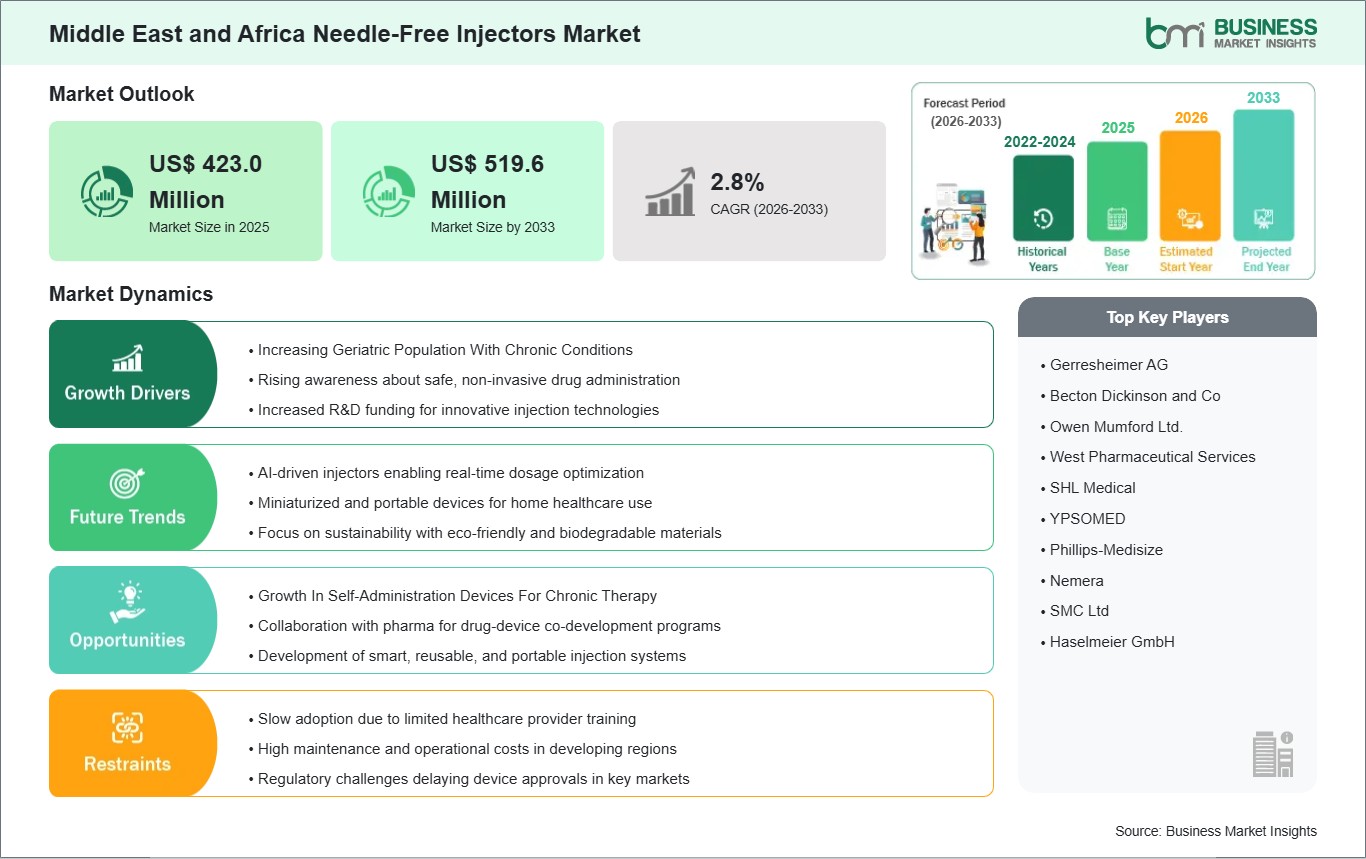
The region, encompassing high-income nations such as the UAE, Saudi Arabia, and Qatar, as well as emerging markets across Africa, including South Africa, Nigeria, and Kenya, presents a diverse landscape for adoption. Collaborations between global device manufacturers and local distributors emphasize regulatory compliance, device reliability, and cost-effectiveness. Clinical adoption is driven by evidence of reduced needle-stick injuries, improved patient adherence, and enhanced safety during high-volume vaccination campaigns and biologic therapy administration. Regulatory frameworks vary widely, with Gulf countries enforcing strict compliance aligned with international standards. African nations implement more flexible, pilot-based approvals to encourage early adoption. Operational considerations, including training requirements, maintenance, consumables management, and total cost of ownership, influence procurement decisions. Product innovation remains a critical differentiator, with devices emphasizing disposable and reusable options, ergonomic design, and compatibility with a range of viscosities. Pilot programs and hospital-led demonstration projects are leveraged to showcase clinical benefits and validate workflow integration. The market reflects a dual-character landscape, where advanced Gulf nations drive high-value adoption, and African markets offer potential through pilot programs and cost-sensitive deployment strategies. Success in this region depends on regulatory alignment, operational efficiency, and clinical validation to establish sustainable market penetration.
Segment Analysis
Middle East and Africa Needle-Free Injectors Market Segmentation
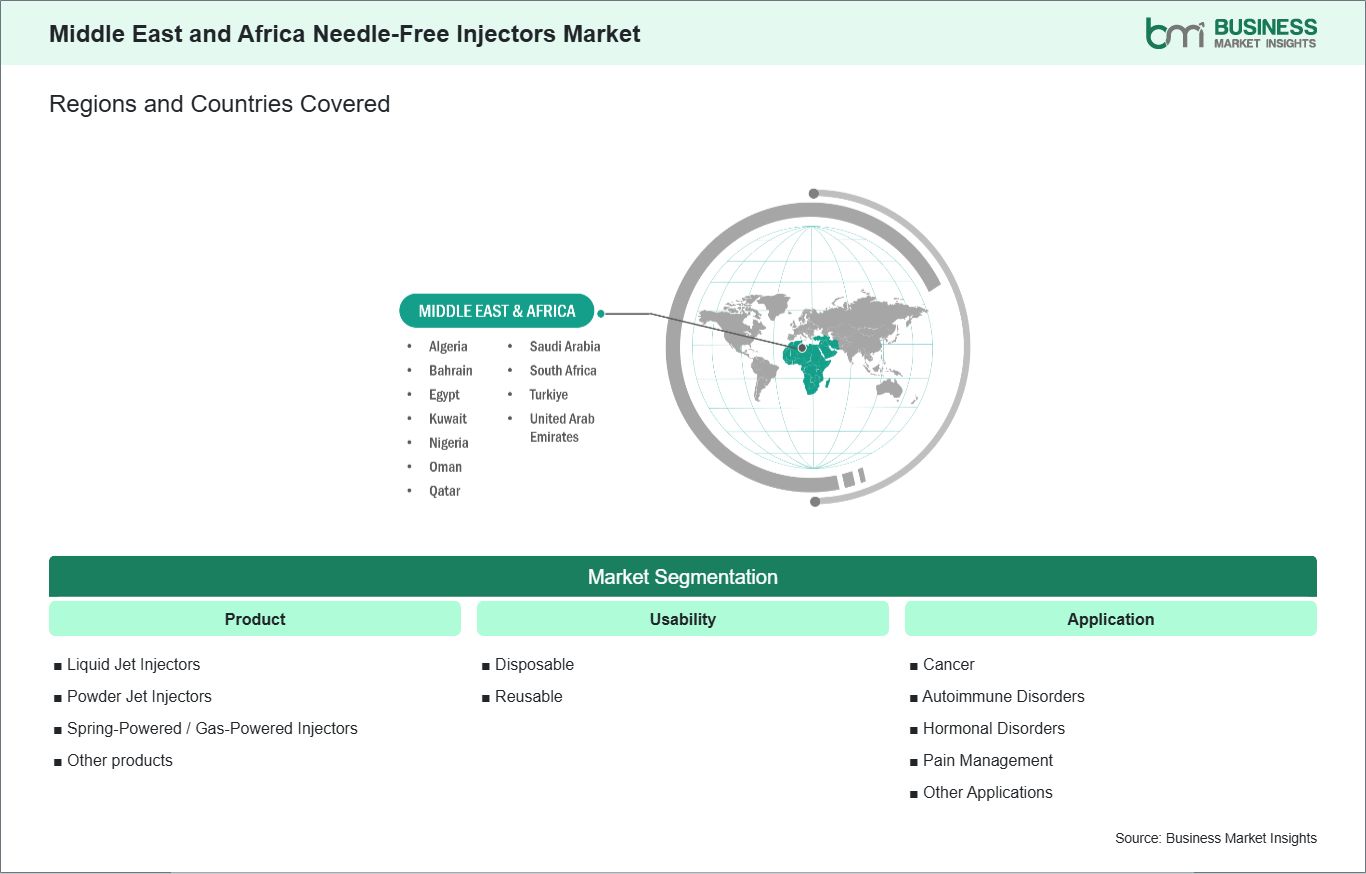
Key segments that contributed to the derivation of the Middle East and Africa needle-free injectors market analysis are product, usability, and application.
- By product, the needle-free injectors market is segmented into liquid jet injectors, powder jet injectors, spring-powered / gas-powered injectors, and other products. The liquid jet injectors segment dominated the market in 2025.
- Based on usability, the needle-free injectors market is categorized into disposable and reusable. The disposable segment dominated the market in 2025.
- In terms of application, the market is classified into cancer, autoimmune disorders, hormonal disorders, pain management, and other applications. The autoimmune disorders segment dominated the market in 2025.
Market Forces
Middle East and Africa Needle-Free Injectors Market Drivers and Opportunities
Increasing Geriatric Population With Chronic Conditions
The region is experiencing a rise in the geriatric population, which is accompanied by a growing prevalence of chronic diseases such as diabetes, cardiovascular disorders, and autoimmune conditions. Older adults require frequent medication administration, creating challenges in adherence and quality of life. Needle-free injectors offer a pain-free and convenient method for long-term treatment that enhances compliance and patient comfort. Countries such as Saudi Arabia, the UAE, South Africa, and Egypt are witnessing shifts in healthcare priorities to address aging populations. Hospitals and outpatient care facilities are adopting technologies that reduce injection-related anxiety and improve patient engagement. Needle-free injectors help older patients manage therapy independently, minimizing the need for repeated clinical visits while maintaining consistent therapeutic outcomes. The increased focus on geriatric care is driving public and private healthcare providers to integrate innovative drug delivery solutions into chronic disease management programs. Needle-free injectors provide benefits such as reduced risk of needle-stick injuries, improved dosing accuracy, and enhanced safety, which are relevant for older patients who may have reduced dexterity or cognitive challenges. As the geriatric population continues to expand, needle-free devices are expected to play a pivotal role in ensuring patient-friendly chronic disease management across the region.
Growth In Self-Administration Devices For Chronic Therapy
Needle-free injectors enable patients to manage chronic therapy safely at home, offering a convenient alternative to traditional injections and fostering greater adherence to treatment regimens. This trend is relevant for conditions requiring frequent dosing, such as diabetes and autoimmune disorders. Healthcare systems in countries such as the UAE, Nigeria, and South Africa are supporting home-based care models. Needle-free devices enhance these models by simplifying drug administration, reducing the need for professional supervision, and providing a safer option for patients and caregivers. Patients benefit from the comfort, portability, and ease of use of these devices, while providers can monitor adherence and outcomes. Patient education programs and awareness campaigns highlight the advantages of needle-free technology. By empowering patients to take control of their therapy, these devices improve adherence, reduce healthcare costs, and enhance treatment outcomes. As healthcare systems evolve toward patient-centric care, needle-free injectors are expected to see widespread adoption as a key tool in chronic disease management.
Size and Share Analysis
Middle East and Africa Needle-Free Injectors Market Size and Share Analysis
The Middle East and Africa Needle-free Injectors Market demonstrates steady growth, with size and share analysis highlighting evolving trends and competitive dynamics among key players. The report examines subsegments categorized within product, usability, and application, offering insights into their contribution to overall market performance.
By product, the liquid jet injectors subsegment dominated the market in 2025, driven by their ability to deliver accurate, rapid, and painless doses, making them ideal for clinical and home-based therapy.
Based on usability, the disposable subsegment dominated the market in 2025, driven by the emphasis on hygiene, infection prevention, and ease of handling in hospitals, clinics, and home-care settings.
In terms of application, the autoimmune disorders subsegment dominated the market in 2025, driven by the need for frequent, long-term medication administration where patient comfort, adherence, and safety are critical for disease management.
Report Coverage
Middle East and Africa Needle-Free Injectors Market Report Coverage and Deliverables
The "Middle East and Africa Needle-free Injectors Market Size and Forecast (2022–2033)" report provides a detailed analysis of the market covering below areas:
- Middle East and Africa Needle-free Injectors Market size and forecast at regional and country levels for all market segments covered under the scope
- Middle East and Africa Needle-free Injectors Market trends, as well as drivers, restraints, and opportunities
- Middle East and Africa Needle-free Injectors Market analysis covering key trends, regional framework, major players, regulations, and recent developments
- Industry landscape and competition analysis covering market concentration, heat map analysis, prominent players, and recent developments for the Middle East and Africa Needle-free Injectors Market
- Detailed company profiles, including SWOT analysis
Geographic Insights
Middle East and Africa Needle-Free Injectors Market Geographic Insights
The geographical scope of the Middle East and Africa Needle-free Injectors Market report is divided into Turkiye, the UAE, Saudi Arabia, Bahrain, Oman, Egypt, South Africa and Africa, Algeria, Nigeria, Kuwait, and Qatar. Turkiye held the largest share in 2025.
Turkiye dominates the market, driven by robust hospital infrastructure, large-scale vaccination initiatives, and rising adoption of home- and outpatient-based therapies. Qatar and Bahrain demonstrate high adoption rates in urban hospitals and specialty clinics, supported by government-led modernization programs and pilot implementations. In Africa, South Africa serves as a leading adopter due to its advanced healthcare system, strong public-private partnerships, and NGO-supported immunization campaigns. Nigeria and Kenya reflect emerging markets with increasing adoption driven by donor-funded programs and pilot studies in urban and rural healthcare facilities. Operational factors, including localized training programs, after-sales support, and distributor reliability, influence uptake across these countries. Urban medical centers act as adoption hubs, setting benchmarks for smaller hospitals and rural clinics. Variations in regulatory frameworks, procurement processes, and healthcare infrastructure necessitate tailored commercialization strategies for each country. Gulf countries lead in technology-driven adoption, and African markets offer potential through pilot programs, donor engagement, and cost-effective deployment, highlighting the need for differentiated regional approaches to achieve market penetration in MEA.
Industry Activity
Recent Developments
The Middle East and Africa Needle-free Injectors Market is evaluated by gathering qualitative and quantitative data post primary and secondary research, which includes important corporate publications, association data, and databases. A few of the key developments in the Middle East and Africa needle-free injectors market are:
- In July 2025, PharmaJet signed an MOU with the Egyptian Unified Procurement Authority (UPA) and EVA Pharma to explore integrating needle‑free delivery of inactivated polio vaccine and to collaborate on distribution, manufacturing, and technology transfer in the region. While this MOU focuses on Egypt, it is positioned as a regional collaboration stepping stone for expanding needle‑free immunization systems throughout the Middle East and Africa health ecosystem, supporting cost savings and reduced vaccination pain. This initiative highlights efforts to strengthen local manufacturing and scale needle‑free tech regionally.
- In March 2025, implementation research in Nigeria demonstrated that needle‑free intradermal delivery of fractional IPV (inactivated polio vaccine) using WHO‑prequalified systems increased coverage and reduced immunization costs compared to traditional needle delivery. The study conducted with partners, including PharmaJet, PATH, and local health agencies, provided evidence supporting routine use of needle‑free injectors in national immunization programmes, reinforcing the value of these technologies for countrywide vaccine delivery expansion.
Trust & Transparency
Research Methodology
The market analysis combines proprietary research with secondary data from government agencies, company disclosures, regulatory filings, industry databases and expert interviews. Market estimates are validated through data triangulation, cross-market benchmarking and analyst
review.
View Full Research Methodology
Key Sources Referred:
World Health Organization (WHO)Organisation for Economic Cooperation and Development (OECD)The World Bank GroupWorldometerThe LancetInternational Bar AssociationInternational Trade Administration