Analysis - by Source (Bio-Based and Synthetic), Form (Dry and Liquid), and Crop Type (Fruits and Vegetables, Cereals and Grains, Oilseeds and Pulses, and Others)
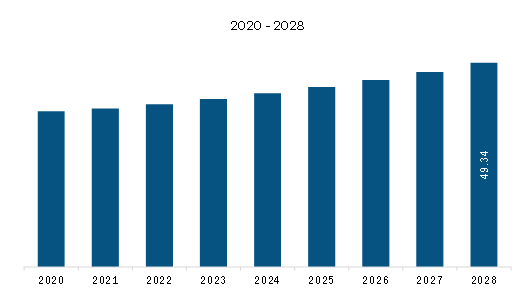
The Middle East & Africa miticides market is expected to grow from US$ 39.29 million in 2022 to US$ 49.34 million by 2028. It is estimated to grow at a CAGR of 3.9% from 2022 to 2028.
Ongoing Developments in Crop Protection Practices Drive Middle East & Africa Miticides Market
A miticide is a chemical insecticide that mainly targets mites (e.g., spider mites) that harbor fruits and vegetables, cereals and grains, oilseeds and pulses, turf and landscape, ornamental flowers, and forage and plantation crops. Miticides are packed in the form of spray concentrates and have powerful active ingredients, resulting in a quick knockdown and fast kill. However, the development of miticide resistance in mites is a major issue in the agriculture field. Repeated pesticide uses result in microevolution due to the selection pressure, ultimately leading to resistance development. Thus, manufacturers have shifted their focus on offering miticides made of chemicals such as omite and palictran, which give better results without harming the predatory fauna of mite pests. Moreover, they offer effective products that can kill mites in all stages of their lifecycle. BASF SE and Sym-Agro, among others, offer organic miticides that also act as fungicides. These miticides help to control adelgids, aphids, fungus gnats, lace bugs, leafminers, leafhoppers, mealybugs, mites, scale, thrips, whiteflies, webworms, and powdery mildew on ornamentals. Such innovative multipurpose products are becoming popular among farmers as they lower the cost of production. Many countries are encouraging the development of pesticides for agricultural use. For instance. Thus, the development of novel products, coupled with favorable government initiatives, is offering future growth opportunities for the Middle East & Africa miticides market players.
Middle East & Africa Miticides Market Overview
The Middle East & Africa faces land and water scarcity issues. Many farmers in developing countries consider pesticide use as the best means to protect their crops against pests, such as desert locusts in parts of the Middle East & Africa, which are often the main threat they face. According to the US Department of Agriculture's Foreign Agricultural Service (USDA FAS), the production of fresh lemons and limes in South Africa is projected to grow by 2% during 2022–2023, bringing it to 660,000 metric tons (MT). Additionally, orange production in Egypt is forecasted to reach 3.6 million metric tons (MMT) during 2022–2023, an increase of almost 20% compared to the production in the prior season that was 3 MMT. These citrus fruits can be largely get affected due to mites, such as citrus rust mites. Thus, to prevent crop damage, the usage of miticides is expected to increase during the forecast period. According to the Food and Agriculture Organization Corporate Statistical Database, Egypt is the world's largest producer of dates, followed by Iran, Algeria, Saudi Arabia, and the UAE. Mite infestation leads to the downgrading of date fruit. In many cases, the fruits may need to be rehydrated to reduce the extent of damage and economic losses. However, the rehydration process can increase the production cost. Thus, the demand for miticides is increasing in the Middle East & Africa.
Middle East & Africa Miticides Market Revenue and Forecast to 2028 (US$ Million)
Middle East & Africa Miticides Market Segmentation
The Middle East & Africa Miticides market is segmented into source, form, crop type, and country.
Based on source, the Middle East & Africa miticides market is bifurcated into bio-based and synthetic. In 2022, the synthetic segment registered a larger share in the Middle East & Africa miticides market.
Based on form, the Middle East & Africa miticides market is segmented into dry and liquid. In 2022, the liquid segment registered a larger share in the Middle East & Africa miticides market.
Based on crop type, the Middle East & Africa miticides market is segmented into fruits and vegetables, cereals and grains, oilseeds and pulses, and others. In 2022, the fruits and vegetables segment registered a largest share in the Middle East & Africa miticides market.
Based on country, the Middle East & Africa miticides market is segmented South Africa, Saudi Arabia, the UAE, and the Rest of Middle East & Africa. In 2022, the Rest of Middle East & Africa segment registered a largest share in the Middle East & Africa miticides market.
BASF SE; Bayer AG; Certis USA LLC; FMC Corp; Gowan Co; Kemin Industries Inc.; Oro Agri International BV; Syngenta AG; and UPL Ltd are the leading companies operating in the Middle East & Africa miticides market.
Middle East & Africa Miticides Market Strategic Insights
Get more information on this report
Middle East & Africa Miticides Market Segmentation Analysis
Middle East & Africa Miticides Market Report Highlights
Middle East & Africa Miticides Report Scope
Report Attribute
Details
Market size in 2022
US$ 39.29 Million
Market Size by 2028
US$ 49.34 Million
CAGR (2022 - 2028)
3.9%
Historical Data
2020-2021
Forecast period
2023-2028
Segments Covered
By Source
Bio-Based
Synthetic
By Form
Dry
Liquid
By Crop Type
Fruits and Vegetables
Cereals and Grains
Oilseeds and Pulses
Regions and Countries Covered
Middle East and Africa
South Africa, Saudi Arabia, UAE, Rest of Middle East and Africa
Market leaders and key company profiles
BASF SE
Bayer AG
Certis USA LLC
FMC Corp
Gowan Co
Kemin Industries Inc.
Oro Agri International BV
Syngenta AG
UPL Ltd
Get more information on this report
Middle East & Africa Miticides Market Country and Regional Insights
Get more information on this report
Identical Market Reports with other Region/Countries
The List of Companies - Middle East & Africa Miticides Market
BASF SE Bayer AG Certis USA LLC FMC Corp Gowan Co Kemin Industries Inc. Oro Agri International BV Syngenta AG UPL Ltd
Frequently Asked Questions
How big is the Middle East & Africa Miticides Market?
The Middle East & Africa Miticides Market is valued at US$ 39.29 Million in 2022, it is projected to reach US$ 49.34 Million by 2028.
What is the CAGR for Middle East & Africa Miticides Market by (2022 - 2028)?
As per our report Middle East & Africa Miticides Market, the market size is valued at US$ 39.29 Million in 2022, projecting it to reach US$ 49.34 Million by 2028. This translates to a CAGR of approximately 3.9% during the forecast period.
What segments are covered in this report?
The Middle East & Africa Miticides Market report typically cover these key segments-
Source (Bio-Based, Synthetic)
Form (Dry, Liquid)
Crop Type (Fruits and Vegetables, Cereals and Grains, Oilseeds and Pulses)
What is the historic period, base year, and forecast period taken for Middle East & Africa Miticides Market?
The historic period, base year, and forecast period can vary slightly depending on the specific market research report. However, for the Middle East & Africa Miticides Market report:
Historic Period : 2020-2021
Base Year : 2022
Forecast Period : 2023-2028
Who are the major players in Middle East & Africa Miticides Market?
The Middle East & Africa Miticides Market is populated by several key players, each contributing to its growth and innovation. Some of the major players include:
BASF SE
Bayer AG
Certis USA LLC
FMC Corp
Gowan Co
Kemin Industries Inc.
Oro Agri International BV
Syngenta AG
UPL Ltd
Who should buy this report?
The Middle East & Africa Miticides Market report is valuable for diverse stakeholders, including:
Investors: Provides insights for investment decisions pertaining to market growth, companies, or industry insights. Helps assess market attractiveness and potential returns.
Industry Players: Offers competitive intelligence, market sizing, and trend analysis to inform strategic planning, product development, and sales strategies.
Suppliers and Manufacturers: Helps understand market demand for components, materials, and services related to concerned industry.
Researchers and Consultants: Provides data and analysis for academic research, consulting projects, and market studies.
Financial Institutions: Helps assess risks and opportunities associated with financing or investing in the concerned market.
Essentially, anyone involved in or considering involvement in the Middle East & Africa Miticides Market value chain can benefit from the information contained in a comprehensive market report.





 Get Free Sample For Middle East & Africa Miticides Market