Analysis - By Method (Genotypic, Phenotypic, and Proteotypic) and Type (Bacterial Identification System, Microbial Enumeration System, Bacterial Resistance Identification Systems, Microbiology Analyzer, and Others)
No. of Pages:107
Report Code:
BMIRE00029667
Category:
Life Sciences
Middle East & Africa Microbial Identification Methods Market
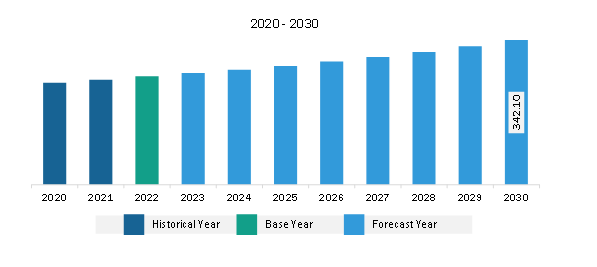
The Middle East & Africa microbial identification methods market was valued at US$ 256.35 million in 2022 and is expected to reach US$ 342.10 million by 2030; it is estimated to grow at a CAGR of 3.7% from 2022 to 2030.
Government Initiatives and Funding to Promote Microbial Identification Fuel the Middle East & Africa Microbial Identification Methods Market
Government initiatives and funding promoting microbial identification are crucial pillars of public health, scientific research, and industrial development. These initiatives serve a wide range of purposes, from enhancing disease surveillance and response to supporting innovative research in microbiology. For instance, Antimicrobial Resistance (AMR) surveillance in the UAE was initially implemented in 2010 at the subnational level (Abu Dhabi Emirate, HAAD/DoH). In partnership with the UAE Ministry of Presidential Affairs (MOPA), Department of Health Abu Dhabi (DoH), Dubai Health Authority (DHA), and Abu Dhabi Public Health Center (ADPHC), the Ministry of Health and Prevention (MOHAP) built and expanded the system nationally in 2015. The WHO created the Global AMR Surveillance System (GLASS) in 2015, and the UAE National AMR surveillance system contributes to it by providing AMR data (WHO-GLASS, 2015). As of July 2022, clinical microbiology laboratories located throughout all seven UAE's Emirates served 44 of the 318 monitoring sites (consisting of 231 centers/clinics and 87 hospitals) that comprise the UAE AMR surveillance system. Furthermore, in 2015, Saudi Arabia's Ministry of Health (MOH) implemented antimicrobial containment and infection prevention and control programs in MOH hospitals after realizing the importance and impact of AMR. The five objectives of the WHO Global Action Plan on AMR were adopted by the country when it created its first AMR National Action Plan in 2017. The Kingdom's 2022 AMR plan places a strong emphasis on the necessity of an efficient One Health strategy that operates at the local, regional, national, and international levels; is cooperative, multisectoral, and transdisciplinary; and acknowledges the connections that exist between people, animals, agriculture, and the shared environment. In order to carry out the essential AMR actions that support the overarching objectives, the transdisciplinary stakeholders in the Kingdom will be able to work together within the framework of this plan. The objectives remain the same as those stated in 2017, although they are more focused now because of the Kingdom's current circumstances and the change in their scope. A National AMR Committee made up of specialists and scientists from related fields was founded in January 2017 to address AMR in the Kingdom. The 2022 strategy and action plan were developed with the Committee's assistance when it was reorganized in 2019. The interdisciplinary Committee's representatives and other stakeholders participated in one-on-one meetings and workshops as well as active engagement and consultation to achieve this. In addition, the 2022-2025 action plan focuses on the nation's efforts on addressing the gaps found and strengthening the work already done, including improving surveillance in humans, especially in animals and the environment, growing hospital-based AMR stewardship programs, consuming antibiotics in humans and animals, and making sure that AMR activities are rigorously monitored. Overall, these initiatives and funding mechanisms play a pivotal role in safeguarding public health, advancing scientific knowledge, and driving economic growth by underpinning the microbial identification field.
Middle East & Africa Microbial Identification Methods Market Overview
Saudi Arabia and the UAE have a stable economy, as a significant portion of the local market witnessed a strong performance in value terms in recent years. According to the Institute for Health Metrics and Evaluation, Saudi Arabia and South Africa have a high prevalence of lower respiratory infections such as acute bronchitis, pneumonia, and tracheitis. Furthermore, according to a study published (October 2020) in the International Journal of Pharmaceutical and Phytopharmacological Research (eIJPPR), acute lower respiratory tract infections (ALRTIs) affect ~15.4% of the Saudi Arabian population, and it is reported to be the most common diseases among children and infants. Additionally, the Middle East & Africa microbial identification methods market is significantly increasing due to the rising consumer awareness regarding the risks of bacterial infections from minor cuts, abrasions, and other small injuries among diabetic patients in Saudi Arabia. Similarly, South Africa has a high prevalence of infectious diseases such as bacterial meningitis and enteric fever. According to a study published (2023) in Frontiers, in Africa, studies describe incidence rates of bacterial meningitis between 0-40 per 100,000 per year. As per the same source, Sub-Saharan Africa is also called the "meningitis belt," as it has many meningitis cases. Epidemic meningococcal group A disease outbreaks have recorded incidence rates of up to 100 cases per 100,000 population. Thus, the prevalence of infectious diseases in the region is expected to boost diagnostics and pharmaceutical production, which will increase the application of microbial identification methods in the region. Further, in the last few years, the private sector has been a crucial part of the healthcare system in Saudi Arabia, with the rising investments in the development projects of healthcare facilities and infrastructure in the country. The government launched the Saudi Vision 2030 program with the aim to reduce oil dependence and diversify other sectors, including healthcare. Under this program, the Health Sector Transformation Program aims to reconstruct the healthcare sector as a comprehensive, effective, and integrated healthcare system based on the individual's health. Similarly, the UAE government strives to develop more strategies and improve the quality of healthcare and laboratory testing services in the country. The UAE offers a highly developed healthcare system with first-class facilities and the latest medical technology. Thus, the increasing investments in developing healthcare facilities and the high prevalence of lower respiratory infection among the population are likely to fuel the microbial identification methods market growth in the Middle East & Africa during the forecast period.
Middle East & Africa Microbial Identification Methods Market Revenue and Forecast to 2030 (US$ Million)
Middle East & Africa Microbial Identification Methods Market Segmentation
The Middle East & Africa microbial identification methods market is segmented based on method, type, and country.
Based on method, the Middle East & Africa microbial identification methods market is segmented into genotypic, phenotypic, and proteotypic. The phenotypic segment held the largest share in 2022. The genotypic segment is further subsegmented into instruments, kits, reagents. The phenotypic segment is further subsegmented into instruments, kits, reagents. The proteotypic segment is further subsegmented into instruments, kits, reagents.
By type, the Middle East & Africa microbial identification methods market is segmented into bacterial identification system, microbial enumeration system, bacterial resistance identification systems, microbiology analyzer, and others. The bacterial identification system segment held the largest share in 2022.
Based on country, the Middle East & Africa microbial identification methods market is bifurcated into South Africa, Saudi Arabia, the UAE, and the Rest Middle East & Africa. Saudi Arabia dominated the Middle East & Africa microbial identification methods market in 2022.
Accelerate Diagnostics Inc, Avantor Inc, Becton Dickinson and Co, bioMérieux SA, Bruker Corp, Danaher Corp, Merck KGaA, Molzym GmbH & Co KG, Shimadzu Corp, Thermo Fisher Scientific Inc are some of the leading companies operating in the Middle East & Africa microbial identification methods market.
Middle East & Africa Microbial Identification Methods Market Strategic Insights
Get more information on this report
Middle East & Africa Microbial Identification Methods Market Segmentation Analysis
Middle East & Africa Microbial Identification Methods Market Report Highlights
Middle East & Africa Microbial Identification Methods Report Scope
Report Attribute
Details
Market size in 2022
US$ 256.35 Million
Market Size by 2030
US$ 342.10 Million
CAGR (2022 - 2030)
3.7%
Historical Data
2020-2021
Forecast period
2023-2030
Segments Covered
By Method
Genotypic
Phenotypic
Proteotypic
By Type
Bacterial Identification System
Microbial Enumeration System
Bacterial Resistance Identification Systems
Microbiology Analyzer
Regions and Countries Covered
Middle East and Africa
South Africa, Saudi Arabia, UAE, Rest of Middle East and Africa
Market leaders and key company profiles
Accelerate Diagnostics Inc
Avantor Inc
Becton Dickinson and Co
bioMérieux SA
Bruker Corp
Danaher Corp
Merck KGaA
Molzym GmbH & Co KG
Shimadzu Corp
Thermo Fisher Scientific Inc
Biolog Inc.
Get more information on this report
Middle East & Africa Microbial Identification Methods Market Country and Regional Insights
Get more information on this report
Identical Market Reports with other Region/Countries
The List of Companies - Middle East & Africa Microbial Identification Methods Market
1. Accelerate Diagnostics Inc 2. Avantor Inc 3. Becton Dickinson and Co 4. bioMérieux SA5. Bruker Corp 6. Danaher Corp 7. Merck KGaA 8. Molzym GmbH & Co KG 9. Shimadzu Corp 10. Thermo Fisher Scientific Inc 11. Biolog Inc.
Frequently Asked Questions
How big is the Middle East & Africa Microbial Identification Methods Market?
The Middle East & Africa Microbial Identification Methods Market is valued at US$ 256.35 Million in 2022, it is projected to reach US$ 342.10 Million by 2030.
What is the CAGR for Middle East & Africa Microbial Identification Methods Market by (2022 - 2030)?
As per our report Middle East & Africa Microbial Identification Methods Market, the market size is valued at US$ 256.35 Million in 2022, projecting it to reach US$ 342.10 Million by 2030. This translates to a CAGR of approximately 3.7% during the forecast period.
What segments are covered in this report?
The Middle East & Africa Microbial Identification Methods Market report typically cover these key segments-
What is the historic period, base year, and forecast period taken for Middle East & Africa Microbial Identification Methods Market?
The historic period, base year, and forecast period can vary slightly depending on the specific market research report. However, for the Middle East & Africa Microbial Identification Methods Market report:
Historic Period : 2020-2021
Base Year : 2022
Forecast Period : 2023-2030
Who are the major players in Middle East & Africa Microbial Identification Methods Market?
The Middle East & Africa Microbial Identification Methods Market is populated by several key players, each contributing to its growth and innovation. Some of the major players include:
Accelerate Diagnostics Inc
Avantor Inc
Becton Dickinson and Co
bioMérieux SA
Bruker Corp
Danaher Corp
Merck KGaA
Molzym GmbH & Co KG
Shimadzu Corp
Thermo Fisher Scientific Inc
Biolog Inc.
Who should buy this report?
The Middle East & Africa Microbial Identification Methods Market report is valuable for diverse stakeholders, including:
Investors: Provides insights for investment decisions pertaining to market growth, companies, or industry insights. Helps assess market attractiveness and potential returns.
Industry Players: Offers competitive intelligence, market sizing, and trend analysis to inform strategic planning, product development, and sales strategies.
Suppliers and Manufacturers: Helps understand market demand for components, materials, and services related to concerned industry.
Researchers and Consultants: Provides data and analysis for academic research, consulting projects, and market studies.
Financial Institutions: Helps assess risks and opportunities associated with financing or investing in the concerned market.
Essentially, anyone involved in or considering involvement in the Middle East & Africa Microbial Identification Methods Market value chain can benefit from the information contained in a comprehensive market report.





 Get Free Sample For Middle East & Africa Microbial Identification Methods Market