
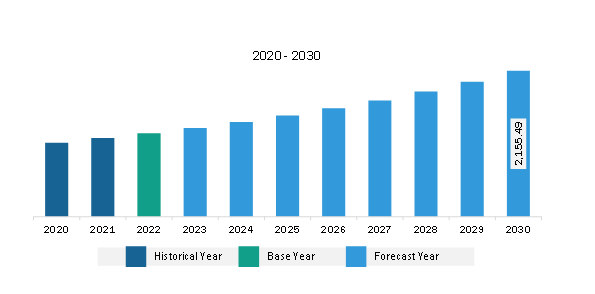
The Europe microbial identification methods market was valued at US$ 1,232.92 million in 2022 and is expected to reach US$ 2,155.49 million by 2030; it is estimated to grow at a CAGR of 7.2% from 2022 to 2030.
Government Initiatives and Funding to Promote Microbial Identification Fuel the Europe Microbial Identification Methods Market
Government initiatives and funding promoting microbial identification are crucial pillars of public health, scientific research, and industrial development. These initiatives serve a wide range of purposes, from enhancing disease surveillance and response to supporting innovative research in microbiology. For instance, the Recommendation on intensifying EU activities to prevent Antimicrobial Resistance (AMR) in a One Health approach was accepted by the European Council (EC) on June 13, 2023. The European Parliament passed a resolution on EU action to address AMR on June 1, 2023. The EC adopted a proposal on April 26, 2023, as part of the pharmaceutical package, for a Council Recommendation on stepping up EU activities to address antimicrobial resistance in a One Health framework, together with a Commission Staff Working Document. Further, in 2023, the new European Roadmap on Antimicrobial Resistance (AMR), which assists nations in the WHO European Region in identifying, prioritizing, and putting into practice high-impact initiatives to combat AMR, has received the authorization of health ministers and delegates from WHO/Europe's 53 Member States. Overall, these initiatives and funding mechanisms play a pivotal role in safeguarding public health, advancing scientific knowledge, and driving economic growth by underpinning the microbial identification field.
Europe Microbial Identification Methods Market Overview
The growing prevalence of infectious diseases caused by microorganisms increases the need for microbial identification tests across Europe. Classifying microorganisms and bacteria is crucial for analyzing diseases for better treatment options. For instance, according to Food Safety News, Shiga toxin-producing E. coli (STEC) ranked as the fourth most prevalent foodborne illness in Europe in 2022. Ireland, Denmark, and Malta had the greatest country-specific notification rates, while Romania, Portugal, Greece, Slovakia, and Poland had the lowest rates. The country with the most infections was Germany (1,635), followed by Denmark (over 900) and Ireland (just under 900). In addition, 362 hemolytic uremic syndrome (HUS) cases were documented across practically all age categories, with the youngest age groups-0 to 4 and 5 to 14 years old-having the largest patient concentration. Furthermore, O26, O157, O80, and O145 were the major serogroups. Additionally, Yersinia infections climbed from 6,800 in 2020 to ~6,800 5,661 in 2019.
In addition, studying bacteria, parasites, fungi, and microbes is encouraging many investors in the pharmaceutical industry to invest in drug development projects. Aside from this, the necessity for microbiological identification methodologies to identify food spoilage contaminants is driven by the rising food safety concerns worldwide. These methods increase the shelf life of processed food goods while maintaining their authenticity and flavor. Furthermore, continuous advancements in microbiology and microbial identification equipment create a positive market outlook. For instance, in June 2023, inBiome, the Netherlands-based company, announced the launch of a new PCR-based molecular platform for diagnosing bacterial infections. The company claims the platform can be used in place of conventional culture and rivals' newer methods, such as sequencing, in terms of time, cost, and scope. Moreover, governments of various countries took many initiatives to prevent any further spread of infectious diseases, coupled with the growing expenditure on the healthcare industry, which is propelling the market growth.
Europe Microbial Identification Methods Market Revenue and Forecast to 2030 (US$ Million)
Europe Microbial Identification Methods Market Segmentation
The Europe microbial identification methods market is segmented based on method, type, and country.
Based on method, the Europe microbial identification methods market is segmented into genotypic, phenotypic, and proteotypic. The phenotypic segment held the largest share in 2022. The genotypic segment is further subsegmented into instruments, kits, reagents. The phenotypic segment is further subsegmented into instruments, kits, reagents. The proteotypic segment is further subsegmented into instruments, kits, reagents.
By type, the Europe microbial identification methods market is segmented into bacterial identification system, microbial enumeration system, bacterial resistance identification systems, microbiology analyzer, and others. The bacterial identification system segment held the largest share in 2022.
Based on country, the Europe microbial identification methods market is segmented into Germany, France, Italy, Spain, the UK, Austria, Benelux, and the Rest Europe. Germany dominated the Europe microbial identification methods market in 2022.
Accelerate Diagnostics Inc, Avantor Inc, Becton Dickinson and Co, bioMérieux SA, Bruker Corp, Danaher Corp, Merck KGaA, Molzym GmbH & Co KG, Shimadzu Corp, Thermo Fisher Scientific Inc are some of the leading companies operating in the Europe microbial identification methods market.
Europe Microbial Identification Methods Market Strategic Insights

Europe Microbial Identification Methods Market Report Highlights
| Report Attribute | Details |
| Market size in 2022 | US$ 1,232.92 Million |
| Market Size by 2030 | US$ 2,155.49 Million |
| CAGR (2022 - 2030) | 7.2% |
| Historical Data | 2020-2021 |
| Forecast period | 2023-2030 |
| Segments Covered |
By Method
|
|
Regions and Countries Covered
|
|
| Europe | UK, Germany, France, Russia, Italy, Rest of Europe |
| Market leaders and key company profiles |
|
Europe Microbial Identification Methods Market Country and Regional Insights



