Analysis by Application (Optimal Route Mapping, Predictive and Prescriptive Analytics, Pricing Insights, Vessel Safety and Security, and Others) and End User (Commercial and Military)
No. of Pages:128
Report Code:
TIPRE00015408
Category:
Technology, Media and Telecommunications
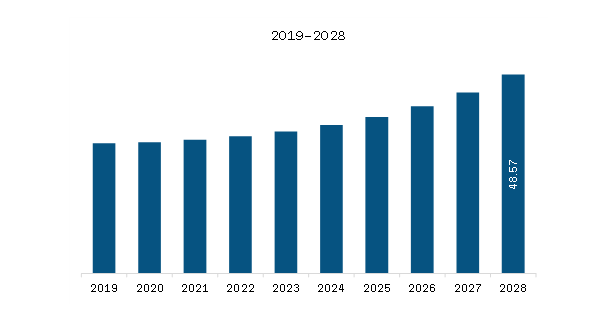
The Middle East & Africa maritime analytics market was valued at US$ 34.68 million in 2023 and is projected to reach US$ 48.57 million by 2028; it is expected to grow at a CAGR of 7.0% from 2023 to 2028.
Use of Advanced Technologies in Maritime Industry is Driving the Middle East & Africa Maritime analytics Market
The maritime industry is investing proactively in advanced technology solutions to bring digital transformation and to become more efficient and sustainable. Artificial intelligence (AI), big data, blockchain, cloud computing, cyber security, digital twin, internet of things (IoT), machine learning, and robotic technologies are some of the key technologies that are contributing towards the advancement of global maritime industry. Furthermore, increase in collaborations between maritime industry stakeholders and technology solution providers, rise in the number of maritime analytics solution providers, investments by maritime companies in big data infrastructure development, and growth of funding opportunities are some of the other factors projected to penetrate the growth of maritime analytics market in the future. Artificial intelligence (AI) is being utilized in the shipping industry to reduce staff and maintenance, increase automation, achieve better navigation and safety, and minimize human errors. IBM and Google are among the key companies helping the shipping sector with process automation. The maritime industry uses AI for an array of applications, including autonomous navigation, route optimization, and predictive maintenance. New players are leveraging the processed information generated through sensors, public information systems, and asset tracking systems to enhance and optimize vessel efficiency and operational costs. Additionally, new entrants are offering digital twins of ships, ports, and fleets utilizing AI to monitor operations continuously while enhancing port and vessel management.
Middle East & Africa Maritime Analytics Market Overview
The maritime analytics market in the Middle East & Africa is further segmented into South Africa, Saudi Arabia, and the UAE. The region is expected to witness rapid commercialization and industrialization, which would also boost the growth of various sectors. The Gulf countries are economically developed, while the African countries are yet to match up to these countries' economic conditions. With large-scale export and import business of oil and gas in the Middle East region, penetration of maritime analytics is anticipated to grow. New orders for gas tanker ships are increasing from the region, showcasing the growth in the oil and gas trade. The use of analytics and predictive maintenance is effective for monitoring engine performance and fuel consumption on vessels. For instance, in 2017 Topaz Energy & Marine has revealed digitalization and offshore communications technology on their vessels to enhance business operations and crew welfare. Topaz is connecting its fleet of up to 110 vessels to a digital platform through Orange Business Services' Maritime Connect solution. Moreover, it invested in vessel tracking technology to monitor fleets in terms of planning maintenance, fuel efficiency, and spending limited on dry-docking. The trend of surging technological investments and developments like these by companies is anticipated to play a greater role in influencing market growth in the Middle East & Africa.
Middle East & Africa Maritime Analytics Market Revenue and Forecast to 2028 (US$ Million)
Middle East & Africa Maritime analytics Market Segmentation
Based on application, the maritime analytics market is divided into optimal route mapping, predictive & prescriptive analytics, pricing insights, vessel safety & security, and others. The predictive & prescriptive analytics segment held the largest market share in 2023.
Based on end user, the market is bifurcated into commercial and defense. The commercial segment held the largest market share in 2023.
Based on country, the Middle East & Africa maritime analytics market is segmented into Saudi Arabia, South Africa, the UAE, and the Rest of Middle East & Africa. Saudi Arabia dominated the market in 2023.
ShipNet; Kpler; OrbitMI, Inc.; Nordic IT; LgMAR; and Windward Ltd are the leading companies operating in the Middle East & Africa maritime analytics market.
Middle East & Africa Maritime Analytics Market Strategic Insights
Get more information on this report
Middle East & Africa Maritime Analytics Market Segmentation Analysis
Middle East & Africa Maritime Analytics Market Report Highlights
Middle East & Africa Maritime Analytics Report Scope
Report Attribute
Details
Market size in 2023
US$ 34.68 Million
Market Size by 2028
US$ 48.57 Million
CAGR (2023 - 2028)
7.0%
Historical Data
2021-2022
Forecast period
2024-2028
Segments Covered
By Application
Optimal Route Mapping
Predictive and Prescriptive Analytics
Pricing Insights
Vessel Safety and Security
By End User
Commercial and Military
Regions and Countries Covered
Middle East and Africa
South Africa, Saudi Arabia, UAE, Rest of Middle East and Africa
Market leaders and key company profiles
ShipNet
Kpler
OrbitMI, Inc.
Nordic IT
LgMAR
Windward Ltd
Get more information on this report
Middle East & Africa Maritime Analytics Market Country and Regional Insights
Get more information on this report
Identical Market Reports with other Region/Countries
The List of Companies - Middle East & Africa Maritime Analytics Market
ShipNetKplerOrbitMI, Inc.Nordic ITLgMARWindward Ltd
Frequently Asked Questions
How big is the Middle East & Africa Maritime Analytics Market?
The Middle East & Africa Maritime Analytics Market is valued at US$ 34.68 Million in 2023, it is projected to reach US$ 48.57 Million by 2028.
What is the CAGR for Middle East & Africa Maritime Analytics Market by (2023 - 2028)?
As per our report Middle East & Africa Maritime Analytics Market, the market size is valued at US$ 34.68 Million in 2023, projecting it to reach US$ 48.57 Million by 2028. This translates to a CAGR of approximately 7.0% during the forecast period.
What segments are covered in this report?
The Middle East & Africa Maritime Analytics Market report typically cover these key segments-
Application (Optimal Route Mapping, Predictive and Prescriptive Analytics, Pricing Insights, Vessel Safety and Security)
End User (Commercial and Military)
What is the historic period, base year, and forecast period taken for Middle East & Africa Maritime Analytics Market?
The historic period, base year, and forecast period can vary slightly depending on the specific market research report. However, for the Middle East & Africa Maritime Analytics Market report:
Historic Period : 2021-2022
Base Year : 2023
Forecast Period : 2024-2028
Who are the major players in Middle East & Africa Maritime Analytics Market?
The Middle East & Africa Maritime Analytics Market is populated by several key players, each contributing to its growth and innovation. Some of the major players include:
ShipNet
Kpler
OrbitMI, Inc.
Nordic IT
LgMAR
Windward Ltd
Who should buy this report?
The Middle East & Africa Maritime Analytics Market report is valuable for diverse stakeholders, including:
Investors: Provides insights for investment decisions pertaining to market growth, companies, or industry insights. Helps assess market attractiveness and potential returns.
Industry Players: Offers competitive intelligence, market sizing, and trend analysis to inform strategic planning, product development, and sales strategies.
Suppliers and Manufacturers: Helps understand market demand for components, materials, and services related to concerned industry.
Researchers and Consultants: Provides data and analysis for academic research, consulting projects, and market studies.
Financial Institutions: Helps assess risks and opportunities associated with financing or investing in the concerned market.
Essentially, anyone involved in or considering involvement in the Middle East & Africa Maritime Analytics Market value chain can benefit from the information contained in a comprehensive market report.





 Get Free Sample For Middle East & Africa Maritime Analytics Market