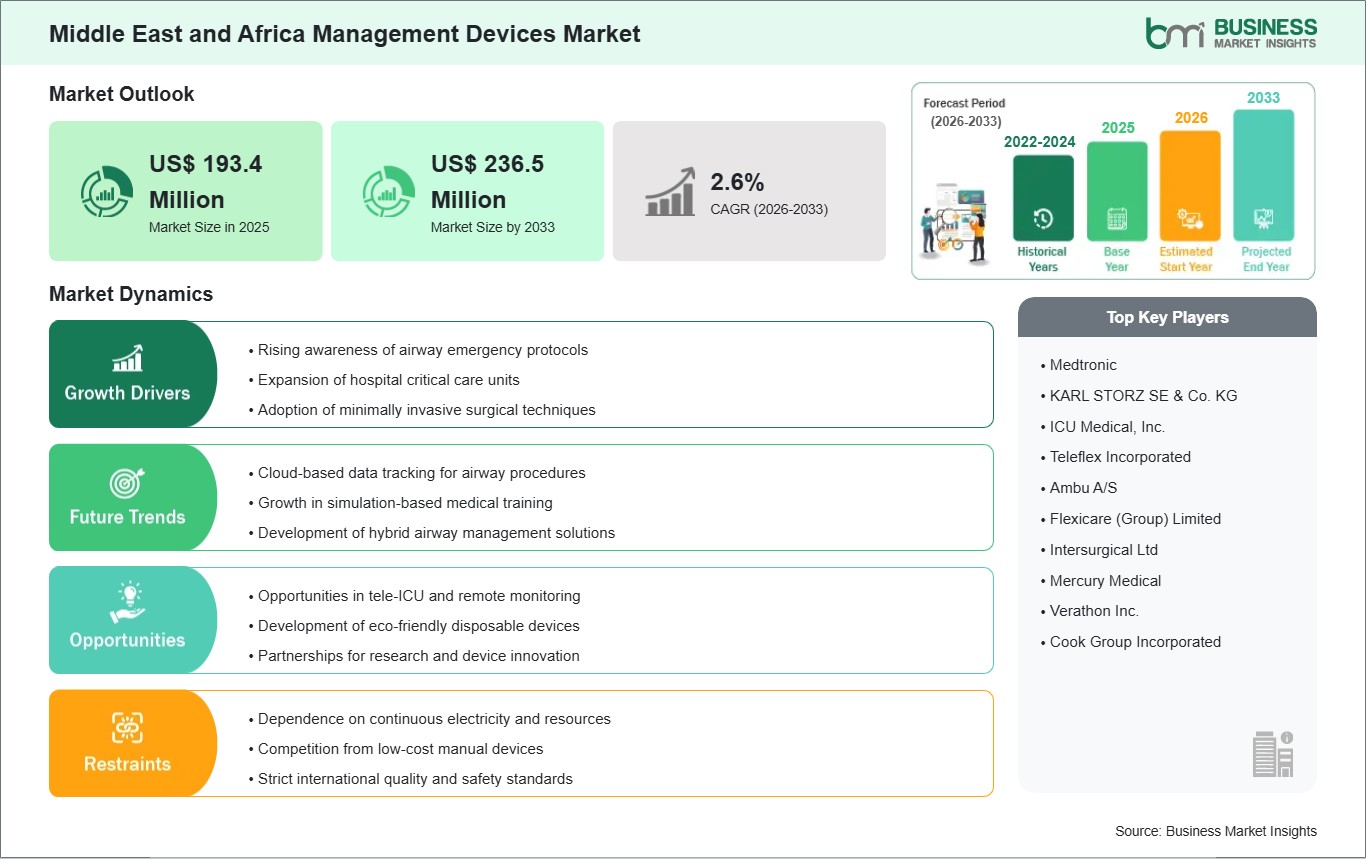
The Middle East and Africa airway management devices market size is expected to reach US$ 236.5 million by 2033 from US$ 193.4 million in 2025. The market is estimated to record a CAGR of 2.6 % from 2026 to 2033.
The Middle East & Africa airway management devices market in the region is witnessing steady growth, supported by growing investments in healthcare infrastructure development, growing awareness about respiratory care, and increasing number of surgeries being performed in cities. Public and private healthcare establishments within the region have recognized the requirement for airway management devices like endotracheal tubes, laryngeal mask, and resuscitation devices. The incidence of respiratory disorders, traumas, and ICU admissions has increased the importance of having advanced airway management devices that ensure safety and effectiveness. Technology-based innovations like video laryngoscope and single-use airway management devices are expected to grow rapidly on account of their ability to increase efficiency, minimize patient complications, and maintain high infection control standards. Increased training programs for clinicians in airway management will facilitate the adoption of new devices. But there are problems with the market. The differences between developed cities and poor rural areas in the healthcare infrastructure may affect the adoption of the latest devices. Besides, the high price of the devices and lack of reimbursement in some countries may act as obstacles to the purchase of such products. Nonetheless, the increasing efforts of governments to improve the emergency care systems along with the growing involvement of the private sector in this field will help to ensure continuous market growth.

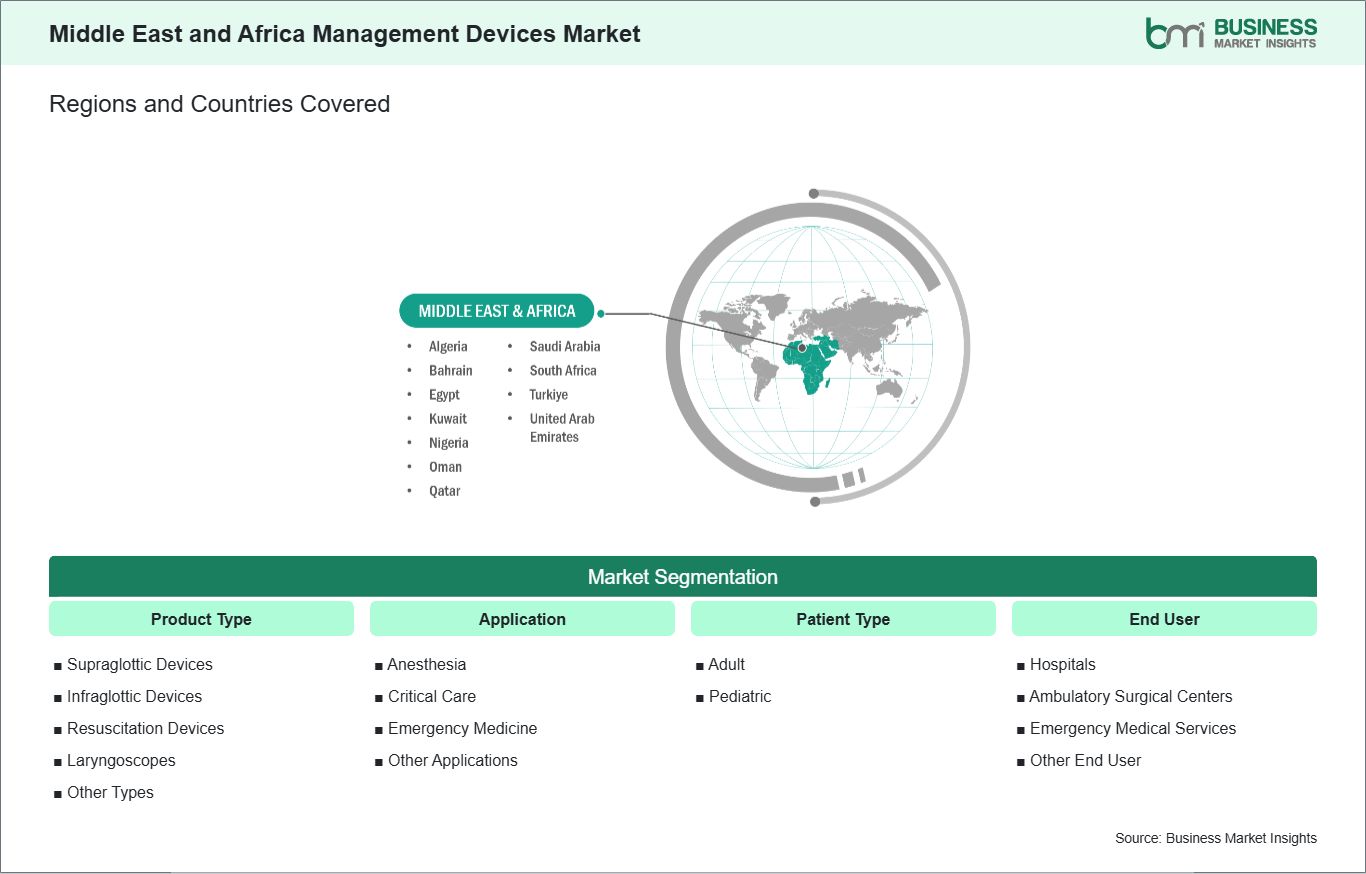
Key segments that contributed to the derivation of the airway management devices market analysis are product type, application, patient type, and end user.
In the Middle Eastern and African countries, there is a trend of preparing for emergencies and especially airway emergency management in emergencies. Countries like Saudi Arabia, United Arab Emirates, and South Africa have made changes in the national health strategies in order to prepare and improve their emergency departments. The reasons for this can be linked not only to domestic changes but also the experience gained at regional mass gathering events, urban car accidents, and even respiratory outbreaks. As hospital emergency departments introduce new protocols into their routine operations, airway emergency management devices become more popular. This includes various types of laryngoscope airways and supraglottic airway devices used as part of emergency carts and trauma bay devices.
Finally, medical education programs of the region are also making changes in order to teach airway emergency procedures better. New residency programs in areas like emergency medicine and anesthesia feature simulated laboratory classes on rapid sequence intubation, which require clinicians to act in a fast-paced stressful situation and make decisions accordingly. This improves clinicians' skills in using various airway devices, therefore increases their interest in purchasing and using new equipment.
Health education programs are playing an important role in increasing the awareness levels of non-medical personnel. Airway management skills have been incorporated into first aid training programs conducted by voluntary groups as well as corporate wellness programs. This has led to increased intervention and awareness about the need for airway devices that help in resuscitation. Awareness of the advantages of airway management devices is helping drive demand in urban as well as secondary facilities in the Middle East and Africa.
Tele-ICUs and remote patient monitoring technology have become increasingly popular in both the Middle East and Africa due to attempts to expand the availability of critical care expertise outside large urban hospitals. With the scarcity of medical personnel in some parts of North Africa and Sub-Saharan Africa, tele-ICU technology allows clinicians from leading hospitals to provide patient care at satellite hospitals. The central theme here is the proper assessment and management of the airway, which calls for appropriate monitoring and airway management devices.
Installations of telemedicine facilities in nations such as the UAE and Kenya are currently being supplemented with respiratory sensors that notify health professionals in case there are any changes in the state of airways or breathing patterns. Such solutions have made it possible for specialists to provide assistance during airway procedures from miles away, such as coaching local nurses in performing more complex airway assistance with the use of video capabilities and other airway sensors. Thus, such an innovation not only leads to improved patient outcomes but also promotes the usage of airway technology in telemedicine.
Moreover, telemonitoring services have been aligned with strategies focused on enhancing home-based care for patients suffering from various chronic respiratory diseases. Patients with conditions like COPD or sleep-related breathing disorders have benefited from the availability of wearables for continuous monitoring and recording of their breathing patterns. This information is then used by physicians to track their condition and act accordingly to prevent emergency cases. In general, tele-ICU projects and telemonitoring initiatives have opened up many opportunities for manufacturers of airway management devices in both the Middle East and Africa regions.
The Middle East & Africa airway management devices market is experiencing steady growth, with market size and share analysis reflecting evolving treatment preferences and competitive dynamics among key players. The report evaluates important subsegments categorized within product type, application, patient type, and end user, highlighting their respective contributions to overall market performance.
By product type, the infraglottic devices subsegment dominated the market in 2025. In anesthesia practice, infraglottic devices provide protection against aspiration and enable precise airway management, driving higher adoption in operating rooms and critical care settings compared to supraglottic devices.
Based on application, the anesthesia subsegment dominated the market in 2025 due to the need for definitive airway control across a wide range of surgical procedures, from routine elective surgeries to complex interventions. Because infraglottic devices are essential for intubation during anesthesia, this segment experiences consistent, high-volume usage, making it the largest segment compared to emergency or general critical care.
In terms of patient type, the adult subsegment dominated the market in 2025. Most procedural training, device designs, and usage guidelines are optimized for adult anatomy and usage scenarios, reinforcing higher market volume.
Based on end user, the hospital subsegment dominated the market in 2025, as hospitals remain the central hub for airway management, handling scheduled surgeries, emergency admissions, ICU care, and trauma cases. Their larger budgets, need for extensive airway inventories, and availability of multidisciplinary professionals make them the largest purchasers compared to outpatient centers or EMS, where volume and purchasing power are comparatively lower.
| Report Attribute | Details |
|---|---|
| Market size in 2025 | US$ 193.4 Million |
| Market Size by 2033 | US$ 236.5 Million |
| CAGR (2026 - 2033) | 2.6% |
| Historical Data | 2022-2024 |
| Forecast period | 2026-2033 |
| Segments Covered | By Product Type
|
|
Regions and Countries Covered
| |
| Middle East and Africa | Saudi Arabia, United Arab Emirates, Kuwait, Bahrain, Qatar, Oman, Turkiye, South Africa, Egypt, Nigeria, Algeria |
| Market leaders and key company profiles |
|
The "Middle East and Africa Airway Management Devices Market Size and Forecast (2022–2033)" report provides a detailed analysis of the market covering below areas:
The geographical scope of the Middle East and Africa airway management devices market report is divided into: Saudi Arabia, the United Arab Emirates, Kuwait, Bahrain, Qatar, Oman, Turkiye, South Africa, Egypt, Nigeria, Algeria, and the Rest of MEA. Turkiye held the largest share in 2025.
Türkiye enjoys a significant market share in the provision of airway management devices in the Middle East & Africa region owing to its relatively developed healthcare facilities, investments made in hospitals’ modernization and adoption of novel medical technology. Modern airway management systems have been introduced in leading hospitals located in cities like Istanbul, Ankara and Izmir to improve patient safety and increase procedure success rate. The private sector of healthcare services in Türkiye is vital in introducing new airway management products as well as ensuring high standards of care while the public hospitals have prioritized providing access to vital medical instruments to more patients. Training and development programs for doctors are also being implemented in Türkiye through simulation-based training. These include pressures in terms of cost for premium equipment as well as access in rural areas. Other barriers could be regulatory hurdles and importing restrictions. Regardless of all the aforementioned problems, due to the country’s initiative toward technological innovation within its healthcare sector, rising cases of surgery, and focus on emergency cases, Turkey emerges as the top force driving the airway management devices market in MEA.

The Middle East and Africa airway management devices market is evaluated by gathering qualitative and quantitative data post primary and secondary research, which includes important corporate publications, association data, and databases. A few of the key developments in the Middle East and Africa airway management devices market are:
The Middle East and Africa Management Devices Market is valued at US$ 193.4 Million in 2025, it is projected to reach US$ 236.5 Million by 2033.
As per our report Middle East and Africa Management Devices Market, the market size is valued at US$ 193.4 Million in 2025, projecting it to reach US$ 236.5 Million by 2033. This translates to a CAGR of approximately 2.6% during the forecast period.
The Middle East and Africa Management Devices Market report typically cover these key segments-
The historic period, base year, and forecast period can vary slightly depending on the specific market research report. However, for the Middle East and Africa Management Devices Market report:
The Middle East and Africa Management Devices Market is populated by several key players, each contributing to its growth and innovation. Some of the major players include:
The Middle East and Africa Management Devices Market report is valuable for diverse stakeholders, including:
Essentially, anyone involved in or considering involvement in the Middle East and Africa Management Devices Market value chain can benefit from the information contained in a comprehensive market report.
Please tell us your area of interest
(Market Segments/ Regions and Countries/ Companies)