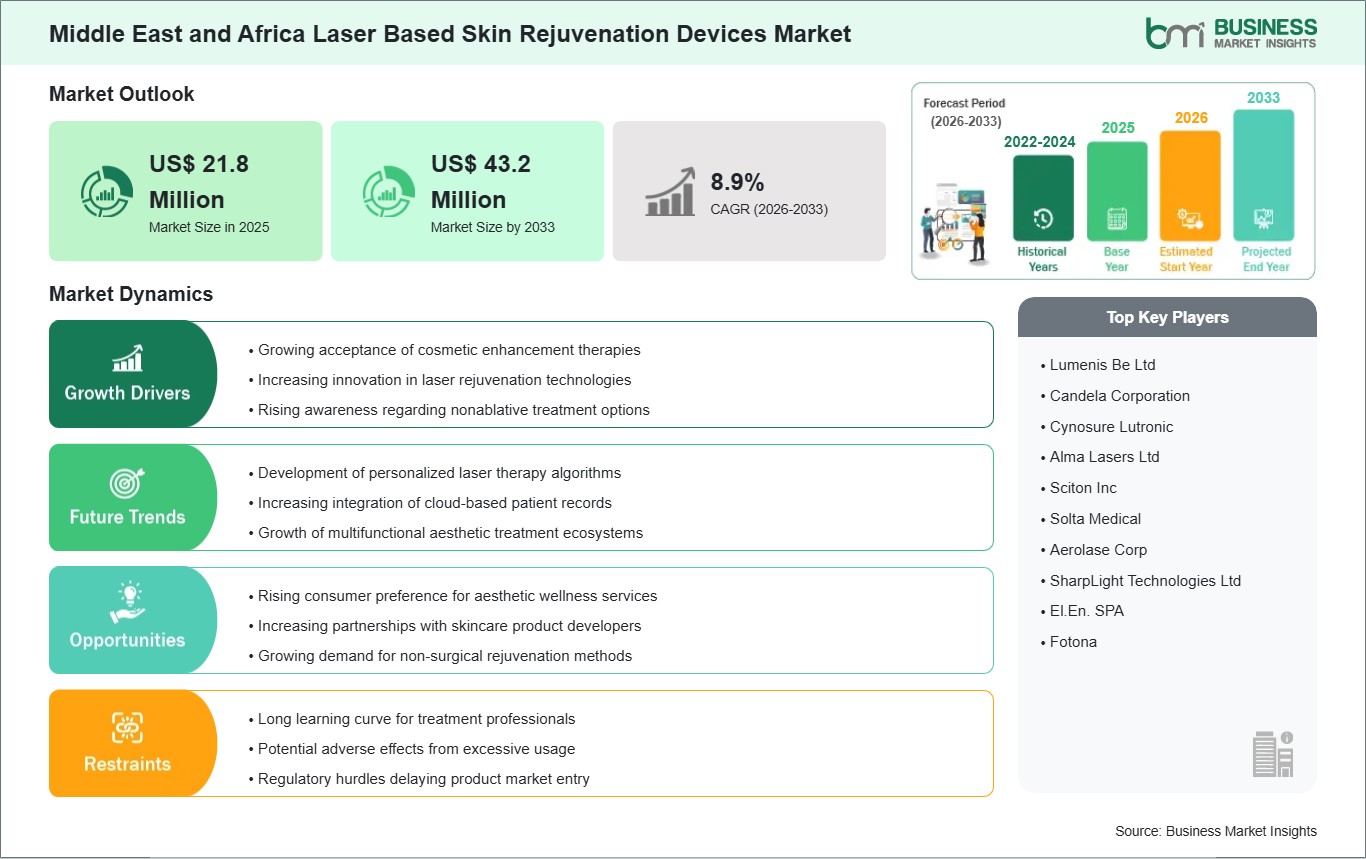
The Middle East and Africa laser based skin rejuvenation devices market size is expected to reach US$ 43.2 million by 2033 from US$ 21.8 million in 2025. The market is estimated to record a CAGR of 8.9% from 2026 to 2033.
The Middle East and Africa laser based skin rejuvenation devices market is experiencing a structurally uneven but steadily expanding growth trajectory, driven by rising aesthetic awareness, increasing penetration of private dermatology clinics, and growing demand for minimally invasive cosmetic procedures. In the Middle East, the demand will be fueled by high disposable income levels, preference for luxury healthcare spending, and a keen interest in advanced skin rejuvenation technology that addresses issues like pigmentation, acne scarring, and aging. Premium private hospitals and medical spas have been integrating high-end laser technologies like fractional CO2, picoseconds, and multi-wavelength lasers to serve the wealthy consumers. Furthermore, the region will gain an influx of medical tourists due to its positioning as a luxury healthcare destination. In Africa, on the other hand, the market represents more of a developing market, where the adoption rate is higher in urban areas and where private healthcare facilities have become more established, along with a growing awareness among consumers of global beauty standards. The market growth in the region will be driven by increased investments from foreign laser equipment makers, distributors’ market expansion plans, and improved dermatological expertise. Despite these constraints, long-term market sentiment remains positive, supported by expanding urbanization, increasing consumer willingness to spend on aesthetic procedures, and continuous technological advancements improving treatment accessibility and clinical outcomes.

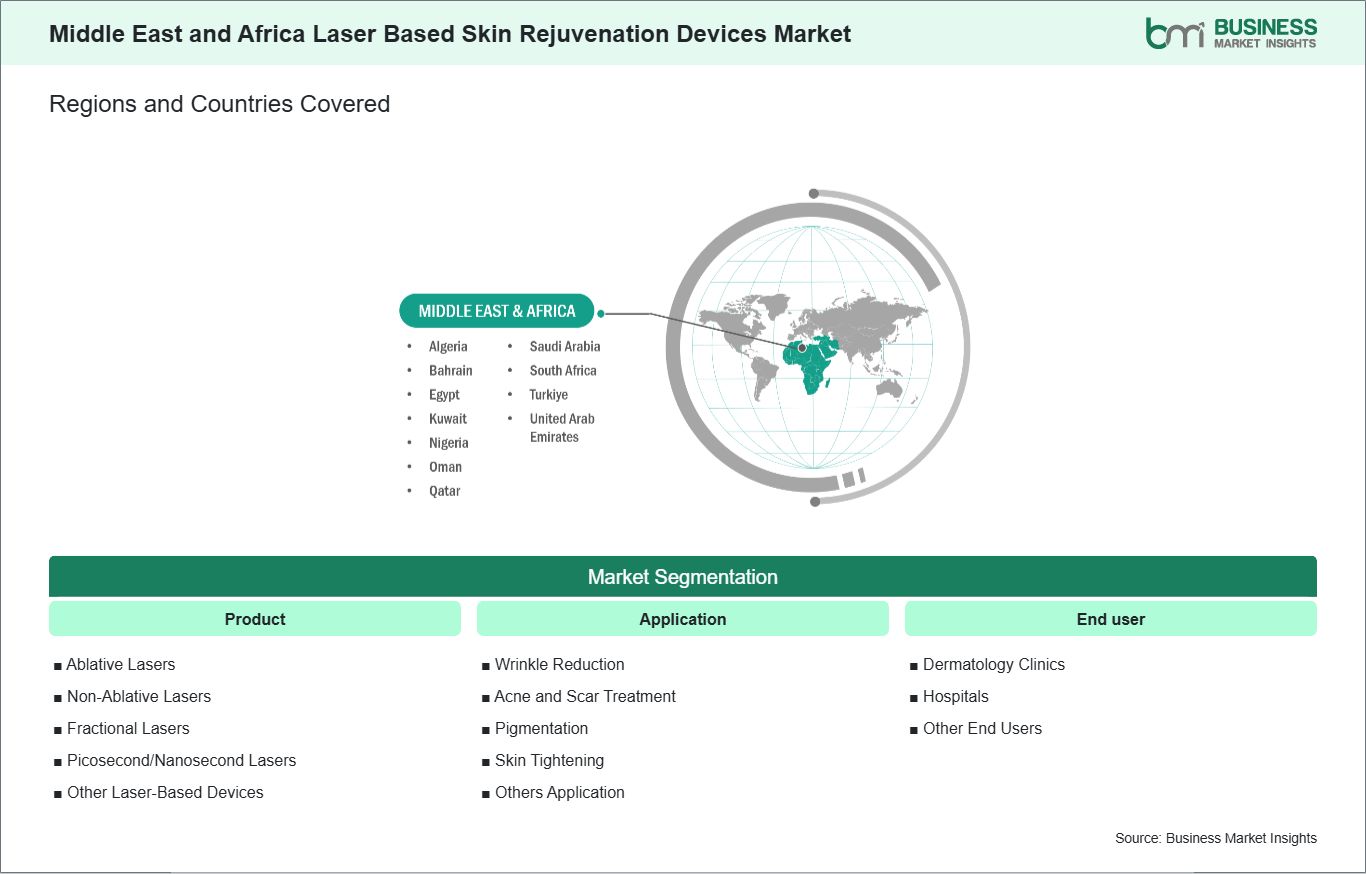
Key segments that contributed to the derivation of the Middle East and Africa laser based skin rejuvenation devices market analysis are product, application, and end user.
The Middle East and Africa Laser Based Skin Rejuvenation Devices Market is witnessing significant progress driven by advancements in fractional laser systems. The adoption of advanced fractional systems that provide precise skin resurfacing without extensive damage to the skin tissues is becoming more widespread in countries like UAE, Saudi Arabia, South Africa, and Egypt. Such technologies are commonly used to address concerns such as acne scars, pigment abnormalities, and premature signs of aging, which makes their use highly pertinent in the region where there is great interest in cosmetic dermatology options.
The development of fractional laser technology has led to an improvement in treatment results through customizable control over penetration depth and energy distribution. In dermatology practices operating in metropolises such as Dubai, Riyadh, and Johannesburg, the adoption of fractional lasers has been witnessed in order to accommodate the various skin types found in the region. The use of non-ablative and fractional hybrids is becoming more common as they produce positive changes in appearance with reduced recovery time, meeting consumer demand for treatments with less downtime.
Moreover, the fusion of fractional laser technology with multi-functional aesthetic equipment is creating more versatility in treatments offered at dermatology clinics. There is an increasing number of dermatology clinics investing in multifunctional lasers that provide both skin resurfacing, skin tightening, and pigment correction capabilities under one machine. This phenomenon is driven by increased awareness among patients about such advanced technologies and the desire to improve their skin appearance using these new treatments. With continued technological advancements, fractional laser technology is projected to be a major contributor to the growth of the industry in the region.
The adoption of laser-based skin rejuvenation devices is steadily increasing across dermatology practices in the Middle East and Africa, supported by expanding healthcare infrastructure and rising demand for aesthetic procedures. It has been noted that nations such as Saudi Arabia, the United Arab Emirates, and South Africa have been experiencing an increase in the number of special clinics focusing on providing dermatological services alongside medical aesthetics treatments. Laser therapy is one of the popular technologies being used to provide patients with these services.
Dermatologists in the area are gradually adopting laser technology in their treatments for a broad spectrum of skin problems. In cities such as Dubai, Abu Dhabi, Cairo, and Cape Town, medical facilities are equipping themselves with new laser technologies that can handle all kinds of skin types. As more dermatologists become proficient in using lasers and better clinical methods are developed for handling skin conditions, more patients are becoming confident about using laser technology in their treatments.
Furthermore, increased investment in private health care providers and aesthetic services has resulted in rapid laser technology proliferation in dermatology centers. Medical spas and dermatology clinics have started operating as one-stop cosmetic centers, providing both dermatology and cosmetic treatment options. The growing awareness among consumers, combined with the falling costs of the procedure in some regions, has been fueling a steady influx of patients. With continuous innovation and service diversification in dermatology centers, laser-based skin rejuvenation equipment is anticipated to witness gradual adoption in the Middle East and Africa region.

The Middle East and Africa laser based skin rejuvenation devices market demonstrates steady growth, with size and share analysis highlighting evolving trends and competitive dynamics among key players. The report examines subsegments categorized within product, application, and end user, offering insights into their contribution to overall market performance.
By product, the non-ablative lasers segment dominated the market in 2025, driven by rising preference for minimally invasive aesthetic procedures with shorter downtime and increasing adoption of advanced laser-based skin rejuvenation technologies across the Middle East and Africa.
Based on application, the wrinkle reduction segment dominated the market in 2025, driven by growing aging population, increasing focus on appearance enhancement, and rising demand for non-surgical anti-aging treatments in the Middle East and Africa.
In terms of end user, the dermatology clinics segment dominated the market in 2025, driven by expanding availability of specialized aesthetic clinics, increasing investment in advanced dermatological technologies, and growing patient preference for expert-led skin rejuvenation procedures in the Middle East and Africa.
| Report Attribute | Details |
|---|---|
| Market size in 2025 | US$ 21.8 Million |
| Market Size by 2033 | US$ 43.2 Million |
| CAGR (2026 - 2033) | 8.9% |
| Historical Data | 2022-2024 |
| Forecast period | 2026-2033 |
| Segments Covered | By Product
|
|
Regions and Countries Covered
| |
| Middle East and Africa | Turkiye, the UAE, Saudi Arabia, Bahrain, Oman, Egypt, South Africa, Algeria, Nigeria, Kuwait, Qatar |
| Market leaders and key company profiles |
|
The "Middle East and Africa Laser Based Skin Rejuvenation Devices Market Size and Forecast (2022–2033)" report provides a detailed analysis of the market covering below areas:
The geographical scope of the Middle East and Africa laser based skin rejuvenation devices market report is divided Turkiye, the UAE, Saudi Arabia, Bahrain, Oman, Egypt, South Africa, Algeria, Nigeria, Kuwait, Qatar. Turkiye held the largest share in 2025.
Turkiye dominates the Middle East and Africa laser based skin rejuvenation devices market due to its highly developed medical aesthetics sector, strong medical tourism industry, and advanced private healthcare infrastructure. Istanbul in particular serves as a major global hub for cosmetic dermatology, attracting both domestic and international patients seeking high-quality, cost-competitive laser-based skin rejuvenation procedures. The country benefits from a large base of skilled dermatologists, widespread availability of modern laser technologies, and strong integration of aesthetic services within private clinics and hospitals. United Arab Emirates represents a premium aesthetic market characterized by luxury healthcare consumption, early adoption of advanced laser platforms, and strong demand for anti-aging and skin correction procedures in cities such as Dubai and Abu Dhabi. The market is further supported by high-income consumers and international patient inflows. Saudi Arabia shows strong growth potential driven by rising private healthcare investment, expanding dermatology clinic networks, and increasing demand for non-invasive cosmetic procedures in major urban centers like Riyadh and Jeddah. South Africa remains the leading market within sub-Saharan Africa, supported by relatively advanced private healthcare infrastructure and increasing consumer awareness of laser-based aesthetic treatments in Johannesburg and Cape Town. Egypt and Nigeria are emerging markets, driven by growing urban populations, rising disposable income segments, and expanding adoption of modern dermatology services, though both remain concentrated in major metropolitan areas.

The Middle East and Africa laser based skin rejuvenation devices market is evaluated by gathering qualitative and quantitative data post primary and secondary research, which includes important corporate publications, association data, and databases. A few of the key developments in the Middle East and Africa laser based skin rejuvenation devices market are:
The Middle East and Africa Laser Based Skin Rejuvenation Devices Market is valued at US$ 21.8 Million in 2025, it is projected to reach US$ 43.2 Million by 2033.
As per our report Middle East and Africa Laser Based Skin Rejuvenation Devices Market, the market size is valued at US$ 21.8 Million in 2025, projecting it to reach US$ 43.2 Million by 2033. This translates to a CAGR of approximately 8.9% during the forecast period.
The Middle East and Africa Laser Based Skin Rejuvenation Devices Market report typically cover these key segments-
The historic period, base year, and forecast period can vary slightly depending on the specific market research report. However, for the Middle East and Africa Laser Based Skin Rejuvenation Devices Market report:
The Middle East and Africa Laser Based Skin Rejuvenation Devices Market is populated by several key players, each contributing to its growth and innovation. Some of the major players include:
The Middle East and Africa Laser Based Skin Rejuvenation Devices Market report is valuable for diverse stakeholders, including:
Essentially, anyone involved in or considering involvement in the Middle East and Africa Laser Based Skin Rejuvenation Devices Market value chain can benefit from the information contained in a comprehensive market report.
Please tell us your area of interest
(Market Segments/ Regions and Countries/ Companies)