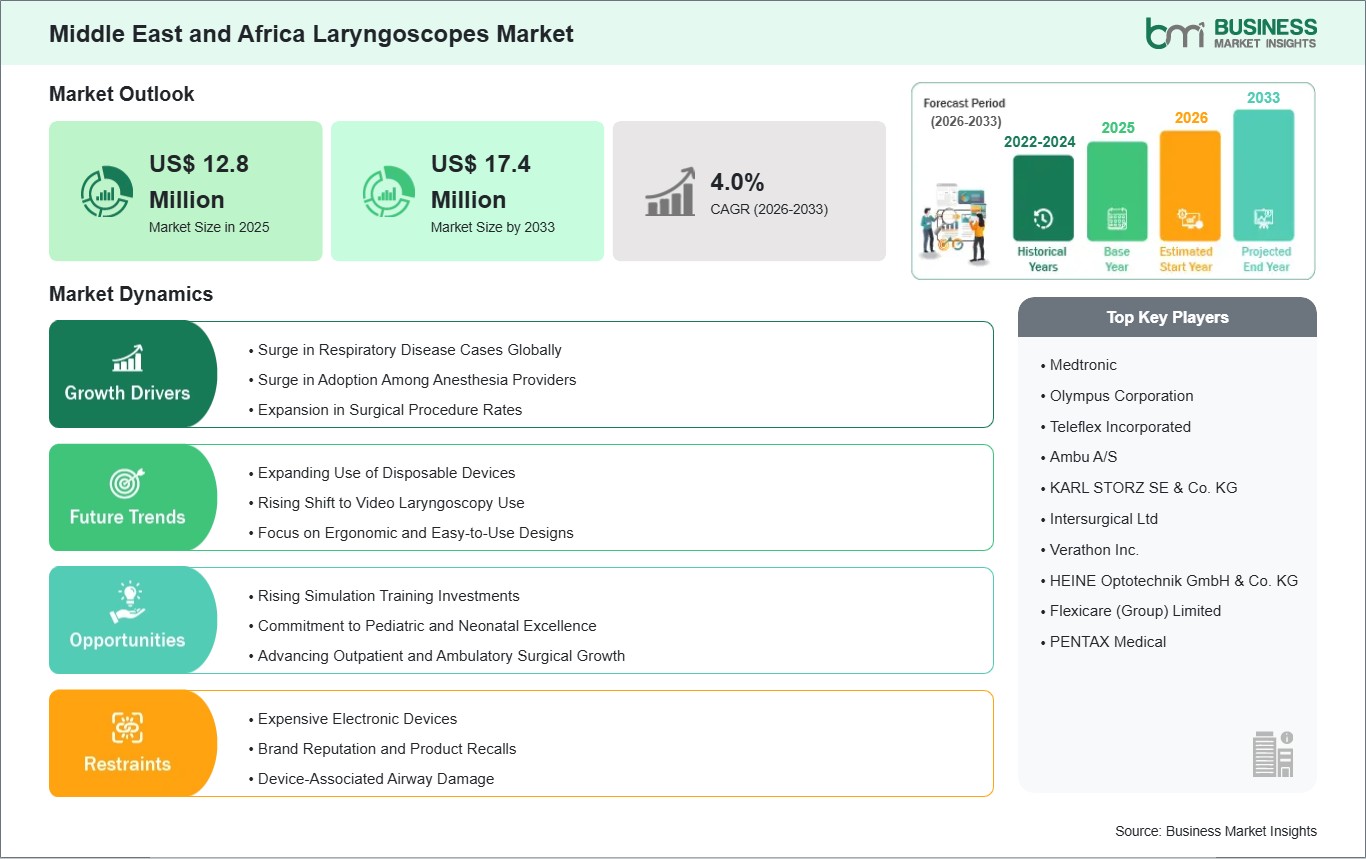
The Middle East and Africa laryngoscopes market size is expected to reach US$ 17.4 million by 2033 from US$ 12.8 million in 2025. The market is estimated to record a CAGR of 4.0% from 2026 to 2033.
The Middle East and Africa laryngoscopes market features a two-tier healthcare setup that integrates sophisticated healthcare practices and evolving medical facilities. Laryngoscopes play an important role in the management of the airway as key instruments used in anesthesia, emergency medicine, and intensive care, and there is a direct relationship between demand for such equipment and rising requirements for surgical procedures, trauma management, and critical care. A trend towards adopting visualization technologies and video laryngoscopes has been observed recently due to better intubation accuracy offered by such instruments.
The region can be viewed as one marked by the constant growth and modernization of the healthcare infrastructure, such as the building of new hospitals, modernizing of surgery centers, and the improvement of emergency services. Awareness of patient safety and the increase in modern anesthesia practices are contributing to the increased adoption of technologically advanced laryngoscope solutions. Furthermore, an increase in the incidence of various diseases, injuries, and other ailments is driving the need for advanced solutions for managing airways. The availability of advanced laryngoscope systems is still not evenly spread since only more expensive products are available in urban areas where the healthcare system is better developed, whereas many other clinics continue to use basic instruments because of a lack of money. Besides, affordability in public healthcare and the import of expensive equipment limit the availability of advanced products, leading to a divided market environment in the region.

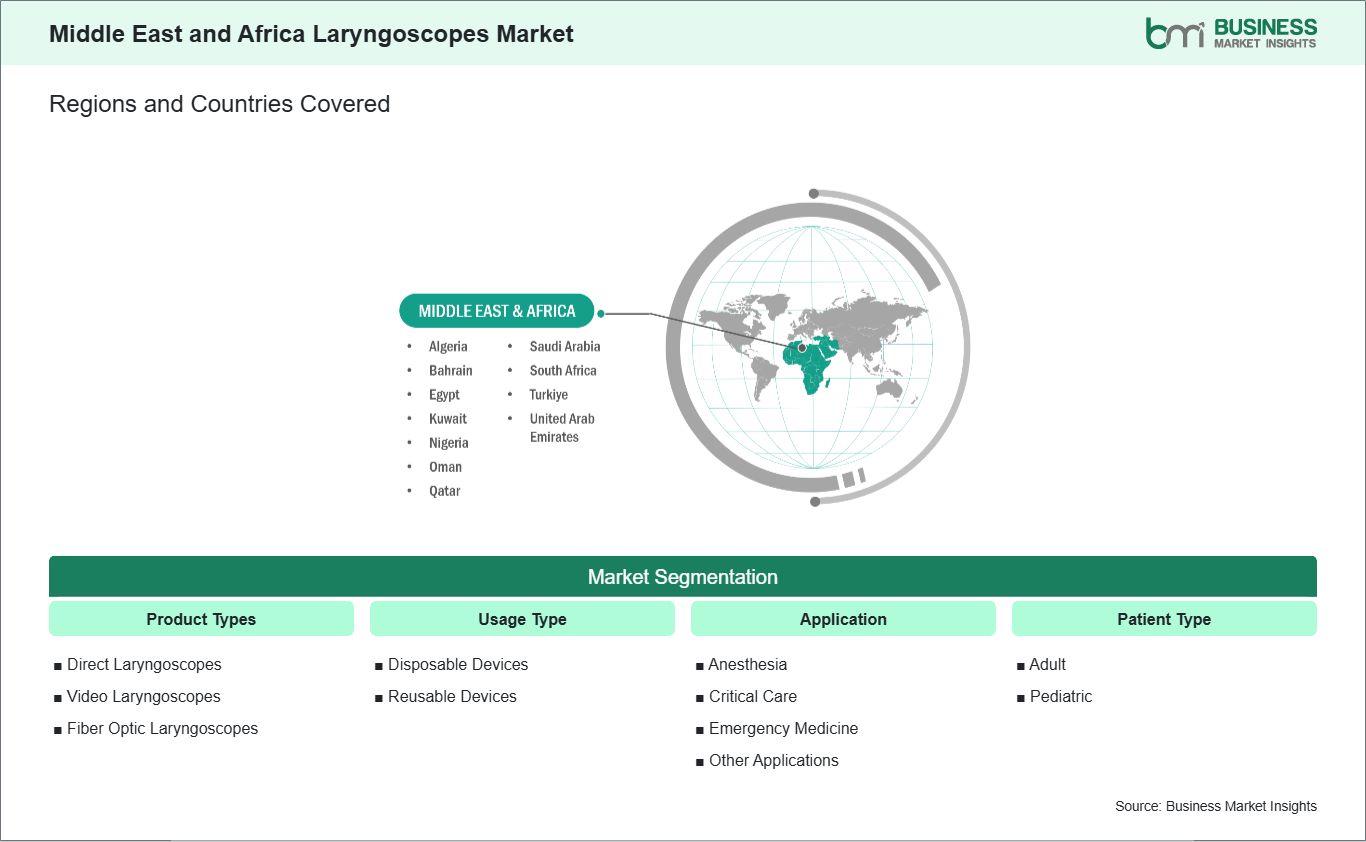
Key segments that contributed to the derivation of the Middle East and Africa laryngoscopes market analysis are product type, usage type, application, patient type, and end user.
The Middle East and Africa region is experiencing a growing clinical burden from respiratory diseases, shaped by a mix of environmental exposure, infectious conditions, and uneven healthcare access. Saudi Arabia, the UAE, and Kuwait, frequent dust storms and desert particulate matter significantly aggravate asthma and chronic respiratory conditions. These environmental triggers often lead to sudden respiratory distress cases in emergency departments, where rapid airway management and laryngoscope use become critical for patient stabilization.
In many African countries, infectious respiratory diseases remain a dominant concern. Tuberculosis continues to affect large populations in South Africa, Nigeria, and Kenya, often progressing to severe lung damage that requires intensive care and airway intervention. At the same time, urban centers such as Cairo, Lagos, and Nairobi are seeing rising rates of pollution-related respiratory illnesses, adding a chronic disease layer to an already complex infectious disease burden.
Healthcare systems across the region are also managing increasing cases of respiratory failure linked to trauma, post-surgical complications, and comorbid conditions such as diabetes and cardiovascular disease. In more developed healthcare hubs like Riyadh and Dubai, expanding ICU capacity has led to more frequent use of advanced airway management techniques. This has made laryngoscopes a standard and indispensable tool across emergency, anesthesia, and critical care departments.
Across the Middle East and Africa, investment in simulation-based medical training is steadily increasing as healthcare systems focus on improving clinical preparedness and patient safety. Saudi Arabia, the UAE, and Qatar, advanced simulation centers are being integrated into teaching hospitals and medical universities. These facilities allow clinicians to practice airway management procedures in controlled, realistic environments before performing them in actual clinical settings.
Simulations have also been applied within several African health care organizations as an alternative to workforce deficits and unequal access to expert knowledge. Since airway interventions are commonly practiced in resource-poor settings, simulations are useful in equipping the personnel with the necessary skills and mitigating risks associated with airway management procedures. Such training programs are especially relevant in rural and underserved areas where clinicians may have little experience with challenging airway cases.
Strategies for modernizing health care services and investments made by private hospitals are facilitating the implementation of formal training programs. The simulations are currently designed in accordance with the actual clinical environment, using modern airway equipment such as video laryngoscopes. Consistency between training and practice is expected to enhance the competence of practitioners, standardize the technique, and progressively promote the use of video laryngoscopes in Middle Eastern and African health care facilities.

The Middle East and Africa Laryngoscopes market demonstrates steady growth, with size and share analysis highlighting evolving trends and competitive dynamics among key players. The report evaluates important subsegments categorized within product type, usage type, application, patient type, and end user, highlighting their respective contributions to overall market performance.
By product type, the video laryngoscopes subsegment dominated the laryngoscopes market in 2025. This is driven by the increasing demand for enhanced airway visualization, improved first-pass intubation success rates, and reduced complications in difficult airway management, making them a key revenue driver for manufacturers and supporting strong adoption in clinical practice.
In terms of usage type, the disposable devices subsegment led the market in 2025. The dominance of disposable devices is attributed to the growing emphasis on infection control, prevention of cross-contamination, and the operational convenience of eliminating reprocessing and sterilization requirements in high-volume healthcare settings.
Based on application, the anesthesia subsegment held the largest share in 2025. Hospitals and surgical centers widely rely on laryngoscopes during anesthesia procedures for airway management and intubation, supported by the rising number of surgeries and the increasing use of advanced airway management techniques.
In terms of patient type, the adult subsegment dominated the market in 2025. This is driven by the higher prevalence of surgical procedures, critical care admissions, and chronic respiratory conditions among adults, resulting in greater demand for airway management devices in this population group.
By end user, the hospitals subsegment held the largest share in 2025. Hospitals maintain leadership due to their advanced infrastructure, availability of skilled healthcare professionals, high patient inflow, and strong capability to perform complex surgical and emergency procedures requiring laryngoscopy.
| Report Attribute | Details |
|---|---|
| Market size in 2025 | US$ 12.8 Million |
| Market Size by 2033 | US$ 17.4 Million |
| CAGR (2026 - 2033) | 4.0% |
| Historical Data | 2022-2024 |
| Forecast period | 2026-2033 |
| Segments Covered | By Product Types
|
|
Regions and Countries Covered
| |
| Middle East and Africa | Saudi Arabia, United Arab Emirates, Kuwait, Bahrain, Qatar, Oman, Turkiye, South Africa, Egypt, Nigeria, Algeria |
| Market leaders and key company profiles |
|
The "Middle East and Africa Laryngoscopes Market Size and Forecast (2022-2033)" report provides a detailed analysis of the market covering below areas:
The geographical scope of the Middle East and Africa Laryngoscopes market report is divided into: Saudi Arabia, the United Arab Emirates, Kuwait, Bahrain, Qatar, Oman, Turkiye, South Africa, Egypt, Nigeria, Algeria, and the Rest of MEA. Turkiye held the largest share in 2025.
Turkiye is considered one of the most crucial and advanced markets for the Middle East and Africa laryngoscopes market, backed by a robust healthcare system and the ever-ongoing process of upgrading its capabilities for clinical uses. The healthcare facilities of Turkiye include a diversified range of tertiary, university, and surgical centers that ensure the demand for airway management products for clinical applications like anesthesiology, emergency care, and intensive care. The increasing complexities in surgical operations are also adding to the demand for laryngoscope solutions.
A distinguishing feature of the market under discussion is high levels of adoption of state-of-the-art airway visualization equipment represented by video laryngoscopes, the application of which is being actively introduced in major hospitals and clinics. Their use is justified by the ability to offer enhanced visualization and fast, accurate intubation, as well as minimizing complications associated with difficult airway management procedures. Therefore, the adoption of this innovation is in line with current trends of modernization and improving patient safety practices in healthcare.
The airway management device market possesses balanced technology adoption rates. Although healthcare facilities with highly-developed infrastructure demonstrate high rates of modern equipment adoption, there are numerous smaller hospitals that still apply traditional devices because of limited budgets. Consequently, the market represents two types of customers: advanced organizations, which tend to adopt innovations rapidly, and more traditional healthcare facilities, which have limited opportunities regarding adopting advanced devices.

The Middle East and Africa Laryngoscopes market is evaluated by gathering qualitative and quantitative data post primary and secondary research, which includes important corporate publications, association data, and databases. A few of the key developments in the Middle East and Africa Laryngoscopes market are:
The Middle East and Africa Laryngoscopes Market is valued at US$ 12.8 Million in 2025, it is projected to reach US$ 17.4 Million by 2033.
As per our report Middle East and Africa Laryngoscopes Market, the market size is valued at US$ 12.8 Million in 2025, projecting it to reach US$ 17.4 Million by 2033. This translates to a CAGR of approximately 4.0% during the forecast period.
The Middle East and Africa Laryngoscopes Market report typically cover these key segments-
The historic period, base year, and forecast period can vary slightly depending on the specific market research report. However, for the Middle East and Africa Laryngoscopes Market report:
The Middle East and Africa Laryngoscopes Market is populated by several key players, each contributing to its growth and innovation. Some of the major players include:
The Middle East and Africa Laryngoscopes Market report is valuable for diverse stakeholders, including:
Essentially, anyone involved in or considering involvement in the Middle East and Africa Laryngoscopes Market value chain can benefit from the information contained in a comprehensive market report.
Please tell us your area of interest
(Market Segments/ Regions and Countries/ Companies)