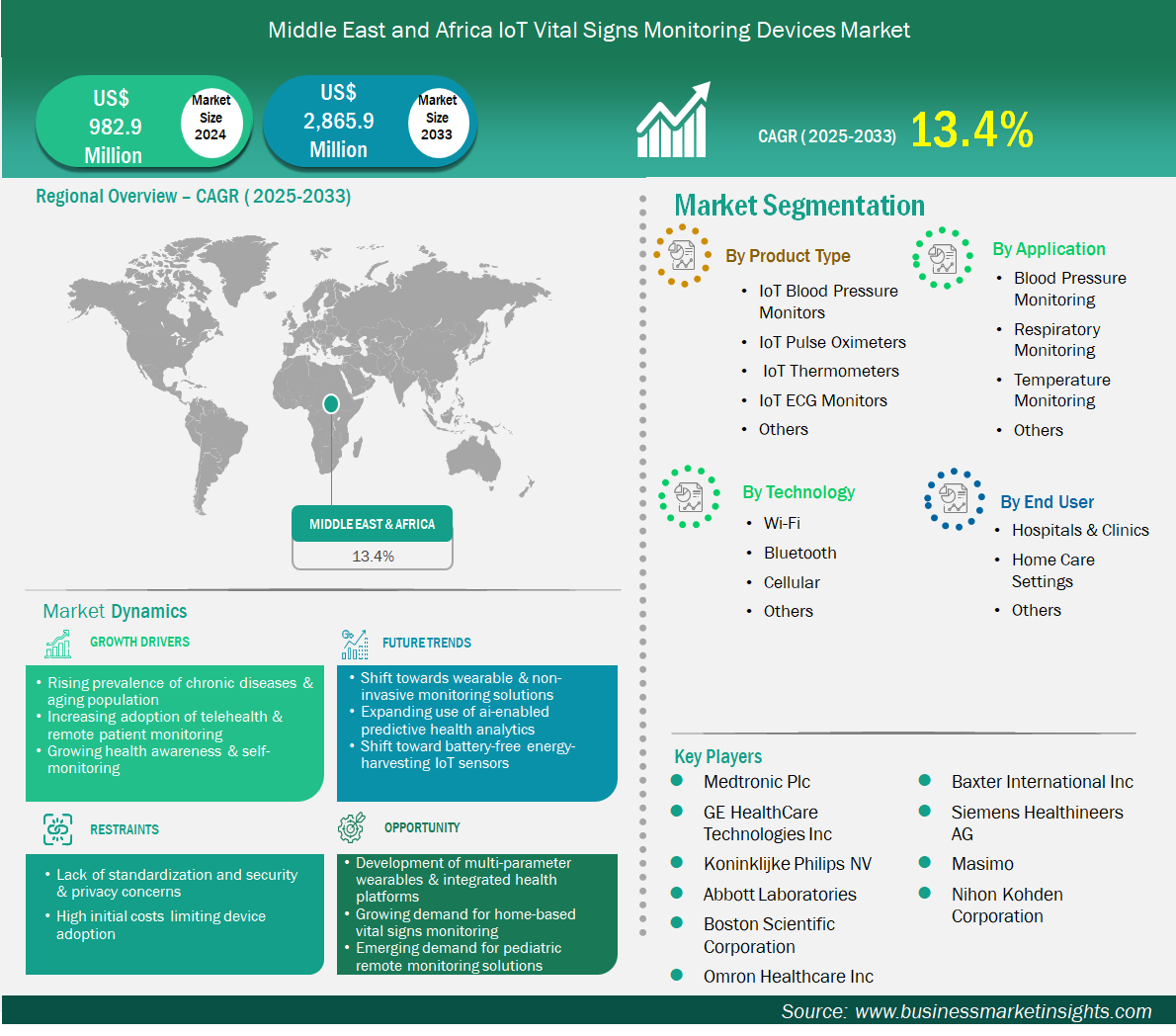
The Middle East and Africa IoT vital signs monitoring devices market size is expected to reach US$ 2,865.9 million by 2033 from US$ 982.9 million in 2024. The market is estimated to record a CAGR of 13.4% from 2025 to 2033.
Executive Summary and Middle East and Africa IoT Vital Signs Monitoring Devices Market Analysis:
The IoT vital signs monitoring devices market in the Middle East and Africa is experiencing significant growth driven by the rising prevalence of chronic diseases & aging population, increasing adoption of telehealth & remote patient monitoring, and growing health awareness & self-monitoring. The Middle East and Africa IoT Vital Signs Monitoring Devices market features a wide variety of healthcare systems, which range from highly developed infrastructures in the Gulf countries to less developed ones in the Sub-Saharan region of Africa. Blood pressure monitors are the leading products in terms of demand, which is a direct consequence of the region's cardiovascular disease burden. In general, hospitals and clinics are the major end users of such devices, where they apply IoT devices in their diagnostic procedures to increase the level of accuracy and patient safety. From a technology perspective, Wi-Fi-enabled devices are the preferred choice, and this is in line with the increasing number of broadband connections in urban areas. The competition dynamics are influenced by multinational companies that bring advanced IoT solutions to the market, whereas local companies focus on pricing and the availability of products. The market is a combination of innovation and affordability, which makes IoT vital signs monitoring devices a leading factor in healthcare modernization across the Middle East and Africa.
Middle East and Africa IoT Vital Signs Monitoring Devices Market Segmentation Analysis:
Key segments that contributed to the derivation of the IoT vital signs monitoring devices market analysis are product, technology, application, and end user.
- By product, the IoT vital signs monitoring devices market is segmented into IoT blood pressure monitors, IoT pulse oximeters, IoT thermometers, IoT ECG monitors, and others. IoT blood pressure monitors dominated the market in 2024, driven by widespread hypertension and cardiovascular disease prevalence.
- By technology, the IoT vital signs monitoring devices market is segmented into Wi-Fi, Bluetooth, cellular, and others. Wi-Fi dominated the market in 2024, driven by growing broadband penetration in urban centers.
- In terms of application, the market is segmented into blood pressure monitoring, respiratory monitoring, temperature monitoring, and others. Blood pressure monitoring dominated the market in 2024, driven by urgent demand for chronic disease management.
- By end user, the market is segmented into hospitals & clinics, home care settings, and others. Hospitals & clinics dominated the market in 2024, driven by their dominance in structured patient monitoring and diagnostics.
Middle East and Africa IoT Vital Signs Monitoring Devices Market Outlook
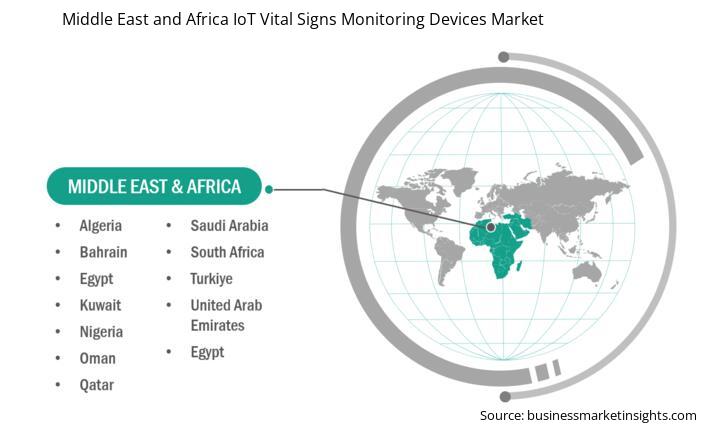
The Middle East and Africa IoT vital signs monitoring devices market is segmented into Turkiye, the United Arab Emirates, Saudi Arabia, Bahrain, Oman, Egypt, South Africa, Algeria, Nigeria, Kuwait, and Qatar. The Middle East and Africa prospects look bright, owing to government spending on e-health infrastructure and the increasing awareness of preventive healthcare among consumers. Hospitals are expected to connect IoT devices with electronic health records and telemedicine platforms to allow patient monitoring in different locations. Private healthcare providers are going to be the first to embrace the advanced IoT technologies by heavily investing in them as a way of differentiating their services and attracting patients who are looking for a higher standard of care. Connectivity solutions will become varied as Wi-Fi will be the mainstay of urban markets, while mobile-enabled devices will be used in remote areas from where services are accessed. There will be strategic collaborations between telecom operators and medical device companies to provide connectivity in underdeveloped areas. Moreover, the region is expected to produce a shift toward personalized healthcare where IoT devices would make it possible to use predictive analytics, get early intervention, and manage chronic diseases. There are still obstacles, such as the existence of different regulatory frameworks in different countries, the problem of affordability, and the healthcare resources that are not distributed evenly. However, in the long run, it is going to be positive with IoT vital signs monitoring devices as the main enablers of universal healthcare access, thus being the link between resource-constrained systems and the increasing patient expectations.
Middle East and Africa IoT Vital Signs Monitoring Devices Market Country Insights
Based on region, the Middle East and Africa IoT vital signs monitoring devices market is further segmented into Turkiye, the United Arab Emirates, Saudi Arabia, Bahrain, Oman, Egypt, South Africa, Algeria, Nigeria, Kuwait, and Qatar. Saudi Arabia held the largest share in 2024.
Country-level dynamics in the Middle East and Africa show significantly different adoption patterns in various regions. In the Middle East, Saudi Arabia and the UAE are the leaders in adoption, which is facilitated by heavy government investment and well-developed infrastructure. The rapid South Africa uptake is mainly attributed to telemedicine expansion and chronic disease management. Nigeria is a new market where affordability and infrastructure are still major challenges, but donor-funded projects are facilitating the introduction of IoT monitoring in community health programs. Egypt is using IoT through public-private partnerships, embedding them in hospital networks and national e-health strategies. Francophone Africa’s slower adoption is mainly due to affordability issues; however, EU-funded projects are gradually initiating the IoT monitoring in community health programs. The country-level dynamics in the Middle East and Africa reveal a varied landscape where advanced economies are setting the benchmarks while emerging markets are gradually growing; thus, the necessity of tailored strategies across the region remains.
Middle East and Africa IoT Vital Signs Monitoring Devices Market Company Profiles
Medtronic Plc, GE HealthCare Technologies Inc, Koninklijke Philips NV, Abbott Laboratories, Boston Scientific Corporation, Omron Healthcare Inc, Baxter International Inc, Siemens Healthineers AG, Masimo, Nihon Cohden Corporation, are among the key players operating in the market. These players adopt strategies such as expansion, product innovation, and mergers and acquisitions to stay competitive in the market and offer innovative products to their consumers.
Middle East and Africa IoT Vital Signs Monitoring Devices Market Research Methodology:
The following methodology has been followed for the collection and analysis of data presented in this report:
Secondary Research
The research process begins with comprehensive secondary research, utilizing both internal and external sources to gather qualitative and quantitative data for each market. Commonly referenced secondary research sources include, but are not limited to:
- Company websites, annual reports, financial statements, broker analyses, and investor presentations
- Industry trade journals and other relevant publications
- Government documents, statistical databases, and market reports
- News articles, press releases, and webcasts specific to companies operating in the market
Note: All financial data included in the Company Profiles section has been standardized to US$. For companies reporting in other currencies, figures have been converted to US$ using the relevant exchange rates for the corresponding year.
Primary Research
Business Market Insights conducts a significant number of primary interviews each year with industry stakeholders and experts to validate and analyze the data and gain valuable insights. These research interviews are designed to:
- Refine findings from secondary research
- Enhance the expertise and market understanding of the analysis team
- Gain insights into market size, trends, growth patterns, competitive dynamics, and future prospects
Primary research is conducted via email interactions and telephone interviews with industry experts across various markets, categories, segments, and sub-segments in different regions. Participants typically include:
- Industry stakeholders: Vice Presidents, business development managers, market intelligence managers, and national sales managers
- External experts: Valuation specialists, research analysts, and key opinion leaders with industry-specific expertise
Key Sources Referred:
- World Health Organization (WHO)
- Organisation for Economic Cooperation and Development (OECD)
- The World Bank Group
- Worldometer
- The Lancet
- International Bar association
- International Trade Administration
- Eurostat
Middle East and Africa IoT Vital Signs Monitoring Devices Market Strategic Insights
Middle East and Africa IoT Vital Signs Monitoring DevicesMarket Report Highlights
| Report Attribute | Details |
| Market size in 2024 | US$ 982.9 Million |
| Market Size by 2033 | US$ 2,865.9 Million |
| CAGR (2025 - 2033) | 13.4% |
| Historical Data | 2022-2023 |
| Forecast period | 2025-2033 |
| Segments Covered |
By Product
|
|
Regions and Countries Covered
|
|
| Middle East and Africa | Saudi Arabia, United Arab Emirates, Kuwait, Bahrain, Qatar, Oman, Turkiye, South Africa, Egypt, Nigeria, Algeria |
| Market leaders and key company profiles |
|
Middle East and Africa IoT Vital Signs Monitoring Devices Market Country and Regional Insights