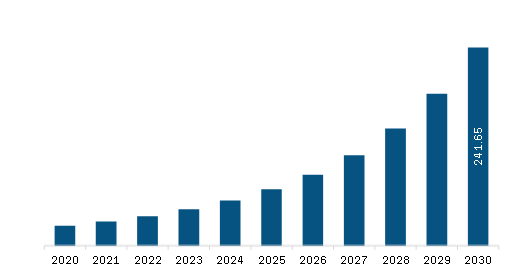
The Middle East & Africa IoT market is expected to grow from US$ 43.99 billion in 2023 to US$ 241.65 billion by 2030; it is estimated to grow at a CAGR of 27.6% from 2023 to 2030.
Rise in Implementation of IoT in Automotive Sector
Automotive is one of the largest sectors in terms of IoT implementation that supports various applications such as self-driving cars, security features, data analytics, in-vehicle infotainment, predictive maintenance, real-time monitoring, and dashboard. Moreover, the high level of competition in the automotive sector is propelling companies to adopt IoT, AI, and other advanced technologies. Audi, BMW, General Motors, and Mercedes-Benz are a few major automakers offering advanced infotainment systems for cars integrated with various technologies. Moreover, the growing demand for connected vehicles and rising investments in autonomous cars boost the adoption of IoT and efficient communication technologies, such as 4G and 5G. For instance, in April 2021, Vodafone Idea announced the launch of its integrated IoT solution for the automotive sector. With this product launch, the company further strengthened its IoT portfolio. Automotive systems that can be enhanced with IoT include logistics management, fleet management, telematics, sensor sharing, advanced driver assistance systems, infotainment, and autonomous driving. Furthermore, due to the increasing demand for dynamic messaging, parking sensors, real-time occupancy data of parking spots, and vehicle parking spots, several government agencies are promoting smart city programs and implementing smart parking to ensure smooth traffic in the city. Therefore, the rise in the implementation of IoT in the automotive sector is driving the IoT software market.
Middle East & Africa IoT Market Overview
The IoT market in the MEA is segmented into Saudi Arabia, the UAE, South Africa, and the Rest of MEA. The Middle East is a dynamic and rapidly developing region that offers massive opportunities for investors and businesses. IoT adoption is already an integral part of the digital transformation of businesses in the region. IoT helps them achieve various objectives by improving asset utilization, managing risks, and creating entirely new business models. The increasing use of smartphones, the growing population of young adults in Gulf Cooperation Council (GCC) countries, and government initiatives for digital transformation to drive economic growth are a few major factors propelling the IoT market growth in the region. Retail, manufacturing, and automotive industries use IoT technologies to differentiate their existing products or services from the competition and provide enhanced customer experiences.
Middle East & Africa IoT Market Revenue and Forecast to 2030 (US$ Billion)
Middle East & Africa IoT Market Segmentation
The Middle East & Africa IoT market is segmented based on component, enterprise size, application, and country. Based on component, the Middle East & Africa IoT market is segmented into hardware, software, and services. The hardware segment held the largest market share in 2023. Furthermore, software is segmented into device management, application management, data management, and network management.
Based on enterprise size, the Middle East & Africa IoT market is bifurcated into large enterprises and SMEs. The large enterprises segment held a larger market share in 2023.
Based on application, the Middle East & Africa IoT market is segmented into building & automation, smart energy & utilities, smart manufacturing, connected logistics, banking & financial services, aerospace & defense, and others. The smart manufacturing segment held the largest market share in 2023.
Based on country, the Middle East & Africa IoT market is segmented into Saudi Arabia, South Africa, the UAE, and the Rest of Middle East & Africa. Saudi Arabia dominated the Middle East & Africa IoT market share in 2023.
Amazon Web Services Inc.; Cisco Systems Inc.; Google LLC; Software AG; International Business Machines Corp; Intel Corp; Microsoft Corp; Oracle Corp; Siemens AG; and SAP SE are the leading companies operating in the Middle East & Africa IoT market.
Middle East & Africa IoT Market Strategic Insights
Get more information on this report
Middle East & Africa IoT Market Segmentation Analysis
Middle East & Africa IoT Market Report Highlights
Middle East & Africa IoT Report Scope
Report Attribute
Details
Market size in 2023
US$ 43.99 Billion
Market Size by 2030
US$ 241.65 Billion
CAGR (2023 - 2030)
27.6%
Historical Data
2021-2022
Forecast period
2024-2030
Segments Covered
By Component
Hardware
Software
Services
By Enterprise Size
Large Enterprises and SMEs
By Application
Building & Automation
Smart Energy & Utilities
Smart Manufacturing
Connected Logistics
Banking & Financial Services
Aerospace & Defense
Regions and Countries Covered
Middle East and Africa
South Africa, Saudi Arabia, UAE, Rest of Middle East and Africa
Market leaders and key company profiles
Amazon Web Services Inc.
Cisco Systems Inc.
Google LLC
Intel Corp
International Business Machines Corp
Microsoft Corp
Oracle Corp
SAP SE
Siemens AG
Software AG
Get more information on this report
Middle East & Africa IoT Market Country and Regional Insights
Get more information on this report
Identical Market Reports with other Region/Countries
The List of Companies - Middle East & Africa IoT Market
Amazon Web Services Inc.Cisco Systems Inc.Google LLCIntel CorpInternational Business Machines CorpMicrosoft CorpOracle CorpSAP SESiemens AGSoftware AG
Frequently Asked Questions
How big is the Middle East & Africa IoT Market?
The Middle East & Africa IoT Market is valued at US$ 43.99 Billion in 2023, it is projected to reach US$ 241.65 Billion by 2030.
What is the CAGR for Middle East & Africa IoT Market by (2023 - 2030)?
As per our report Middle East & Africa IoT Market, the market size is valued at US$ 43.99 Billion in 2023, projecting it to reach US$ 241.65 Billion by 2030. This translates to a CAGR of approximately 27.6% during the forecast period.
What segments are covered in this report?
The Middle East & Africa IoT Market report typically cover these key segments-
What is the historic period, base year, and forecast period taken for Middle East & Africa IoT Market?
The historic period, base year, and forecast period can vary slightly depending on the specific market research report. However, for the Middle East & Africa IoT Market report:
Historic Period : 2021-2022
Base Year : 2023
Forecast Period : 2024-2030
Who are the major players in Middle East & Africa IoT Market?
The Middle East & Africa IoT Market is populated by several key players, each contributing to its growth and innovation. Some of the major players include:
Amazon Web Services Inc.
Cisco Systems Inc.
Google LLC
Intel Corp
International Business Machines Corp
Microsoft Corp
Oracle Corp
SAP SE
Siemens AG
Software AG
Who should buy this report?
The Middle East & Africa IoT Market report is valuable for diverse stakeholders, including:
Investors: Provides insights for investment decisions pertaining to market growth, companies, or industry insights. Helps assess market attractiveness and potential returns.
Industry Players: Offers competitive intelligence, market sizing, and trend analysis to inform strategic planning, product development, and sales strategies.
Suppliers and Manufacturers: Helps understand market demand for components, materials, and services related to concerned industry.
Researchers and Consultants: Provides data and analysis for academic research, consulting projects, and market studies.
Financial Institutions: Helps assess risks and opportunities associated with financing or investing in the concerned market.
Essentially, anyone involved in or considering involvement in the Middle East & Africa IoT Market value chain can benefit from the information contained in a comprehensive market report.





 Get Free Sample For Middle East & Africa IoT Market