Analysis - by Product Type (CMP Slurries, Photoresist Chemicals, Wet Chemicals, Acids, and Others) and End Use (Semiconductors, Flat Panel Displays, Printed Circuit Boards, Photovoltaics, and Others)
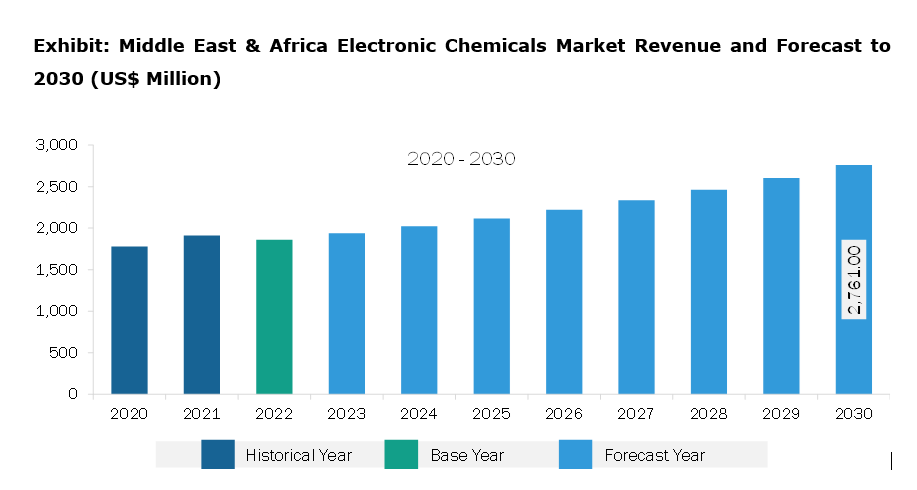
The Middle East & Africa electronic chemicals market was valued at US$ 1,860.65 million in 2022 and is expected to reach US$ 2,761.00 million by 2030; it is estimated to register a CAGR of 5.1% from 2022 to 2030.
Adoption of Nanotechnology in Electronic Devices Bolsters Middle East & Africa Electronic Chemicals Market
Nanotechnology has enabled the development of nanoelectronic devices and components, such as nanoscale transistors, nanowire-based sensors, Organic light-emitting diodes, electronic paper, and quantum dot displays. These nanoelectronic devices have the potential to overcome the drawbacks of conventional silicon-based electronics and offer a promising future for sensor technology. It has a wide range of applications in flexible electronic devices such as wearable technology, flexible displays, and biomedical devices. Nanotechnology is also utilized in various devices such as digital cameras, televisions, mobile phones, computers, and laptops. In October 2023, Teledyne Technologies launched a nano-drone with upgraded sensors. The device is integrated with a daytime camera, a thermal imager, and a software-defined data system. In 2021, Somalytics Inc launched two nano-based capacitive sensors-the SomaControl gesture monitor and the SomaSense 3D floor mat. Electronic chemicals are used to synthesize nanomaterials using sol-gel processes or electrochemical deposition. Nanomaterials require specific surface chemistries to enhance sensitivity, selectivity, and stability. Thus, electronic chemicals are used to functionalize the surface of nanomaterials. Therefore, the adoption of nanotechnology in electronic devices is anticipated to create research opportunities in the electronic chemicals market during the forecast period.
Middle East & Africa Electronic Chemicals Market Overview
Increasing awareness of environmental concerns, government initiatives, and investments in charging infrastructure are factors fostering the penetration of electric vehicles in the region. In 2023, Saudi Arabia's Public Investment Fund (PIF) partnered with the Saudi Electricity Company (SEC) to develop an electric vehicle infrastructure company. The company aimed to establish its presence in more than 1,000 locations and install 5,000 chargers across the country by 2030. Further, as the demand for mobile phones is high, the demand for smartphone-related accessories subsequently increases. In 2022, the Information Technology Industry Development Agency (Egypt) and OPPO (Chinese electronics manufacturer) signed a Memorandum of Understanding (MoU) for setting up a mobile phone manufacturing plant in Egypt, with an investment of ~US$ 20 million. In 2022, Nokia (a mobile manufacturer) and HMD Global partnered with Etisal for Advanced Industries (EAI) to assemble 1 million mobile phones in Egypt. In 2021, PV Hardware opened its manufacturing facility in Saudi Arabia to produce PV structures, solar tracking systems, and robotic cleaning devices in this facility. This growing investment of manufacturers in the region is expected to fuel the demand for electronic chemicals.
Middle East & Africa Electronic Chemicals Market Revenue and Forecast to 2030 (US$ Million)
Middle East & Africa Electronic Chemicals Market Segmentation
Based on product type, the Middle East & Africa electronic chemicals market is categorized into CMP slurries, photoresist chemicals, wet chemicals, acids, and others. The wet chemicals segment held the largest market share in 2022.
In terms of end use, the Middle East & Africa electronic chemicals market is segmented into semiconductors, flat panel displays, printed circuit boards, photovoltaics, and others. The printed circuit boards segment held the largest market share in 2022.
By country, the Middle East & Africa electronic chemicals market is segmented into South Africa, Saudi Arabia, the UAE, and the Rest of Middle East & Africa. The Rest of Middle East & Africa dominated the Middle East & Africa electronic chemicals market share in 2022.
FUJIFILM Holdings Corp, Songwon Industrial Co Ltd, Solvay SA, BASF SE, Linde Plc, and Honeywell International Inc are some of the leading companies operating in the Middle East & Africa electronic chemicals market.
Middle East & Africa Electronic Chemicals Market Strategic Insights
Get more information on this report
Middle East & Africa Electronic Chemicals Market Segmentation Analysis
Middle East & Africa Electronic Chemicals Market Report Highlights
Middle East & Africa Electronic Chemicals Report Scope
Report Attribute
Details
Market size in 2022
US$ 1,860.65 Million
Market Size by 2030
US$ 2,761.00 Million
CAGR (2022 - 2030)
5.1%
Historical Data
2020-2021
Forecast period
2023-2030
Segments Covered
By Product Type
CMP Slurries
Photoresist Chemicals
Wet Chemicals
Acids
By End Use
Semiconductors
Flat Panel Displays
Printed Circuit Boards
Photovoltaics
Regions and Countries Covered
Middle East and Africa
South Africa, Saudi Arabia, UAE, Rest of Middle East and Africa
Market leaders and key company profiles
FUJIFILM Holdings Corp
Songwon Industrial Co Ltd
Solvay SA
BASF SE
Linde Plc
Honeywell International Inc
Get more information on this report
Middle East & Africa Electronic Chemicals Market Country and Regional Insights
Get more information on this report
Identical Market Reports with other Region/Countries
The List of Companies - Middle East & Africa Electronic Chemicals Market
FUJIFILM Holdings CorpSongwon Industrial Co LtdSolvay SABASF SELinde PlcHoneywell International Inc
Frequently Asked Questions
How big is the Middle East & Africa Electronic Chemicals Market?
The Middle East & Africa Electronic Chemicals Market is valued at US$ 1,860.65 Million in 2022, it is projected to reach US$ 2,761.00 Million by 2030.
What is the CAGR for Middle East & Africa Electronic Chemicals Market by (2022 - 2030)?
As per our report Middle East & Africa Electronic Chemicals Market, the market size is valued at US$ 1,860.65 Million in 2022, projecting it to reach US$ 2,761.00 Million by 2030. This translates to a CAGR of approximately 5.1% during the forecast period.
What segments are covered in this report?
The Middle East & Africa Electronic Chemicals Market report typically cover these key segments-
Product Type (CMP Slurries, Photoresist Chemicals, Wet Chemicals, Acids)
End Use (Semiconductors, Flat Panel Displays, Printed Circuit Boards, Photovoltaics)
What is the historic period, base year, and forecast period taken for Middle East & Africa Electronic Chemicals Market?
The historic period, base year, and forecast period can vary slightly depending on the specific market research report. However, for the Middle East & Africa Electronic Chemicals Market report:
Historic Period : 2020-2021
Base Year : 2022
Forecast Period : 2023-2030
Who are the major players in Middle East & Africa Electronic Chemicals Market?
The Middle East & Africa Electronic Chemicals Market is populated by several key players, each contributing to its growth and innovation. Some of the major players include:
FUJIFILM Holdings Corp
Songwon Industrial Co Ltd
Solvay SA
BASF SE
Linde Plc
Honeywell International Inc
Who should buy this report?
The Middle East & Africa Electronic Chemicals Market report is valuable for diverse stakeholders, including:
Investors: Provides insights for investment decisions pertaining to market growth, companies, or industry insights. Helps assess market attractiveness and potential returns.
Industry Players: Offers competitive intelligence, market sizing, and trend analysis to inform strategic planning, product development, and sales strategies.
Suppliers and Manufacturers: Helps understand market demand for components, materials, and services related to concerned industry.
Researchers and Consultants: Provides data and analysis for academic research, consulting projects, and market studies.
Financial Institutions: Helps assess risks and opportunities associated with financing or investing in the concerned market.
Essentially, anyone involved in or considering involvement in the Middle East & Africa Electronic Chemicals Market value chain can benefit from the information contained in a comprehensive market report.





 Get Free Sample For Middle East & Africa Electronic Chemicals Market