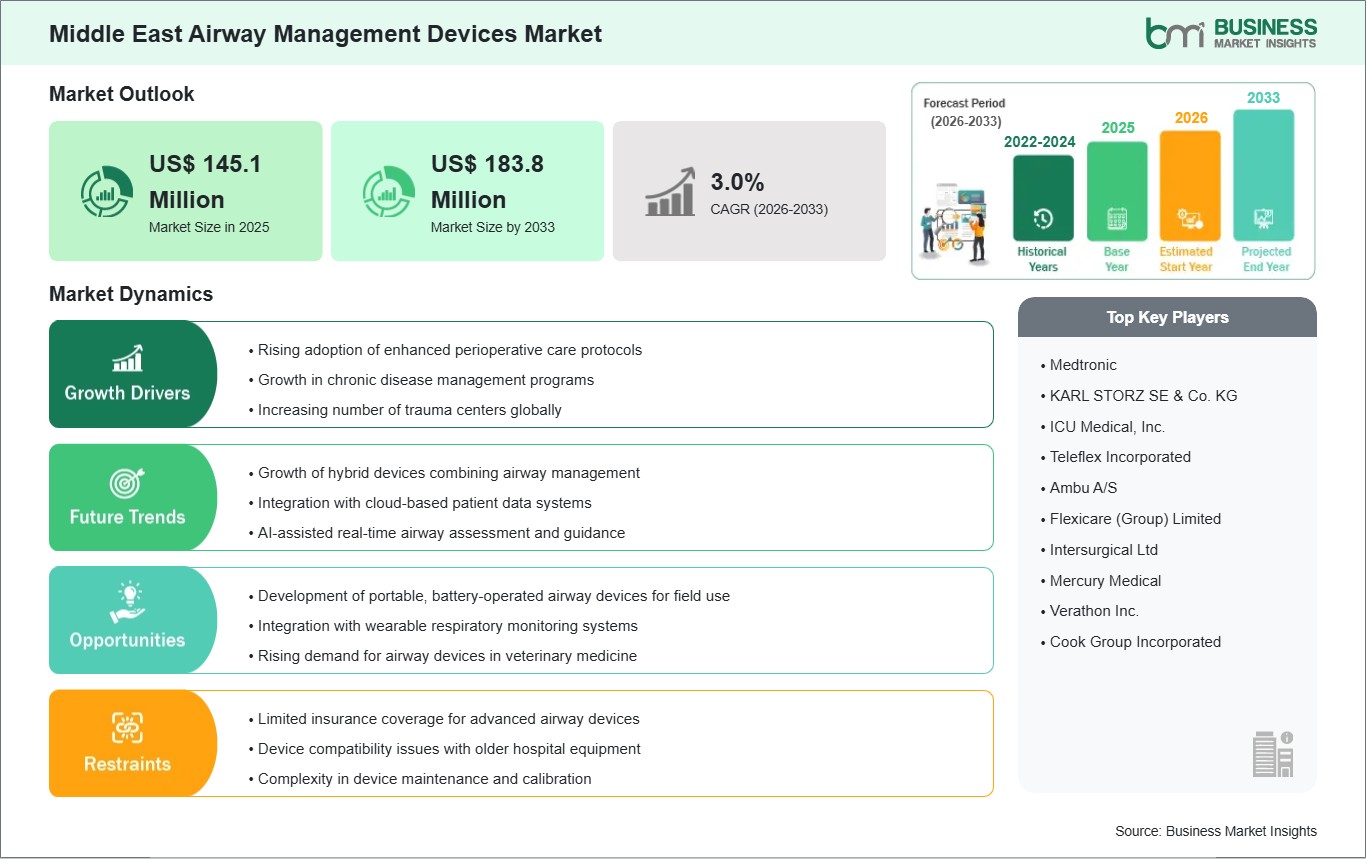
The Middle East Airway management devices market size is expected to reach US$ 183.8 million by 2033 from US$ 145.1 million in 2025. The market is estimated to record a CAGR of 3.0% from 2026 to 2033.
The Middle East airway management devices market is experiencing steady growth, driven by expanding healthcare infrastructure, rising surgical volumes, and increasing focus on critical care and emergency response. The region includes key countries such as Turkiye, Saudi Arabia, United Arab Emirates, Qatar, and Iran, with Turkiye emerging as the dominant market due to its advanced hospital network, investment in modern medical technologies, and strong training programs for healthcare professionals. The growth in this field will depend on factors such as the rising number of respiratory disorders, the growth in intensive care units, and the rising importance given to patient safety. Hospitals in Turkiye, as well as those in countries around it, will gradually move towards adopting new technologies in airway management such as video laryngoscope, supraglottic airways, and disposables kits for intubation. There is also an increase in the number of emergency medical service teams equipped with portable airway devices in cities. However, there are several restraints that could affect the market negatively. These include budget constraints, which may prevent smaller hospitals from acquiring more advanced airway management devices. Another issue includes disparities in access to healthcare services in the region, and finally, dependence on imports may also pose some problems. Despite these issues, there is a lot of potential for airway management device manufacturers in the Middle East region.

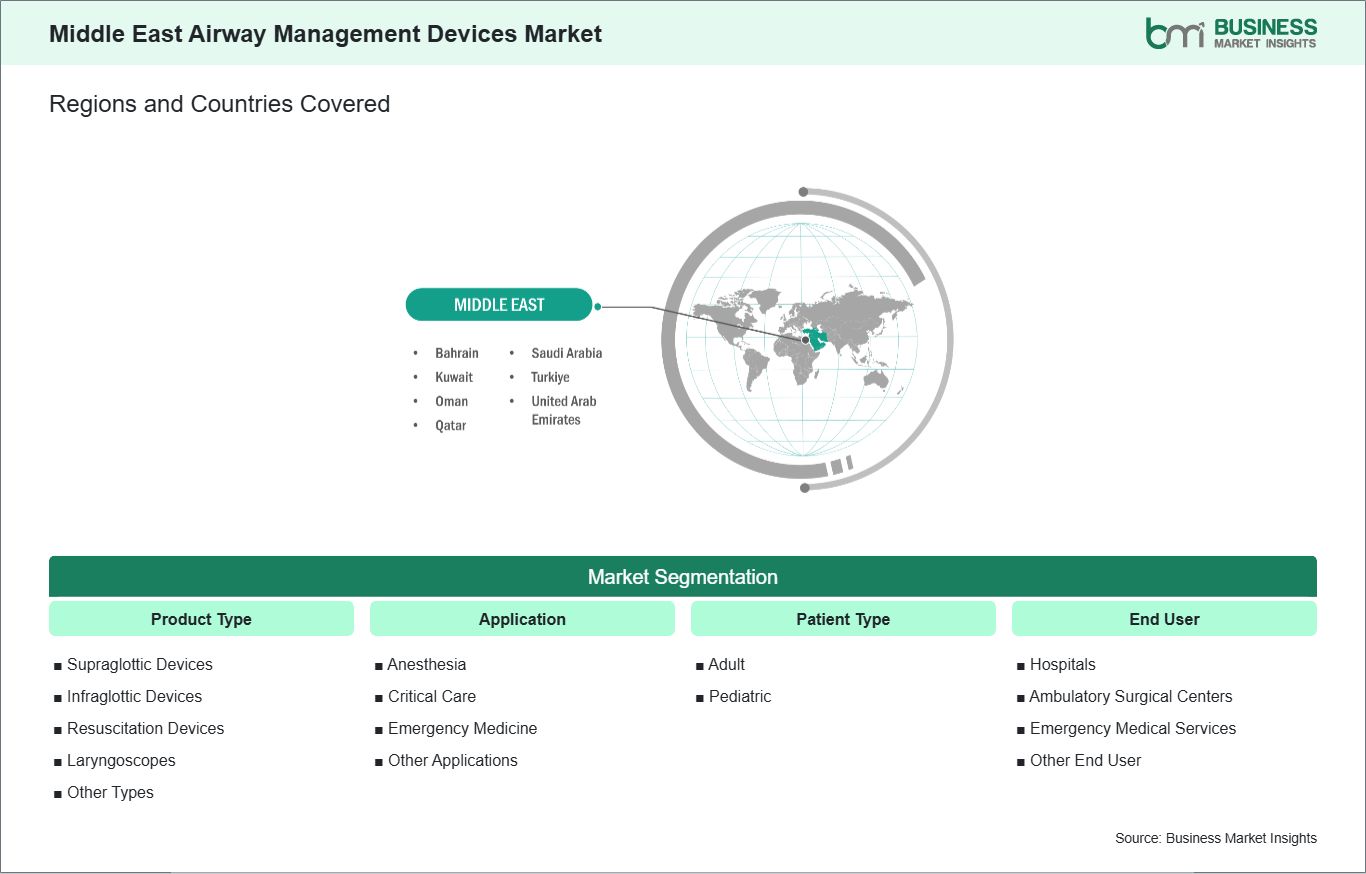
Key segments that contributed to the derivation of the airway management devices market analysis are product type, application, patient type, and end user.
In the airway management devices market in the Middle East region, there is an ongoing trend towards improved perioperative processes to ensure better patient safety and results. Hospitals and surgical centers in the United Arab Emirates, Saudi Arabia, and Qatar are embracing international practices that focus on detailed airway examination and preparation as essential components of perioperative process flows. As a result, there has been a growing need for innovative airway assessment solutions that include flexible fiberoptic laryngoscope, videolaryngoscope, and other monitoring systems.
Airway management devices in Kuwait and Bahrain are receiving special attention in addressing perioperative complications that result from difficult airway conditions. In such cases, airway management algorithms are introduced in anesthesia departments, and this demands that hospitals acquire various devices to achieve this purpose. Video laryngoscope has been shown to be more preferred compared to conventional laryngoscope as it provides more visualization while reducing airway injury. This has been made possible through the introduction of special training programs to help promote greater acceptance of these devices among professionals.
The adoption of perioperative suites by public hospitals in Egypt and Jordan is another way through which perioperative care is improved in these countries. These improvements entail the installation of sophisticated ventilators with advanced modes of airway management alongside provision of backup supraglottic airway devices. With these improvements in place, surgical teams have been empowered to handle airway management during surgery effectively. Improvement in perioperative care can therefore be viewed as one of the major stimulators of airway management devices market in the region.
In the Middle Eastern region, increasing attention is being paid to portable airway equipment powered by batteries, which are intended for use in the field due to the rise in emergency medical services (EMS), military needs, and remote care programs. In Saudi Arabia’s northern areas and in the interior of Oman, where population density is low, ambulances and rural health facilities are providing first responders with portable suction machines, battery-operated ventilators, and video laryngoscopes.
Emergency kits used in the UAE and Qatar are now using reliable and light weight airway support instruments to aid with disaster relief programs. Large crowds that come together through major sporting events and other national celebrations call for immediate action in case of emergency. Battery-powered instruments including CPAP machines and emergency airway kits provide flexibility and promptness in responding to emergencies and stabilizing patients before moving to hospitals.
Additionally, defense health care providers in Jordan and Bahrain are investing in airway devices that can resist challenging environments experienced in training grounds and operational sites. Devices under consideration include battery powered oxygen delivery devices and quick attach supraglottic instruments. Local health organizations and manufacturers from the region have been working hand in hand developing airway management equipment that is tailored to cope with harsh climatic conditions. Due to rising demand for such airway management devices, this particular industry is gaining prominence in the Middle East airway management device industry.
The Middle East airway management devices market is experiencing steady growth, with market size and share analysis reflecting evolving treatment preferences and competitive dynamics among key players. The report evaluates important subsegments categorized within product type, application, patient type, and end user, highlighting their respective contributions to overall market performance.
By product type, the infraglottic devices subsegment dominated the market in 2025. In anesthesia practice, infraglottic devices provide protection against aspiration and enable precise airway management, driving higher adoption in operating rooms and critical care settings compared to supraglottic devices.
Based on application, the anesthesia subsegment dominated the market in 2025 due to the need for definitive airway control across a wide range of surgical procedures, from routine elective surgeries to complex interventions. Because infraglottic devices are essential for intubation during anesthesia, this segment experiences consistent, high-volume usage, making it the largest segment compared to emergency or general critical care.
In terms of patient type, the adult subsegment dominated the market in 2025. Most procedural training, device designs, and usage guidelines are optimized for adult anatomy and usage scenarios, reinforcing higher market volume.
Based on end user, the hospital subsegment dominated the market in 2025, as hospitals remain the central hub for airway management, handling scheduled surgeries, emergency admissions, ICU care, and trauma cases. Their larger budgets, need for extensive airway inventories, and availability of multidisciplinary professionals make them the largest purchasers compared to outpatient centers or EMS, where volume and purchasing power are comparatively lower.
| Report Attribute | Details |
|---|---|
| Market size in 2025 | US$ 145.1 Million |
| Market Size by 2033 | US$ 183.8 Million |
| CAGR (2026 - 2033) | 3.0% |
| Historical Data | 2022-2024 |
| Forecast period | 2026-2033 |
| Segments Covered | By Product Type
|
|
Regions and Countries Covered
| |
| Middle East | UAE, Saudi Arabia, Bahrain, Oman, Kuwait, Qatar, Turkiye |
| Market leaders and key company profiles |
|
The "Middle East Airway Management Devices Market Size and Forecast (2022–2033)" report provides a detailed analysis of the market covering below areas:
The geographical scope of the Middle East airway management devices market report is divided into: the UAE, Saudi Arabia, Bahrain, Oman, Kuwait, Qatar, and Turkey. Turkey held the largest share in 2025.
Turkey is a dominates in the Middle East airway management management devices market owing to its highly developed healthcare system. Leading hospitals in major cities like Istanbul, Ankara, and Izmir are increasingly implementing advanced airway management techniques that include video-laryngoscopy, second-generation supraglottic airway devices, and disposable intubation kits. An important element of leadership shown by Turkey is the incorporation of technology into the education of healthcare professionals. For instance, the regular simulation of anesthesiologists and emergency physicians helps them acquire skills for airway management and ensures appropriate use of equipment. Another important feature of Turkiye's success is the availability of ambulance cars equipped with necessary means for airway intervention in a pre-hospital setting. In this respect, Turkiye enjoys a good balance between manufacturing and foreign collaboration to purchase high-quality equipment in a cost-effective manner. Moreover, initiatives implemented by the government of Turkiye aimed at updating hospitals' equipment and implementing clinical protocols favor the development of the market for advanced airway management devices. All this makes Turkiye a top market for airway management devices in the Middle East.

The Middle East Airway management devices market is evaluated by gathering qualitative and quantitative data post primary and secondary research, which includes important corporate publications, association data, and databases. A few of the key developments in the Middle East Airway management devices market are:
The Middle East Airway Management Devices Market is valued at US$ 145.1 Million in 2025, it is projected to reach US$ 183.8 Million by 2033.
As per our report Middle East Airway Management Devices Market, the market size is valued at US$ 145.1 Million in 2025, projecting it to reach US$ 183.8 Million by 2033. This translates to a CAGR of approximately 3.0% during the forecast period.
The Middle East Airway Management Devices Market report typically cover these key segments-
The historic period, base year, and forecast period can vary slightly depending on the specific market research report. However, for the Middle East Airway Management Devices Market report:
The Middle East Airway Management Devices Market is populated by several key players, each contributing to its growth and innovation. Some of the major players include:
The Middle East Airway Management Devices Market report is valuable for diverse stakeholders, including:
Essentially, anyone involved in or considering involvement in the Middle East Airway Management Devices Market value chain can benefit from the information contained in a comprehensive market report.
Please tell us your area of interest
(Market Segments/ Regions and Countries/ Companies)