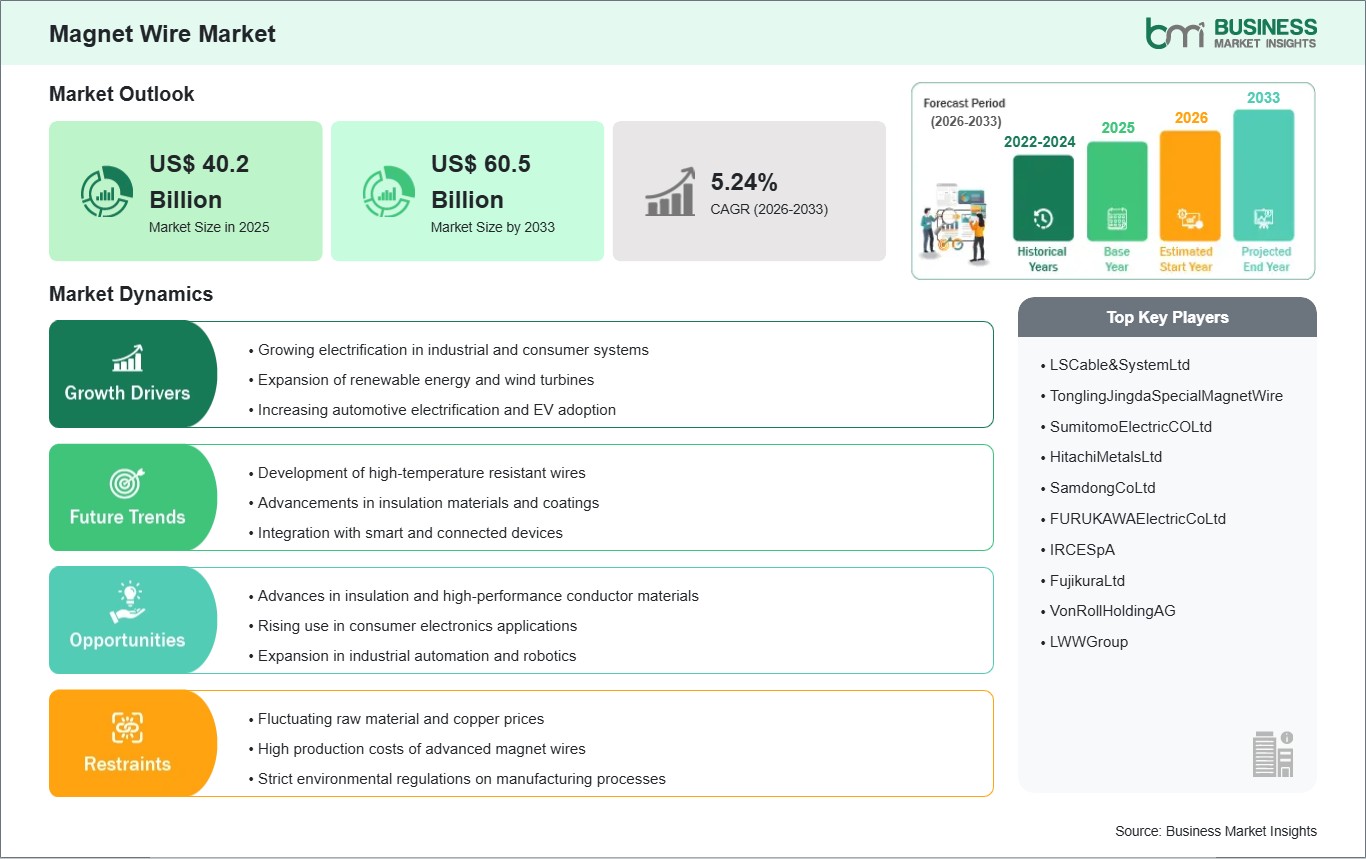
The Magnet Wire Market size is expected to reach US$ 60.5 Billion by 2033 from US$ 40.2 Billion in 2025. The market is estimated to record a CAGR of 5.24% from 2026 to 2033.
The magnet wire business is expanding due to more industries using electrical machines and needing better parts for motors, transformers, generators, inductors, etc. Magnet wire is usually made of copper or aluminium with a thin layer of insulating material. As industry focuses more on electric transportation, renewable energy systems, and advanced automation, the demand for magnet wire has dramatically increased. This has led manufacturers to produce high-quality magnet wire with superior electrical conductivity, thermal lifetime, and the ability to create compact windings using new insulation technologies, such as enamel and polymer film coatings. Additionally, as the electronics industry continues to miniaturise, and more manufacturers use high-speed motors in their appliances and production machinery, magnets will need to be thinner and precisely constructed.
The cost of materials, especially copper and aluminium has resulted in material efficiencies being developed so that companies can improve the quality and consistency of their product. Companies are now spending money on new manufacturing methods (like continuous annealing and precision coating) to improve the overall quality and consistency of their finished products. As industry experts are demanding increased energy efficiency and reliability of performance from magnetic wires, manufacturers that focus on technology developments, material improvements and customised solutions will be able to compete in an ever-evolving marketplace for magnet wires.

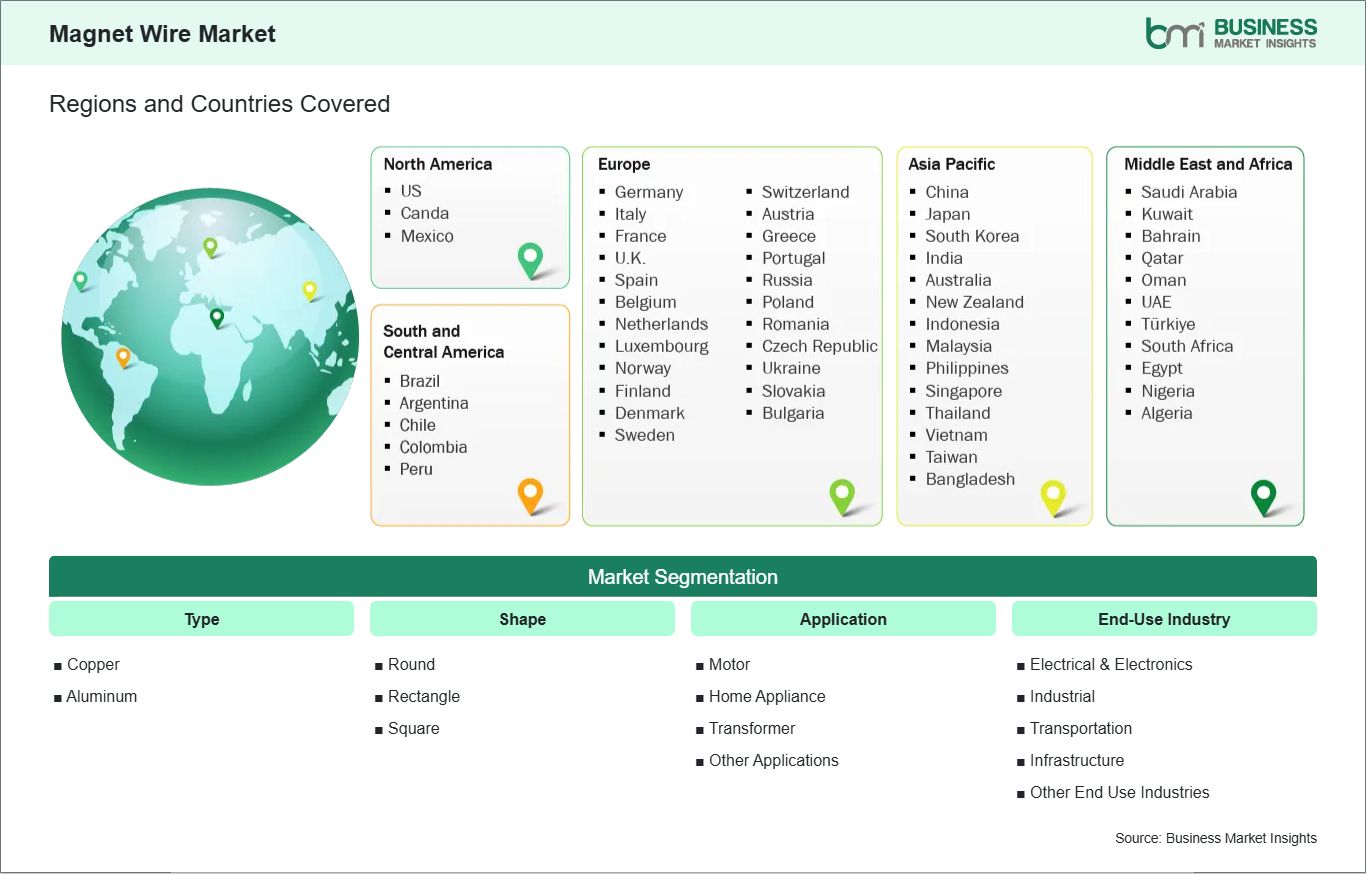
Key segments that contributed to the derivation of the magnet wire market analysis are type, shape, application, and end-use industry.
The growing demand for electric-powering solutions is seeing an increase in the global market for magnet wires. Magnet wire plays an important role in providing efficient transfer of energy within electrical equipment such as motors, transformers, and generators. As the industry continues to modernize its infrastructure and convert to electric-power solutions, the demand for high-quality and dependable magnet wire continues to grow. In the industrial setting, as companies adopt and use more automated equipment and electrically driven machinery, there is a constant demand for effective winding solutions. Magnet wire ensures that the operation of the equipment is smooth, efficient and has a long operational lifespan. Similarly, in consumer applications, the trend toward creating more compact devices and appliances will require magnet wire that not only supports miniaturization but also has robust electrical properties. The increasing concern of reducing energy losses and improving system efficiency is causing manufacturers to concentrate on improving the conductivity and thermal stability of their products to meet the changing industry demand for electric-powered products. This trend is continuing to reinforce the significance of magnet wire in supporting modern electricity across the broad spectrum of applications.
Technological advancements in insulation and conductor materials are opening new growth avenues in the magnet wire market. Manufacturers are developing innovative insulation coatings that improve resistance to heat, moisture, and mechanical stress. These improvements enable magnet wire to operate efficiently in demanding environments, supporting a wide range of industrial and electrical applications. There is also a strong focus on refining conductor materials to enhance electrical performance and durability. Improved material processing techniques are helping achieve better conductivity and reduced energy loss, which are critical for high-efficiency systems. These advancements allow manufacturers to meet stringent operational standards while optimizing overall product reliability. In addition, increasing collaboration between material developers and equipment manufacturers is leading to the creation of customized magnet wire solutions. These solutions are designed to meet specific application needs, including compact designs and higher power density requirements. As innovation continues, advanced materials and insulation systems are expected to play a key role in shaping the future of the magnet wire market.
The magnet wire market demonstrates steady growth, with size and share analysis highlighting evolving trends and competitive dynamics among key players. The report examines subsegments categorized within type, shape, application, and end-use industry, offering insights into their contribution to overall market performance.
By Type, the copper subsegment dominated the market in 2025, driven by its superior conductivity, lower electrical resistance, and widespread use across electrical and electronic applications.
Based on Shape, the round subsegment dominated the market in 2025, owing to its higher mechanical strength, flexibility, and efficient space utilization in coil winding applications.
On the basis of Application, the motor subsegment dominated the market in 2025, supported by increasing demand from automotive, industrial machinery, and electric vehicle applications.
On the basis of End-Use Industry, the electrical & electronics subsegment dominated the market in 2025, fueled by rising consumption of consumer electronics and electrical equipment globally.
| Report Attribute | Details |
|---|---|
| Market size in 2025 | US$ 40.2 Billion |
| Market Size by 2033 | US$ 60.5 Billion |
| Global CAGR (2026 - 2033) | 5.24% |
| Historical Data | 2022-2024 |
| Forecast period | 2026-2033 |
| Segments Covered | By Type
|
|
Regions and Countries Covered
| |
| North America | US, Canada, Mexico |
| Europe | Belgium, Austria, Finland, Denmark, Greece, Poland, Romania, Russia, Ukraine, Czech Republic, Slovakia, Bulgaria, Italy, Luxembourg, Germany, Switzerland, France, Netherlands, Norway, Portugal, Spain, Sweden, United Kingdom |
| Asia-Pacific | Australia, China, India, Japan, South Korea, Indonesia, Malaysia, Philippines, Singapore, Thailand, Vietnam, Bangladesh, New Zealand, Taiwan |
| South and Central America | Brazil, Argentina, Peru, Chile, Colombia |
| Middle East and Africa | Bahrain, Kuwait, Oman, Qatar, Saudi Arabia, United Arab Emirates, Turkiye, South Africa, Egypt, Algeria, Nigeria |
| Market leaders and key company profiles |
|
The "Magnet Wire Market Size and Forecast (2022 - 2033)" report provides a detailed analysis of the market covering below areas:
The geographical scope of the Magnet Wire Market report is divided into North America, Asia Pacific, Europe, Middle East & Africa, and South & Central America. North America held the largest share in 2025.
Regional dynamics in the magnet wire market are shaped by industrial growth, electrification trends, and infrastructure development. North America holds a strong position, driven by demand from electric vehicles, renewable energy installations, and industrial automation, with the U.S. focusing on domestic manufacturing and supply chain resilience. Europe is characterized by high demand for energy-efficient electrical systems, particularly in Germany, France, and Italy, where electrification of transport and renewable integration are key priorities.
In the Asia Pacific region, rapid industrialization and large-scale manufacturing in China, India, Japan, and South Korea are driving substantial demand for magnet wires, especially in consumer electronics, automotive production, and power infrastructure. The region also benefits from cost-effective manufacturing and strong export capabilities.
Middle East & Africa is gradually expanding, supported by investments in power generation, transmission networks, and infrastructure development, increasing the need for electrical components.
South & Central America, led by Brazil and Mexico, is witnessing moderate growth driven by industrial development and expansion of electrical distribution systems. Across all regions, the focus remains on efficiency, durability, and adaptability of magnet wires to meet evolving technological and energy demands.

The Magnet Wire Market is evaluated by gathering qualitative and quantitative data post primary and secondary research, which includes important corporate publications, association data, and databases. A few of the key developments in the magnet wire market are:
The Magnet Wire Market is valued at US$ 40.2 Billion in 2025, it is projected to reach US$ 60.5 Billion by 2033.
As per our report Magnet Wire Market, the market size is valued at US$ 40.2 Billion in 2025, projecting it to reach US$ 60.5 Billion by 2033. This translates to a CAGR of approximately 5.24% during the forecast period.
The Magnet Wire Market report typically cover these key segments-
The historic period, base year, and forecast period can vary slightly depending on the specific market research report. However, for the Magnet Wire Market report:
The Magnet Wire Market is populated by several key players, each contributing to its growth and innovation. Some of the major players include:
The Magnet Wire Market report is valuable for diverse stakeholders, including:
Essentially, anyone involved in or considering involvement in the Magnet Wire Market value chain can benefit from the information contained in a comprehensive market report.
Please tell us your area of interest
(Market Segments/ Regions and Countries/ Companies)