Market Summary
Executive Summary and Market Analysis
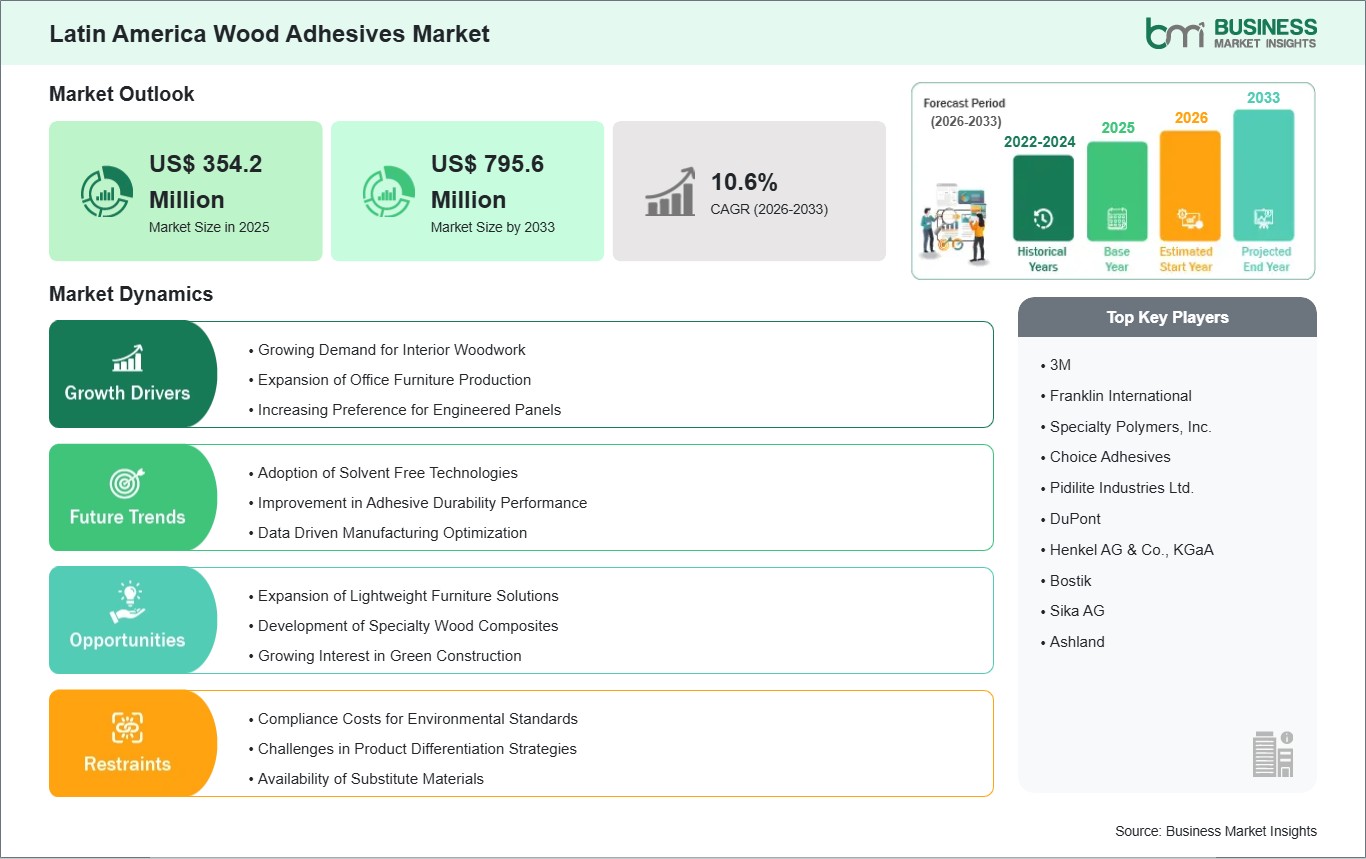
The Latin America wood adhesives market is growing steadily, supported by expansion in furniture manufacturing, housing construction, and increasing use of engineered wood products such as MDF, plywood, and particleboard. Demand is driven by urbanization, infrastructure development, and the gradual shift toward industrialized woodworking processes across both domestic and export-oriented production. Manufacturers are focusing on improving adhesive properties such as bonding strength, moisture resistance, and curing efficiency to suit diverse regional climates. Conventional products like urea-formaldehyde, polyvinyl acetate, and polyurethane adhesives continue to dominate, while adoption of low-emission and bio-based formulations is slowly increasing due to environmental awareness and international trade requirements. The market is also supported by growth in organized retail furniture channels and rising renovation activities in urban centers. However, supply chain constraints and dependence on imported raw materials continue to affect cost stability and production consistency for local manufacturers. Competitive dynamics are intensifying as global chemical companies expand regional presence through partnerships and distribution networks. Overall, the market is shifting toward more standardized, performance-driven, and environmentally conscious adhesive solutions aligned with the modernization of construction and furniture industries across the region.
Segment Analysis
Latin America Wood Adhesives Market Segmentation
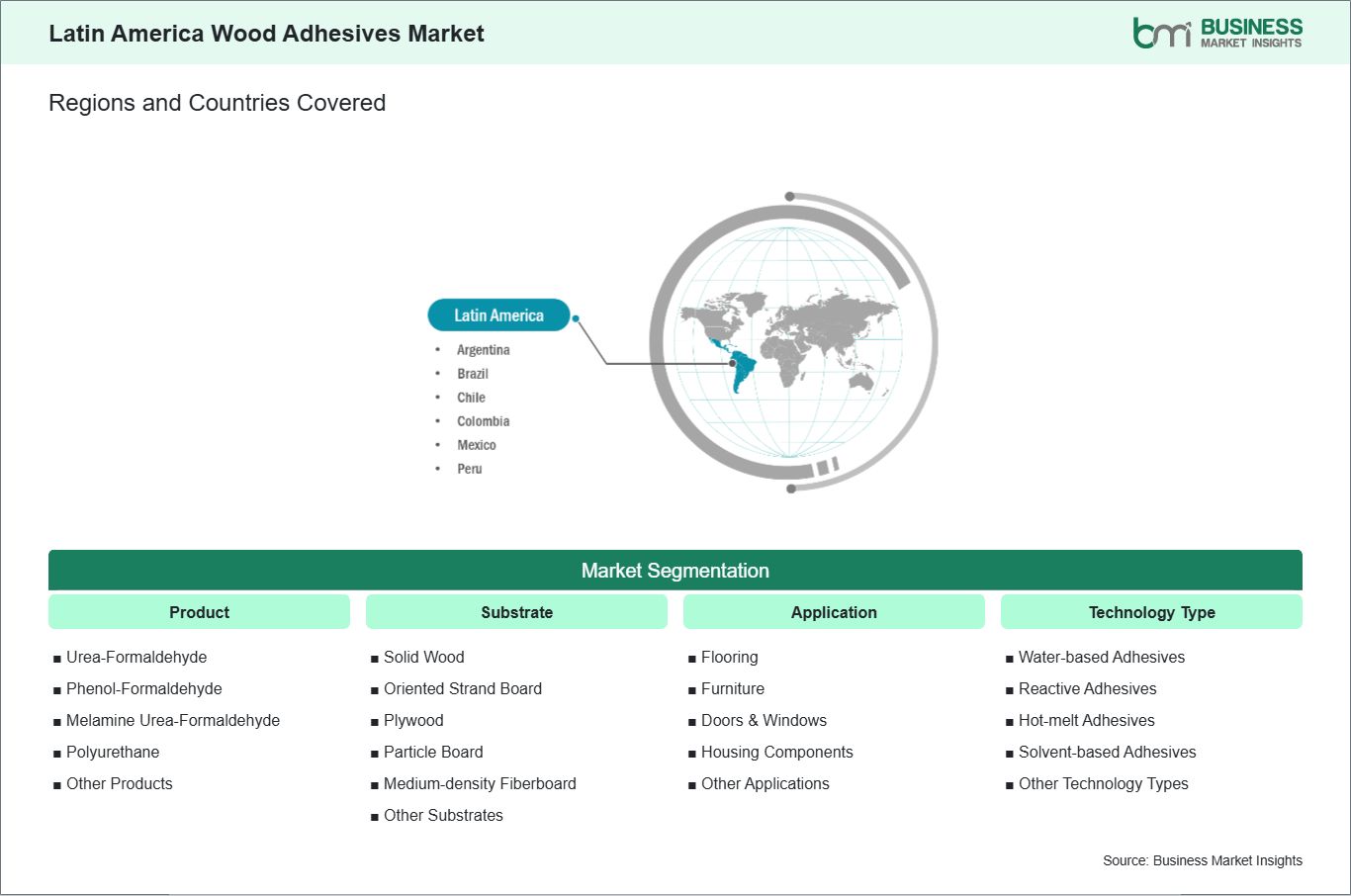
Key segments that contributed to the derivation of the Latin America wood adhesives market analysis are product, substrate, application, and technology type.
- By product, the wood adhesives market is segmented into urea-formaldehyde (UF), phenol-formaldehyde (PF), melamine urea-formaldehyde (MUF), polyurethane (PU), and other products. The urea-formaldehyde (UF) segment dominated the market in 2025.
- Based on substrate, the wood adhesives market is segmented into solid wood, oriented strand board (OSB), plywood, particle board (PB), medium-density fiberboard (MDF), and other substrates. The particle board (PB) segment dominated the market in 2025.
- On the basis of application, the wood adhesives market is classified as flooring, furniture, doors & windows, housing components, and other applications. The furniture segment dominated the market in 2025.
- In terms of technology type, the wood adhesives market is segmented into water-based adhesives, reactive adhesives, hot-melt adhesives, solvent-based adhesives, and other technology types. The water-based adhesives segment dominated the market in 2025.
Market Forces
Latin America Wood Adhesives Market Drivers and Opportunities
Growing Demand for Interior Woodwork
The Latin America wood adhesives market is expanding due to the rising demand for interior woodwork across residential and commercial construction. The trend of rising growth in the development and renovation sector of countries like Brazil, Mexico, Argentina, and Chile has made there be an increasing demand for products made from wood in the form of doors, panels, cabinets, and installations that need glue to be put in place.
Wood bonding agents play a critical role in the manufacture of interior woodwork as it helps make sure that the products remain stable and resilient to any changes in humidity, which may be experienced in many regions of Latin America. The trend towards more modern building processes means that more manufacturers are turning to engineered wood materials which need bonding agents.
Public infrastructure development and commercial construction are also supporting market growth. Schools, offices, healthcare facilities, and retail environments are incorporating wood-based interior elements to improve aesthetics and functionality. In urban centers such as São Paulo, Mexico City, and Bogotá, demand for modern interior finishes is increasing, creating sustained opportunities for wood adhesive suppliers across the region.
Expansion of Lightweight Furniture Solutions
The expansion of lightweight furniture solutions is becoming a key growth factor for the Latin America wood adhesives market. Rising urban population density and smaller living spaces are driving demand for compact, portable, and easy-to-assemble furniture products. This trend is encouraging manufacturers to focus on lightweight engineered wood designs that depend heavily on adhesive technologies.
Brazilian and Mexican furniture manufacturers have started embracing modularity and flat pack furniture ideas to meet the changing lifestyles of their consumers. These kinds of furniture need adhesives which offer strong bonding yet enable the manufacture of light-weighted pieces. The adhesive is important in ensuring product stability as well as design flexibility.
The increasing use of e-commerce and retail sales networks will also contribute to this trend. Consumers are buying more pre-assembled furniture through the Internet, which creates a greater need for inexpensive and reliable wood adhesives. As manufacturers develop more innovative products and new distribution systems, the application of wood adhesives in lightweight furniture will grow throughout Latin America.
Size and Share Analysis
Latin America Wood Adhesives Market Size and Share Analysis
The wood adhesives market in Latin America is experiencing steady growth, with market size and share analysis reflecting evolving treatment preferences and competitive dynamics among key players. The report evaluates important subsegments categorized within product, substrate, application, and technology, highlighting their respective contributions to market performance.
By product, the urea-formaldehyde (UF) segment dominated the market in 2025, driven by its cost-effectiveness and strong demand from expanding furniture and plywood manufacturing sectors.
Based on substrate, the particle board (PB) segment dominated the market in 2025, driven by increasing use in affordable furniture production and rising construction and renovation activities across the region.
On the basis of application, the furniture segment dominated the market in 2025, driven by growing urbanization, improving living standards, and rising demand for low-cost, functional home furnishings.
In terms of technology, the water-based adhesives segment dominated the market in 2025, driven by increasing shift toward environmentally safer, low-VOC formulations supported by gradual regulatory tightening and sustainability awareness.
Report Coverage
Latin America Wood Adhesives Market Report Coverage and Deliverables
The "Latin America Wood Adhesives Market Size and Forecast (2022–2033)" report provides a detailed analysis of the market covering below areas:
- Market size and forecast at the regional and country levels for segments covered under the scope
- Market trends, as well as drivers, restraints, and opportunities
- Market analysis, covering key trends, regional framework, major players, regulations, and recent developments
- Market concentration, heat map analysis, prominent players, and recent developments for the Market
- Detailed company profiles, including SWOT analysis
Geographic Insights
Latin America Wood Adhesives Market Geographic Insights
The geographical scope of the Latin America wood adhesives market report is divided into Mexico, Brazil, Argentina, Peru, Chile, Colombia. Brazil held the largest share in 2025.
Brazil leads the Latin America wood adhesives market due to its large-scale furniture manufacturing base, strong plywood and panel production industry, and abundant availability of timber resources. Industrial demand is supported by export-oriented woodworking operations and continuous modernization of manufacturing facilities. Mexico follows with significant consumption driven by its well-established furniture sector, construction activity, and proximity to North American supply chains, which encourages adoption of standardized and high-performance adhesive systems. Argentina shows steady demand influenced by residential construction cycles, domestic furniture production, and gradual recovery in industrial output. Chile contributes through its structured forestry sector and wood processing industry, particularly in engineered wood and export-focused applications, supporting consistent adhesive usage. Colombia is witnessing growing demand driven by urban housing development, retail expansion, and increasing investment in interior furnishing and modular furniture production. Peru demonstrates emerging potential supported by construction growth and expanding small-to-medium woodworking enterprises. Across Latin America, market dynamics are shaped by rising urbanization, increasing adoption of engineered wood products, and gradual industrial upgrading of furniture manufacturing. However, variations in economic stability, import dependency for raw materials, and infrastructure gaps influence country-level performance. Overall, demand across these countries is shifting toward more efficient, cost-effective, and performance-oriented adhesive solutions aligned with modernization in construction and woodworking industries.
Industry Activity
Recent Developments
The Latin America wood adhesives market is evaluated by gathering qualitative and quantitative data post primary and secondary research, which includes important corporate publications, association data, and databases. A few of the key developments in the Latin America wood adhesives market are:
- In June 2025, Sika announced that it expanded its production facility near Belo Horizonte, Brazil, increasing local manufacturing capacity for construction chemicals and high-performance polymer technologies, including adhesive systems used in flooring, wood installation, and engineered building applications across the Brazilian market.
- In March 2026, Henkel announced the inauguration of its US$ 43.4 million Inspiration Center in Jundiaí, Brazil, establishing a major R&D hub for adhesive technologies, including engineered wood bonding systems, furniture adhesives, and sustainable formulation development for Latin American manufacturing industries.
Trust & Transparency
Research Methodology
The market analysis combines proprietary research with secondary data from government agencies, company disclosures, regulatory filings, industry databases and expert interviews. Market estimates are validated through data triangulation, cross-market benchmarking and analyst
review.
View Full Research Methodology
Key Sources Referred:
Food and Agriculture Organization (FAO) United Nations Industrial Development Organization (UNIDO) World Bank International Trade Centre (ITC) Organization for Economic Co-operation and Development (OECD) European Chemicals Agency (ECHA) S. Environmental Protection Agency (EPA) International Organization for Standardization (ISO) United Nations Environment Programme (UNEP) World Trade Organization (WTO)