Market Summary
Executive Summary and Market Analysis
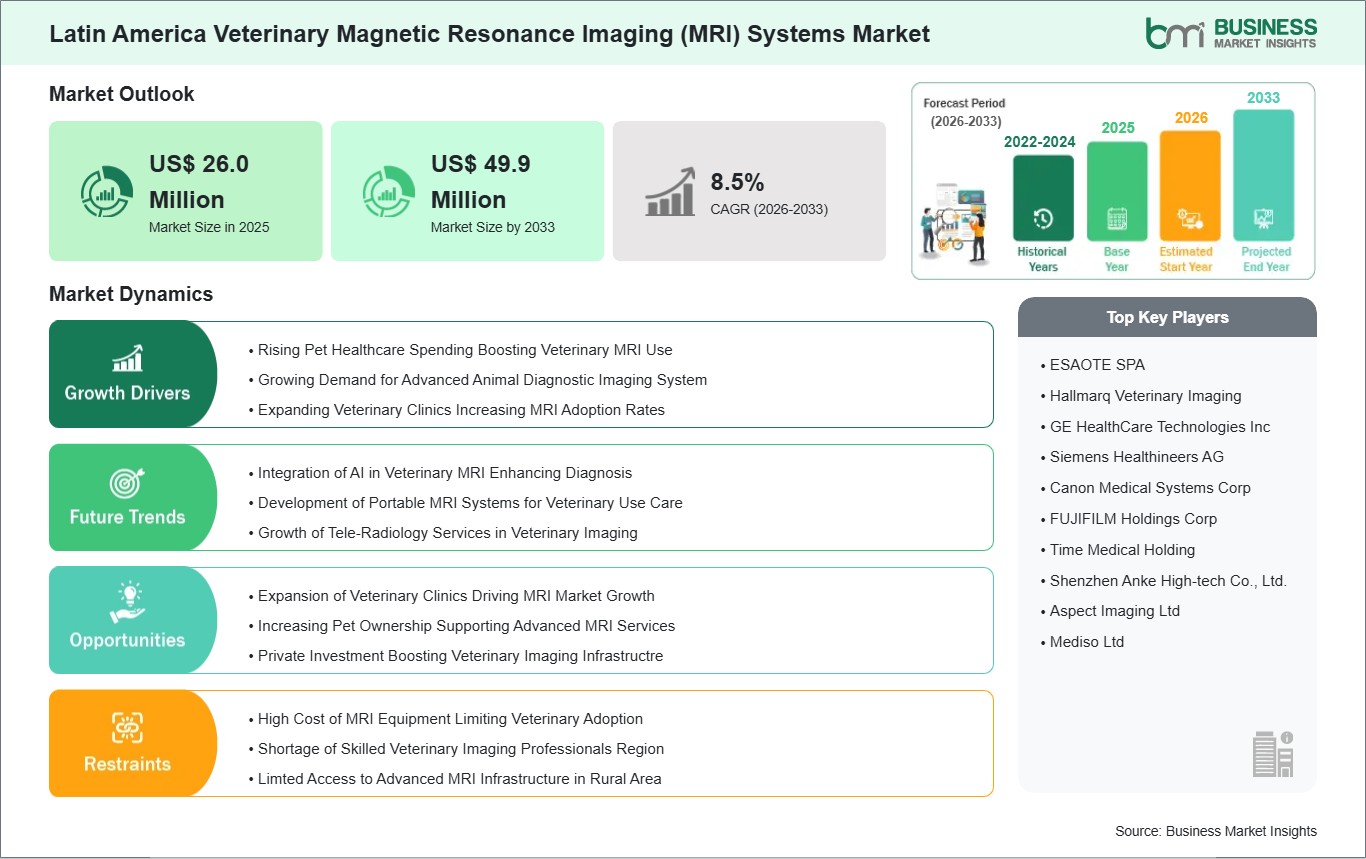
The Latin America veterinary MRI systems market is an emerging segment within the regional veterinary imaging landscape, which shows slow development through its partial infrastructure growth and its ongoing implementation of advanced diagnostic tools at particular urban and specialty veterinary facilities. The market is primarily concentrated in key economies such as Brazil, Mexico, and Argentina because these countries have developed better veterinary service systems and people in these countries understand companion animal healthcare better. The industry is expanding because more people own pets, and they want better diagnostic tests, and veterinarians are moving from basic care to advanced pet treatment methods. The market experiences growth because more pets develop complex health issues, which include neurological disorders, orthopedic injuries and soft tissue abnormalities that affect companion animals. Veterinary clinics are increasing their use of MRI systems because pet owners now understand advanced medical treatments, and they want to enhance their diagnostic accuracy and patient care results. Urban veterinary hospitals and referral centers are essential to the industry because these facilities use advanced imaging technology, which used to be restricted to human healthcare facilities and academic institutions for their competitive advantage. The region's veterinary profession is becoming more professional, thus it drives diagnostic modernization investments, which focus on major urban areas. The market development process receives its second essential support line through improvements to veterinary infrastructure, which allow international medical professionals and advanced imaging systems to establish operations in this geographical area. Private specialty clinics and research-based veterinary hospitals currently adopt advanced imaging technologies, which include MRI systems at a slow yet continuous rate. The distribution of MRI systems across different locations shows extreme disparities since most facilities operate in major urban areas, while remote and semi-urban regions depend on fundamental diagnostic equipment. The market experiences positive market trends but encounters several significant barriers that impede its progress. The region's price-sensitive market faces a major obstacle because MRI systems require high initial costs and ongoing operational expenses, which prevent their widespread use. The presence of insufficient veterinary radiologists and technical experts results in restricted system operation, which leads to decreased performance of advanced imaging systems. The infrastructure development of veterinary healthcare facilities encounters delays due to economic instability present in multiple Latin American nations, which affects their capital spending patterns. The Latin America veterinary MRI systems market exhibits three main characteristics, which include selective system adoption that increases through time, combined with strong urban system distribution and slow system development through technological progress. The market will grow according to three factors, which are economic stability, workforce training and ongoing improvements in veterinary medical service delivery systems.
Segment Analysis
Latin America Veterinary Magnetic Resonance Imaging (MRI) Systems Market Segmentation
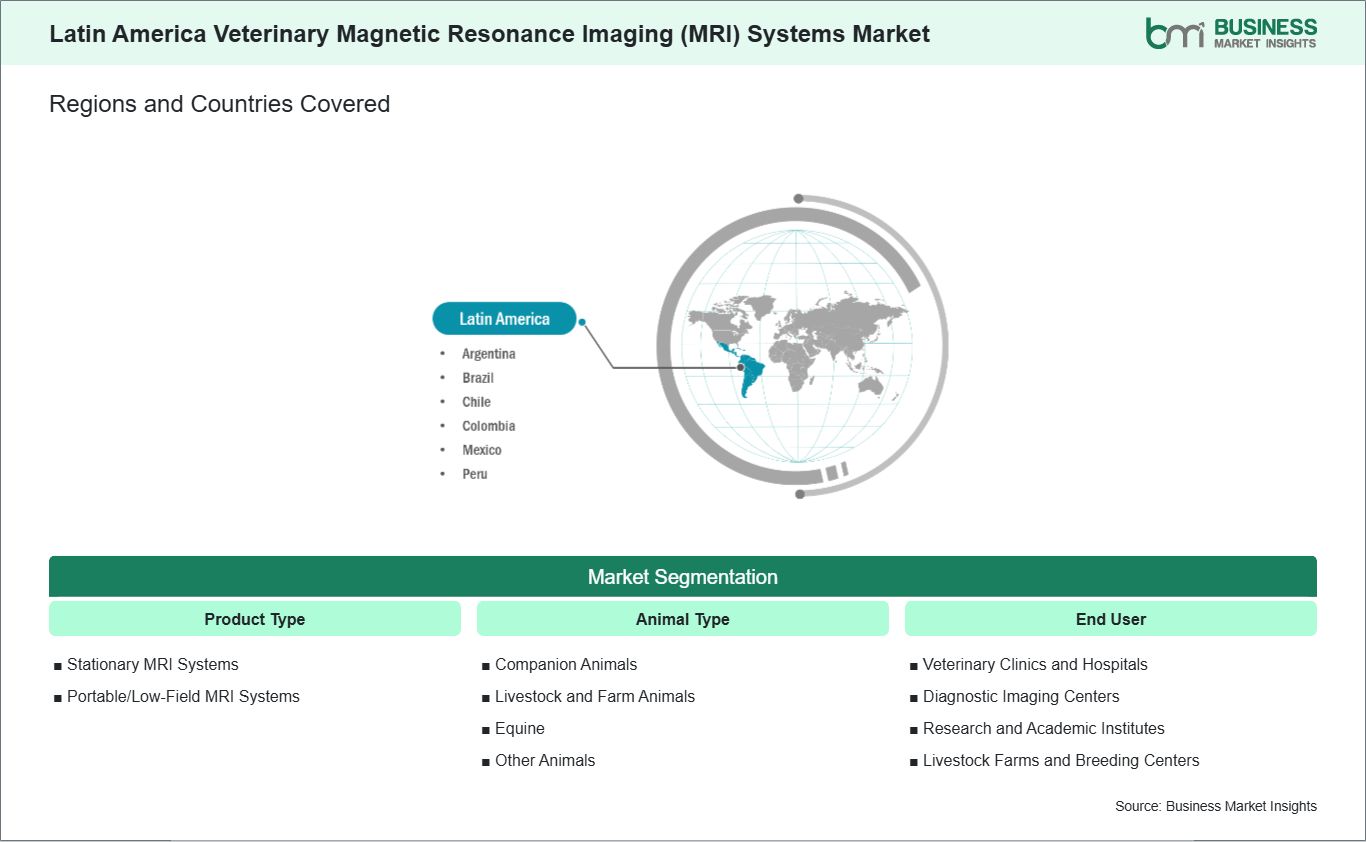
Key segments that contributed to the derivation of the Latin America veterinary magnetic resonance imaging (MRI) systems market analysis are product type, animal type, and end user.
- By product type, the veterinary magnetic resonance imaging (MRI) systems market is segmented into stationary MRI systems, portable/low-field MRI systems. The stationary MRI systems segment dominated the market in 2025.
- Based on animal type, the veterinary magnetic resonance imaging (MRI) systems market is categorized into companion animals, livestock and farm animals, equine, others. The companion animals segment dominated the market in 2025.
- In terms of end user, the veterinary magnetic resonance imaging (MRI) systems market is categorized into veterinary clinics and hospitals, diagnostic imaging centers, research and academic institutes, livestock farms and breeding centers. The veterinary clinics and hospitals segment dominated the market in 2025.
Market Forces
Latin America Veterinary Magnetic Resonance Imaging (MRI) Systems Market Drivers and Opportunities
Rising Pet Healthcare Spending Boosting Veterinary MRI Use
The Latin America veterinary MRI systems market is experiencing growth because urbanized countries such as Brazil, Mexico and Argentina are spending more money on pet medical treatment. Pet owners now demand more precise medical imaging solutions because they want their pets to receive correct medical evaluations of their complex medical conditions, which include neurological problems and soft tissue damage. Veterinary centers need MRI systems because they require accurate medical tests to treat high-value companion animals.
The region is experiencing higher demand for advanced veterinary tests because pet ownership has increased, and people now have more money to spend while maintaining their urban living habits. Veterinary hospitals in major cities such as São Paulo and Mexico City are expanding their diagnostic services to establish a competitive advantage over rival institutions. The market is moving toward advanced imaging technology, which includes MRI systems, because this technology provides better diagnostic capabilities despite its high costs for both equipment and operating expenses.
People are becoming more aware of preventive animal healthcare, which leads them to start using diagnostic imaging tools at an earlier stage of their animal healthcare process. Veterinarians are progressively incorporating MRI into referral-based diagnostic workflows, particularly for orthopedic and neurological assessments. The Latin American animal healthcare system uses MRI systems as essential tools to provide advanced veterinary services throughout the region's developing veterinary medical field.
Expansion of Veterinary Clinics Driving MRI Market Growth
The expansion of veterinary clinics and diagnostic centers across Latin America is creating strong growth opportunities for MRI system adoption. Countries such as Brazil and Argentina are witnessing a steady increase in private veterinary practices and multi-specialty animal hospitals, particularly in metropolitan regions. These facilities are increasingly integrating advanced imaging modalities to improve diagnostic accuracy and clinical outcomes.
Infrastructure development in veterinary healthcare is also improving access to sophisticated diagnostic tools beyond major urban hubs. As clinics expand their service portfolios, there is a growing emphasis on offering comprehensive diagnostic solutions under one roof, including MRI imaging for complex cases. This is particularly important for referral cases involving soft tissue evaluation and chronic disease management in companion animals.
Furthermore, partnerships between local veterinary providers and international equipment suppliers are facilitating the introduction of advanced imaging technologies in the region. Training programs and technical support initiatives are helping clinics overcome operational challenges associated with MRI systems. Combined with rising investment in veterinary healthcare infrastructure, this expansion is expected to significantly accelerate MRI system penetration across Latin America.
Size and Share Analysis
Latin America Veterinary Magnetic Resonance Imaging (MRI) Systems Market Size and Share Analysis
The Latin America veterinary magnetic resonance imaging (MRI) systems market is experiencing steady growth, with market size and share analysis reflecting evolving treatment preferences and competitive dynamics among key players. The report evaluates important subsegments categorized within product type, animal type, and end user, highlighting their respective contributions to market performance.
By product type, the stationary MRI systems subsegment dominated the market in 2025, driven by higher image quality, greater throughput, and widespread adoption in hospitals for comprehensive diagnostic imaging.
Based on animal type, the companion animals subsegment dominated the market in 2025, driven by increasing pet ownership and rising demand for advanced diagnostic imaging in routine veterinary care.
In terms of end user, the veterinary clinics and hospitals subsegment dominated the market in 2025, driven by the widespread adoption of x-ray systems for comprehensive diagnostic and treatment services.
Report Coverage
Latin America Veterinary Magnetic Resonance Imaging (MRI) Systems Market Report Coverage and Deliverables
The "Latin America Veterinary Magnetic Resonance Imaging (MRI) Systems Market Size and Forecast (2022–2033)" report provides a detailed analysis of the market covering below areas:
- Market size and forecast at regional and country levels for all market segments covered under the scope
- Market trends, as well as drivers, restraints, and opportunities
- Market analysis covering key trends, regional framework, major players, regulations, and recent developments
- Market concentration, heat map analysis, prominent players, and recent developments for the Market
- Detailed company profiles, including SWOT analysis
Geographic Insights
Latin America Veterinary Magnetic Resonance Imaging (MRI) Systems Market Geographic Insights
The geographical scope of the Latin America Veterinary Magnetic Resonance Imaging (MRI) Systems Market report is divided into Mexico, Brazil, Argentina, Peru, Chile, and Colombia. Brazil held the largest share in 2025.
The Latin America Veterinary MRI Systems market is in a developing but steadily expanding phase, with demand shaped by rising pet ownership, gradual modernization of veterinary infrastructure, and increasing willingness among pet owners to pursue advanced diagnostic care. Brazil operates as the leading market throughout the region because its extensive companion animal population combines with its developed veterinary hospital system and its multiple specialty diagnostic facilities, which exist in major urban areas. The continuous investment in veterinary healthcare services, together with the rising demand for high-precision imaging tools such as MRI, which detect neurological, musculoskeletal and complex soft-tissue conditions, establishes Brazil as the primary market for advanced veterinary diagnostic tools in Latin America. The Mexican market exists as a secondary growth market, where urbanization and middle-class pet ownership expansion, and increasing private veterinary clinic development of specialized services all drive forward, although MRI technology adoption stays fixed within major urban medical centers. Argentina possesses substantial market potential because of its strong cultural bond with pet animals and its rising understanding of veterinary diagnostic methods, yet economic instability continues to slow down the speed of equipment acquisition. The Chilean market operates with less volume than other markets, yet it maintains organized veterinary services and premium clinics together with university-operated veterinary hospitals that use advanced imaging technology at their discretion. The Colombian market is developing through improved veterinary service availability and increased public knowledge about early disease detection in companion animals, although the country lacks sufficient infrastructure for MRI technology to reach areas beyond its main cities. Peruvian veterinary centers and research facilities currently need high-end equipment for their operations because the country has not yet reached full adoption of veterinary services. The entire region experiences three main drivers because pet owners increasingly treat their pets as family members, and they demand high-quality veterinary services, while diagnostic skills in the veterinary field gradually develop over time. The high costs for equipment acquisition, together with the shortage of trained veterinary radiologists and the uneven availability of advanced veterinary facilities, prevent the adoption of MRI technology from becoming widespread. The Latin American veterinary MRI market depends on Brazil to drive growth and introduce new technology, while the country serves as the main center for veterinary MRI services throughout the region.
Industry Activity
Recent Developments
The Latin America Veterinary Magnetic Resonance Imaging (MRI) Systems Market is evaluated by gathering qualitative and quantitative data post primary and secondary research, which includes important corporate publications, association data, and databases. A few of the key developments in the Latin America veterinary magnetic resonance imaging (MRI) systems market are:
- In July 2025, Esaote, announced at ECVS 2025 the launch of its next-generation veterinary MRI system, Vet-MR Grande ELITE, featuring AI-powered image reconstruction and improved workflow efficiency for veterinary diagnostic imaging across global markets, including Latin America via distributor networks.
- In January 2026, Siemens Healthineers, announced advancements to its MAGNETOM Flow platform for veterinary MRI, featuring helium-free DryCool magnet technology and AI-driven imaging workflows designed to improve diagnostic efficiency and reduce installation complexity for veterinary imaging facilities globally.
Trust & Transparency
Research Methodology
The market analysis combines proprietary research with secondary data from government agencies, company disclosures, regulatory filings, industry databases and expert interviews. Market estimates are validated through data triangulation, cross-market benchmarking and analyst
review.
View Full Research Methodology
Key Sources Referred:
American College of Veterinary Radiology (ACVR)World Small Animal Veterinary Association (WSAVA)British Veterinary Association (BVA)International Veterinary Radiology Association (IVRA)American Veterinary Medical Association (AVMA)European College of Veterinary Diagnostic Imaging (ECVDI)World Organisation for Animal Health (WOAH / OIE)Veterinary Imaging & Radiation Oncology Society (VIROS)