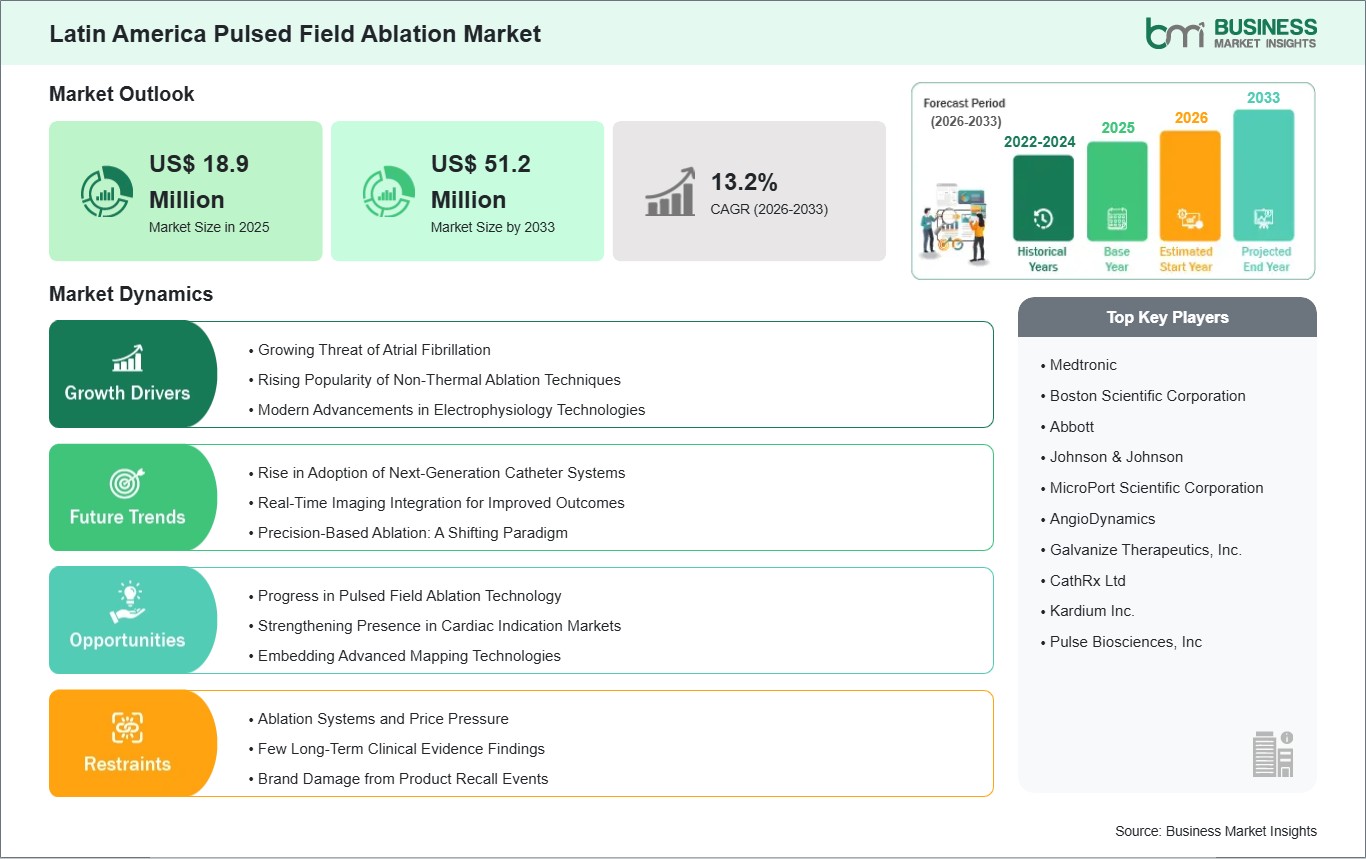
The Latin America pulsed field ablation market size is expected to reach US$ 51.2 million by 2033 from US$ 18.9 million in 2025. The market is estimated to record a CAGR of 13.2% from 2026 to 2033.
The PFA market in Latin America represents an interesting paradigm shift from the conventional thermal-based procedures for treating heart rhythm disorders. Traditional treatments, based on thermal ablation, imply that doctors rely on heating or cooling down tissues to get rid of them. Although this method was helpful in many cases, the recovery process used to be lengthy, and patients often suffered collateral damage during such operations. In contrast to this method, PFA implies targeting particular cells in heart tissue with electrical pulses rather than removing tissue entirely.
With the increasing number of arrhythmia cases (for example, cases of atrial fibrillation), more attention is paid to safe and efficient solutions like PFA treatment. Moreover, with the increasing number of electrophysiology laboratories equipped with sophisticated diagnostic devices in major cities' hospitals, the technology is gaining popularity and support in Latin American healthcare institutions. However, this trend is still far from being developed due to the expenses related to the acquisition and training for PFA procedures. Thus, only well-funded medical organizations can afford PFA technologies. With close collaboration with international corporations and technological progress in Latin American infrastructure, PFA technologies will become widely available to all patients.

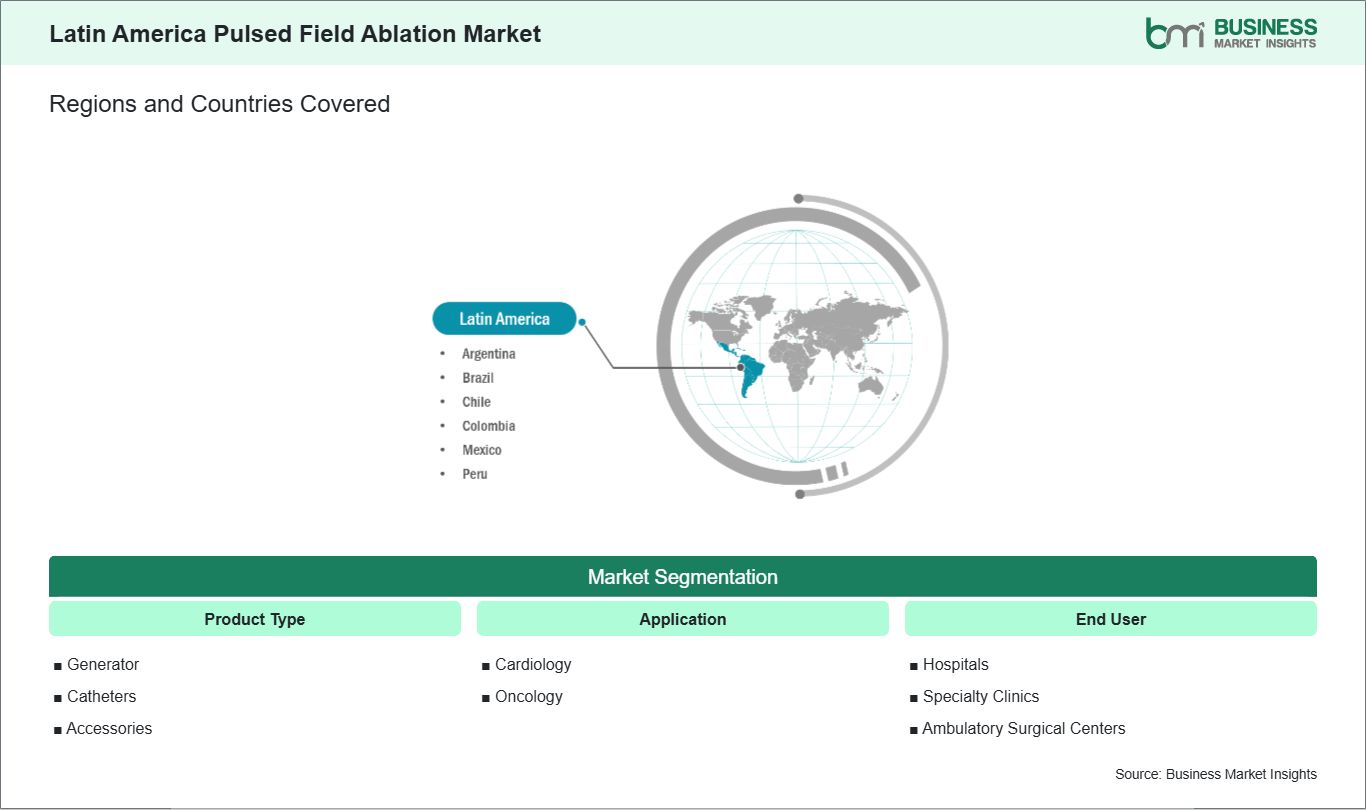
Key segments that contributed to the derivation of the Latin America pulsed field ablation market analysis are product type, application, and end user.
Latin America is witnessing a rising burden of atrial fibrillation (AF) that is closely tied to regional demographic and epidemiological trends. Rapid urbanization, population aging, and increasing prevalence of metabolic conditions such as obesity, diabetes, and hypertension have amplified the incidence of cardiac arrhythmias. In contrast to some developed regions, public awareness of AF remains limited, and diagnosis often occurs after complications arise. As a result, healthcare systems in Brazil, Mexico, Argentina, and Colombia face growing pressure to expand cardiology services and integrate community-based detection programs.
The burden of AF in Latin America is further complicated by disparities in healthcare access. Urban centers may have well-equipped cardiac facilities, while rural areas often lack specialized services. This uneven distribution challenges hospitals to deliver timely intervention and highlights the need for scalable solutions that can be deployed across diverse healthcare settings. Minimally invasive procedures that reduce procedural risk and hospitalization times are increasingly critical in managing these pressures efficiently.
These dynamics have created a strategic imperative for the adoption of advanced treatment options. Pulsed field ablation (PFA) offers a targeted and tissue-selective method that minimizes collateral damage, reduces procedure duration, and facilitates quicker patient recovery. Integrating PFA into Latin America’s cardiac care framework enables hospitals to address the growing AF threat with precision, efficiency, and greater operational adaptability.
Pulsed field ablation (PFA) is gaining attention in Latin America as a transformative solution for arrhythmia management, offering a precise, safe, and adaptable approach. Unlike traditional thermal ablation, PFA delivers high-voltage electrical pulses that selectively target cardiac tissue while preserving surrounding structures, lowering the risk of complications. Recent improvements in catheter design, real-time mapping integration, and energy delivery have made the technology suitable for varied hospital infrastructures across the region, from metropolitan centers to tertiary care facilities in smaller cities.
Latin American hospitals are increasingly focusing on implementing PFA through structured clinician training and protocol standardization. Electrophysiology teams are receiving comprehensive procedural guidance, which ensures that adoption does not compromise patient safety or clinical outcomes. These measures also allow facilities to manage higher patient volumes efficiently, addressing the dual challenges of rising AF prevalence and healthcare system limitations.
Continued technological enhancements in PFA are expected to reshape arrhythmia care across Latin America. Innovations in workflow integration, device usability, and procedural precision are enabling clinicians to perform interventions with predictable results and greater confidence. By combining safety, efficiency, and scalability, PFA positions Latin American healthcare providers to offer high-quality, modern cardiac care while responding to the region’s unique epidemiological and operational challenges.

The Latin America pulsed field ablation market demonstrates steady growth, with size and share analysis highlighting evolving trends and competitive dynamics among key players. The report evaluates important subsegments categorized within product type, application, and end user, highlighting their respective contributions to overall market performance.
By product type, the catheters subsegment dominated the market in 2025. Catheter devices offer improved procedural efficiency, reduced risk of complications, and real-time control for electrophysiologists, making them a crucial component for effective PFA therapy and a key revenue driver for manufacturers.
In terms of application, the cardiology subsegment dominated the market in 2025. The leadership of cardiology applications is attributed to the rising prevalence of atrial fibrillation and other cardiac arrhythmias, growing preference for non-thermal and tissue-selective ablation techniques, and increasing awareness among healthcare providers about the clinical benefits of PFA.
Based on end user, the hospitals subsegment dominated the market in 2025. Hospitals maintain a stronghold due to their established cardiology and electrophysiology departments, access to advanced PFA systems, trained physicians and clinical staff, and the capability to perform specialized cardiac procedures with comprehensive patient monitoring and post-procedure care.
| Report Attribute | Details |
|---|---|
| Market size in 2025 | US$ 18.9 Million |
| Market Size by 2033 | US$ 51.2 Million |
| CAGR (2026 - 2033) | 13.2% |
| Historical Data | 2022-2024 |
| Forecast period | 2026-2033 |
| Segments Covered | By Product Type
|
|
Regions and Countries Covered
| |
| Latin America | Mexico, Brazil, Argentina, Peru, Chile, Colombia |
| Market leaders and key company profiles |
|
The "Latin America Pulsed Field Ablation Market Size and Forecast (2022–2033)" report provides a detailed analysis of the market covering below areas:
The geographical scope of the Latin America pulsed field ablation market report is divided into: Brazil, Mexico, Argentina, Colombia, Chile, and Peru. Mexico held the largest share in 2025.
Mexico is the leading driver of the Latin America PFA market, owing to its progressive healthcare system and focus on adopting cutting-edge cardiac technologies. The country’s growing patient population with atrial fibrillation and other arrhythmias has created demand for therapies that prioritize both efficacy and safety. PFA’s non-thermal, tissue-selective ablation provides an ideal solution, enabling precise treatment while minimizing risks and reducing recovery time, a critical advantage for patient outcomes and hospital workflow efficiency.
PFA market adoption in Mexico is also driven by investments made in electrophysiology laboratories, image machines, and cardiac mapping tools. Clinician education programs play a significant role in preparing cardiologists for performing PFA safely and efficiently. Collaboration with foreign suppliers of medical devices is beneficial when it comes to implementing procedures, transferring knowledge, and using innovative device products. Problems exist in this process since expensive equipment prevents performing PFA only in major urban hospitals with sufficient budgets. There are few qualified electrophysiologists, which impedes the wide implementation of this procedure in smaller healthcare facilities. Mexico's great interest in innovation, infrastructure development, and active cardiovascular treatment gives it an opportunity to become the central region where PFA will be adopted in Latin America.

The Latin America pulsed field ablation market is evaluated by gathering qualitative and quantitative data post primary and secondary research, which includes important corporate publications, association data, and databases. A few of the key developments in the Latin America pulsed field ablation market are:
The Latin America Pulsed Field Ablation Market is valued at US$ 18.9 Million in 2025, it is projected to reach US$ 51.2 Million by 2033.
As per our report Latin America Pulsed Field Ablation Market, the market size is valued at US$ 18.9 Million in 2025, projecting it to reach US$ 51.2 Million by 2033. This translates to a CAGR of approximately 13.2% during the forecast period.
The Latin America Pulsed Field Ablation Market report typically cover these key segments-
The historic period, base year, and forecast period can vary slightly depending on the specific market research report. However, for the Latin America Pulsed Field Ablation Market report:
The Latin America Pulsed Field Ablation Market is populated by several key players, each contributing to its growth and innovation. Some of the major players include:
The Latin America Pulsed Field Ablation Market report is valuable for diverse stakeholders, including:
Essentially, anyone involved in or considering involvement in the Latin America Pulsed Field Ablation Market value chain can benefit from the information contained in a comprehensive market report.
Please tell us your area of interest
(Market Segments/ Regions and Countries/ Companies)