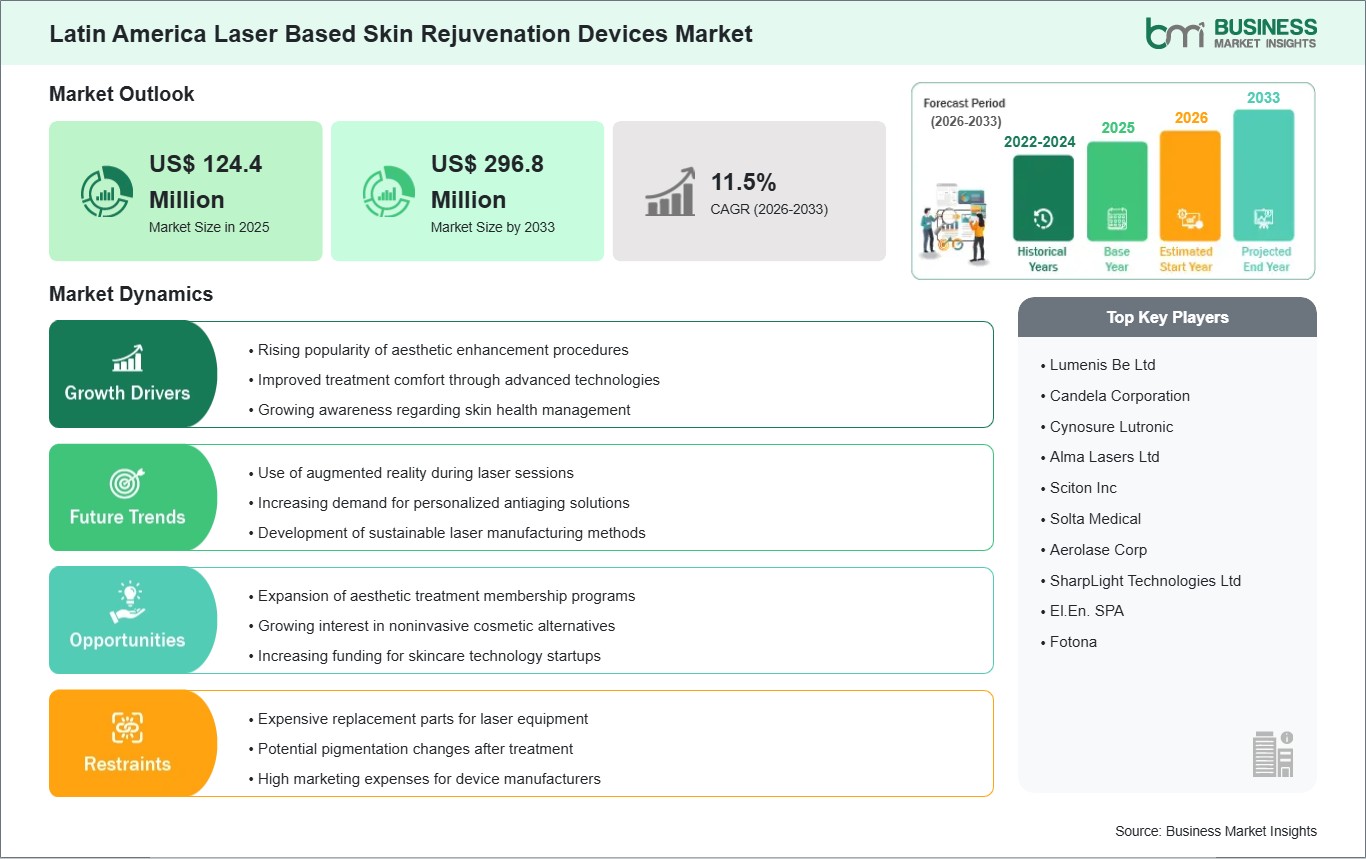
The Latin America laser based skin rejuvenation devices market size is expected to reach US$ 296.8 million by 2033 from US$ 124.4 million in 2025. The market is estimated to record a CAGR of 11.5% from 2026 to 2033.
The Latin America laser based skin rejuvenation devices market is evolving steadily, supported by increasing aesthetic awareness, expansion of private dermatology clinics, and rising demand for minimally invasive cosmetic procedures across urban populations. Consumer preference is shifting toward advanced skin rejuvenation solutions addressing pigmentation disorders, acne scarring, photoaging, and skin tightening, driven by growing exposure to global beauty trends and social media influence. The market is witnessing increased adoption of fractional lasers, diode systems, and picosecond technologies as clinics aim to deliver faster results with reduced downtime. Private healthcare providers, medical spas, and cosmetic surgery centers are expanding their service portfolios, particularly in metropolitan areas, to cater to rising demand for non-surgical aesthetic treatments. Medical tourism is also contributing to procedural volumes, especially in countries offering cost-effective yet quality-assured dermatology services. International manufacturers are actively strengthening their regional presence through distributor partnerships, training programs for dermatologists, and localized marketing strategies. However, market growth is constrained by economic volatility in certain countries, uneven access to advanced healthcare infrastructure, and high dependency on imported laser systems, which increases pricing pressure. Despite these challenges, the long-term outlook remains positive, supported by improving healthcare investment, rising disposable income among urban populations, and continuous technological advancements that are making laser-based skin rejuvenation procedures more accessible and efficient across the region.

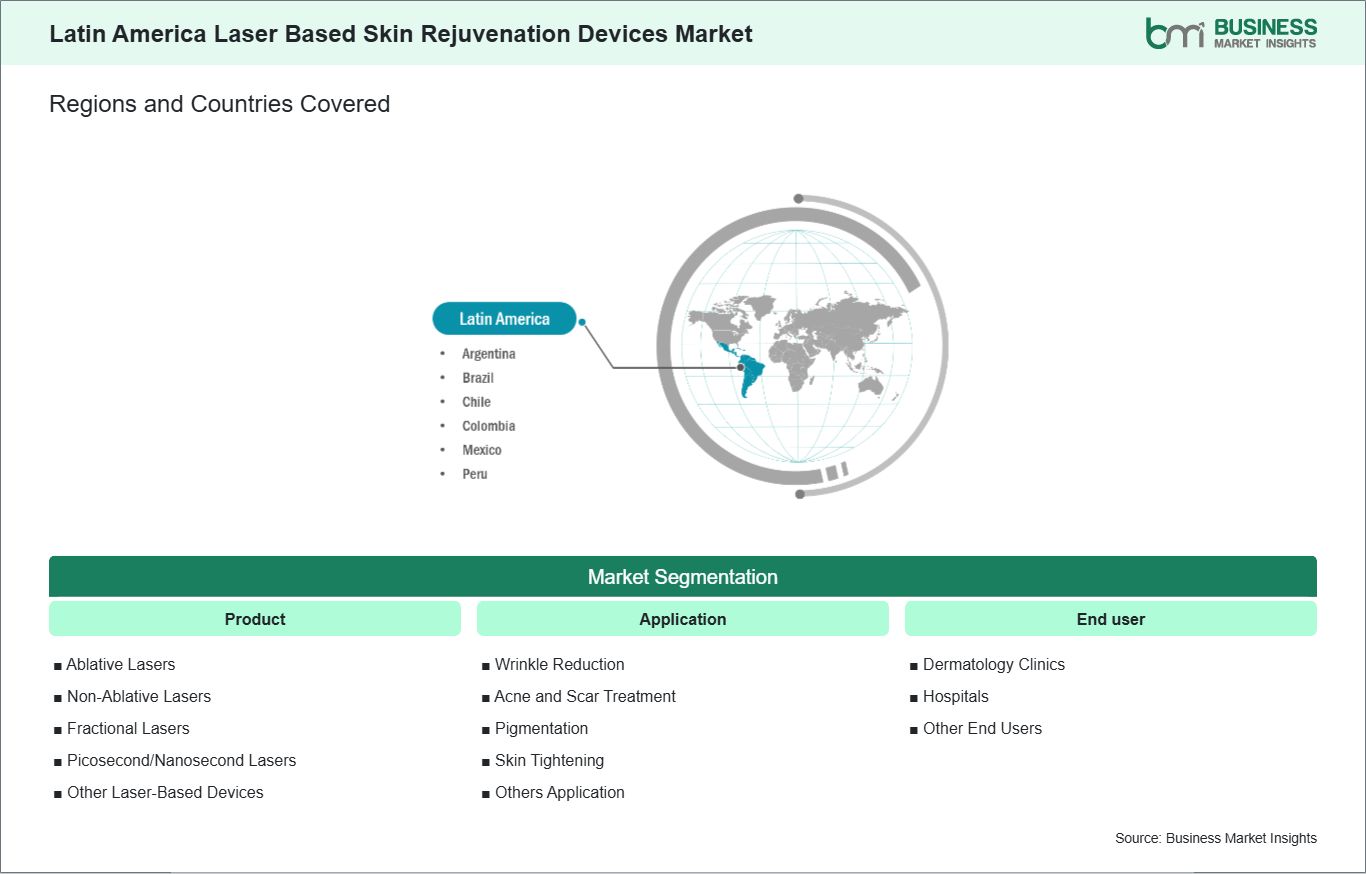
Key segments that contributed to the derivation of the Latin America laser based skin rejuvenation devices market analysis are product, application, and end user.
The Latin America Laser Based Skin Rejuvenation Devices Market is strongly shaped by celebrity-driven beauty culture, where public figures significantly influence consumer preferences for aesthetic treatments. In nations like Brazil, Mexico, Colombia, and Argentina, entertainment industries and social media platforms play a prominent role in promoting skin-care regimens and non-invasive cosmetology treatments, where celebrity endorsements play an integral role. The prevalence of such industries has led to the widespread acceptance of high-end dermatological procedures, including laser skin rejuvenation.
In metropolitan cities such as Sao Paulo, Mexico City, and Bogota, there is strong reliance on celebrities within the entertainment industry, including performers from television and music, who openly talk about their use of such beauty services. Consequently, more people are curious about using laser technology in the treatment of skin pigmentation, scarring, and rejuvenation. The influence of celebrities on aesthetic beauty makes people develop good skincare routines at an early age.
The social media platforms further boost the impact of these narratives, with the fast spread of trends for beauty across the entire region being possible. Influencers often post about their experiences with cosmetic procedures, specifically focusing on the effect of non-invasive laser treatments on the body. Given that Latin American beauty culture puts a great deal of emphasis on appearance, celebrities will likely continue to be an important element that will drive the growth of this market.
The integration of digital skincare systems is emerging as a transformative trend in the Latin America Laser Based Skin Rejuvenation Devices Market. Brazilian clinics and skin disease facilities, as well as Chilean, Peruvian, and Colombian ones, are incorporating digital diagnosis instruments, artificial intelligence–based skin disease assessment platforms, and telemedicine systems into their operations to improve their treatment plans. The use of these technological advancements has improved the accuracy of identifying skin diseases and customizing laser treatments.
For dermatologists operating out of large urban health centers, laser facial rejuvenation procedures are being complemented by digitized skin tracking programs for each individual’s skin response over the course of their treatment period. With this system, doctors can tweak their laser settings according to the immediate reaction of the skin, making the procedure safer and more effective. This trend toward skin monitoring is contributing to the evolution of modern dermatology clinics.
The advancement of teledermatology and smartphone skin care apps is also helping to facilitate the availability of laser treatment suggestions. People are leveraging digital technologies to consult with dermatologists, get skin analysis done, and schedule beauty treatments even before they visit the clinic. The amalgamation of digital technology and laser treatment inside clinics is creating a demand for such solutions. With the continuous development of digital healthcare technology in Latin America, its adoption alongside aesthetic laser technology will lead to more market growth.

The Latin America laser based skin rejuvenation devices market demonstrates steady growth, with size and share analysis highlighting evolving trends and competitive dynamics among key players. The report examines subsegments categorized within product, application, and end user, offering insights into their contribution to overall market performance.
By product, the non-ablative lasers segment dominated the market in 2025, driven by increasing demand for affordable, minimally invasive skin rejuvenation procedures and growing adoption of advanced aesthetic technologies in Latin America.
Based on application, the wrinkle reduction segment dominated the market in 2025, driven by rising aging population, increasing beauty consciousness, and growing preference for non-surgical anti-aging treatments in Latin America.
In terms of end user, the dermatology clinics segment dominated the market in 2025, driven by expanding network of specialist aesthetic centers, improving access to advanced laser treatments, and growing trust in dermatologist-led procedures in Latin America.
| Report Attribute | Details |
|---|---|
| Market size in 2025 | US$ 124.4 Million |
| Market Size by 2033 | US$ 296.8 Million |
| CAGR (2026 - 2033) | 11.5% |
| Historical Data | 2022-2024 |
| Forecast period | 2026-2033 |
| Segments Covered | By Product
|
|
Regions and Countries Covered
| |
| Latin America | Mexico, Brazil, Argentina, Peru, Chile, Colombia |
| Market leaders and key company profiles |
|
The "Latin America Laser Based Skin Rejuvenation Devices Market Size and Forecast (2022–2033)" report provides a detailed analysis of the market covering below areas:
The geographical scope of the Latin America laser based skin rejuvenation devices market report is divided into Mexico, Brazil, Argentina, Peru, Chile, Colombia. Brazil held the largest share in 2025.
Brazil dominates the Latin America laser based skin rejuvenation devices market due to its highly mature aesthetic dermatology industry, strong cultural acceptance of cosmetic procedures, and extensive private clinic network. Major urban centers such as São Paulo and Rio de Janeiro serve as key adoption hubs for advanced laser technologies targeting skin rejuvenation, anti-aging, and pigmentation correction treatments. Argentina demonstrates steady market growth supported by a well-established private healthcare system and strong aesthetic awareness among urban consumers. Demand is driven by increasing preference for non-invasive skin resurfacing and rejuvenation procedures in cities such as Buenos Aires. Colombia is emerging as a rapidly growing market fueled by expanding medical tourism, competitive treatment pricing, and increasing investment in modern dermatology clinics. Cities like Bogotá and Medellín are witnessing higher adoption of advanced laser systems for cosmetic skin treatments. Chile shows stable and structured growth driven by higher healthcare standards, rising disposable income, and increasing consumer inclination toward preventive and corrective aesthetic dermatology procedures. Private clinics are progressively integrating modern laser technologies to meet growing demand in urban areas.

The Latin America laser based skin rejuvenation devices market is evaluated by gathering qualitative and quantitative data post primary and secondary research, which includes important corporate publications, association data, and databases. A few of the key developments in the Latin America laser based skin rejuvenation devices market are:
The Latin America Laser Based Skin Rejuvenation Devices Market is valued at US$ 124.4 Million in 2025, it is projected to reach US$ 296.8 Million by 2033.
As per our report Latin America Laser Based Skin Rejuvenation Devices Market, the market size is valued at US$ 124.4 Million in 2025, projecting it to reach US$ 296.8 Million by 2033. This translates to a CAGR of approximately 11.5% during the forecast period.
The Latin America Laser Based Skin Rejuvenation Devices Market report typically cover these key segments-
The historic period, base year, and forecast period can vary slightly depending on the specific market research report. However, for the Latin America Laser Based Skin Rejuvenation Devices Market report:
The Latin America Laser Based Skin Rejuvenation Devices Market is populated by several key players, each contributing to its growth and innovation. Some of the major players include:
The Latin America Laser Based Skin Rejuvenation Devices Market report is valuable for diverse stakeholders, including:
Essentially, anyone involved in or considering involvement in the Latin America Laser Based Skin Rejuvenation Devices Market value chain can benefit from the information contained in a comprehensive market report.
Please tell us your area of interest
(Market Segments/ Regions and Countries/ Companies)