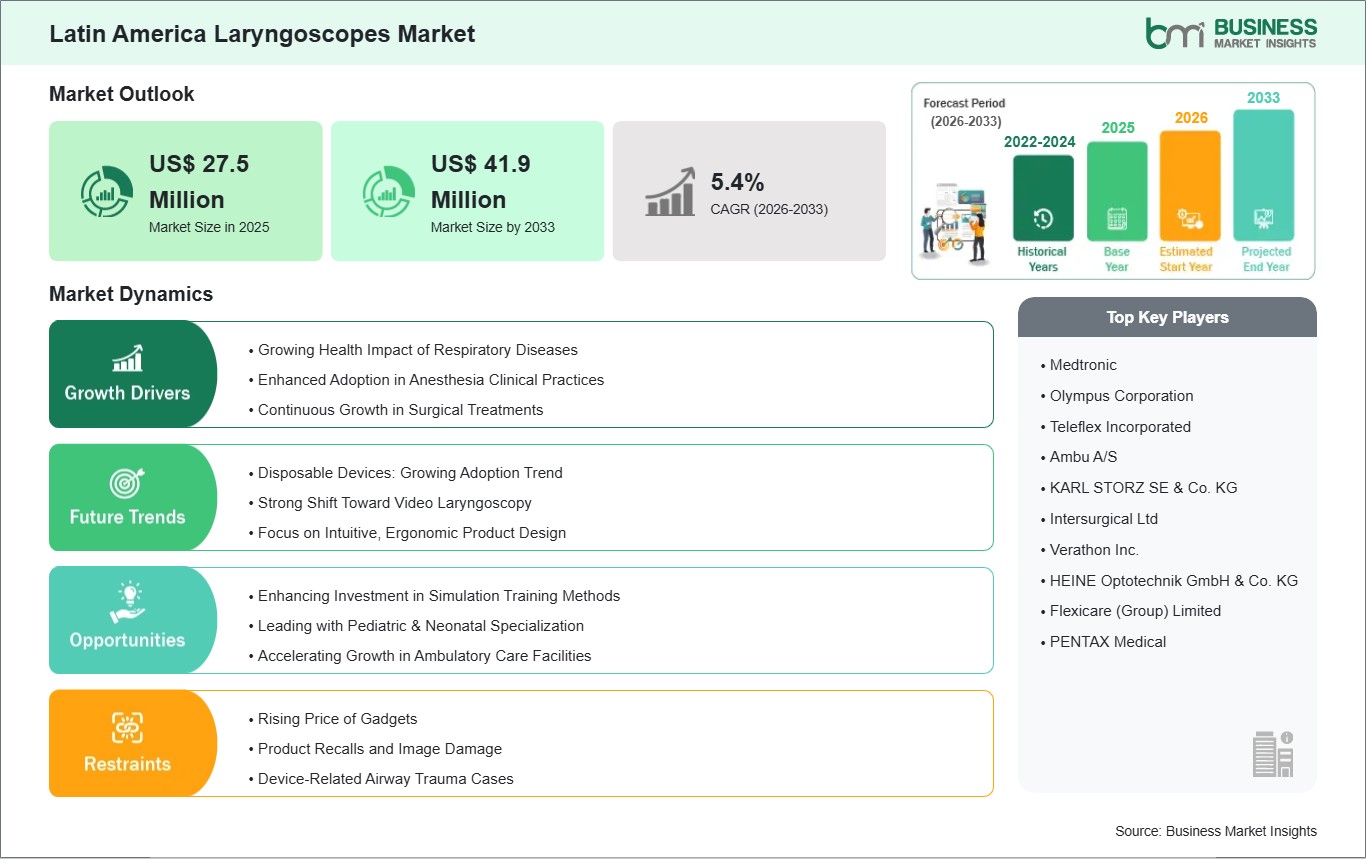
The Latin America laryngoscopes market size is expected to reach US$ 41.9 million by 2033 from US$ 27.5 million in 2025. The market is estimated to record a CAGR of 5.4% from 2026 to 2033.
The laryngoscopes market in Latin America features incremental growth, driven by continuous developments in health care access and rising need for surgical and emergency services. The use of laryngoscopes is crucial in managing the airways in cases related to anesthesia, critical care, and emergency medicine, and their application is growing in parallel with the development of medical expertise in the region. Health care professionals in key countries are increasingly embracing sophisticated techniques in laryngoscopy, which include video-assisted devices, to optimize visualization and ensure safety in the process. Direct laryngoscopes also account for a significant share of the region's health care market.
The key factor impacting the demand in this market segment is the improvement in hospital infrastructures and the increasing involvement of private healthcare providers, which are contributing towards increased accessibility to state-of-the-art technologies. Another important factor is the increase in awareness amongst the healthcare industry about the use of airway management solutions. The increase in the number of cases where surgical interventions are required due to chronic illnesses or respiratory problems is another important driver. However, variations in the economic situation in different countries usually impact the healthcare spending habits, which is why high-cost devices cannot be purchased on a wide scale. Also, lack of infrastructure in rural versus urban centers means that modern-day laryngoscope systems may not always be available to patients.

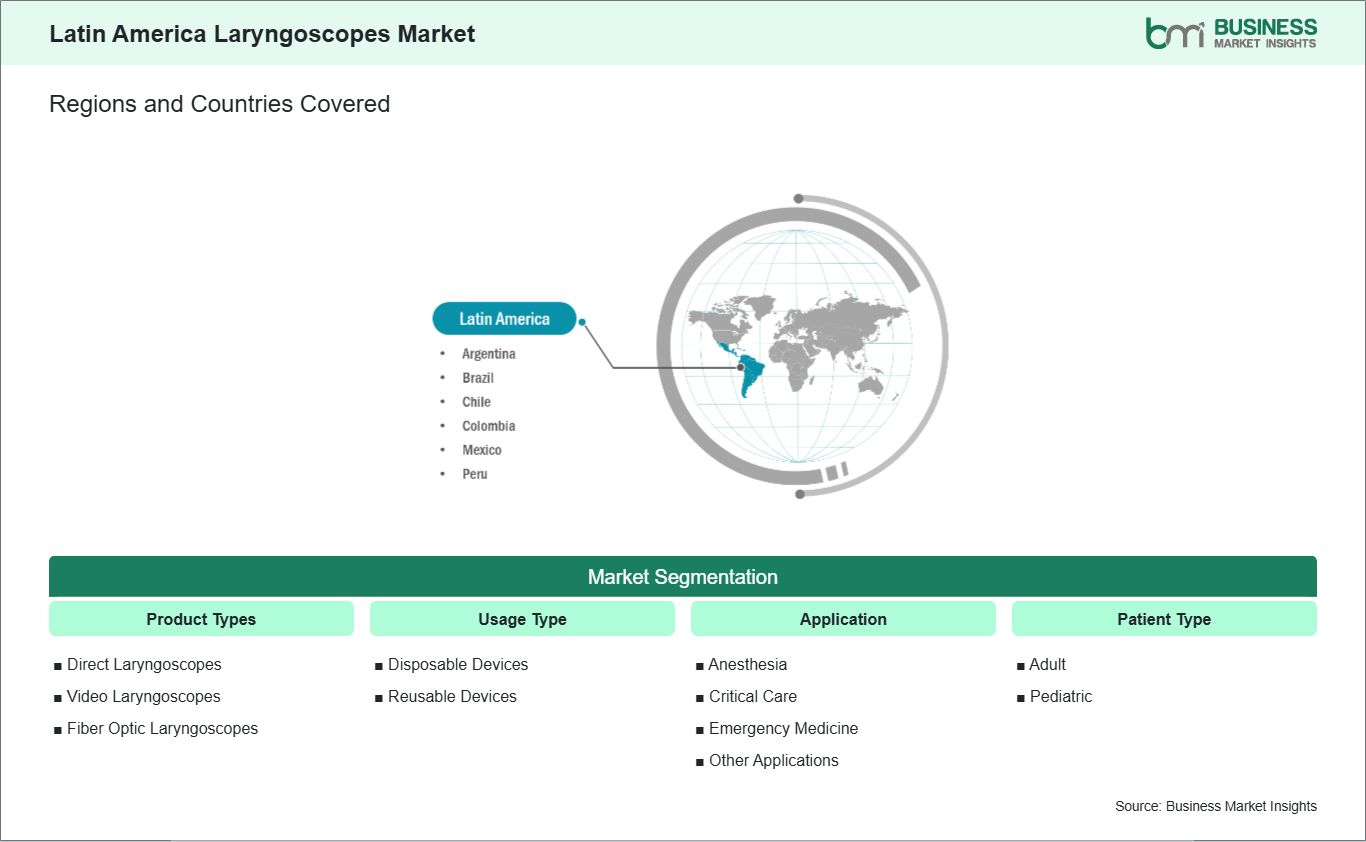
Key segments that contributed to the derivation of the Latin America laryngoscopes market analysis are product type, usage type, application, patient type, and end user.
Latin America is experiencing a significant and sustained rise in the health impact of respiratory diseases, driven by rapid urbanization, environmental exposure, and healthcare access disparities. São Paulo, Mexico City, and Buenos Aires face persistent air pollution challenges, which contribute to increasing rates of asthma and other chronic respiratory conditions. Urban living conditions, combined with traffic-related emissions and industrial activity, have been closely linked to higher respiratory morbidity, particularly among lower-income populations residing in densely populated areas.
Chronic respiratory diseases are now a major public health concern across the region, contributing to substantial mortality and long-term disability. Conditions such as COPD and asthma are widespread, with COPD affecting a notable portion of the adult population especially among smokers and individuals exposed to biomass fuels. In rural and peri-urban areas, the continued use of wood and charcoal for cooking further exacerbates lung damage, creating a dual burden of disease linked to both modern and traditional risk factors.
Additionally, respiratory diseases in Latin America are often underdiagnosed or detected at advanced stages, leading to more severe clinical presentations that require urgent intervention. Seasonal infections such as influenza and pneumonia, combined with chronic disease progression, frequently result in acute respiratory distress cases in hospitals. This increases the need for airway management procedures, reinforcing the importance of laryngoscopes across emergency departments, surgical units, and intensive care settings throughout the region.
Investment in simulation-based medical education is gaining momentum across Latin America as healthcare systems aim to improve clinical outcomes and address skill variability. Teaching hospitals in Brazil, Mexico, and Chile are expanding simulation centers that allow clinicians to practice airway management in controlled environments. These facilities use high-fidelity mannequins and scenario-based training to replicate real-life emergencies, helping practitioners refine intubation techniques without patient risk.
In several other regions, simulation training is also being used as a way to address inequalities in the availability of clinical exposure opportunities and resources. Practitioners working in smaller cities and rural settings may not have had much experience dealing with complicated airways, thus necessitating the use of simulation training to enhance their skills. The use of repetitive exercises has helped clinicians build confidence and expertise in handling laryngoscopes in high-stakes environments.
In addition, there are partnerships between governmental health organizations, academic institutions, and foreign organizations that are helping facilitate the adoption of up-to-date training infrastructures within the health sector. The government and independent health care providers are beginning to realize the benefits of using simulation technology as a means of creating uniformity in treatment and minimizing mistakes. As the simulation curriculum becomes more integrated with the clinical equipment available, proficiency in using advanced laryngoscopy devices, especially video laryngoscopy, is becoming increasingly common in Latin American countries.

The Latin America Laryngoscopes market demonstrates steady growth, with size and share analysis highlighting evolving trends and competitive dynamics among key players. The report evaluates important subsegments categorized within product type, usage type, application, patient type, and end user, highlighting their respective contributions to overall market performance.
By product type, the video laryngoscopes subsegment dominated the laryngoscopes market in 2025. This is driven by the increasing demand for enhanced airway visualization, improved first-pass intubation success rates, and reduced complications in difficult airway management, making them a key revenue driver for manufacturers and supporting strong adoption in clinical practice.
In terms of usage type, the disposable devices subsegment led the market in 2025. The dominance of disposable devices is attributed to the growing emphasis on infection control, prevention of cross-contamination, and the operational convenience of eliminating reprocessing and sterilization requirements in high-volume healthcare settings.
Based on application, the anesthesia subsegment held the largest share in 2025. Hospitals and surgical centers widely rely on laryngoscopes during anesthesia procedures for airway management and intubation, supported by the rising number of surgeries and the increasing use of advanced airway management techniques.
In terms of patient type, the adult subsegment dominated the market in 2025. This is driven by the higher prevalence of surgical procedures, critical care admissions, and chronic respiratory conditions among adults, resulting in greater demand for airway management devices in this population group.
By end user, the hospitals subsegment held the largest share in 2025. Hospitals maintain leadership due to their advanced infrastructure, availability of skilled healthcare professionals, high patient inflow, and strong capability to perform complex surgical and emergency procedures requiring laryngoscopy.
| Report Attribute | Details |
|---|---|
| Market size in 2025 | US$ 27.5 Million |
| Market Size by 2033 | US$ 41.9 Million |
| CAGR (2026 - 2033) | 5.4% |
| Historical Data | 2022-2024 |
| Forecast period | 2026-2033 |
| Segments Covered | By Product Types
|
|
Regions and Countries Covered
| |
| Latin America | Mexico, Brazil, Argentina, Peru, Chile, Colombia |
| Market leaders and key company profiles |
|
The "Latin America Laryngoscopes Market Size and Forecast (2022-2033)" report provides a detailed analysis of the market covering below areas:
The geographical scope of the Latin America Laryngoscopes market report is divided into: Brazil, Mexico, Argentina, Colombia, Chile, and Peru. Mexico held the largest share in 2025.
Mexico is one of the key markets for laryngoscopes in Latin America due to the growth of its healthcare infrastructure and increased attention to improving clinical practice. The healthcare infrastructure in Mexico is characterized by public healthcare organizations and the development of the private healthcare sector. The growth of demand for airway management devices takes place among both types of healthcare facilities. Hospitals in Mexico City, Monterrey, and Guadalajara are increasingly adopting laryngoscope technology, including video laryngoscopes.
The Mexican market can be defined as a combination of diverse degrees of technological uptake. Whereas privately run hospitals as well as adequately financed establishments are more likely to be interested in adopting highly sophisticated airway visualization systems, a large number of public healthcare facilities are still making use of traditional laryngoscope kits owing to budgetary limitations. The emergence of a segmented market environment means that different categories of products are still being used by various organizations within the country. The introduction of government programs designed to promote greater accessibility to healthcare services, as well as improve the structure of existing hospitals, has been slowly helping increase the adoption rate of medical equipment. Public healthcare facilities' budget issues, along with regional differences in the distribution of healthcare, have become an obstacle to the adoption of innovative medical solutions.

The Latin America Laryngoscopes market is evaluated by gathering qualitative and quantitative data post primary and secondary research, which includes important corporate publications, association data, and databases. A few of the key developments in the Latin America Laryngoscopes market are:
The Latin America Laryngoscopes Market is valued at US$ 27.5 Million in 2025, it is projected to reach US$ 41.9 Million by 2033.
As per our report Latin America Laryngoscopes Market, the market size is valued at US$ 27.5 Million in 2025, projecting it to reach US$ 41.9 Million by 2033. This translates to a CAGR of approximately 5.4% during the forecast period.
The Latin America Laryngoscopes Market report typically cover these key segments-
The historic period, base year, and forecast period can vary slightly depending on the specific market research report. However, for the Latin America Laryngoscopes Market report:
The Latin America Laryngoscopes Market is populated by several key players, each contributing to its growth and innovation. Some of the major players include:
The Latin America Laryngoscopes Market report is valuable for diverse stakeholders, including:
Essentially, anyone involved in or considering involvement in the Latin America Laryngoscopes Market value chain can benefit from the information contained in a comprehensive market report.
Please tell us your area of interest
(Market Segments/ Regions and Countries/ Companies)