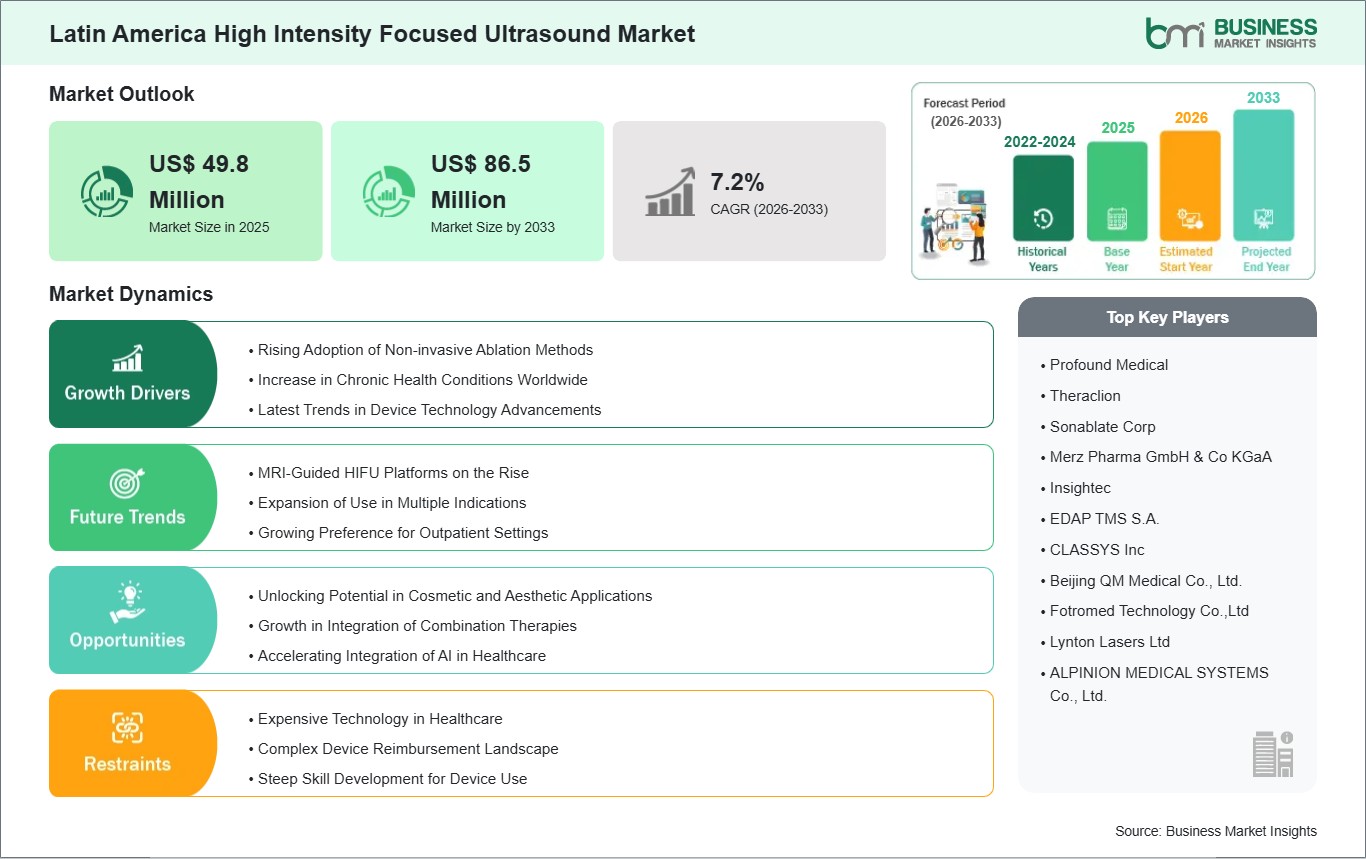
The Latin America high intensity focused ultrasound market size is expected to reach US$ 86.5 million by 2033 from US$ 49.8 million in 2025. The market is estimated to register a CAGR of 7.2% from 2026 to 2033.
The Latin American High Intensity Focused Ultrasound market has been gaining increasing strategic importance as healthcare infrastructures in the region evolve from traditional surgical procedures toward less invasive therapeutic alternatives. In recent years, HIFU technology has transitioned from being a niche innovation to a more mainstream intervention, particularly in oncology and gynecological care, driven by a growing preference among clinicians for treatments that reduce patient recovery time and minimize procedural risks. Key market drivers include an expanding base of trained specialists who are increasingly incorporating advanced energy‑based devices into clinical practice, broader acceptance of non‑invasive therapies by patients and caregivers, and supportive health policy shifts that encourage adoption of technologies promising better quality of care with lower hospitalization burdens. Nonetheless, the region faces challenges associated with limited reimbursement frameworks that delay institutional investment decisions, uneven healthcare spending across urban and rural areas, and the need for more robust clinical evidence tailored to local patient populations. Despite these restraints, the market’s positive innovation trajectory and heightened focus on precision medicine position HIFU as an increasingly relevant modality in Latin America’s therapeutic landscape.

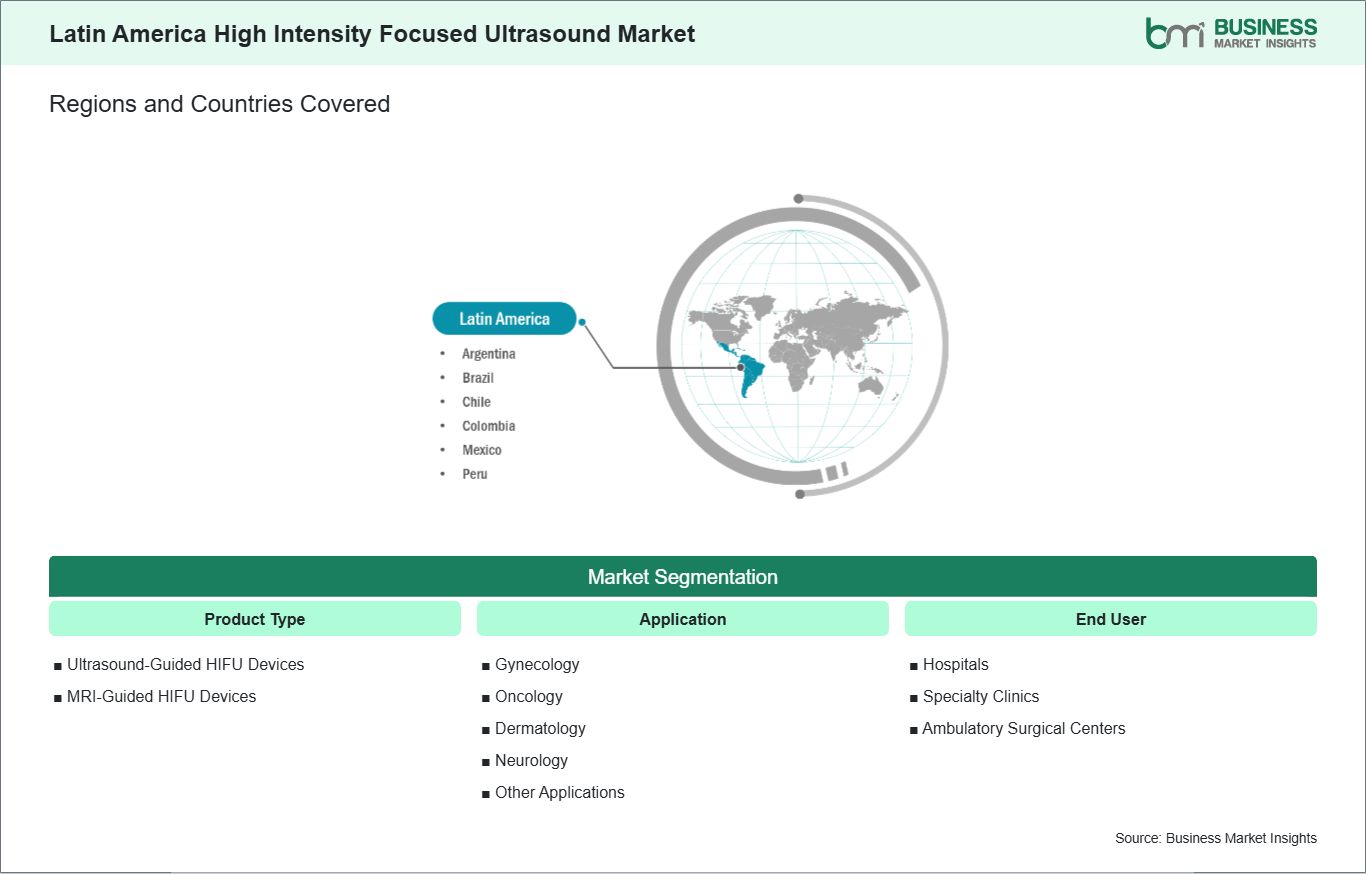
Key segments that contributed to the derivation of the Latin America high intensity focused ultrasound market analysis are product type, application, and end user.
Healthcare providers throughout Latin America are increasingly incorporating high intensity focused ultrasound (HIFU) as a non‑invasive treatment option for conditions that traditionally required surgical intervention. In major medical centers, clinicians are turning to HIFU to treat uterine fibroids, select tumors, and other localized tissue abnormalities, it allows for precise energy delivery without cutting through tissue. This has resonated with both patients and physicians seeking alternatives that reduce procedural risk and shorten recovery time.
Hospitals and specialty clinics are investing in training and infrastructure to support image‑guided HIFU procedures, improving clinical confidence in the technology. Interventional radiologists, gynecologists, and oncology specialists are collaborating to refine treatment workflows, leveraging real‑time imaging to plan and monitor ablation therapy. This multidisciplinary approach is helping to integrate HIFU into broader care pathways that emphasize patient comfort and procedural efficiency.
In addition, domestic initiatives aimed at expanding access to minimally invasive care are helping to drive interest in HIFU outside of major urban hubs. Healthcare networks are beginning to explore pilot programs in regional hospitals, enabling physicians to gain experience with focused ultrasound while increasing patient awareness of non‑surgical alternatives. As clinicians are more familiar with HIFU’s clinical potential, demand for non‑invasive ablation methods continues to grow across the region.
Alongside therapeutic uses, HIFU is gaining traction in the cosmetic and aesthetic sector throughout Latin America. Aesthetic clinics in metropolitan areas are offering non‑surgical skin tightening, face lifting, and body contouring treatments using focused ultrasound technologies. These services appeal to patients who want noticeable cosmetic results with minimal recovery time, fitting a broader regional trend toward minimally invasive beauty and wellness procedures.
Cosmetic practitioners are increasingly integrating HIFU with other non‑invasive modalities, such as radiofrequency and microneedling, to provide more comprehensive rejuvenation programs. By combining different technologies, clinics can tailor treatments to meet a wider range of aesthetic goals, from improving skin elasticity to reducing signs of aging. This flexibility enhances service offerings and helps practices attract clients seeking modern alternatives to traditional cosmetic surgery.
Consumer awareness is also playing a key role in expanding the adoption of HIFU for aesthetic applications. Many individuals now research and compare non‑surgical options before selecting a treatment, often influenced by patient testimonials and educational content shared online. Aesthetic centers are responding by emphasizing the safety profile and convenience of focused ultrasound procedures, helping position HIFU as a mainstream choice for cosmetic enhancement in the region’s evolving beauty landscape.

The Latin America high intensity focused ultrasound market demonstrates steady growth, with size and share analysis highlighting evolving trends and competitive dynamics among key players. The report evaluates important subsegments categorized within product type, application, and end user, highlighting their respective contributions to market performance.
By product type, the ultrasound-guided HIFU devices subsegment dominated the market in 2025. This is driven by the recurring need for precise and reliable imaging during HIFU procedures, which ensures accurate targeting and effective ablation of tissues, making these devices a key revenue driver for manufacturers and sustaining consistent demand in clinical settings.
In terms of application, the gynecology subsegment led the market in 2025. The dominance of gynecology applications is attributed to the rising prevalence of uterine fibroids and adenomyosis, growing adoption of non-invasive treatment methods, and increasing awareness among healthcare providers of HIFU’s effectiveness in providing safe, minimally invasive therapeutic options for women’s health conditions.
Based on end user, the hospitals subsegment held the largest share in 2025. Hospitals maintain leadership due to their well-established gynecology and surgical departments, access to advanced HIFU equipment, trained medical staff, and the capability to perform complex procedures while providing comprehensive patient care.
| Report Attribute | Details |
|---|---|
| Market size in 2025 | US$ 49.8 Million |
| Market Size by 2033 | US$ 86.5 Million |
| CAGR (2026 - 2033) | 7.2% |
| Historical Data | 2022-2024 |
| Forecast period | 2026-2033 |
| Segments Covered | By Product Type
|
|
Regions and Countries Covered
| |
| Latin America | Mexico, Brazil, Argentina, Peru, Chile, Colombia |
| Market leaders and key company profiles |
|
The "Latin America High Intensity Focused Ultrasound Market Size and Forecast (2022–2033)" report provides a detailed analysis of the market covering below areas:
The geographical scope of the Latin America High Intensity Focused Ultrasound market report is divided into: Brazil, Mexico, Argentina, Colombia, Chile, and Peru. Mexico held the largest share in 2025.
Mexico has emerged as the dominant market for High Intensity Focused Ultrasound solutions, reflecting the country’s relatively advanced healthcare infrastructure and proactive adoption of novel medical technologies. Mexico’s leadership in this space can be attributed to a combination of strong academic and clinical research communities advocating for minimally invasive care, and a steadily growing network of specialty medical centers that invest in state‑of‑the‑art therapeutic devices. Mexican healthcare providers are particularly focused on expanding HIFU applications across urology, oncology, and women’s health, recognizing the technology’s ability to serve as an alternative or complement to more invasive surgical procedures. A supportive regulatory environment that has streamlined approvals for energy‑based devices, along with increased collaborations between local hospitals and international technology partners, has also helped accelerate technology diffusion. Furthermore, patient awareness campaigns and specialist training programs have bolstered adoption by improving clinician confidence and patient acceptance. Access disparities between major urban hubs and smaller regional healthcare facilities persist, and ongoing efforts are necessary to ensure equitable reach of HIFU treatments across the country. Mexico’s position as the regional leader highlights its role as a key influencer in shaping Latin America’s HIFU market maturity.

The Latin America high intensity focused ultrasound market is evaluated by gathering qualitative and quantitative data post primary and secondary research, which includes important corporate publications, association data, and databases. A few of the key developments in the Latin America High Intensity Focused Ultrasound market are:
The Latin America High Intensity Focused Ultrasound Market is valued at US$ 49.8 Million in 2025, it is projected to reach US$ 86.5 Million by 2033.
As per our report Latin America High Intensity Focused Ultrasound Market, the market size is valued at US$ 49.8 Million in 2025, projecting it to reach US$ 86.5 Million by 2033. This translates to a CAGR of approximately 7.2% during the forecast period.
The Latin America High Intensity Focused Ultrasound Market report typically cover these key segments-
The historic period, base year, and forecast period can vary slightly depending on the specific market research report. However, for the Latin America High Intensity Focused Ultrasound Market report:
The Latin America High Intensity Focused Ultrasound Market is populated by several key players, each contributing to its growth and innovation. Some of the major players include:
The Latin America High Intensity Focused Ultrasound Market report is valuable for diverse stakeholders, including:
Essentially, anyone involved in or considering involvement in the Latin America High Intensity Focused Ultrasound Market value chain can benefit from the information contained in a comprehensive market report.
Please tell us your area of interest
(Market Segments/ Regions and Countries/ Companies)