Latin America Airway Management Devices Market Outlook (2022-2033)

Historic Data: 2022-2024   |   Base Year: 2025   |   Forecast Period: 2026-2033
Report Content: Market Scope, Market Segmentation, Market Dynamics, and Competitive Analysis

Report Coverage:
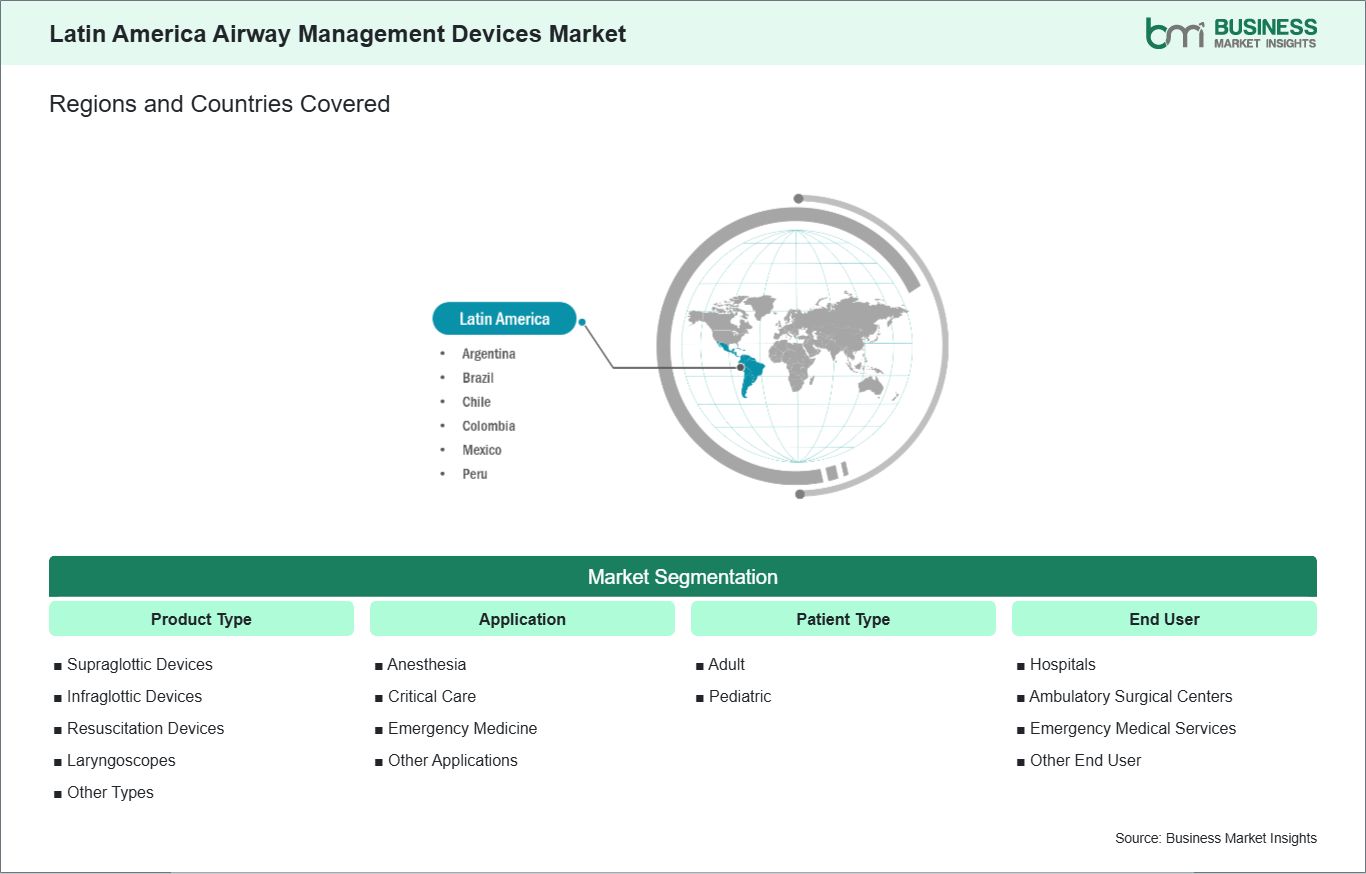
  • Product Type (Supraglottic Devices, Infraglottic Devices, Resuscitation Devices, Laryngoscopes, Other Types)
  • Application (Anesthesia, Critical Care, Emergency Medicine, Other Applications)
  • Patient Type (Adult, Pediatric)
  • End User (Hospitals, Ambulatory Surgical Centers, Emergency Medical Services, Other End User)

No. of Pages: 150
Report Code: BMIPUB00034859
Category: Life Sciences
Latin America Airway Management Devices Market

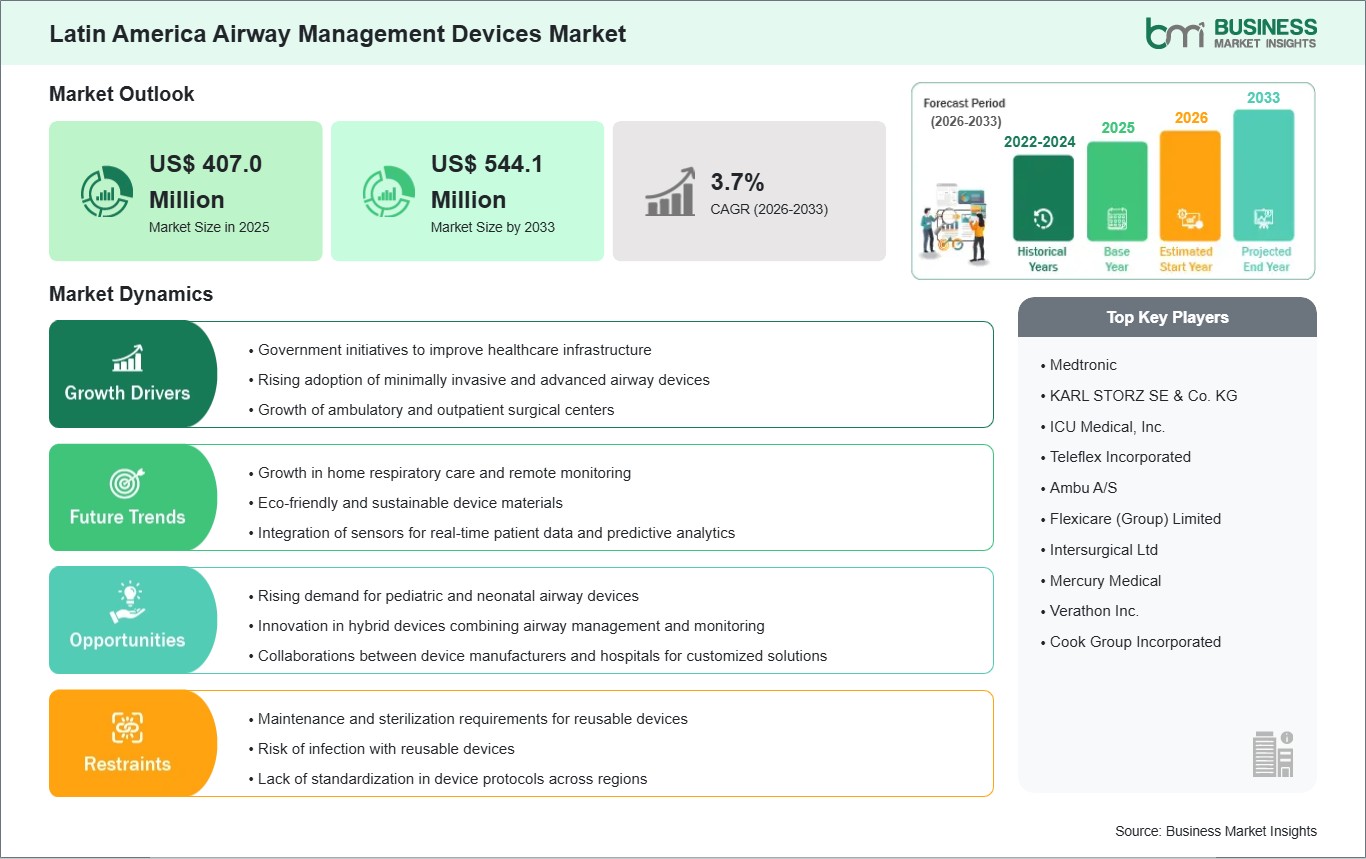
The Latin America airway management devices market size is expected to reach US$ 544.1 million by 2033 from US$ 407.0  million in 2025. The market is estimated to record a CAGR of 3.7% from 2026 to 2033.

Executive Summary and Latin America Airway Management Devices Market Analysis:

Latin America airway management devices market is one where a sense of transition can be noticed. There is an upsurge in health care consciousness and a rise in surgeries that have led to the growth of the market, but infrastructural and economic gaps continue to exist. Some of the countries included in the market are Mexico, Brazil, Argentina, Chile, and Colombia, while Mexico can be seen to dominate the market owing to several reasons. Some of the factors contributing to growth in the region include the prevalence of chronic respiratory disorders, increased surgical procedures, and the growth in intensive care unit admissions, especially in urban hospitals. Hospitals are transitioning from the use of basic airway management products to sophisticated equipment such as video laryngoscopes, supraglottic airway devices, and disposable intubation devices, reflecting international best practices. However, some constraints may limit the growth potential of the market. For instance, rural and semi-urban settings may lack state-of-the-art equipment due to the limited availability of modern medical equipment in the area. Moreover, the cost-sensitive nature of the region coupled with the need to import medical devices may affect purchases from small healthcare facilities. Nevertheless, the favorable growth prospects in the Latin American airway management devices market include strong government support, heightened clinical awareness, and healthcare facility investments.

Latin America Airway Management Devices Market - Strategic Insights:

global-market-strategic-framework
Get more information on this report

Latin America Airway Management Devices Market Segmentation Analysis:

Key segments that contributed to the derivation of the Latin America airway management devices market analysis are product type, application, patient type, and end user.

  • By product type, the airway management devices market is segmented into supraglottic devices, infraglottic devices, resuscitation devices, laryngoscopes, and other types. The infraglottic devices segment dominated the market in 2025.
  • Based on application, the airway management devices market is classified into anesthesia, critical care, emergency medicine, and other applications. The anesthesia segment dominated the market in 2025.
  • On the basis of patient type, the airway management devices market is bifurcated into adult and pediatric. The adult segment dominated the market in 2025.
  • In terms of end user, the airway management devices market is categorized into hospitals, ambulatory surgical centers, emergency medical services, and other end user. The hospitals segment dominated the market in 2025.

Latin America Airway Management Devices Market Drivers and Opportunities:

Government initiatives to improve healthcare infrastructure

In Latin America, government initiatives aimed at strengthening healthcare infrastructure are playing a pivotal role in the growth of the airway management devices market. Across countries such as Brazil, Mexico, and Colombia, recent public health plans have prioritized upgrading emergency and critical care facilities, particularly in underserved urban and rural areas. Investments in new regional hospitals and modernization of existing intensive care units have driven the procurement of advanced airway devices, including portable ventilators and video laryngoscopes, to support more effective respiratory intervention. These developments are part of broader national strategies to enhance crisis response capabilities after lessons learned from respiratory pandemics.

Additionally, public-private partnerships are also enhancing access to key airway management technology. Collaborative projects between the health ministries and private companies dealing in medical equipment in Peru and Chile are now ensuring that small community hospitals can have access to modern airway support mechanisms that would be found in major cities only. This development is ensuring that there is no discrepancy in terms of care delivery within regions that suffer from longer emergency service times. The local health authorities are also providing continued training sessions for the practitioners and paramedics regarding the use of airway support technology.

In addition, in Argentina, new fiscal policies have been introduced that now provide funding opportunities to invest in improved critical care facilities through competitive tendering for effective and efficient airway management technology. As part of national vaccination drives and chronic diseases, management campaigns, the requirement for an effective airway management system in case of serious infections and non-infections respiratory illnesses has been highlighted by the government, leading to increased budgetary allocation in this sector. These infrastructure-based changes are not only improving the quality of services but are also creating sustainable demand for airway management technology in Latin America.

Rising Demand For Pediatric And Neonatal Airway Devices

The need for specific airway devices for children and neonates is now being recognized by health administrators in Latin America, resulting in an increasing demand in the market. In Brazil and Mexico, for instance, the health authorities have been providing NICUs with devices that are suitable for the airway of children and neonates, including infant-specific endotracheal tubes, laryngeal masks tailored for small anatomy, and ventilators that reduce lung injury. The trend of having many births in certain areas and the development of neonatal survival programs account for this emphasis.

The hospitals dealing with pediatric patients in Colombia and Ecuador have been witnessing an increase in reports of respiratory distress caused due to congenital disorders and seasonal virus infections. These factors have forced health practitioners to search for diagnostic and treatment methods that are suitable for infants and young children. In response, the manufacturers of airway devices in the Latin American region have been organizing training sessions for health practitioners to help them learn to operate the sophisticated and sensitive pediatric devices. Such measures become very significant where hospitals used mostly adult-oriented solutions before.

In addition to this, the professional associations in Chile and Uruguay are advocating in Latin America to promote the benefits of using appropriate devices at the earliest in case of pediatric respiratory disease cases. As a result, there is a great deal of emphasis placed on the application of ergonomically-designed airway devices among neonates and infants. The respiratory care teams in hospitals have also been formed with the purpose of overcoming the difficulties related to the management of small airways in pediatric patients, leading to the use of innovations like removable cuffless tubes and miniature supraglottic airways.

Latin America Airway Management Devices Market Size and Share Analysis:

The Latin America airway management devices market is experiencing steady growth, with market size and share analysis reflecting evolving treatment preferences and competitive dynamics among key players. The report evaluates important subsegments categorized within product type, application, patient type, and end user, highlighting their respective contributions to overall market performance.

By product type, the infraglottic devices subsegment dominated the market in 2025. In anesthesia practice, infraglottic devices provide protection against aspiration and enable precise airway management, driving higher adoption in operating rooms and critical care settings compared to supraglottic devices.

Based on application, the anesthesia subsegment dominated the market in 2025 due to the need for definitive airway control across a wide range of surgical procedures, from routine elective surgeries to complex interventions. Because infraglottic devices are essential for intubation during anesthesia, this segment experiences consistent, high-volume usage, making it the largest segment compared to emergency or general critical care.

In terms of patient type, the adult subsegment dominated the market in 2025. Most procedural training, device designs, and usage guidelines are optimized for adult anatomy and usage scenarios, reinforcing higher market volume.

Based on end user, the hospital subsegment dominated the market in 2025, as hospitals remain the central hub for airway management, handling scheduled surgeries, emergency admissions, ICU care, and trauma cases. Their larger budgets, need for extensive airway inventories, and availability of multidisciplinary professionals make them the largest purchasers compared to outpatient centers or EMS, where volume and purchasing power are comparatively lower.

Latin America Airway Management Devices Market Report Highlights:

Report Attribute Details
Market size in 2025 US$ 407.0 Million
Market Size by 2033 US$ 544.1 Million
CAGR (2026 - 2033)3.7%
Historical Data 2022-2024
Forecast period 2026-2033
Segments Covered By Product Type
  • Supraglottic Devices
  • Infraglottic Devices
  • Resuscitation Devices
  • Laryngoscopes
  • Other Types
By Application
  • Anesthesia
  • Critical Care
  • Emergency Medicine
  • Other Applications
By Patient Type
  • Adult
  • Pediatric
By End User
  • Hospitals
  • Ambulatory Surgical Centers
  • Emergency Medical Services
  • Other End User
Regions and Countries Covered
Latin America Mexico, Brazil, Argentina, Peru, Chile, Colombia
Market leaders and key company profiles
  • Medtronic
  • KARL STORZ SE & Co. KG
  • ICU Medical, Inc.
  • Teleflex Incorporated
  • Ambu A/S
  • Flexicare (Group) Limited
  • Intersurgical Ltd
  • Mercury Medical
  • Verathon Inc.
  • Cook Group Incorporated
Get more information on this report

Latin America Airway Management Devices Market Report Coverage and Deliverables:

The "Latin America Airway Management Devices Market Size and Forecast (2022–2033)" report provides a detailed analysis of the market covering below areas:

  • Latin America airway management devices market size and forecast at the regional and country levels for market segments covered under the scope
  • Latin America airway management devices market trends, as well as drivers, restraints, and opportunities
  • Latin America airway management devices market analysis covering key trends, regional framework, major players, regulations, and recent developments
  • Industry landscape and competition analysis covering market concentration, heat map analysis, prominent players, and recent developments for the Latin America airway management devices market
  • Detailed company profiles, including SWOT analysis

Latin America Airway Management Devices Market Geographic Insights:

The geographical scope of the Latin America airway management devices market report is divided into: Brazil, Mexico, Argentina, Colombia, Chile, and Peru. Mexico held the largest share in 2025.

Mexico dominates the Latin America airway management devices market due to its relatively advanced healthcare infrastructure and focus on improving surgical and emergency care outcomes. Large urban hospitals in Mexico are increasingly integrating advanced airway management technologies such as video laryngoscopes, second-generation supraglottic airway devices, and disposable intubation kits to improve patient safety and procedural efficiency. One such factor that needs to be mentioned is the increasing focus by the country on emergency medical care facilities with ambulances equipped with proper equipment and skilled paramedics to perform airway management. Additionally, the Mexican government encourages technological innovation in the field of medicine through its public hospital modernization projects, thus promoting the use of new airway equipment. Training is one of the most important components when considering the adoption of medical devices, whereby anaesthesiologists and emergency staff are trained using simulations that will help them be more efficient with their use of modern airway management devices. Collaboration between Mexican organizations and foreign device makers has increased the availability of high-quality devices at relatively lower costs, making it possible to scale up in both private and government-owned hospitals.

global-market-geography
Get more information on this report

Latin America Airway Management Devices Market Research Report Guidance:

  • The report includes qualitative and quantitative data in the Latin America airway management devices market across product type, application, patient type, end user, and geography.
  • The report starts with the key takeaways (chapter 2), highlighting the key trends and outlook of the Latin America Airway management devices market.
  • Chapter 3 focuses on the research methodology of the study.
  • Chapter 4 includes ecosystem analysis.
  • Chapter 5 highlights the major industry dynamics in the Latin America airway management devices market, including factors that are driving the market, prevailing deterrents, potential opportunities, as well as future trends. Impact analysis of these drivers and restraints is also covered in this section.
  • Chapter 6 discusses the Latin America airway management devices market scenario, in terms of historical market revenues, and forecast till the year 2033.
  • Chapters 7 to 11 cover Latin America airway management devices market segments by product type, application, patient type, end user, and geography across Brazil, Mexico, Argentina, Colombia, Chile, and Peru. They cover the market revenue, forecast, and factors driving the market.
  • Chapter 12 describes the competitive analysis along with the heat map analysis for the key players operating in the market.
  • Chapter 13 describes the industry landscape analysis. It provides detailed descriptions of business activities such as market initiatives, new developments, mergers, and joint ventures globally, along with a competitive landscape.
  • Chapter 14 provides detailed profiles of the major companies operating in the Latin America airway management devices market. Companies have been profiled on the basis of their key facts, business descriptions, products, financial overview, SWOT analysis, and key developments.
  • Chapter 15, i.e., the appendix, is inclusive of a brief overview of the company, list of abbreviations, and disclaimer.

Latin America Airway Management Devices Market News and Key Development:

The Latin America airway management devices market is evaluated by gathering qualitative and quantitative data post primary and secondary research, which includes important corporate publications, association data, and databases. A few of the key developments in the Latin America airway management devices market are:

  • In March 2025, Medtronic plc announced that it expanded its regional supply and clinical support operations in Brazil, including broader deployment of its McGrath video laryngoscope and related airway management tools to meet rising demand from surgical and critical care units in the region (reflecting the company’s broader product rollout and regional expansion strategy).
  • In October 2024, a leading international airway device manufacturer (e.g., Ambu A/S) announced plans to increase its distribution footprint for single‑use airway management devices across Latin American hospital networks, enabling improved access to disposable laryngoscopes and supraglottic airway products in Brazil and neighbouring markets.

Key Sources Referred:

  • The World Bank
  • World Health Organization (WHO)
  • Center for Disease Control and Prevention (CDC)
  • European Database on Medical Devices (EUDAMED)
  • European Society of Cardiology
  • American College of Cardiology
  • American Heart Association
  • Company Websites
  • Company Annual Reports
  • Company Investor Presentations
The List of Companies - Latin America Airway Management Devices Market
  • Medtronic
  • KARL STORZ SE & Co. KG
  • ICU Medical, Inc.
  • Teleflex Incorporated
  • Ambu A/S
  • Flexicare (Group) Limited
  • Intersurgical Ltd
  • Mercury Medical
  • Verathon Inc.
  • Cook Group Incorporated
Frequently Asked Questions
How big is the Latin America Airway Management Devices Market?

The Latin America Airway Management Devices Market is valued at US$ 407.0 Million in 2025, it is projected to reach US$ 544.1 Million by 2033.

What is the CAGR for Latin America Airway Management Devices Market by (2026 - 2033)?

As per our report Latin America Airway Management Devices Market, the market size is valued at US$ 407.0 Million in 2025, projecting it to reach US$ 544.1 Million by 2033. This translates to a CAGR of approximately 3.7% during the forecast period.

What segments are covered in this report?

The Latin America Airway Management Devices Market report typically cover these key segments-

  • Product Type (Supraglottic Devices, Infraglottic Devices, Resuscitation Devices, Laryngoscopes, Other Types)
  • Application (Anesthesia, Critical Care, Emergency Medicine, Other Applications)
  • Patient Type (Adult, Pediatric)
  • End User (Hospitals, Ambulatory Surgical Centers, Emergency Medical Services, Other End User)

What is the historic period, base year, and forecast period taken for Latin America Airway Management Devices Market?

The historic period, base year, and forecast period can vary slightly depending on the specific market research report. However, for the Latin America Airway Management Devices Market report:

  • Historic Period : 2022-2024
  • Base Year : 2025
  • Forecast Period : 2026-2033
  • Who are the major players in Latin America Airway Management Devices Market?

    The Latin America Airway Management Devices Market is populated by several key players, each contributing to its growth and innovation. Some of the major players include:

  • Medtronic
  • KARL STORZ SE & Co. KG
  • ICU Medical, Inc.
  • Teleflex Incorporated
  • Ambu A/S
  • Flexicare (Group) Limited
  • Intersurgical Ltd
  • Mercury Medical
  • Verathon Inc.
  • Cook Group Incorporated
  • Who should buy this report?

    The Latin America Airway Management Devices Market report is valuable for diverse stakeholders, including:

    • Investors: Provides insights for investment decisions pertaining to market growth, companies, or industry insights. Helps assess market attractiveness and potential returns.
    • Industry Players: Offers competitive intelligence, market sizing, and trend analysis to inform strategic planning, product development, and sales strategies.
    • Suppliers and Manufacturers: Helps understand market demand for components, materials, and services related to concerned industry.
    • Researchers and Consultants: Provides data and analysis for academic research, consulting projects, and market studies.
    • Financial Institutions: Helps assess risks and opportunities associated with financing or investing in the concerned market.

    Essentially, anyone involved in or considering involvement in the Latin America Airway Management Devices Market value chain can benefit from the information contained in a comprehensive market report.

    Available Report Formats

    pdf-format excel-format pptx-format
    Buy Now
    Sales Assistance
    +1 646 791 7070 (US & UK)
    Customization Form

    Please tell us your area of interest
    (Market Segments/ Regions and Countries/ Companies)