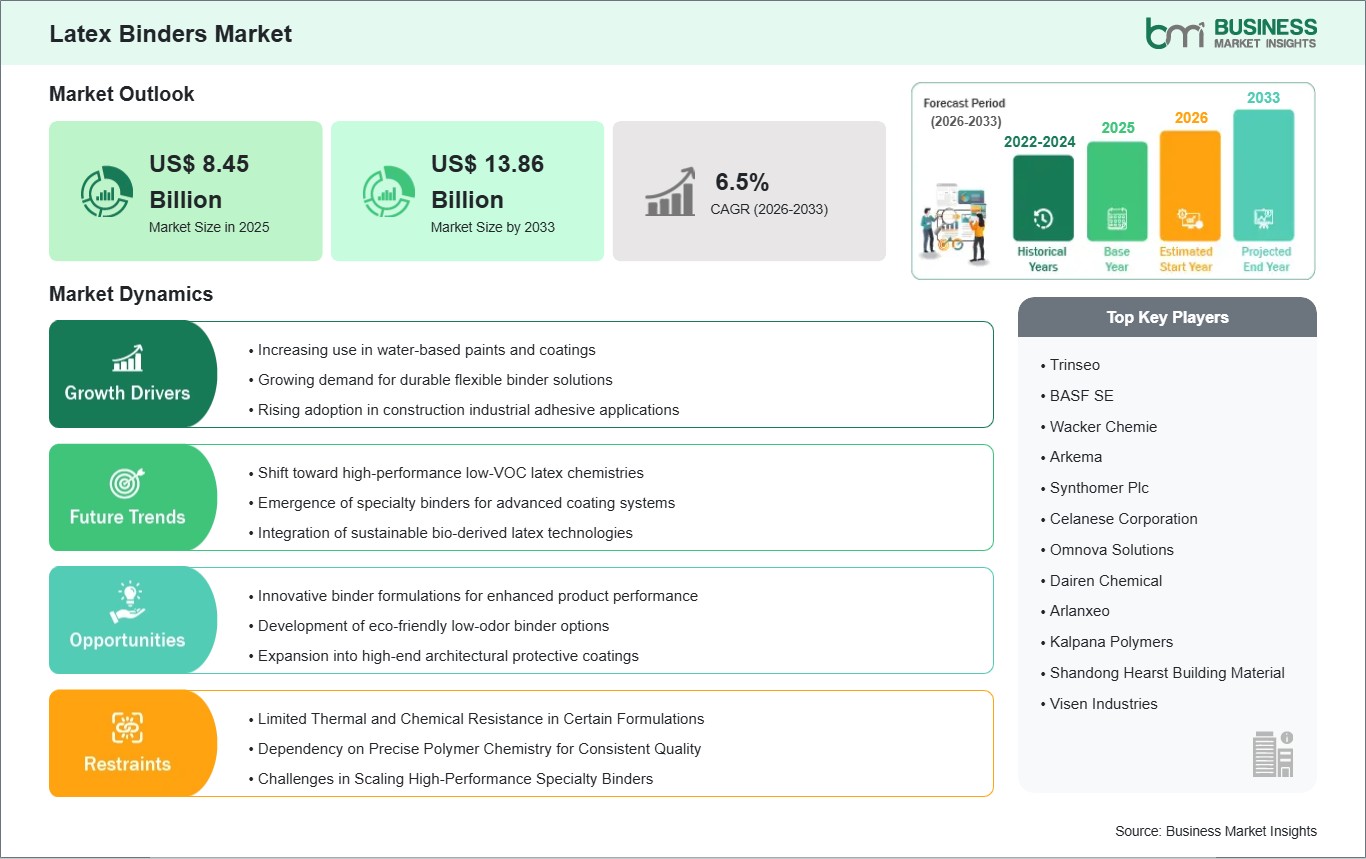
The Latex Binders Market size is expected to reach US$ 13.86 Billion by 2033 from US$ 8.45 Billion in 2025. The market is estimated to record a CAGR of 6.38% from 2026 to 2033.
The global latex binders market is a cornerstone of many industries that rely on strong adhesion, flexibility, and durability in their products. Latex binders, which are water-based polymer dispersions, are widely used across paints and coatings, paper and paperboard, textiles, carpet backing, and specialty adhesives. Due to their capacity to create films, bond firmly to surfaces, and withstand cracking, latex binders are the preferred choice of manufacturers who want their products to deliver consistent results. Latex binder coatings, for example, guarantee that paints will maintain their color and texture over time while still offering washability and durability against wear and tear. Latex binders also guarantee improved strength, smoothness, and printability of papers and packages, and durability and smoothness of fabrics and carpets. The wide range of latex binders makes them suitable for manufacturers who want to deliver products that meet different specifications.
The increasing demand for environmentally friendly and green products with low emissions is fueling the demand for latex binders worldwide. Manufacturers and consumers are looking for latex binders that will help them minimize the emission of volatile organic compounds (VOCs) without compromising their products' performance. Despite the huge market demand, there are challenges that manufacturers face in meeting the market demand. The cost and availability of raw materials can affect production, especially for specialized formulations. Additionally, other binder technologies, like hybrid polymer systems or solvent-based alternatives, remain competitive in niche applications that require extreme chemical or environmental resistance. Manufacturers are focusing on innovation, developing latex binders that meet sustainability goals while delivering superior performance. Those who can balance these factors effectively are well-positioned to capture opportunities in a market that continues to grow with evolving industrial and consumer needs.

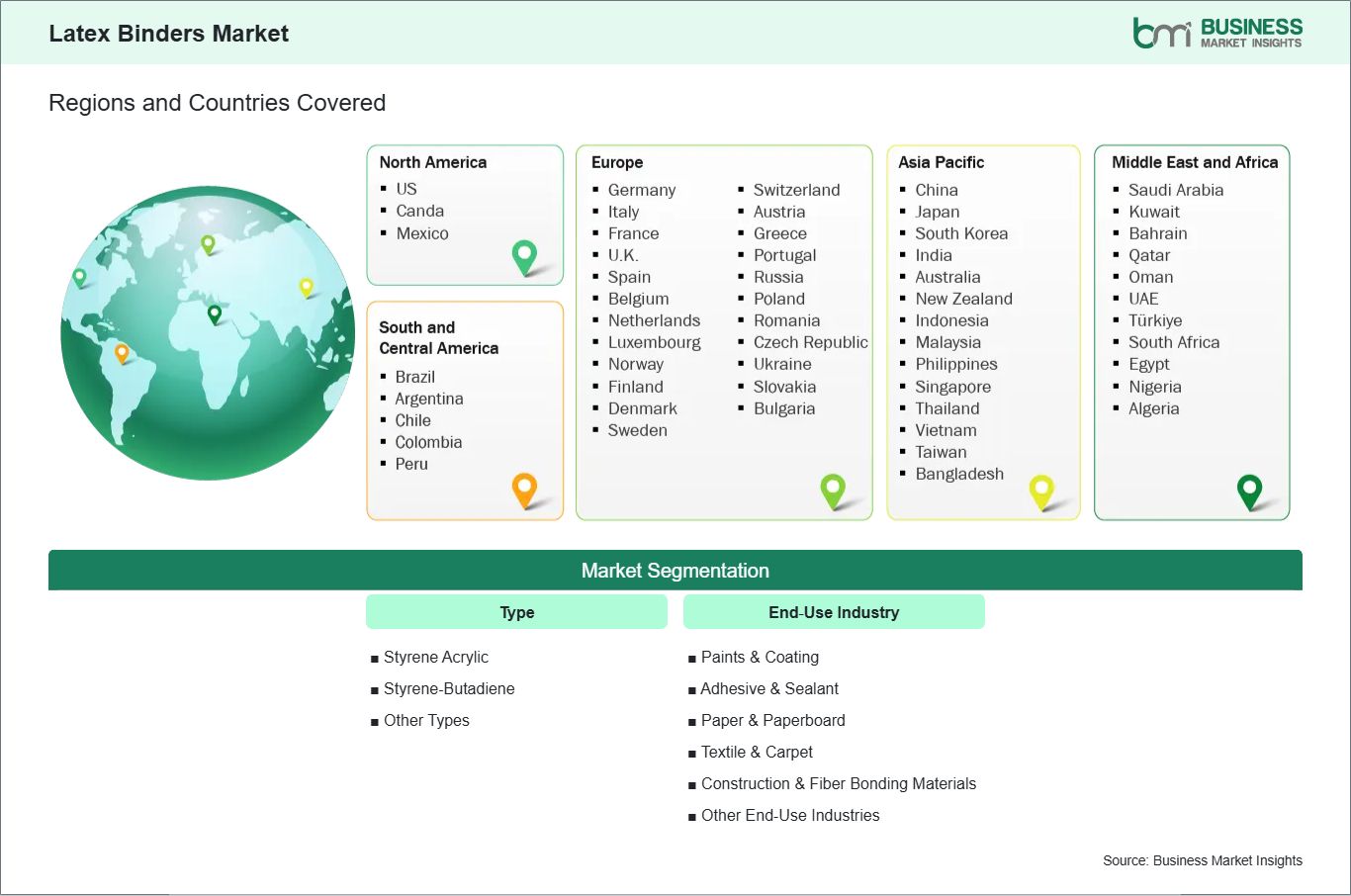
Key segments that contributed to the derivation of the latex binders market analysis are type and end‑use industry.
The global latex binders market has seen significant growth as a result of the increasing usage of latex binders in water-based paints and coatings, as this type of paint and coating is becoming the go-to solution for sustainable and VOC-free products. Latex binders, being a type of film-forming polymer, have excellent adhesion, flexibility, and durability, and are considered a necessity for the manufacturing of premium-quality interior and exterior paints. In industrial, commercial, and residential construction, latex-based coatings are seen as a solution that not only maintains the aesthetic appeal of a structure but also helps in achieving environmental compliance, especially in regions where there are strict regulations on emissions.
Water-based paints containing latex binders have numerous benefits that have led to their increasing popularity worldwide. These include their quick-drying properties, reduced emission of volatile organic compounds, and ease of cleanup using water, making them suitable for different applications such as architectural and protective coatings. During large-scale commercial and high-rise construction projects, paint contractors often prefer to use latex binder-based paints because of their reliability and superior performance in different climatic conditions. Moreover, the demand for low-odor and non-toxic paints is also boosting the market for different types of decorative and functional paints worldwide.
The adoption of latex binders is further supported by technological advances in polymer chemistry, which have improved the performance characteristics of water-based paints. Modern formulations enhance adhesion to multiple substrates, increase resistance to abrasion, and reduce cracking and peeling over time. As global construction and renovation activities continue to expand, the use of water-based coatings with latex binders is expected to grow steadily. Their combination of sustainability, ease of use, and high performance positions latex binders as a critical component in the ongoing transformation of the paints and coatings industry toward greener, more efficient solutions.
Innovation in latex binder formulations is driving the global market by enabling enhanced performance characteristics in paints, coatings, adhesives, and specialty applications. Advanced latex binders are engineered to provide superior adhesion, improved water and chemical resistance, and better mechanical strength, which are critical for demanding industrial and architectural applications. Formulators are using new copolymers, crosslinking agents, and hybrid blend systems to meet specific performance needs, such as faster drying times, flexibility, and weatherability, to enable their products to withstand harsh environmental conditions for long periods of time.
Apart from performance improvements, the new innovative binder systems are helpful in developing multifunctional products to meet the specific needs of customers. For example, anti-microbial, anti-fungal, and stain-resistant latex binders are used in developing paints, which are used in healthcare facilities, hospitality industries, and other public areas. Moreover, innovation in UV-resistant and heat-resistant binders is helpful in developing protective coatings for metal, wooden, and concrete substrates, which enhances the durability of structures and maintains their aesthetic appeal. Innovation in the field of latex binder coatings also extends the market scope of latex binder coatings beyond paints.
The drive for enhanced product performance is closely aligned with sustainability and regulatory compliance. Innovative latex binders are being formulated to reduce VOC content, improve environmental compatibility, and provide energy-efficient manufacturing benefits. By enabling the production of high-performance, eco-friendly coatings and adhesives, these advanced binders support both industrial efficiency and consumer preferences for safe, sustainable products. As demand for durable, high-performance, and environmentally responsible solutions continues to rise, the global latex binder market is expected to grow steadily, with innovation in formulations remaining a key factor in differentiating products and expanding application opportunities worldwide.

The latex binders market is experiencing steady growth, with market size and share analysis reflecting evolving treatment preferences and competitive dynamics among key players. The report evaluates important subsegments categorized within type and end‑use industry, highlighting their respective contributions to overall market performance.
By type, the styrene‑butadiene subsegment dominated the latex binders market in 2025. Styrene‑butadiene binders offer excellent adhesion, flexibility, and water resistance, driving their widespread use across coatings and industrial applications.
Based on end-use industry, the paints & coating subsegment dominated the latex binders market in 2025. Paints and coatings applications rely on latex binders for superior film formation, durability, and aesthetic finish, reinforcing the dominance of this segment.
| Report Attribute | Details |
|---|---|
| Market size in 2025 | US$ 8.45 Billion |
| Market Size by 2033 | US$ 13.86 Billion |
| Global CAGR (2026 - 2033) | 6.38% |
| Historical Data | 2022-2024 |
| Forecast period | 2026-2033 |
| Segments Covered | By Type
|
|
Regions and Countries Covered
| |
| North America | US, Canada, Mexico |
| Europe | Belgium, Austria, Finland, Denmark, Greece, Poland, Romania, Russia, Ukraine, Czech Republic, Slovakia, Bulgaria, Italy, Luxembourg, Germany, Switzerland, France, Netherlands, Norway, Portugal, Spain, Sweden, United Kingdom |
| Asia-Pacific | Australia, China, India, Japan, South Korea, Indonesia, Malaysia, Philippines, Singapore, Thailand, Vietnam, Bangladesh, New Zealand, Taiwan |
| South and Central America | Brazil, Argentina, Peru, Chile, Colombia |
| Middle East and Africa | Bahrain, Kuwait, Oman, Qatar, Saudi Arabia, United Arab Emirates, Turkiye, South Africa, Egypt, Algeria, Nigeria |
| Market leaders and key company profiles |
|
The "Latex Binders Market Size and Forecast (2022 - 2033)" report provides a detailed analysis of the market covering below areas:
The geographical scope of the Latex Binders market report is divided into five regions: North America, Asia Pacific, Europe, Middle East & Africa, and South & Central America. The Latex Binders market in North America is expected to grow during the forecast period.
North America dominates the latex binders industry, and this can be attributed to the fact that this region has well-established industries that require latex binders for quality and durability. The region, comprising the United States and Canada, has a well-established coatings, adhesives, paper, and textile industry, among others. In the architectural coatings industry, for example, latex binders are highly sought for the quality and durability of paint that they are able to produce. The paint produced by latex binders is not only easy to apply but also maintains color and withstands weathering. The fact that this region demands eco-friendly products, such as low-VOC products, has led to a shift from traditional solvent-based latex binders to water-based latex binders.
Beyond coatings, North America’s paper, packaging, and textile industries benefit from the functional properties of latex binders, which improve strength, surface finish, and adhesion in end products. Carpet backing and specialty adhesives also rely on these binders for flexibility and durability. The region’s focus on regulatory compliance, product safety, and sustainability has prompted manufacturers to invest in research and development for new formulations that meet evolving requirements. Collaboration between raw material suppliers, polymer producers, and end-users has strengthened the innovation ecosystem, enabling faster adoption of next-generation latex binders. With a strong emphasis on product performance, environmental responsibility, and supply chain reliability, North America continues to set the benchmark for the global latex binders market and shapes trends that influence other regions around the world.

The latex binders market is evaluated by gathering qualitative and quantitative data post primary and secondary research, which includes important corporate publications, association data, and databases. A few of the key developments in the latex binders market are:
The Latex Binders Market is valued at US$ 8.45 Billion in 2025, it is projected to reach US$ 13.86 Billion by 2033.
As per our report Latex Binders Market, the market size is valued at US$ 8.45 Billion in 2025, projecting it to reach US$ 13.86 Billion by 2033. This translates to a CAGR of approximately 6.38% during the forecast period.
The Latex Binders Market report typically cover these key segments-
The historic period, base year, and forecast period can vary slightly depending on the specific market research report. However, for the Latex Binders Market report:
The Latex Binders Market is populated by several key players, each contributing to its growth and innovation. Some of the major players include:
The Latex Binders Market report is valuable for diverse stakeholders, including:
Essentially, anyone involved in or considering involvement in the Latex Binders Market value chain can benefit from the information contained in a comprehensive market report.
Please tell us your area of interest
(Market Segments/ Regions and Countries/ Companies)