
Intraoral Imaging Market Outlook: Size, Share, Trends, Growth Analysis, Competitive Landscape & Forecast, 2026-2033

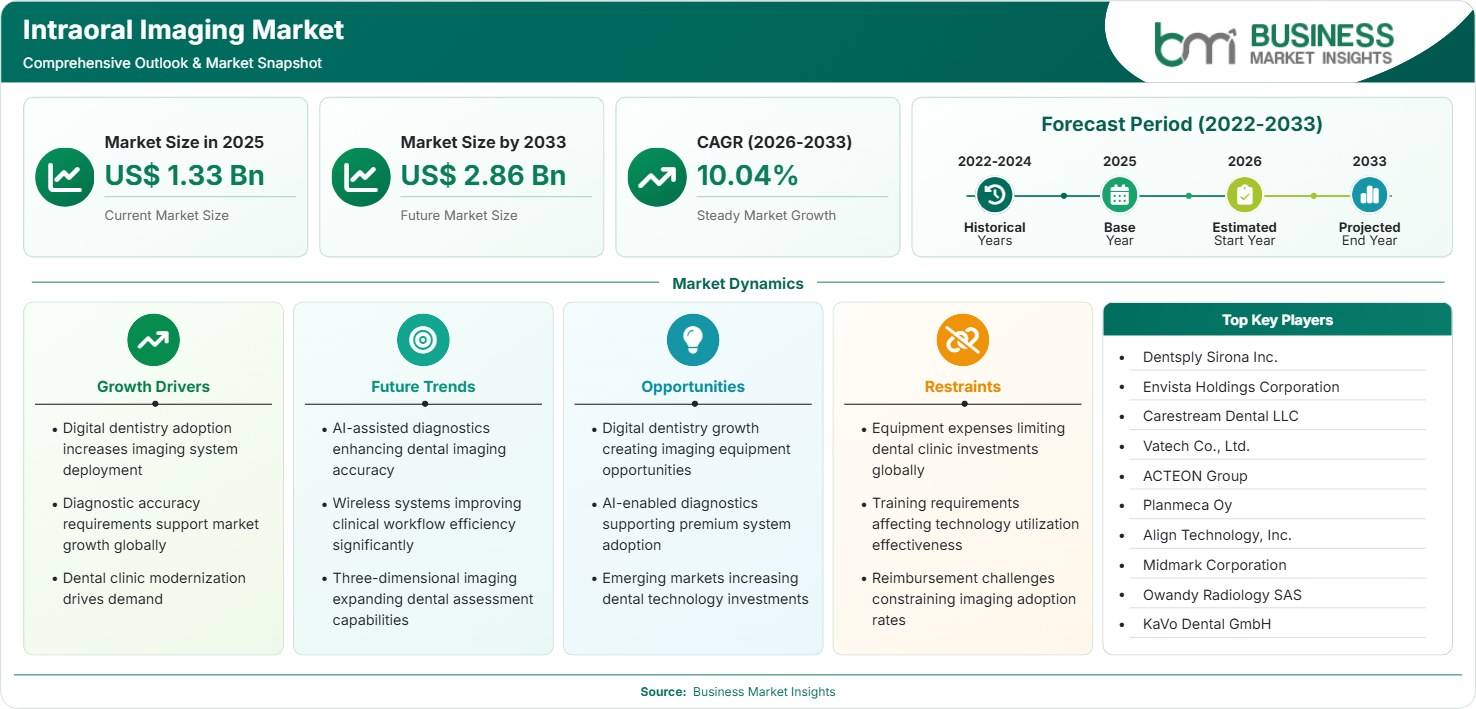
The Intraoral Imaging Market size was valued at US$ 1.33 Billion in 2025 and is projected to reach US$ 2.86 Billion by 2033, growing at a CAGR of 10.04% during 2026–2033, driven by digital dentistry adoption, AI-enabled diagnostics, rising cosmetic procedures, expanding dental service organizations, and growing investments in chairside workflow integration and preventive oral care technologies.

Report Coverage
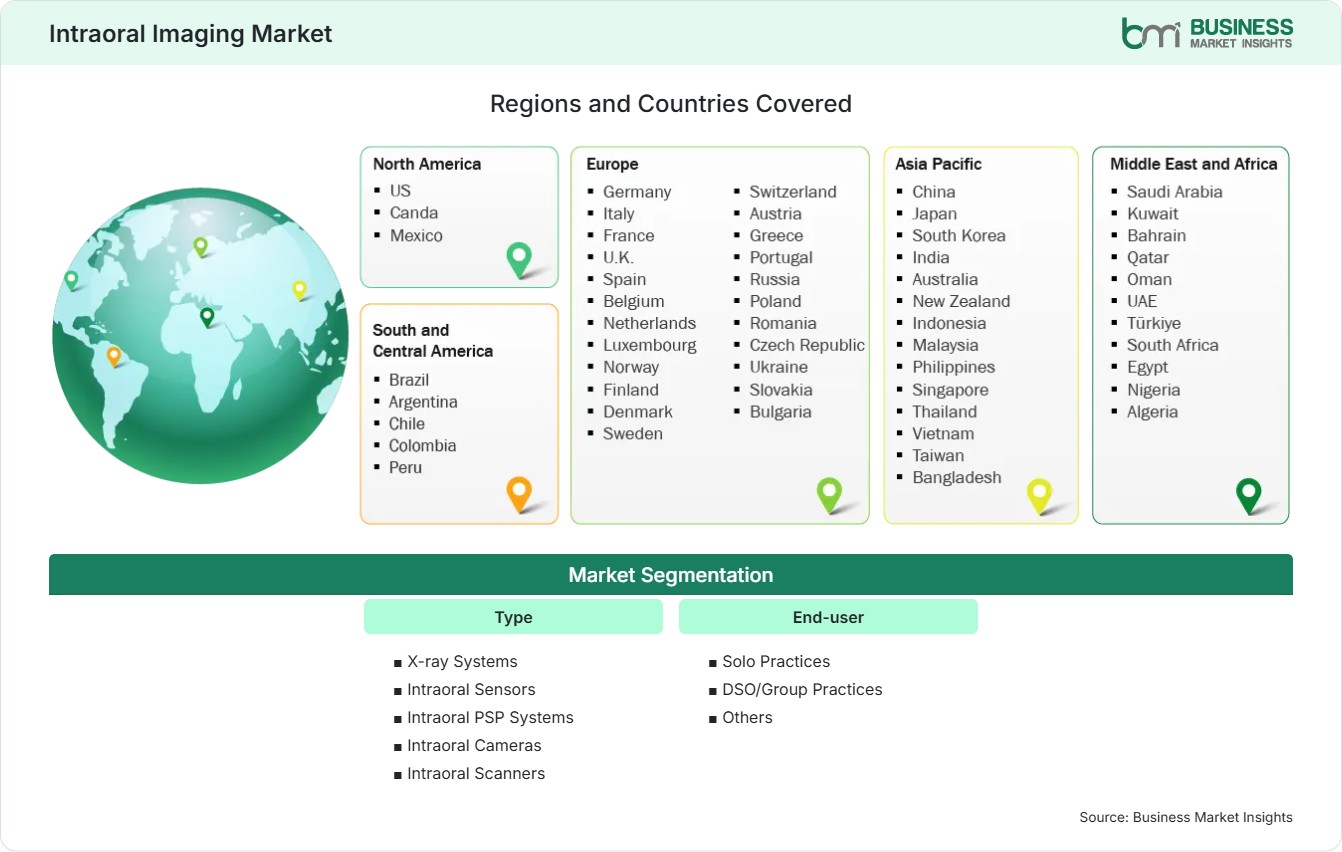
  • Type: X-ray Systems, Intraoral Sensors, Intraoral PSP Systems, Intraoral Cameras, Intraoral Scanners
  • End-user: Solo Practices, DSO/Group Practices, Others
US$ 1.33 Bn Market size in 2025
US$ 2.86 Bn Market Size by 2033
10.04% CAGR, 2026 - 2033
2026-2033 Forecast Period

AI Overview

Intraoral Imaging Market Summary

  • North America Region: North America holds a market share of 37%–40% in 2025, growing with a CAGR of 8.5%–9.5% during 2026–2033, supported by high digital dentistry penetration, favorable reimbursement environments, strong dental clinic investments, growing cosmetic dentistry demand, integrated workflows, preventive care initiatives, advanced diagnostic adoption, and expanding imaging software ecosystems across practices. The U.S. remains the largest contributor, supported by DSO expansion and digital workflow adoption, advancing at a CAGR of 8.8%–9.8%.
  • Fastest Growing Region: Asia Pacific accounts for 24%–27% Intraoral Imaging Market share in 2025 and is projected to expand at a CAGR of 11.5%–12.5% during 2026–2033, supported by dental infrastructure modernization, healthcare spending growth, rising middle-class populations, increasing oral health awareness, private clinic expansion, digital equipment financing availability, tourism-driven dentistry, and accelerated technology adoption in emerging economies.
  • Leading Segment: X-ray Systems hold a 31%–34% share in 2025 and are anticipated to grow at a CAGR of 8.8%–9.8% during 2026–2033, benefiting from broad clinical applicability, diagnostic reliability, workflow integration, continuous technology enhancements, regulatory acceptance, practitioner familiarity, preventive screening growth, and rising utilization across restorative and orthodontic procedures worldwide.
  • High Growth Segment: Intraoral Scanners represent an 18%–21% share in 2025 and are expected to achieve a CAGR of 13.0%–14.0% during 2026–2033, driven by digital impressions, laboratory connectivity, chairside restoration workflows, treatment planning accuracy, patient comfort improvements, orthodontic applications, cloud-based collaboration, and increasing demand for fully digital dental ecosystems.
  • Key Market Opportunity: Growing integration of artificial intelligence with imaging platforms creates opportunities for automated diagnostics, enhanced treatment planning, predictive oral disease detection, workflow optimization, clinician productivity gains, and scalable cloud-enabled dental networks.
  • Major Market Players: Dentsply Sirona Inc., Envista Holdings Corporation, Carestream Dental LLC, Vatech Co., Ltd., ACTEON Group, Planmeca Oy, Align Technology, Inc., Midmark Corporation, Owandy Radiology SAS, and KaVo Dental GmbH.
Strategic Insights

Intraoral Imaging Market: Strategic Insights

Intraoral Imaging Market Strategic Framework
FREE PDF
Request your free sample
Request free sample
Stakeholder View

Key Takeaways

  • The value chain is increasingly interconnected with imaging device manufacturers, software houses, CAD/CAM providers, labs, and dental clinics all working together to create an integrated diagnostic and treatment environment.
  • The biggest growth potential is to be found in the digital workflow applications, specifically scanner-based ortho, scanner-based implant planning, scanner-based restorative, and in the multi-location dental practice.
  • Innovation is moving from discrete pieces of equipment to intelligent platforms that incorporate AI-assisted image interpretation, cloud storage, workflow automation, and the ability to integrate with the wider clinical management system.
  • Asia Pacific presents a compelling investment case due to expanding dental infrastructure, growing private healthcare expenditure, favorable demographics, and rapid adoption of digital technologies among younger practitioners.
  • Strategic acquisitions are increasingly being focused on software capabilities, imaging analytics, and workflow integration solutions as vendors look for differentiation and recurring revenue.
  • Competitive positioning is increasingly going to be about service quality, training support, software updates, and ecosystem partnerships rather than just the hardware specs.
Geographic Outlook

Intraoral Imaging Market Regional Highlights

North America Intraoral Imaging Market

North America accounted for approximately 37%–40% of global revenue in 2025 and is expected to grow at a CAGR of 8.5%–9.5% through 2033. The Intraoral Imaging Market share in North America remains supported by continuous equipment upgrades, integrated digital workflows, increasing cosmetic treatment demand, and growing utilization of AI-assisted imaging tools across clinical environments.

  • Large DSO networks are increasingly moving towards standardization of their digital imaging systems across the network. This has the benefit of improving operational consistency, diagnostic reliability, clinician productivity, and procurement efficiency, and provides a platform for ongoing software and maintenance revenue.
  • Strong consumer spend on cosmetic and restorative procedures is continuing to drive equipment utilization rates, especially in the areas of implantology, orthodontics, and aesthetic dentistry where high-quality imaging is a key factor in the accuracy of treatment planning.
  • Growing use of AI-enabled imaging analytics is helping clinicians to identify potential pathology, enabling preventative interventions and improving patient communication during the course of a treatment consultation.
  • Regulatory clarity around digital health technologies will facilitate the commercialization of next-generation imaging platforms and at the same time provide the impetus for investment in integrated software ecosystems and in cybersecurity capabilities.
  • Academies and further education providers are actively promoting digital workflow training to boost practitioner confidence and encourage wider adoption of technology in the independent practice environment.

US Intraoral Imaging Market

The United States represents approximately 78%–82% of North American Intraoral Imaging Market revenue and is projected to register a CAGR of 8.8%–9.8% during 2026–2033. Market expansion is supported by corporate dentistry growth, increasing dental insurance participation, high technology awareness among clinicians, and strong demand for cosmetic procedures.

  • Multi-location practice operators are investing in centralized patient data management and integrated imaging systems to achieve the benefits of scale, consistent workflow, and improved operational visibility.
  • Adoption of the more advanced scanners and digital diagnostic technologies is picking up pace among ortho's and implant specialists looking for greater treatment accuracy and more patient engagement tools.
  • The ongoing replacement of legacy radiography systems will continue to drive demand for upgraded sensors, software, and imaging systems within the existing base of dental practices.
  • The increasing demand for same-day restorative procedures is driving greater integration of imaging devices into the manufacturing and CAD/CAM workflows in modern dental practices.

Europe Intraoral Imaging Market

Europe accounted for approximately 27%–30% of Intraoral Imaging Market revenue in 2025 and is forecast to expand at a CAGR of 9.0%–10.0% through 2033. The region benefits from mature dental infrastructures, strong practitioner adoption of digital technologies, and increasing demand for minimally invasive treatments.

  • Germany has the lead through its vast network of dental clinics, its significant investment in technology, and its strong presence of manufacturers who, in turn, support innovation and training of the practitioners.
  • France and the UK are continuing to expand their adoption of digital dentistry with an increase in orthodontic treatment and greater use of digital imaging for treatment planning.
  • Eastern European countries are in the process of modernizing their healthcare systems, and this is creating opportunities for imaging equipment suppliers and their distribution partners.
  • The demand for lower radiation diagnostic technologies is driving the replacement of ageing radiography equipment with digitally connected equipment in both the public and private sectors.
  • Cross border collaboration between dental labs and clinicians is driving up the demand for interoperable imaging and workflow management solutions.

Asia Pacific Intraoral Imaging Market

Asia Pacific represented approximately 24%–27% of global Intraoral Imaging Market revenue during 2025 and is expected to achieve the fastest CAGR of 11.5%–12.5% through 2033. Rising disposable incomes, growing awareness of preventive dental care, expanding private clinic investments, and favorable demographic trends collectively support regional expansion.

  • Urban dental chains are increasingly using sophisticated imaging platforms to differentiate their clinical services and underpin higher-value treatment options in the highly competitive urban marketplaces.
  • Dental tourism is growing in a number of countries, and this has prompted clinics to invest in digital technology to improve the quality of treatment and the patient experience.
  • Government initiatives aimed at the modernization of healthcare will go some way towards facilitating the wider uptake of digital equipment and the enhancement of diagnostic capability across the public healthcare sector.
  • Local manufacturing capability will improve product availability and, in the process, strengthen the regional supply chain and the after-sales support ecosystem.
  • The younger practitioners are clearly in favor of digital workflows, and that is driving the uptake of scanners, sensors, and integrated imaging systems.

Rest of World Intraoral Imaging Market

The Rest of World region accounted for approximately 8%–10% of global Intraoral Imaging Market revenue in 2025 and is projected to grow at a CAGR of 9.5%–10.5% through 2033. South and Central America are benefiting from private dental sector expansion and increasing technology penetration.

  • Private healthcare investments throughout the Gulf countries are being used to fund the acquisition of high-end diagnostic equipment and the expansion of their premium dental service portfolios.
  • Brazilian dental practitioners are increasingly adopting digital workflows to improve treatment efficiency and to enhance their competitiveness in the urban healthcare market.
  • International manufacturers are going ahead with the expansion of regional partnerships to improve distribution efficiency, service delivery and the breadth of practitioner training.
  • Growing awareness of oral health is leading to earlier diagnosis and hence increased demand for advanced imaging in private clinics.
  • Infrastructure modernization programs are a route to technology deployment in a number of emerging economies and create long-term opportunities for the equipment and software suppliers.
Global Market Geography
FREE PDF
Request your free sample
Request free sample
Segment Analysis

Intraoral Imaging Market Segmentation

Type

This segment accounted for approximately 68%–71% of total revenue in 2025 and is projected to expand at a CAGR of 9.8%–10.8% through 2033. The growing adoption of cloud-enabled diagnostics, AI-supported imaging, and integrated treatment planning tools continues to broaden the Intraoral Imaging Market scope across general dentistry, orthodontics, prosthodontics, and implantology applications.

  • X-ray Systems: Remain essential diagnostic tools for routine examinations, restorative procedures, and pathology detection. Continuous hardware improvements, digital integration, and widespread clinical familiarity support sustained utilization across dental practices globally.
  • Intraoral Sensors: Adoption is increasing due to immediate image acquisition, enhanced diagnostic precision, reduced radiation exposure, and seamless connectivity with practice management software and digital treatment planning systems.
  • Intraoral Photostimulable Phosphor Systems: Preferred in clinics seeking a balance between digital transition costs and imaging flexibility, offering reusable plates, quality image output, and simplified workflow implementation.
  • Intraoral Cameras: Growing utilization for patient communication, treatment visualization, case documentation, and preventive care consultations supports demand among general practitioners and specialty dental clinics.
  • Intraoral Scanners: Rapid adoption is driven by digital impression workflows, orthodontic planning, implant procedures, laboratory collaboration, and increasing preference for fully digital treatment ecosystems.

End-user

The end-user segment represented approximately 29%–32% of market revenue in 2025 and is forecast to register a CAGR of 10.8%–11.8% through 2033. Current Intraoral Imaging Market trends indicate stronger investments in imaging technologies among organizations pursuing scalable care delivery models, centralized data management, and enhanced diagnostic consistency.

  • Solo Practices: Independent dentists continue investing in digital imaging solutions to improve diagnostic capabilities, patient engagement, treatment acceptance rates, and competitiveness against larger multi-location organizations.
  • DSO/Group Practices: Rapid expansion of corporate dentistry supports large-scale procurement of advanced imaging systems, standardized workflows, centralized data management, and integrated technology infrastructures across multiple clinic locations.
Market Forces

Intraoral Imaging Market Dynamics

Key Market Drivers

Expansion of Digital Dentistry Workflows

Dental clinics worldwide are accelerating the transition from analog processes to integrated digital ecosystems, creating sustained demand for advanced imaging technologies. CAD/CAM adoption, digital impression systems, and software-based treatment planning are encouraging providers to upgrade legacy equipment. The increasing need for efficient diagnostics and faster clinical decision-making continues to support equipment modernization across both independent and corporate practices. Current Intraoral Imaging Market growth is closely linked to the broader digitalization of dental services, while evolving trends indicate stronger demand for interoperable imaging platforms capable of supporting multi-disciplinary treatment environments.

Rising Prevalence of Oral Health Disorders

The incidence of dental caries, periodontal disease, tooth loss, and malocclusion is rising, increasing demand for accurate diagnostic imaging. The WHO estimates that oral disease affects billions of people globally, and this underlines the importance of early diagnosis and the use of preventive strategies. Advanced imaging allows for more accurate identification of pathology and facilitates the development of individualized treatment plans. With the aging of the population in both the developed and the developing world, the demand for restorative, implant, and orthodontic treatment is set to continue to grow.

Growth of Cosmetic and Implant Dentistry

Demand for aesthetic dentistry and implant-based restorations is on the rise in both developed and emerging markets. Patients are increasingly looking for cosmetic improvements, orthodontics, and permanent restorations, and to achieve this, they require high-quality diagnostic imaging as part of their treatment planning. Intraoral imaging provides a level of visualization that enhances the predictability of the procedure and reduces the incidence of complications. The growth in volume is being driven by expanding disposable incomes, increased awareness of the range of aesthetic dental options and the influence of social media.

Key Market Opportunities

Artificial Intelligence Integration in Diagnostic Imaging

Artificial intelligence represents a significant avenue for value creation across dental imaging workflows. AI-enabled systems can support clinicians by identifying potential abnormalities, assisting image interpretation, prioritizing diagnostic findings, and enhancing consistency across practices. Vendors are increasingly incorporating machine learning capabilities within software platforms to improve workflow efficiency and clinical productivity. The opportunity extends beyond diagnostics into treatment planning, patient communication, and predictive oral health management. These developments support long-term Intraoral Imaging Market Forecasts focused on intelligent, data-driven clinical decision support.

Expansion of Dental Service Organizations in Emerging Markets

The continued growth of dental service organizations across Asia Pacific, Latin America, and the Middle East creates substantial Intraoral Imaging Market opportunities for imaging vendors. Corporate practice models typically prioritize standardized technology platforms, centralized procurement strategies, and scalable clinical workflows. These requirements align closely with advanced digital imaging solutions that improve operational consistency and patient outcomes. As private equity participation in dental care expands, larger clinic networks are expected to invest in imaging upgrades across multiple locations simultaneously.

Cloud-Based Imaging and Remote Collaboration Platforms

Cloud-connected imaging ecosystems are opening up new areas of growth through remote consultations, multidisciplinary treatment planning, and lab collaboration. There's a clear move in the dental profession towards solutions that enable secure image sharing across sites and patient record access. Cloud deployment has the potential to break down information silos and improve workflow continuity in a multi-site environment. The technology providers that can offer a scalable, security-centric imaging platform are the ones that will be in a good position to capitalize on this.

Market Restraints and Challenges

High Capital Investment and Ownership Costs

Factor: The up-front cost of advanced imaging systems is significant and is then compounded by software licensing, staff training, maintenance, and periodic upgrades. Impact: This can be a major constraint on the purchasing decisions of smaller clinics and independent practices that are working with limited capital. The long-term efficiency gains are very real, but the capital outlay can delay the adoption cycle.

Data Security and Interoperability Challenges

Factor: The increased use of cloud platforms, digital patient records and integrated imaging systems brings with it an increased concern around cybersecurity, data privacy compliance and software compatibility. Impact: A security breach or interoperability issue can have a knock-on effect on clinical workflow, erode clinician confidence, and add to implementation complexity. If these issues aren't adequately addressed, then the rate of deployment could be slowed and wider adoption of the digitally connected imaging ecosystem could be constrained.

Company Analysis

Competitive Landscape

The competitive environment remains characterized by continuous product innovation, software integration, workflow digitization, and expanding AI capabilities. Current Intraoral Imaging Market analysis indicates that vendors are increasingly differentiating through ecosystem connectivity, imaging accuracy, cloud-based collaboration tools, and comprehensive service offerings tailored to digital dentistry workflows.

Company Name

Overview

Products and Services relevant to this market

Dentsply Sirona Inc.

Global dental technology leader with extensive digital dentistry capabilities spanning diagnostics, treatment planning, and clinical workflow optimization solutions.

Intraoral scanners, digital X-ray systems, imaging software, CAD/CAM solutions, treatment planning platforms, and integrated digital dentistry services.

Envista Holdings Corporation

Diversified dental technology company focused on diagnostics, specialty products, and digital workflows supporting clinical efficiency and patient outcomes.

Imaging systems, intraoral scanners, diagnostic software, orthodontic technologies, implant planning tools, and digital workflow solutions.

Carestream Dental LLC

Provider of imaging systems and software platforms supporting advanced diagnostics and connectivity throughout dental practices worldwide.

Intraoral sensors, imaging software, digital radiography systems, workflow management tools, and cloud-enabled clinical solutions.

Vatech Co., Ltd.

Specialized dental imaging company recognized for innovation in radiographic technologies and diagnostic imaging equipment development.

Intraoral sensors, digital radiography equipment, dental imaging software, diagnostic platforms, and workflow integration solutions.

ACTEON Group

International dental technology provider offering diagnostic and imaging systems serving general and specialty dental practitioners.

Intraoral cameras, imaging systems, diagnostic software, preventive care technologies, and clinical workflow enhancement solutions.

Planmeca Oy

Leading digital dentistry supplier emphasizing integrated imaging, software interoperability, and advanced diagnostic technologies.

Intraoral scanners, imaging platforms, digital radiography systems, software ecosystems, and treatment planning solutions.

Align Technology, Inc.

Prominent digital orthodontics company leveraging advanced scanning technologies and connected treatment workflows.

Intraoral scanners, visualization software, digital treatment planning tools, orthodontic workflow solutions, and cloud-based services.

Midmark Corporation

Healthcare equipment provider supporting dental clinics through integrated diagnostic, workflow, and operatory technologies.

Imaging integration platforms, clinical workflow systems, software connectivity tools, and dental operatory technology solutions.

Owandy Radiology SAS

Dental imaging specialist focused on diagnostic technologies and digital radiography solutions for modern clinics.

Intraoral sensors, digital imaging devices, radiography systems, imaging software, and diagnostic workflow applications.

KaVo Dental GmbH

Established dental equipment manufacturer serving global practitioners through technology-focused clinical solutions.

Imaging equipment, diagnostic technologies, practice integration systems, workflow support tools, and digital dentistry solutions.

Trust & Transparency

Research Methodology

The market analysis combines proprietary research with secondary data from government agencies, company disclosures, regulatory filings, industry databases and expert interviews. Market estimates are validated through data triangulation, cross-market benchmarking and analyst review.

View Full Research Methodology

Questions Answered

Frequently Asked Questions

What does the Intraoral Imaging Market Report typically cover?

The Intraoral Imaging Market report evaluates market size, revenues, growth outlook, regional performance, technology trends, competitive positioning, investment opportunities, end-user adoption patterns, regulatory influences, and strategic developments shaping future industry expansion.

What role does artificial intelligence play in imaging workflows?

Artificial intelligence assists image interpretation, anomaly detection, treatment planning support, workflow automation, and patient communication. Its use is expected to expand as software capabilities mature and clinical confidence increases.

Which technology category is expected to experience the fastest adoption?

Intraoral scanners are expected to record the strongest momentum due to demand for digital impressions, clear aligner treatment planning, laboratory connectivity, and fully integrated chairside workflows that improve efficiency and patient comfort.

How are dental service organizations influencing industry development?

Large dental service organizations increasingly standardize imaging platforms across locations, enabling centralized procurement, consistent clinical protocols, stronger equipment utilization rates, and accelerated deployment of digital workflows.

What factors are accelerating the adoption of digital intraoral imaging technologies?

Growing demand for accurate diagnostics, digital treatment planning, AI-assisted workflows, orthodontic procedures, and patient-friendly clinical experiences are driving adoption. Improved interoperability with CAD/CAM platforms also supports faster and more efficient care delivery.

Access the Full Intraoral Imaging Market Report

Get segment-level forecasts, regional estimates, competitive benchmarking, company profiles and downloadable Excel datasets.

Access the full Intraoral Imaging Market Report
350 pages PDF & Excel | 2026-11-10
Similar Research

Related Market Reports