Glaucoma Therapeutics Market Regional Highlights
North America Glaucoma Therapeutics Market
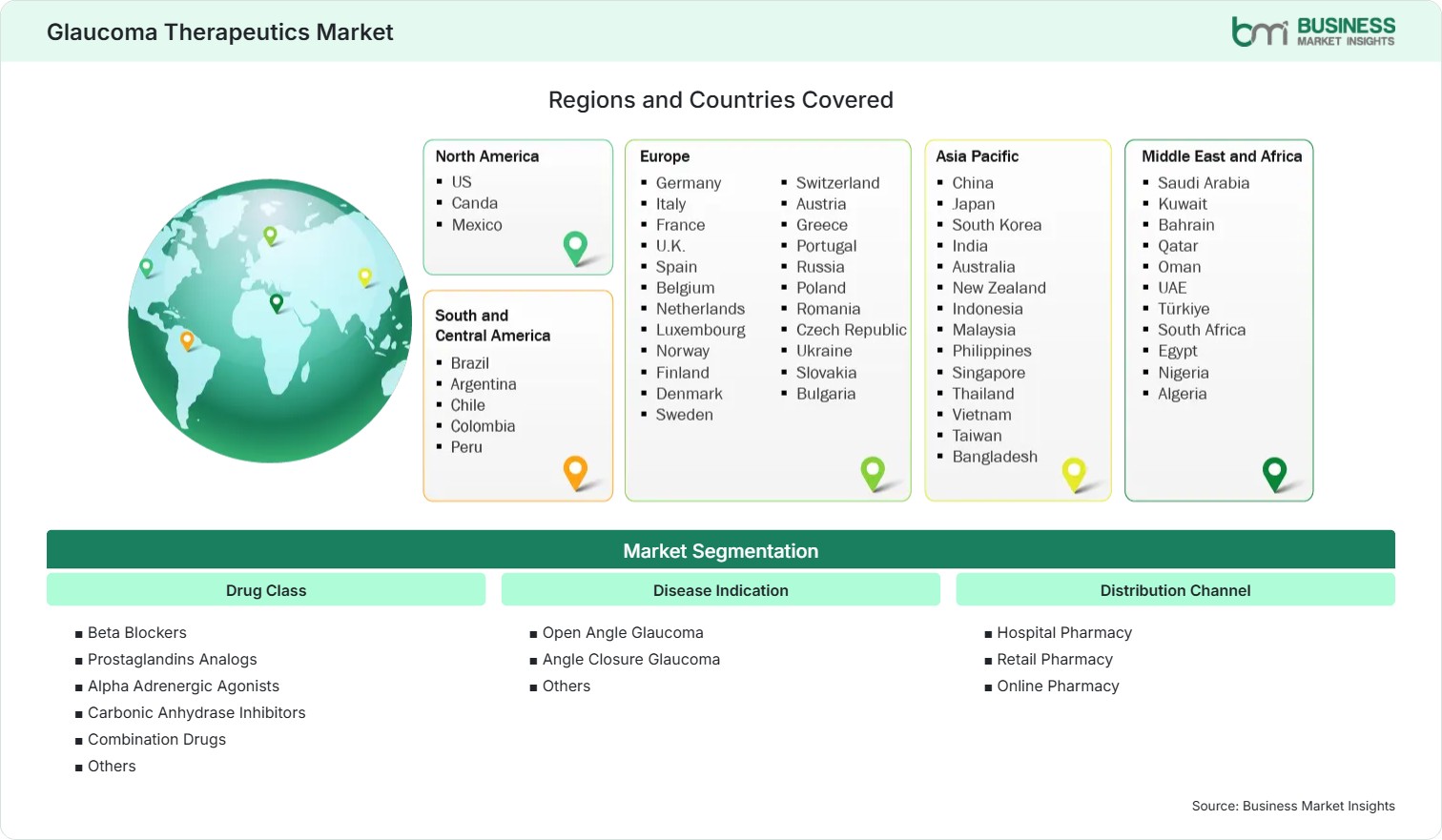
North America Glaucoma Therapeutics Market holds 38%–41% share in 2025 and expands at a 6.4%–7.0% CAGR through 2033. The region benefits from established ophthalmology infrastructure, reimbursement, high diagnostic penetration, clinical research capacity, and differentiated therapy adoption. The United States dominates demand, while Canada contributes through specialist networks and healthcare access. Commercial activity emphasizes premium formulations, combination therapies, sustained delivery, and treatment pathways integrating pharmacological and procedural care.
- Aging populations and high diagnosis rates support prescription demand, while specialist networks facilitate adoption of newer formulations and combination therapies.
- Reimbursement coverage and pharmacy infrastructure strengthen treatment continuity, although payer scrutiny encourages manufacturers to demonstrate adherence benefits and comparative value.
- Clinical research concentration supports innovation in neuroprotection, sustained delivery, novel mechanisms, and disease-management technologies.
- The United States remains the principal commercial center, while Canada offers incremental growth through specialist access and established pharmaceutical distribution.
US Glaucoma Therapeutics Market
The US Glaucoma Therapeutics Market represents 82%–86% of North American demand in 2025 and grows at 6.2%–6.8% CAGR through 2033. Demand reflects substantial diagnosis, specialist access, broad pharmacy coverage, and adoption of branded and generic ophthalmic medicines. Commercial dynamics favor products improving dosing convenience or complementing procedural options. Pricing pressure remains material as mature molecules face generic competition, but innovation can preserve value where differentiation improves persistence, administration frequency, or treatment outcomes.
- Large ophthalmology networks support rapid uptake of new therapies, while retail and specialty pharmacies provide broad access to recurring prescriptions.
- Digital prescribing, automated refills, and home delivery strengthen adherence-oriented channels, particularly among older patients managing multiple chronic conditions.
- Laser treatment innovations can complement pharmacotherapy, creating broader treatment pathways for manufacturers spanning medicines and ophthalmic technologies.
Europe Glaucoma Therapeutics Market
Europe Glaucoma Therapeutics Market holds 25%–28% share in 2025 and expands at 6.6%–7.2% CAGR through 2033. Germany, France, the United Kingdom, Italy, and Spain represent leading markets, while Poland and selected Central European markets offer faster expansion. Public healthcare systems support access but maintain pricing discipline. Manufacturers therefore emphasize cost-effective combinations, adherence benefits, preservative reduction, and evidence supporting long-term management. Regulatory harmonization supports commercialization, although country-specific reimbursement decisions remain important.
- Germany and France remain major markets because of established ophthalmology capacity, aging demographics, specialist prescribing, and broad pharmaceutical distribution.
- The United Kingdom benefits from centralized healthcare procurement and structured clinical pathways, favoring products with clear adherence and health-economic advantages.
- Poland and selected Central European markets can deliver higher growth as diagnosis improves and access to modern pharmacological treatment broadens.
- European manufacturers increasingly evaluate preservative-free and fixed-dose products as differentiation tools where mature molecules face generic competition.
Asia Pacific Glaucoma Therapeutics Market
Asia Pacific Glaucoma Therapeutics Market holds 22%–25% share in 2025 and records the fastest regional CAGR of 8.0%–8.7% through 2033. Japan, China, India, South Korea, and Australia anchor demand, while India, Indonesia, and China provide strong expansion opportunities. Population aging, diagnosis, healthcare investment, specialist capacity, and broader medicine access support growth. Local manufacturing and licensing partnerships are increasingly important for balancing affordability, regulatory requirements, distribution reach, and scalability.
- Japan represents a mature market with strong ophthalmology specialization, while differentiated mechanisms can create incremental value despite established treatment penetration.
- China offers substantial expansion potential through improving diagnosis, local approvals, hospital procurement, and broader access to branded and generic ophthalmic products.
- India combines population scale with expanding private healthcare and pharmaceutical manufacturing capabilities, creating opportunities for affordable fixed-dose and chronic-refill therapies.
- South Korea and Australia provide sophisticated healthcare environments where differentiated products can gain adoption through specialist prescribing and clinical evidence.
Rest of World Glaucoma Therapeutics Market
South and Central America benefit from improving private healthcare capacity, urban specialist networks, and pharmaceutical distribution. Brazil and Mexico remain leading markets, while Colombia and Chile offer attractive growth. Middle East and Africa demand is shaped by uneven specialist availability, healthcare investment, and medicine affordability. Saudi Arabia, the United Arab Emirates, and South Africa provide leading commercial opportunities, while selected Gulf and African markets can outpace regional averages as access improves.
- Brazil benefits from population scale, expanding specialist services, and established pharmaceutical distribution, supporting demand for affordable chronic glaucoma therapies.
- Mexico combines public and private healthcare channels, while increasing diagnosis and pharmacy availability supports broader access to pressure-lowering medicines.
- Gulf markets are investing in specialist infrastructure, creating opportunities for premium ophthalmic products, diagnostic services, and differentiated treatment technologies.
- South Africa serves as a regional healthcare hub, while neighboring markets offer longer-term potential as specialist coverage and medicine availability improve.