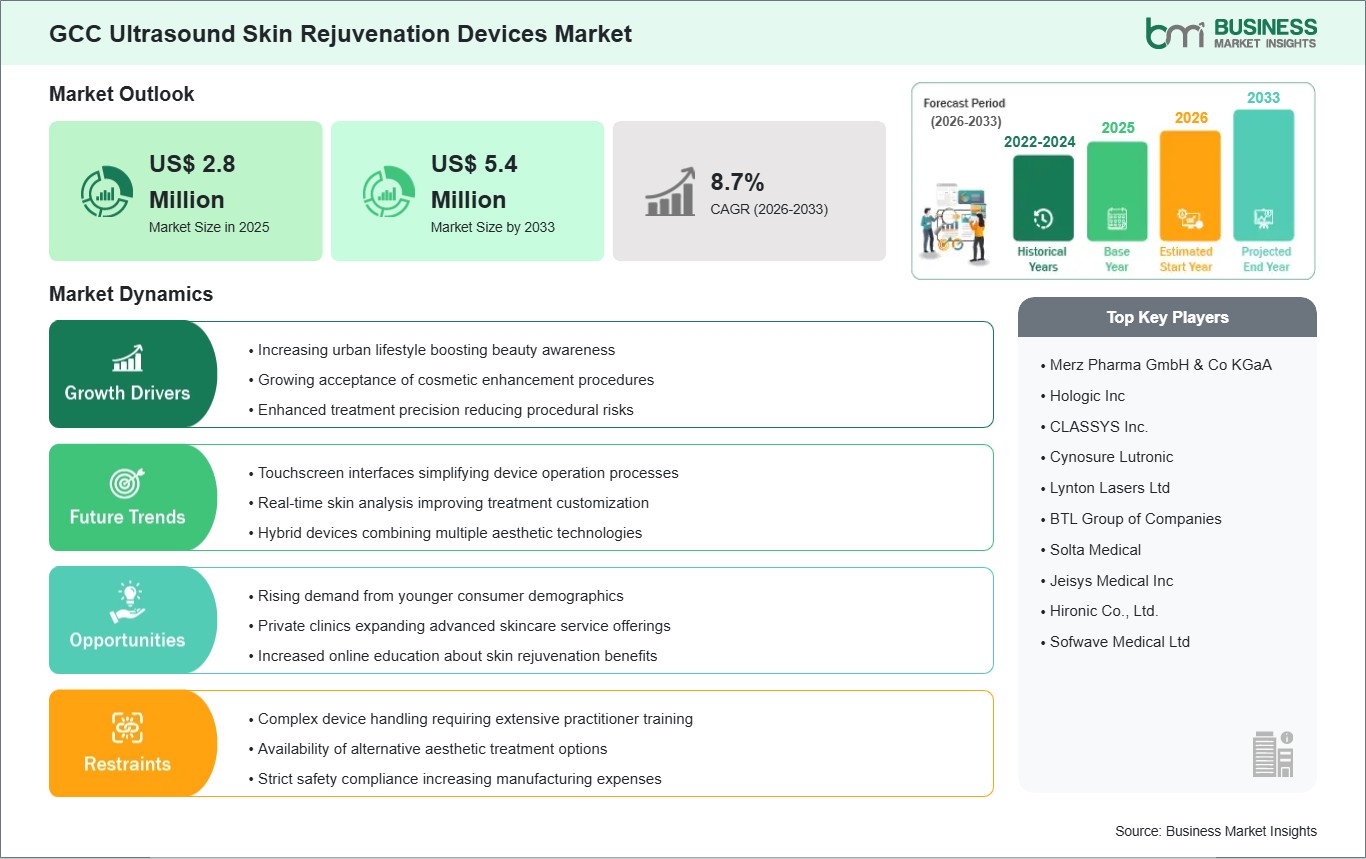
The GCC ultrasound skin rejuvenation devices market size is expected to reach US$ 5.4 million by 2033 from US$ 2.8 million in 2025. The market is estimated to record a CAGR of 8.7% from 2026 to 2033.
The GCC ultrasound skin rejuvenation devices market is witnessing robust expansion driven by strong consumer inclination toward premium aesthetic treatments, rapid growth of medical tourism, and increasing adoption of non-invasive dermatology procedures across high-income urban populations. Demand is predominantly seen among the rich dermatology clinics and high-end medspas where ultrasound technology is being used for tightening of the skin, collagen stimulation, and facial contouring. The area has a wealthy consumer base that is highly willing to pay for cosmetic treatments, fueled by a deep-rooted culture of beauty enhancement and grooming. The market has seen the fast growth in the private health care facilities, with aesthetic medicine becoming an important source of revenues for diversified medical facilities. There has been a growing trend among dermatology clinics in the GCC region to invest in multi-functional ultrasound devices that provide precise treatment, reduced recovery time, and are easy to combine with other cosmetic procedures such as injections and laser technologies. International experience among cosmetic physicians also facilitates faster adoption of innovative equipment. In terms of supply, major international vendors are now focused on marketing their products to the GCC through various distribution and training strategies. High-end clinics are prioritizing devices with advanced safety features, customizable energy settings, and strong clinical validation to meet regulatory and patient expectations. Regulatory frameworks across GCC countries are evolving toward stricter medical device approvals, enhancing trust in certified technologies while maintaining high entry barriers for low-quality devices. Additionally, medical tourism hubs such as Dubai and Riyadh are reinforcing regional demand by attracting international patients seeking premium aesthetic treatments. Rising influence of social media-driven beauty standards and increasing male participation in cosmetic procedures are further diversifying the customer base. Overall, the GCC market reflects a premium, innovation-led ecosystem with strong growth potential anchored in luxury healthcare consumption and technology-driven dermatology services.

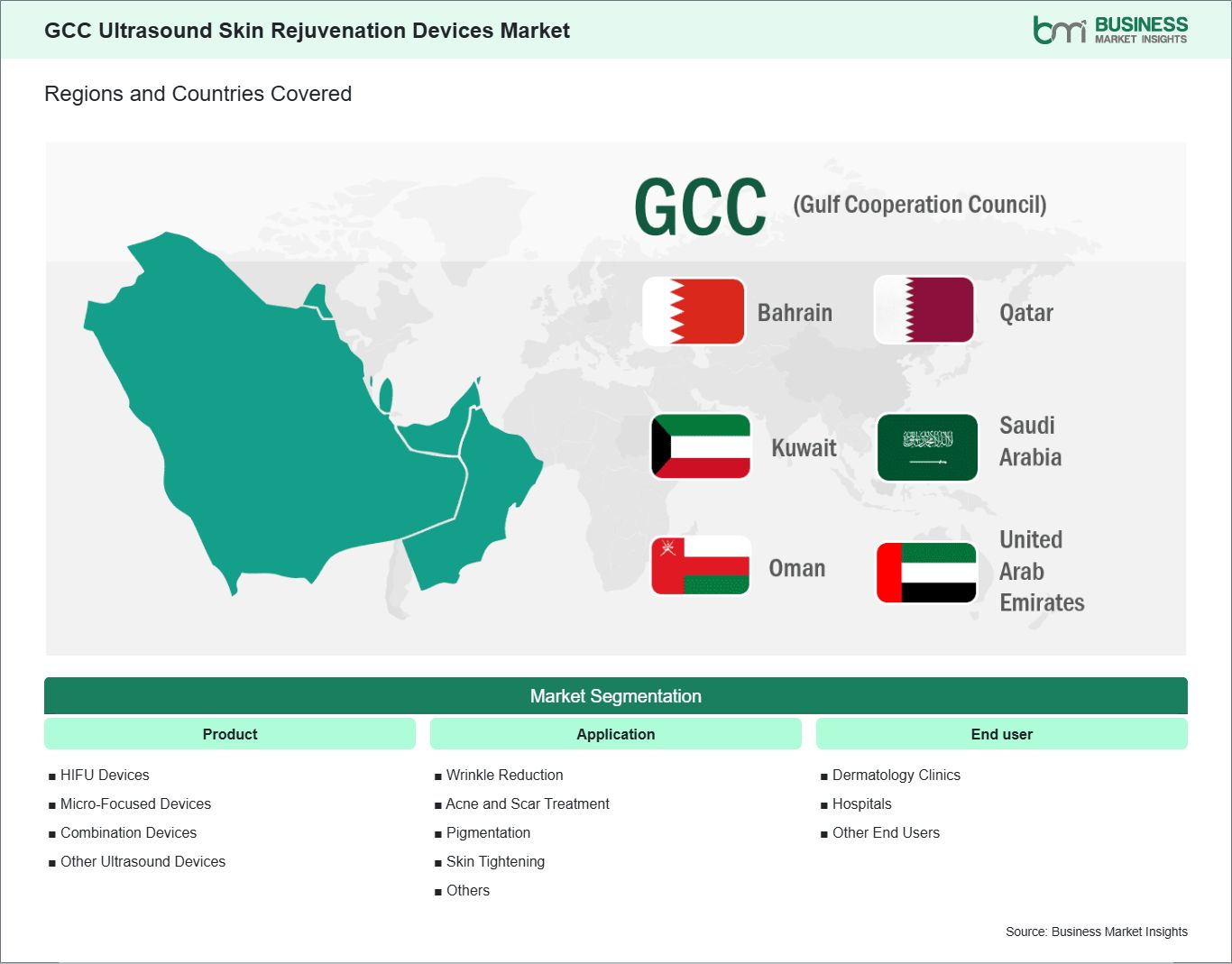
Key segments that contributed to the derivation of the GCC ultrasound skin rejuvenation devices market analysis are product, application, and end user.
The GCC ultrasound skin rejuvenation devices market is expanding rapidly due to a structural shift toward noninvasive aesthetic treatments across key urban economies such as South GCC, Egypt, Nigeria, Kenya, and Morocco. However, skin-tightening treatments through the use of ultrasonic technology are becoming increasingly common in South African clinics found in Johannesburg and Cape Town, as people are now preferring minimally invasive treatments without any need for recovery periods in place of facelifts. In South GCC itself, non-surgical cosmetic procedures are preferred over surgical treatments.
Rising awareness regarding the benefits of anti-aging treatment among individuals with average to high financial background in North GCCn nations including Egypt and Morocco is driving the demand for ultrasound facelift procedures and collagen therapy. The Cairo skin care clinics are observing an increase in the number of patients requiring treatment for concerns like loose skin and hyper-pigmentation, which can be more suitably treated using ultrasound devices due to the Fitzpatrick skin type (type IV-VI) present in this region. At the same time, medical tourism coming from Europe and other Middle Eastern countries is driving the adoption of non-invasive procedures.
Both West and East GCC countries such as Nigeria and Kenya exhibit an increase in the level of income which makes it possible to use the ultrasound tightening technique in order to combat aging. These countries will have ultrasound skin tightening technique introduced in boutiques via aesthetic practices directed towards younger consumers who want to stay young by preventing their skin from becoming wrinkled. In spite of the fact that the technique is still not prevalent in rural areas, mobile ultrasound devices are getting more common among dermatology clinics.
The integration of artificial intelligence into ultrasound skin rejuvenation workflows is transforming treatment planning and personalization across Europe. In highly developed dermatological markets, such as Germany and France, dermatologists are employing AI-powered analysis solutions for assessing dermis thickness, collagen density, and asymmetry of the face prior to the initiation of ultrasound treatments. With these solutions, doctors can create highly personalized treatment programs for their patients. This approach allows for more accurate diagnostics as well as the adjustment of the energy parameters for individual clients.
In the UK and Italy, AI-driven skin assessment tools are being adopted not only by individual dermatology clinics but also by large aesthetic franchises. The London-based clinics and Rome-based clinics are embracing the technology that allows capturing digital images through a combination of 3D facial mapping with predictive analytics, showing patients how they will look like after their procedure. This approach does not just make them more confident about their choices but makes them convert at higher rates into paying customers for high-margin aesthetic treatments. Moreover, AI is being used to monitor treatment efficacy and make necessary changes to the ultrasonic frequency and penetration depending on their reaction.
Adoption trends in Southern and Eastern European countries continue to push the democratization process in AI-assisted beauty care. Increasingly, Spanish, Greek, and Polish clinics have been adopting cloud technologies for diagnostic purposes. The latter allows them to use AI-powered skin diagnostics on a standardized basis without having to rely on highly developed infrastructure. Such technology becomes especially useful for small clinics who want to keep up with the big centers in terms of delivering a personalized and data-driven experience. The integration of ultrasound skin rejuvenation devices with AI technology can be expected soon in Europe.

The GCC ultrasound skin rejuvenation devices market demonstrates steady growth, with size and share analysis highlighting evolving trends and competitive dynamics among key players. The report examines subsegments categorized within product, application, and end user, offering insights into their contribution to overall market performance.
By product, the HIFU devices segment dominated the market in 2025, driven by their superior non-invasive lifting efficacy, deeper tissue penetration, and strong clinical adoption in aesthetic dermatology clinics.
Based on application, the wrinkle reduction segment dominated the market in 2025, driven by high consumer demand for anti-aging treatments and collagen-stimulating, non-surgical facial rejuvenation outcomes.
In terms of end user, the dermatology clinics segment dominated the market in 2025, driven by their specialized infrastructure, high patient footfall for aesthetic procedures, and strong preference for advanced energy-based skin rejuvenation technologies.
| Report Attribute | Details |
|---|---|
| Market size in 2025 | US$ 2.8 Million |
| Market Size by 2033 | US$ 5.4 Million |
| CAGR (2026 - 2033) | 8.7% |
| Historical Data | 2022-2024 |
| Forecast period | 2026-2033 |
| Segments Covered | By Product
|
|
Regions and Countries Covered
| |
| GCC | UAE, Bahrain, Saudi Arabia, Oman, Qatar, Kuwait |
| Market leaders and key company profiles |
|
The "GCC Ultrasound Skin Rejuvenation Devices Market Size and Forecast (2022-2033)" report provides a detailed analysis of the market covering below areas:
The geographical scope of the GCC ultrasound skin rejuvenation devices market report is divided into UAE, Bahrain, Saudi Arabia, Oman, Qatar, Kuwait. Saudi Arabia held the largest share in 2025.
Within the GCC ultrasound skin rejuvenation devices market, Saudi Arabia stands as the dominant market, driven by large-scale healthcare transformation initiatives, rapid expansion of private dermatology networks, and increasing acceptance of non-surgical cosmetic procedures. Major cities such as Riyadh, Jeddah, and Dammam are witnessing significant growth in aesthetic clinics and medspas, supported by rising disposable income and a strong cultural shift toward preventive and corrective aesthetic treatments. The country’s Vision-driven healthcare modernization is also accelerating investment in advanced dermatology infrastructure, making it the central growth engine of the region. United Arab Emirates represents a highly advanced aesthetic hub, characterized by strong medical tourism inflows, luxury-focused clinics, and early adoption of cutting-edge ultrasound-based technologies. Dubai and Abu Dhabi continue to attract international patients seeking premium cosmetic procedures, reinforcing demand for high-end aesthetic devices. Qatar demonstrates strong adoption in high-income segments, with increasing demand for technologically advanced, clinic-based rejuvenation treatments. Kuwait shows steady market growth supported by strong consumer spending on personal care and expanding availability of private dermatology services. Oman and Bahrain represent emerging markets with gradual expansion of aesthetic medicine services, driven by improving healthcare infrastructure and rising awareness of non-invasive cosmetic procedures. Across the GCC, while all countries contribute to market expansion, Saudi Arabia remains the dominant force due to its scale, investment intensity, and rapidly evolving aesthetic healthcare ecosystem.

The GCC ultrasound skin rejuvenation devices market is evaluated by gathering qualitative and quantitative data post primary and secondary research, which includes important corporate publications, association data, and databases. A few of the key developments in the GCC ultrasound skin rejuvenation devices market are:
The GCC Ultrasound Skin Rejuvenation Devices Market is valued at US$ 2.8 Million in 2025, it is projected to reach US$ 5.4 Million by 2033.
As per our report GCC Ultrasound Skin Rejuvenation Devices Market, the market size is valued at US$ 2.8 Million in 2025, projecting it to reach US$ 5.4 Million by 2033. This translates to a CAGR of approximately 8.7% during the forecast period.
The GCC Ultrasound Skin Rejuvenation Devices Market report typically cover these key segments-
The historic period, base year, and forecast period can vary slightly depending on the specific market research report. However, for the GCC Ultrasound Skin Rejuvenation Devices Market report:
The GCC Ultrasound Skin Rejuvenation Devices Market is populated by several key players, each contributing to its growth and innovation. Some of the major players include:
The GCC Ultrasound Skin Rejuvenation Devices Market report is valuable for diverse stakeholders, including:
Essentially, anyone involved in or considering involvement in the GCC Ultrasound Skin Rejuvenation Devices Market value chain can benefit from the information contained in a comprehensive market report.
Please tell us your area of interest
(Market Segments/ Regions and Countries/ Companies)