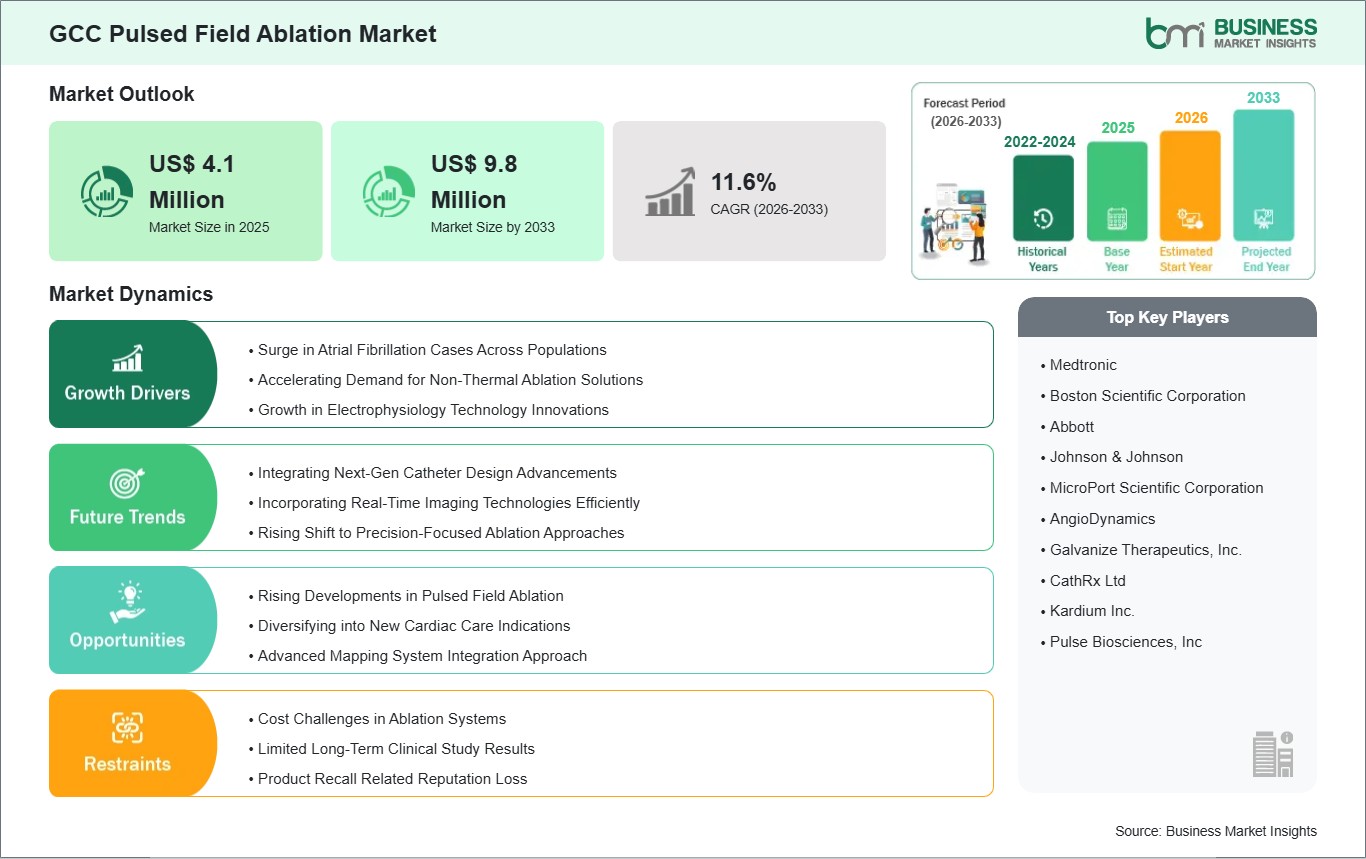
The GCC pulsed field ablation market size is expected to reach US$ 9.8 million by 2033 from US$ 4.1 million in 2025. The market is estimated to register a CAGR of 11.6% from 2026 to 2033.
The GCC pulsed field ablation (PFA) market is establishing itself as a niche within market segments in cardiac healthcare, as the region continues to invest significantly in modernizing and developing its healthcare infrastructure and in the implementation of new, advanced, and minimally invasive procedure techniques. Furthermore, the growth of the GCC PFA market is driven by the increasing prevalence of cardiovascular disease, such as atrial fibrillation and other types of arrhythmias, and by the increasing awareness of the advantages of newer, safer, and more precise ablation technologies. PFA, which utilizes a no-touch, tissue-selective, non-thermal energy source to ablate tissue/targeted areas, limits damage to surrounding tissue, as well as reduces the risk of complications, making it extremely relevant in the areas where patient safety and efficiency in care delivery have advanced significantly.
Saudi Arabia’s leadership position in terms of healthcare investment, the establishment of state-of-the-art medical facilities, and the adoption of new and more innovative cardiovascular technologies are driving growth in the GCC PFA market and setting a standard for the development of this particular market segment throughout the rest of the GCC. As a result, many hospitals are completing renovations of their electrophysiology (EP) labs and have developed structured clinician training programs to train physicians on PFA technologies, and are also developing programs for conducting pilot studies of PFA procedures in order to establish their clinical efficacy and safety as procedures. However, due to the expense of PFA procedures and the expense of the specialized equipment used to perform these procedures, mostly only leading hospitals will use PFA. Furthermore, there is a shortage of electrophysiologists trained to perform advanced PFA procedures, which will impede widespread use of PFA technologies in the region. However, clinical interest is growing, infrastructure development is supported, and therefore, there will continue to be a strong emphasis on PFA as a cutting-edge technology in the GCC healthcare industry.

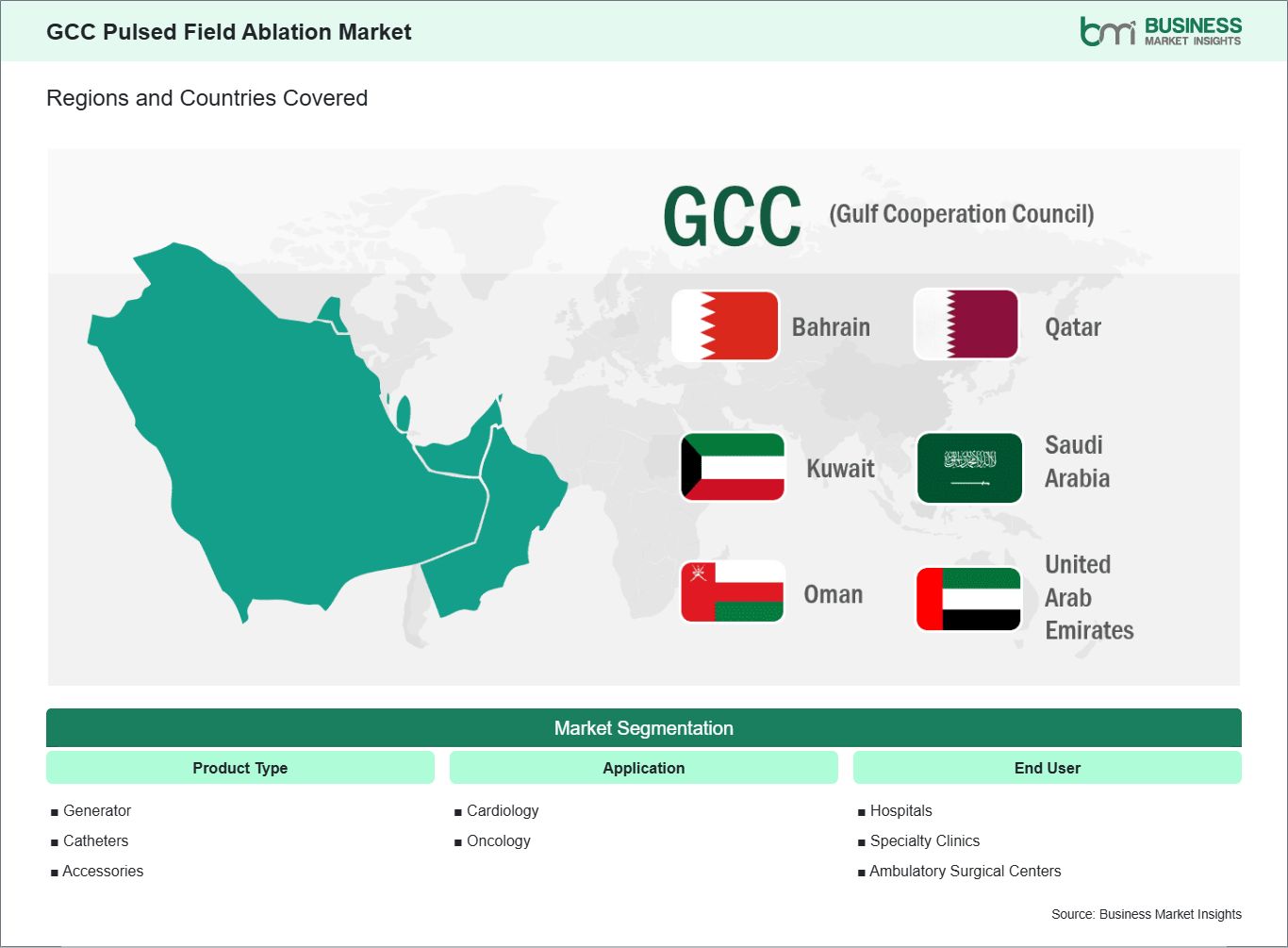
Key segments that contributed to the derivation of the GCC pulsed field ablation market analysis are product type, application, and end user.
Atrial fibrillation (AF) is emerging as a pressing cardiovascular concern in the GCC, influenced by rapid urbanization, rising prevalence of lifestyle-related conditions, and population aging. Unlike some other regions, high rates of obesity, diabetes, and metabolic syndrome in Gulf countries are driving an increase in arrhythmia cases at a younger age. Healthcare systems are facing growing demand for cardiology services, prompting hospitals to enhance diagnostic capabilities, integrate specialized AF screening programs, and expand access to electrophysiology care. Early identification and management remain central to reducing long-term complications such as stroke and heart failure.
The clinical burden of AF is shaping treatment pathways in the GCC. Hospitals are focusing on minimally invasive strategies that reduce procedure times and hospital stays while ensuring reliable outcomes. Multi-disciplinary teams are being developed to streamline care delivery and optimize workflow efficiency, particularly in urban centers with high patient volumes. These approaches help balance resource constraints with the need for high-quality clinical care, ensuring that growing caseloads are managed effectively without compromising safety.
The surge in AF cases has created an environment favorable to adopting advanced technologies. Pulsed field ablation (PFA) is increasingly recognized for its ability to target cardiac tissue precisely while minimizing collateral damage. By enhancing procedural safety and efficiency, PFA offers healthcare providers in the GCC a scalable solution to meet rising patient demand, improve outcomes, and strengthen overall cardiac service capabilities across the region.
Pulsed field ablation (PFA) is reshaping arrhythmia management in the GCC, reflecting a shift toward more precise, tissue-selective approaches. Unlike thermal-based methods, PFA uses short, high-intensity electrical pulses to ablate cardiac tissue while preserving surrounding structures, reducing procedural risk and enabling faster patient recovery. Recent technological innovations such as advanced catheter designs, improved energy delivery systems, and integration with mapping software have enhanced procedural predictability, making PFA suitable for hospitals across diverse healthcare infrastructures in the region.
GCC healthcare providers are actively investing in PFA infrastructure and clinician training programs to support adoption. Electrophysiology teams are receiving targeted education on device operation and procedural planning, enabling hospitals to implement standardized workflows that maintain consistency and efficiency. These efforts ensure that high patient volumes can be managed effectively while minimizing complications, improving both clinical outcomes and operational performance.
Moreover, advances in PFA technology will further contribute to the modernization of AF treatment in the Gulf Cooperation Council region. More efficient mapping technologies, ergonomic catheters, and improved workflows allow for greater accuracy and predictability in procedures. By achieving the optimal combination of effectiveness and efficiency, PFA ensures that Gulf Cooperation Council hospitals can tackle the growing problem of atrial fibrillation.

The GCC pulsed field ablation market demonstrates steady growth, with size and share analysis highlighting evolving trends and competitive dynamics among key players. The report evaluates important subsegments categorized within product type, application, and end user, highlighting their respective contributions to overall market performance.
By product type, the catheters subsegment dominated the market in 2025. Catheter devices offer improved procedural efficiency, reduced risk of complications, and real-time control for electrophysiologists, making them a crucial component for effective PFA therapy and a key revenue driver for manufacturers.
In terms of application, the cardiology subsegment dominated the market in 2025. The leadership of cardiology applications is attributed to the rising prevalence of atrial fibrillation and other cardiac arrhythmias, growing preference for non-thermal and tissue-selective ablation techniques, and increasing awareness among healthcare providers about the clinical benefits of PFA.
Based on end user, the hospitals subsegment dominated the market in 2025. Hospitals maintain a stronghold due to their established cardiology and electrophysiology departments, access to advanced PFA systems, trained physicians and clinical staff, and the capability to perform specialized cardiac procedures with comprehensive patient monitoring and post-procedure care.
| Report Attribute | Details |
|---|---|
| Market size in 2025 | US$ 4.1 Million |
| Market Size by 2033 | US$ 9.8 Million |
| CAGR (2026 - 2033) | 11.6% |
| Historical Data | 2022-2024 |
| Forecast period | 2026-2033 |
| Segments Covered | By Product Type
|
|
Regions and Countries Covered
| |
| GCC | UAE, Bahrain, Saudi Arabia, Oman, Qatar, Kuwait |
| Market leaders and key company profiles |
|
The "GCC Pulsed Field Ablation Market Size and Forecast (2022–2033)" report provides a detailed analysis of the market covering below areas:
The geographical scope of the GCC pulsed field ablation market report is divided into: Saudi Arabia, the United Arab Emirates (UAE), Qatar, Kuwait, Bahrain, and Oman. Saudi Arabia held the largest share in 2025.
Saudi Arabia is the leader in the Gulf Cooperation Council (GCC) PFA market because of the well-developed healthcare system, large investment in cardiovascular disease care and rapid growth in innovative medical technology use. With a growing burden of atrial fibrillation and other arrhythmias, the country has an increasing need for safer and less invasive procedures (PFA) to improve patient outcomes and reduce complications following procedures. The growing demand for PFA procedures is due to PFA's non-thermal, tissue-selective mechanism of precise ablation; it will help to address the needs of the country’s focus on patient safety and clinical efficiency, due to the ability to precisely ablate cardiac tissue without having collateral damage to surrounding or adjacent tissues.
PFA adoption is supported by significant investments in advanced electrophysiology labs, modern mapping systems, advanced imaging technologies and structured training programs to prepare cardiologists for the complex ablation techniques needed to safely perform PFA procedures. In addition, partnerships with international technology companies facilitate the transfer of knowledge and best practices between Saudi Arabia and other countries that are further along in the adoption of PFAs.
Despite many challenges with high costs associated with equipment and procedures limiting patient access to PFAs, limited availability of trained electrophysiologists beyond leading tertiary-care hospitals, and limited adoption of PFA procedures, advancing cardiac care through modernization, superior healthcare system infrastructure, and the commitment to innovative technology by the Kingdom creates an environment that positions it as the core driver for PFA implementation.

The GCC pulsed field ablation market is evaluated by gathering qualitative and quantitative data post primary and secondary research, which includes important corporate publications, association data, and databases. A few of the key developments in the GCC pulsed field ablation market are:
The GCC Pulsed Field Ablation Market is valued at US$ 4.1 Million in 2025, it is projected to reach US$ 9.8 Million by 2033.
As per our report GCC Pulsed Field Ablation Market, the market size is valued at US$ 4.1 Million in 2025, projecting it to reach US$ 9.8 Million by 2033. This translates to a CAGR of approximately 11.6% during the forecast period.
The GCC Pulsed Field Ablation Market report typically cover these key segments-
The historic period, base year, and forecast period can vary slightly depending on the specific market research report. However, for the GCC Pulsed Field Ablation Market report:
The GCC Pulsed Field Ablation Market is populated by several key players, each contributing to its growth and innovation. Some of the major players include:
The GCC Pulsed Field Ablation Market report is valuable for diverse stakeholders, including:
Essentially, anyone involved in or considering involvement in the GCC Pulsed Field Ablation Market value chain can benefit from the information contained in a comprehensive market report.
Please tell us your area of interest
(Market Segments/ Regions and Countries/ Companies)