Market Summary
Executive Summary and Market Analysis
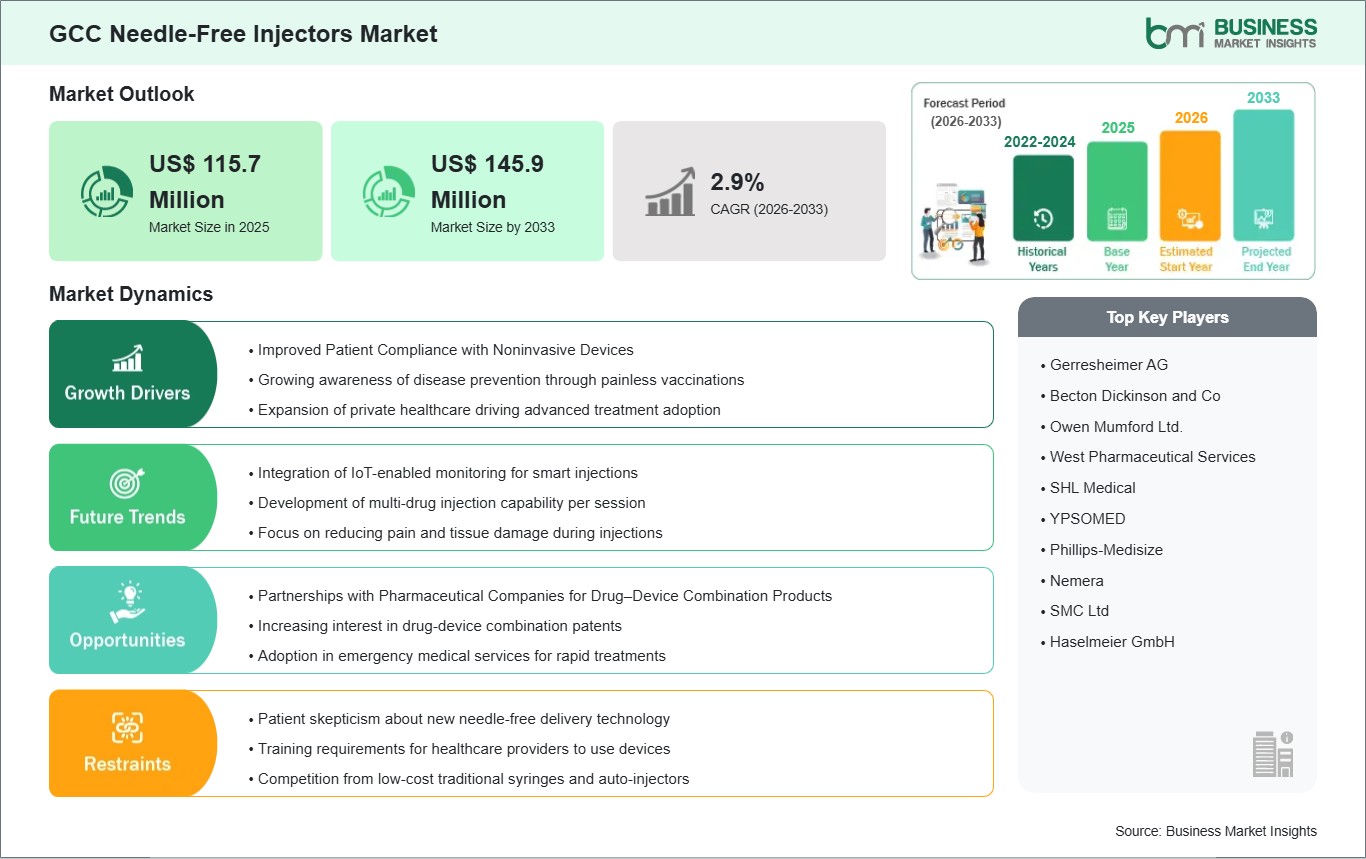
Countries such as Saudi Arabia, the UAE, Qatar, Kuwait, Bahrain, and Oman are investing in innovative medical technologies to reduce needle-stick injuries, enhance patient comfort, and streamline drug delivery across hospitals, specialty clinics, and vaccination centers. Market dynamics are shaped by collaborations between multinational medical device manufacturers and local distributors, emphasizing regulatory compliance, ease of use, and adaptability across multiple drug formulations. Clinical acceptance is driven by evidence demonstrating reduced infection risk, improved adherence, and simplified administration, particularly in high-volume immunization and biologic therapy programs. Regulatory frameworks are evolving rapidly, with health authorities in Saudi Arabia and the UAE adopting stringent approval processes aligned with international standards. Smaller states offer expedited pathways for pilot programs. Decision-makers evaluate devices based on total cost of ownership, considering training, maintenance, consumables management, and long-term operational efficiency. Innovation is a key differentiator, with disposable and reusable systems, ergonomic designs, and smart devices capable of digital tracking gaining attention. Pilot deployments and hospital-led demonstrations are essential to validate clinical and operational benefits, influencing procurement strategies across public and private healthcare facilities. The GCC market reflects a technology-driven environment where product reliability, regulatory compliance, and workflow integration define competitive positioning and adoption trajectories.
Segment Analysis
GCC Needle-Free Injectors Market Segmentation
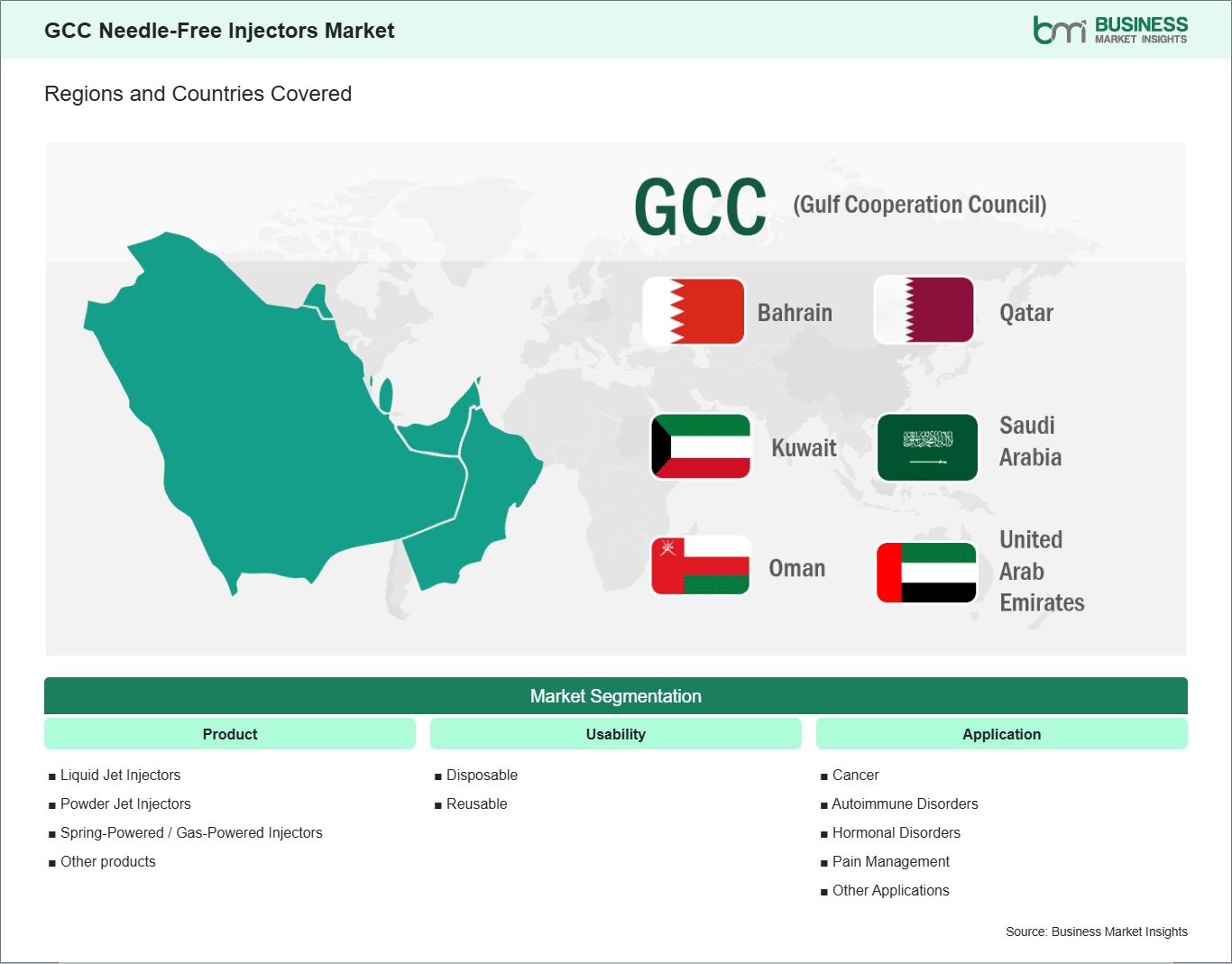
Key segments that contributed to the derivation of the GCC needle-free injectors market analysis are product, usability, and application.
- By product, the needle-free injectors market is segmented into liquid jet injectors, powder jet injectors, spring-powered / gas-powered injectors, and other products. The liquid jet injectors segment dominated the market in 2025.
- Based on usability, the needle-free injectors market is categorized into disposable and reusable. The disposable segment dominated the market in 2025.
- In terms of application, the market is classified into cancer, autoimmune disorders, hormonal disorders, pain management, and other applications. The autoimmune disorders segment dominated the market in 2025.
Market Forces
GCC Needle-Free Injectors Market Drivers and Opportunities
Improved Patient Compliance with Noninvasive Devices
Patient adherence to long-term treatment regimens has emerged as a critical challenge, particularly for chronic conditions such as diabetes, autoimmune disorders, and cardiovascular diseases. Needle-free injectors are recognized as a solution to enhance compliance by providing a painless and convenient method for medication administration. Patients are more likely to adhere to prescribed therapies when discomfort, anxiety, or fear associated with traditional needles is eliminated. The adoption of non-invasive delivery systems is relevant in GCC countries such as Saudi Arabia, the UAE, and Qatar, where healthcare providers are focusing on patient-centric care models. Home-based self-administration programs are gaining traction. Needle-free injectors allow patients to manage their treatments independently, reducing the need for frequent hospital visits and improving quality of life. This trend aligns with regional healthcare strategies that emphasize preventive care and chronic disease management. Healthcare professionals are recommending needle-free devices as a means to minimize injection-related complications, improve adherence rates, and enhance treatment outcomes. The convenience and comfort offered by these devices foster higher patient engagement and loyalty to treatment plans. As public and private healthcare sectors promote patient-centered interventions, needle-free injectors are poised to play a key role in improving treatment compliance.
Partnerships with Pharmaceutical Companies for Drug–Device Combination Products
By combining innovative drug delivery technologies with approved medications, these partnerships create drug–device combination products that improve therapeutic efficacy and patient convenience. Such integrated solutions are attractive in the GCC, where there is a growing focus on advanced healthcare technologies and value-added treatments. Pharmaceutical collaborations facilitate regulatory approvals and market entry by leveraging established supply chains, distribution networks, and clinical expertise. Joint development programs enable faster commercialization of combination products tailored to regional patient needs, including chronic disease management and vaccination programs. These collaborations help ensure product reliability, safety, and adherence to local regulatory requirements, enhancing confidence among healthcare providers and patients. Drug–device combination products allow healthcare institutions to implement more efficient treatment protocols. By integrating medication and delivery systems into a single solution, hospitals and clinics can reduce administration errors, minimize waste, and optimize patient outcomes. As regional healthcare infrastructure continues to modernize and prioritize patient-centered innovations, partnerships between pharmaceutical companies and needle-free device manufacturers are expected to support the adoption of advanced drug delivery solutions.
Size and Share Analysis
GCC Needle-Free Injectors Market Size and Share Analysis
The GCC Needle-free Injectors Market demonstrates steady growth, with size and share analysis highlighting evolving trends and competitive dynamics among key players. The report examines subsegments categorized within product, usability, and application, offering insights into their contribution to overall market performance.
By product, the liquid jet injectors subsegment dominated the market in 2025, driven by their ability to deliver accurate doses quickly and painlessly, making them suitable for clinical and home-based use.
Based on usability, the disposable subsegment dominated the market in 2025, driven by the emphasis on hygiene, infection control, and ease of handling in hospitals, clinics, and home-care settings.
In terms of application, the autoimmune disorders subsegment dominated the market in 2025, driven by the need for frequent, long-term medication administration where patient comfort, adherence, and safety are critical for disease management.
Report Coverage
GCC Needle-Free Injectors Market Report Coverage and Deliverables
The "GCC Needle-free Injectors Market Size and Forecast (2022–2033)" report provides a detailed analysis of the market covering below areas:
- GCC Needle-free Injectors Market size and forecast at regional and country levels for all market segments covered under the scope
- GCC Needle-free Injectors Market trends, as well as drivers, restraints, and opportunities
- GCC Needle-free Injectors Market analysis covering key trends, regional framework, major players, regulations, and recent developments
- Industry landscape and competition analysis covering market concentration, heat map analysis, prominent players, and recent developments for the GCC Needle-free Injectors Market
- Detailed company profiles, including SWOT analysis
Geographic Insights
GCC Needle-Free Injectors Market Geographic Insights
The geographical scope of the GCC Needle-free Injectors Market report is divided into the UAE, Bahrain, Saudi Arabia, Oman, Qatar, and Kuwait. UAE held the largest share in 2025.
UAE dominates the market, driven by extensive government-led vaccination programs, hospital modernization initiatives, and large-scale chronic disease management projects. Saudi Arabia represents a technologically advanced market, where private hospitals, specialty clinics, and corporate wellness programs prioritize innovative devices with high safety standards and digital integration capabilities. Qatar and Kuwait demonstrate growing adoption, primarily through government healthcare facilities and pilot programs, validating operational efficiency and patient experience. Bahrain and Oman are emerging markets, where early adoption is focused on public hospitals and preventive care programs supported by international aid and demonstration projects. Across the GCC, distributor networks, after-sales support, and localized clinician training are critical in facilitating adoption, particularly in smaller markets. Urban healthcare centers serve as benchmarks, influencing procurement strategies and establishing best-practice models for secondary facilities. These insights underscore that adoption is influenced by government policy, infrastructure development, and clinical validation, requiring targeted commercialization strategies to capture long-term opportunities across the region.
Industry Activity
Recent Developments
The GCC Needle-free Injectors Market is evaluated by gathering qualitative and quantitative data post primary and secondary research, which includes important corporate publications, association data, and databases. A few of the key developments in the GCC needle-free injectors market are:
- In November 2025, the UAE Ministry of Health and Prevention (MOHAP) introduced a needle‑free influenza vaccine delivered via nasal spray, offering a painless alternative to traditional flu shots for healthy individuals aged 2– This product marks the first registered needle‑free vaccine option in the country’s national immunization programme, aiming to increase uptake and reduce needle‑related anxiety. The rollout began across selected public and private healthcare centres, with plans to expand access nationwide. This launch underscores the UAE’s commitment to innovative immunization options and broader preventive health strategies.
- In March 2025, medical suppliers in the UAE (e.g., on Al Reem Island, Abu Dhabi) began offering J‑Tip needle‑free jet injectors, a handheld cartridge‑based device used for delivering local anaesthetic without a needle. This product presence in UAE supplier catalogues represents local expansions in device availability and clinical uptake among healthcare providers seeking needle‑free alternatives for subcutaneous delivery. These devices are positioned as pain reduction tools before routine procedures. This listing supports increased access to needle‑free injectors within GCC healthcare supply channels.
Trust & Transparency
Research Methodology
The market analysis combines proprietary research with secondary data from government agencies, company disclosures, regulatory filings, industry databases and expert interviews. Market estimates are validated through data triangulation, cross-market benchmarking and analyst
review.
View Full Research Methodology
Key Sources Referred:
World Health Organization (WHO)Organisation for Economic Cooperation and Development (OECD)The World Bank GroupWorldometerThe LancetInternational Bar AssociationInternational Trade Administration