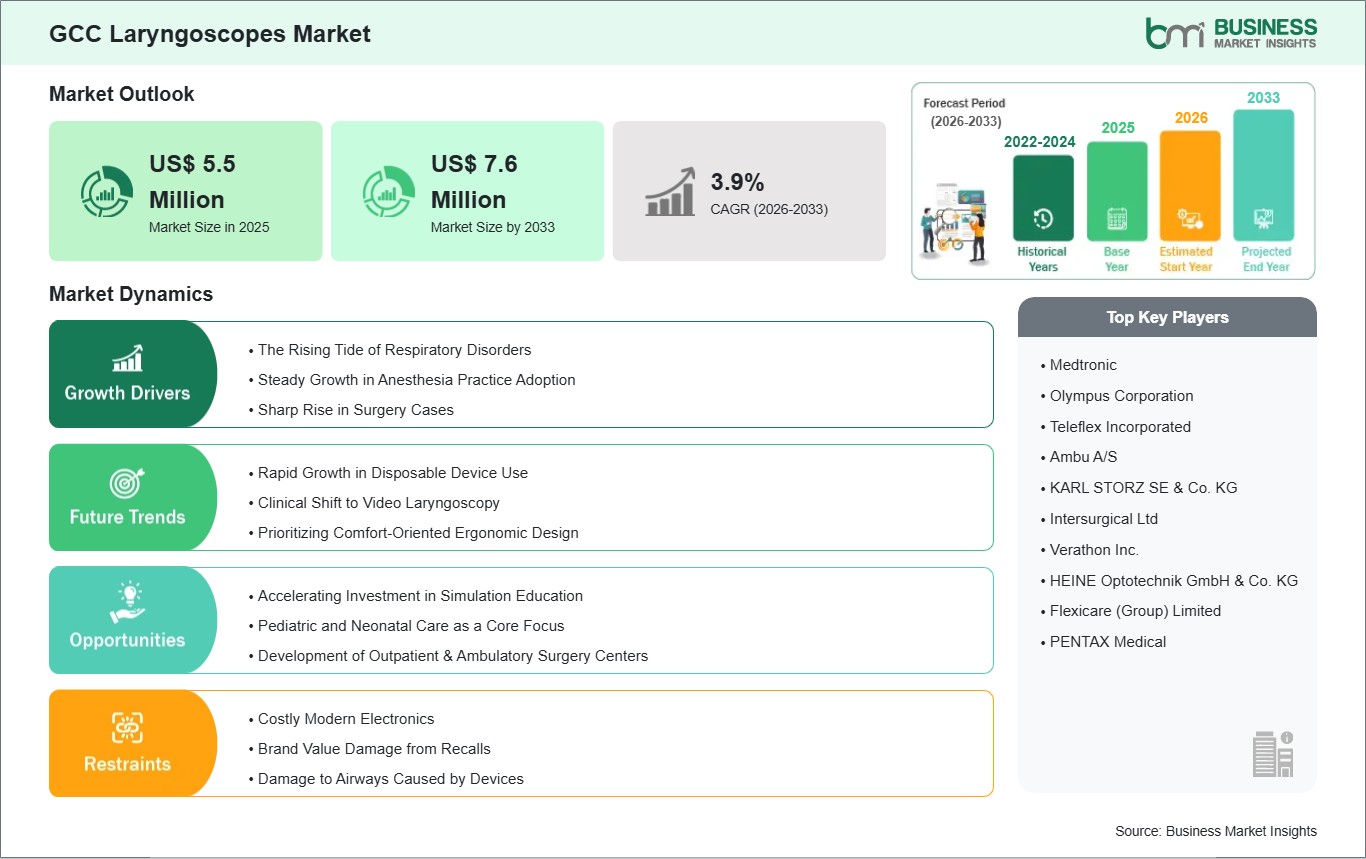
The GCC laryngoscopes market size is expected to reach US$ 7.6 million by 2033 from US$ 5.5 million in 2025. The market is estimated to record a CAGR of 3.9% from 2026 to 2033.
The GCC laryngoscope market operates in an advanced healthcare setting driven by significant investments made by the government in the healthcare infrastructure, higher numbers of surgeries performed, and an overall focus on modernizing clinical settings. Laryngoscopes continue to play a crucial role in managing the airways during anesthesia, emergency situations, intensive care units, and surgeries. The market dynamics for laryngoscopes are highly correlated with the growth of tertiary care hospitals and the complexity of clinical interventions. Healthcare organizations in the GCC are gradually shifting from traditional direct laryngoscopes to visualization-based devices, especially video laryngoscopes.
The constant growth and development of healthcare infrastructures, especially in Saudi Arabia and the UAE, where the authorities are working towards developing the hospital infrastructure and emergency healthcare services. Increasing cases of respiratory problems, in addition to a larger number of surgeries, are some of the factors contributing to a continuous requirement for airway management equipment. Growing adherence to global clinical guidelines and the existence of world-class healthcare institutions are also promoting the implementation of technically advanced laryngoscope systems. The heavy reliance on imports of medical devices is one of the factors that makes prices highly sensitive. Besides, while the leading hospitals are quick to adopt advanced laryngoscope systems, small healthcare establishments can continue using traditional laryngoscopes due to financial constraints and other considerations.

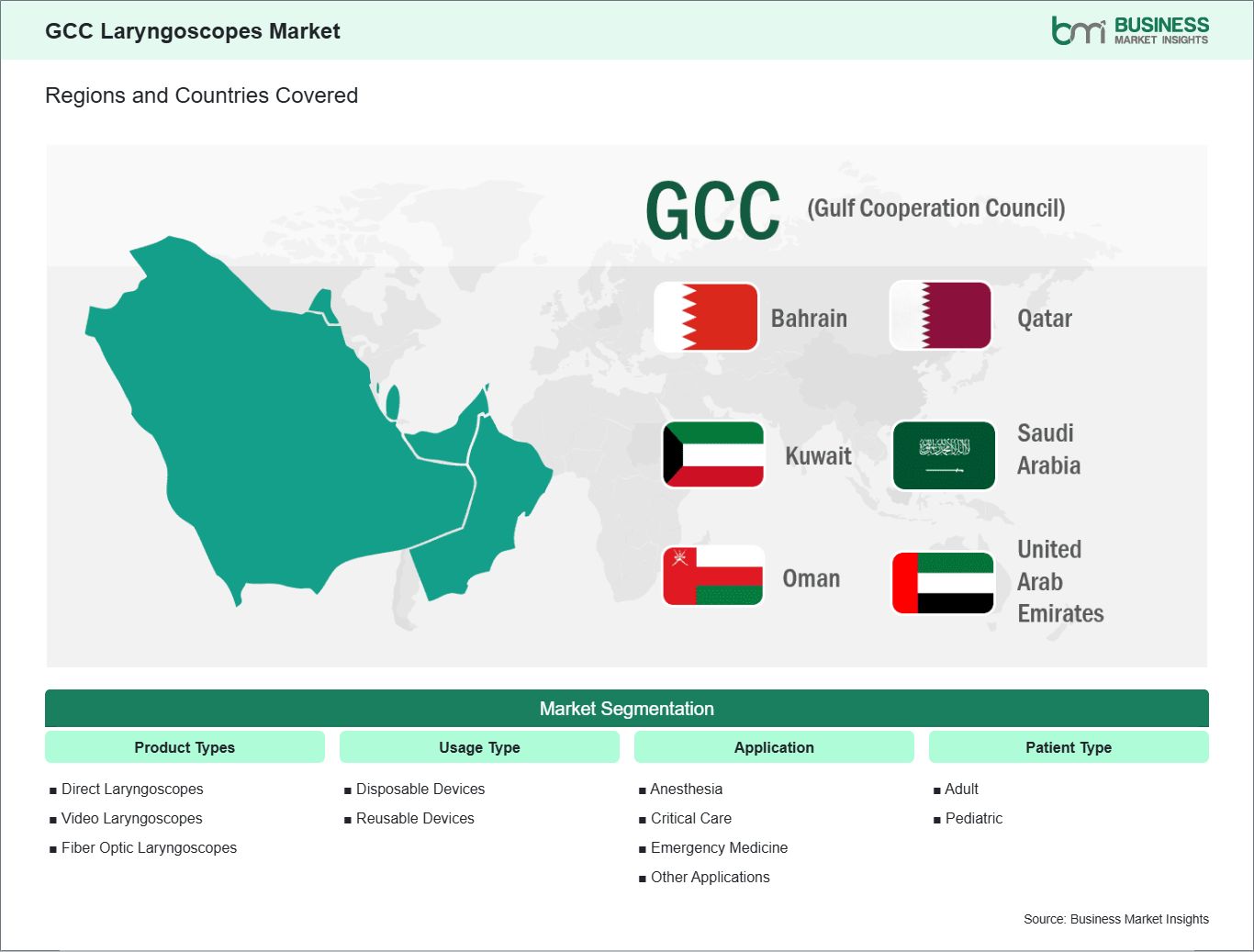
Key segments that contributed to the derivation of the GCC laryngoscopes market analysis are product type, usage type, application, patient type, and end user.
The GCC region is experiencing a growing burden of respiratory disorders driven by rapid urban development, desert dust exposure, and lifestyle-related risk factors. Riyadh, Dubai, and Doha frequently encounter high particulate matter levels due to construction activity and arid climatic conditions, which aggravate asthma and chronic obstructive pulmonary disease (COPD). These environmental stressors are increasingly translating into hospital admissions where airway management and emergency intubation are required, reinforcing the importance of laryngoscopes in critical care settings.
Smoking, including cigarettes and shisha smoking, contributes greatly to the development of chronic lung diseases in the region. Furthermore, the disease is frequently either misdiagnosed as asthma or diagnosed late since there are no proper screening measures available to detect COPD at an earlier stage. It results in late diagnosis of patients who arrive in emergency situations with severe respiratory failure, which requires quick laryngoscopy access and contributes further to the high need for this device among both public and private hospitals.
Moreover, various respiratory conditions remain prevalent causes of acute respiratory failures, especially among elderly patients. These conditions include viral infections, such as influenza and other respiratory illnesses that cause pneumonia or other post-viral complications. Hospitals have expanded their facilities for treating critically ill patients and improved emergency measures taken recently, but the problems related to respiratory health worldwide. Laryngoscopy becomes a regular procedure used to manage the airway during emergency and critical procedures, not only surgeries.
Healthcare systems in the GCC are increasingly directing capital toward simulation-based medical education as part of broader healthcare modernization efforts. Leading medical institutions in Saudi Arabia, the UAE, and Qatar are establishing advanced simulation centers where clinicians are trained in airway management techniques using high-fidelity mannequins and real-world clinical scenarios. These environments allow repeated practice of intubation procedures, improving precision and confidence before clinicians work on actual patients.
This emerging trend is associated with an emphasis on improved clinical outcomes and standardized procedures in emergency care within the region. Simulation training is especially important in the field of airway management, which has immediate implications in case of procedure-related complications. In such a manner, the implementation of traditional laryngoscopy tools and video-assisted laryngoscopy in the simulation training curriculum ensures that clinicians work with the same tools in real-life settings at their hospitals or emergency departments.
At the same time, healthcare transformation initiatives initiated by the GCC governments, along with cooperation with foreign medical institutions, improve the current state of training programs. In particular, hospitals are developing procurement strategies in accordance with training requirements, thus making sure that simulation tools are consistent with the clinical environment in terms of laryngoscope types used in training.

The GCC Laryngoscopes market demonstrates steady growth, with size and share analysis highlighting evolving trends and competitive dynamics among key players. The report evaluates important subsegments categorized within product type, usage type, application, patient type, and end user, highlighting their respective contributions to overall market performance.
By product type, the video laryngoscopes subsegment dominated the laryngoscopes market in 2025. This is driven by the increasing demand for enhanced airway visualization, improved first-pass intubation success rates, and reduced complications in difficult airway management, making them a key revenue driver for manufacturers and supporting strong adoption in clinical practice.
In terms of usage type, the disposable devices subsegment led the market in 2025. The dominance of disposable devices is attributed to the growing emphasis on infection control, prevention of cross-contamination, and the operational convenience of eliminating reprocessing and sterilization requirements in high-volume healthcare settings.
Based on application, the anesthesia subsegment held the largest share in 2025. Hospitals and surgical centers widely rely on laryngoscopes during anesthesia procedures for airway management and intubation, supported by the rising number of surgeries and the increasing use of advanced airway management techniques.
In terms of patient type, the adult subsegment dominated the market in 2025. This is driven by the higher prevalence of surgical procedures, critical care admissions, and chronic respiratory conditions among adults, resulting in greater demand for airway management devices in this population group.
By end user, the hospitals subsegment held the largest share in 2025. Hospitals maintain leadership due to their advanced infrastructure, availability of skilled healthcare professionals, high patient inflow, and strong capability to perform complex surgical and emergency procedures requiring laryngoscopy.
| Report Attribute | Details |
|---|---|
| Market size in 2025 | US$ 5.5 Million |
| Market Size by 2033 | US$ 7.6 Million |
| CAGR (2026 - 2033) | 3.9% |
| Historical Data | 2022-2024 |
| Forecast period | 2026-2033 |
| Segments Covered | By Product Types
|
|
Regions and Countries Covered
| |
| GCC | UAE, Bahrain, Saudi Arabia, Oman, Qatar, Kuwait |
| Market leaders and key company profiles |
|
The "GCC Laryngoscopes Market Size and Forecast (2022-2033)" report provides a detailed analysis of the market covering below areas:
The geographical scope of the GCC Laryngoscopes market report is divided into: Saudi Arabia, the United Arab Emirates (UAE), Qatar, Kuwait, Bahrain, and Oman. Saudi Arabia held the largest share in 2025.
Saudi Arabia emerges as the leading market for laryngoscopes among all the member nations in the Gulf Cooperation Council, attributed to the presence of an advanced healthcare system, a large number of surgeries performed daily, and the government's efforts toward healthcare reforms through several transformation programs. Saudi Arabia has an elaborate hospital network, consisting of tertiary hospitals, surgery-only hospitals, and emergency care hospitals.
In terms of the Saudi Arabian market for laryngoscope technology, there is the widespread adoption of sophisticated medical equipment in prominent hospitals within the country, especially video laryngoscopes that are becoming more common in the use of anesthetics and ICU units in order to enhance precision. The substantial investment made towards expansion of hospital facilities, ICU capacity, and EMS services has only served to reinforce the adoption of modern airway management tools. Moreover, internationally recognized healthcare establishments and medical training programs ensure the continuous application of traditional and sophisticated laryngoscopy systems within the healthcare industry. While high-end hospitals and major metropolitan healthcare centers have shown a keenness towards the adoption of highly sophisticated systems, smaller or regional hospitals might stick to traditional laryngoscopy equipment due to limited budgets. Therefore, it can be concluded that Saudi Arabia possesses a relatively sophisticated market structure for laryngoscope technology.

The GCC Laryngoscopes market is evaluated by gathering qualitative and quantitative data post primary and secondary research, which includes important corporate publications, association data, and databases. A few of the key developments in the GCC Laryngoscopes market are:
The GCC Laryngoscopes Market is valued at US$ 5.5 Million in 2025, it is projected to reach US$ 7.6 Million by 2033.
As per our report GCC Laryngoscopes Market, the market size is valued at US$ 5.5 Million in 2025, projecting it to reach US$ 7.6 Million by 2033. This translates to a CAGR of approximately 3.9% during the forecast period.
The GCC Laryngoscopes Market report typically cover these key segments-
The historic period, base year, and forecast period can vary slightly depending on the specific market research report. However, for the GCC Laryngoscopes Market report:
The GCC Laryngoscopes Market is populated by several key players, each contributing to its growth and innovation. Some of the major players include:
The GCC Laryngoscopes Market report is valuable for diverse stakeholders, including:
Essentially, anyone involved in or considering involvement in the GCC Laryngoscopes Market value chain can benefit from the information contained in a comprehensive market report.
Please tell us your area of interest
(Market Segments/ Regions and Countries/ Companies)