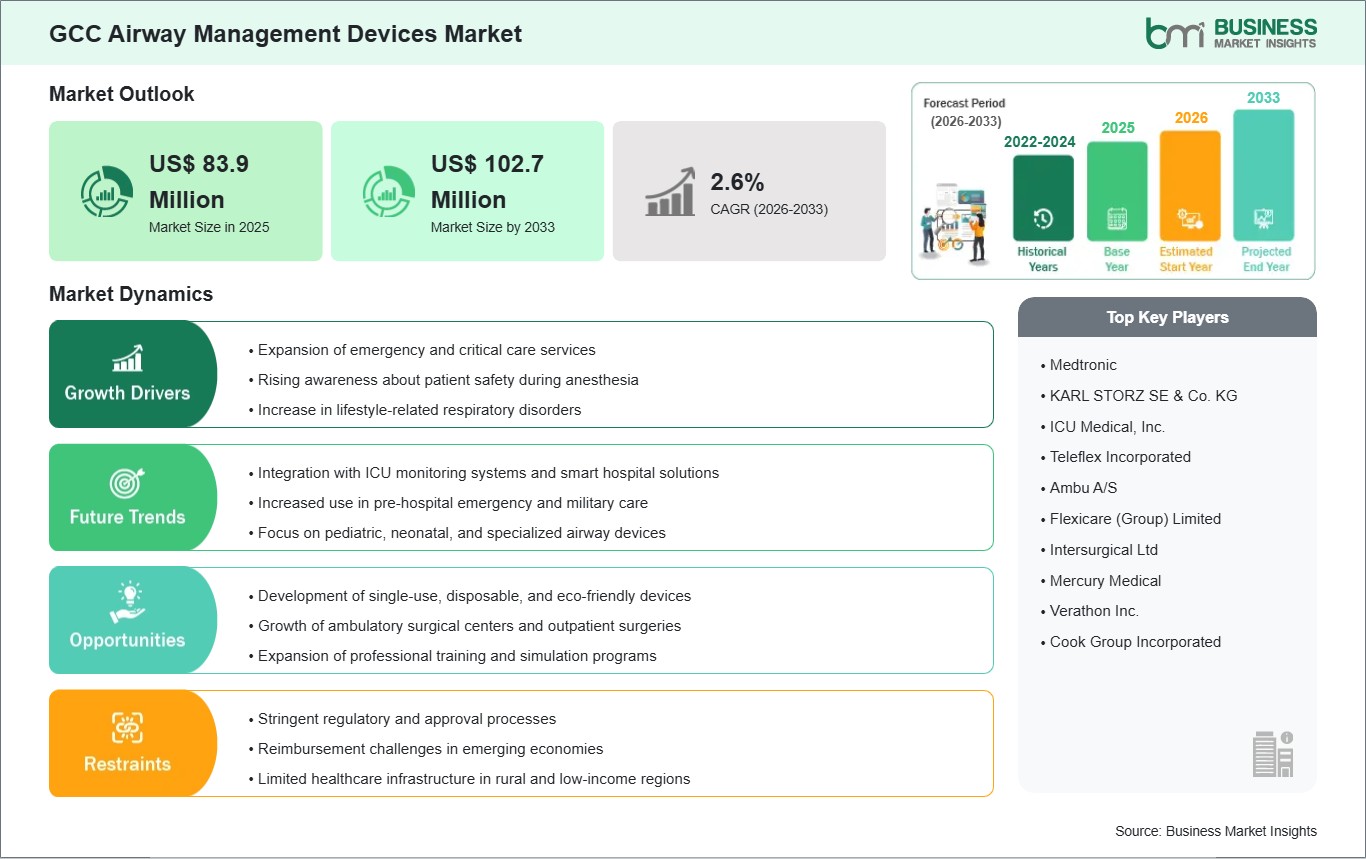
The GCC airway management devices market size is expected to reach US$ 102.7 million by 2033 from US$ 83.9 million in 2025. The market is estimated to record a CAGR of 2.6% from 2026 to 2033.
The GCC airway management devices market is characterized by modernization, high healthcare expenditure, and a keen concern for enhancing patient safety in the public and private healthcare sectors. Some of the significant countries within the GCC airway management devices market include Saudi Arabia, UAE, Qatar, Kuwait, Bahrain, and Oman. Saudi Arabia has been the most prominent country in this market, thanks to the presence of advanced healthcare facilities and investments made by the country for modernizing hospitals and emergency facilities. The preference for advanced equipment such as video laryngoscopes, supraglottic airways devices, and disposables is due to their efficiency in improving procedural success, decreasing the complication rate, and reducing risks of infections. Emergency Medical Services in the region are quite efficient, especially in cities, thus further increasing the need for portable devices that ensure safe procedures. Moreover, the government's focus on digitizing and certifying hospitals is likely to increase adoption of advanced airway management devices. On the other hand, high prices of devices and import of technology act as barriers to growth in the market. Moreover, training of staff and adoption of advanced technology may be challenging in small and rural hospitals. Regardless of the existing obstacles, the airway management equipment market is lucrative with a great potential for future growth in the region.

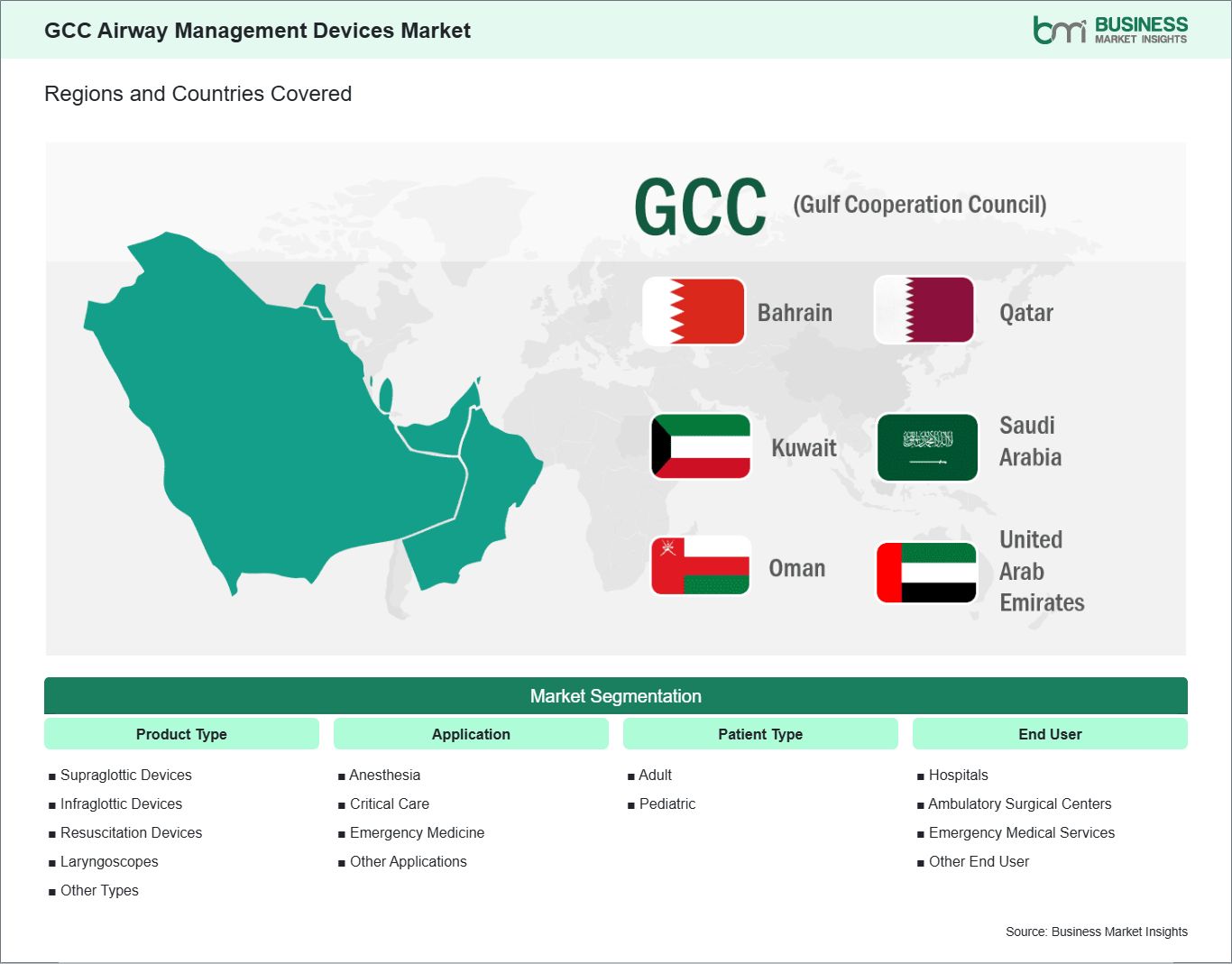
Key segments that contributed to the derivation of the airway management devices market analysis are product type, application, patient type, and end user.
The GCC Airway Management Devices Market is growing due to an increasing number of emergency care and critical care facilities within the region. Saudi Arabia, the United Arab Emirates, and Qatar have invested extensively in health care facilities within their strategic plans for economic diversification. They are constructing tertiary care facilities and retrofitting their emergency facilities with modern airway management units. Facilities in Riyadh and Jeddah are outfitting their ambulance and ICU units with cutting-edge airway management devices like video laryngoscopy and high-efficiency ventilators to respond quickly to road accidents and acute respiratory conditions.
As a result of the drive to boost the critical care sector in the UAE and Kuwait, there have been developments aimed at integrating specialty airway management equipment within newly set-up multidisciplinary departments that not only address the demands of surgical operations but also critical incidences such as cardiac arrest and asthmatic episodes. Within the context of regional events that draw numerous transient populations to Saudi Arabia, such as Hajj pilgrimages, the country is also stocking up on equipment for respiratory emergency management like endotracheal tubes, supraglottic devices, and portable suction devices in readiness for any respiratory crisis that may arise.
Additionally, due to the government-led health campaigns in Oman and Bahrain, there is an increased emphasis on the importance of emergency medicine, with airway management courses being offered to paramedics and nurses through training programs in order to increase their competency in advanced airway management skills. Consequently, the need for highly sophisticated equipment will increase in tandem. Strategic improvements in the fields of emergency and critical care within the GCC region provide a strong catalyst for market growth in the airway management devices market.
The GCC airway management devices market is also being shaped by growing interest in single‑use, disposable, and environmentally conscious products. Infection control remains a top priority in healthcare facilities across the Gulf Cooperation Council, particularly in busy hospitals in Saudi Arabia and the UAE. Single‑use endotracheal tubes, laryngoscope blades, and supraglottic airway devices are increasingly preferred to reduce cross‑contamination and streamline sterilization workflows. Clinics serving large expatriate populations, common in Dubai and Doha, are standardizing disposable airway consumables to maintain high hygiene benchmarks.
Environmentally sustainable options have become one of the key concerns of the procurement process. In line with the respective national strategies, such as the environmental targets outlined by Saudi Vision 2030 and the UAE's commitment to becoming carbon neutral by 2050, many healthcare organizations are investigating biodegradable or recyclable airway management product solutions. Currently, local distributors are introducing environmentally friendly options based on plant polymers and minimal waste packaging, which not only align with the sustainability agenda but also satisfy the stringent clinical requirements.
In addition, due to innovations encouraged by small countries within the GCC region, such as Kuwait and Bahrain, partnerships between local manufacturers and healthcare facilities are facilitating the development of disposable and low-cost equipment designed to function effectively in hot desert environments. The extreme temperature and high incidence of field emergency situations require the implementation of single-use airway kits that can be used outdoors. Another promising trend is disposable airway toolkits intended to be used in mobile clinics and field hospitals located in rural regions.

The GCC airway management devices market is experiencing steady growth, with market size and share analysis reflecting evolving treatment preferences and competitive dynamics among key players. The report evaluates important subsegments categorized within product type, application, patient type, and end user, highlighting their respective contributions to overall market performance.
By product type, the infraglottic devices subsegment dominated the market in 2025. In anesthesia practice, infraglottic devices provide protection against aspiration and enable precise airway management, driving higher adoption in operating rooms and critical care settings compared to supraglottic devices.
Based on application, the anesthesia subsegment dominated the market in 2025 due to the need for definitive airway control across a wide range of surgical procedures, from routine elective surgeries to complex interventions. Because infraglottic devices are essential for intubation during anesthesia, this segment experiences consistent, high-volume usage, making it the largest segment compared to emergency or general critical care.
In terms of patient type, the adult subsegment dominated the market in 2025. Most procedural training, device designs, and usage guidelines are optimized for adult anatomy and usage scenarios, reinforcing higher market volume.
Based on end user, the hospital subsegment dominated the market in 2025, as hospitals remain the central hub for airway management, handling scheduled surgeries, emergency admissions, ICU care, and trauma cases. Their larger budgets, need for extensive airway inventories, and availability of multidisciplinary professionals make them the largest purchasers compared to outpatient centers or EMS, where volume and purchasing power are comparatively lower.
| Report Attribute | Details |
|---|---|
| Market size in 2025 | US$ 83.9 Million |
| Market Size by 2033 | US$ 102.7 Million |
| CAGR (2026 - 2033) | 2.6% |
| Historical Data | 2022-2024 |
| Forecast period | 2026-2033 |
| Segments Covered | By Product Type
|
|
Regions and Countries Covered
| |
| GCC | UAE, Bahrain, Saudi Arabia, Oman, Qatar, Kuwait |
| Market leaders and key company profiles |
|
The "GCC Airway Management Devices Market Size and Forecast (2022–2033)" report provides a detailed analysis of the market covering below areas:
The geographical scope of the GCC airway management devices market report is divided into: Saudi Arabia, the UAE, Qatar, Kuwait, Bahrain, and Oman. Saudi Arabia held the largest share in 2025.
Saudi Arabia dominates the GCC airway management devices market due to its large-scale healthcare infrastructure, proactive government policies, and substantial investment in critical care and emergency medical services. Hospitals in major urban centers are increasingly equipped with advanced airway management solutions, including video-assisted laryngoscopes, second-generation supraglottic airway devices, and disposable intubation kits designed to enhance patient safety and procedural efficiency. Modernization in healthcare technology is a major characteristic in the Saudi Arabian market, where there are government-wide efforts aimed at standardizing healthcare protocols and improving surgical procedures. Additionally, pre-hospital emergency services are another key component, where ambulances in urban centers are fitted with portable airway devices that guarantee quick responses during emergencies. Professional training is encouraged in the country, where anesthesiologists, paramedics, and emergency care professionals undergo simulation exercises for effective utilization of advanced airway management devices. Moreover, Saudi Arabia has a policy of collaboration with international firms involved in manufacturing medical devices to promote innovation without compromising on affordability. Overall, Saudi Arabia has a solid infrastructure in terms of hospitals, advanced emergency facilities, and policy-driven adoption of airway devices, positioning it at the forefront of the GCC airway management devices market.

The GCC airway management devices market is evaluated by gathering qualitative and quantitative data post primary and secondary research, which includes important corporate publications, association data, and databases. A few of the key developments in the GCC airway management devices market are:
The GCC Airway Management Devices Market is valued at US$ 83.9 Million in 2025, it is projected to reach US$ 102.7 Million by 2033.
As per our report GCC Airway Management Devices Market, the market size is valued at US$ 83.9 Million in 2025, projecting it to reach US$ 102.7 Million by 2033. This translates to a CAGR of approximately 2.6% during the forecast period.
The GCC Airway Management Devices Market report typically cover these key segments-
The historic period, base year, and forecast period can vary slightly depending on the specific market research report. However, for the GCC Airway Management Devices Market report:
The GCC Airway Management Devices Market is populated by several key players, each contributing to its growth and innovation. Some of the major players include:
The GCC Airway Management Devices Market report is valuable for diverse stakeholders, including:
Essentially, anyone involved in or considering involvement in the GCC Airway Management Devices Market value chain can benefit from the information contained in a comprehensive market report.
Please tell us your area of interest
(Market Segments/ Regions and Countries/ Companies)