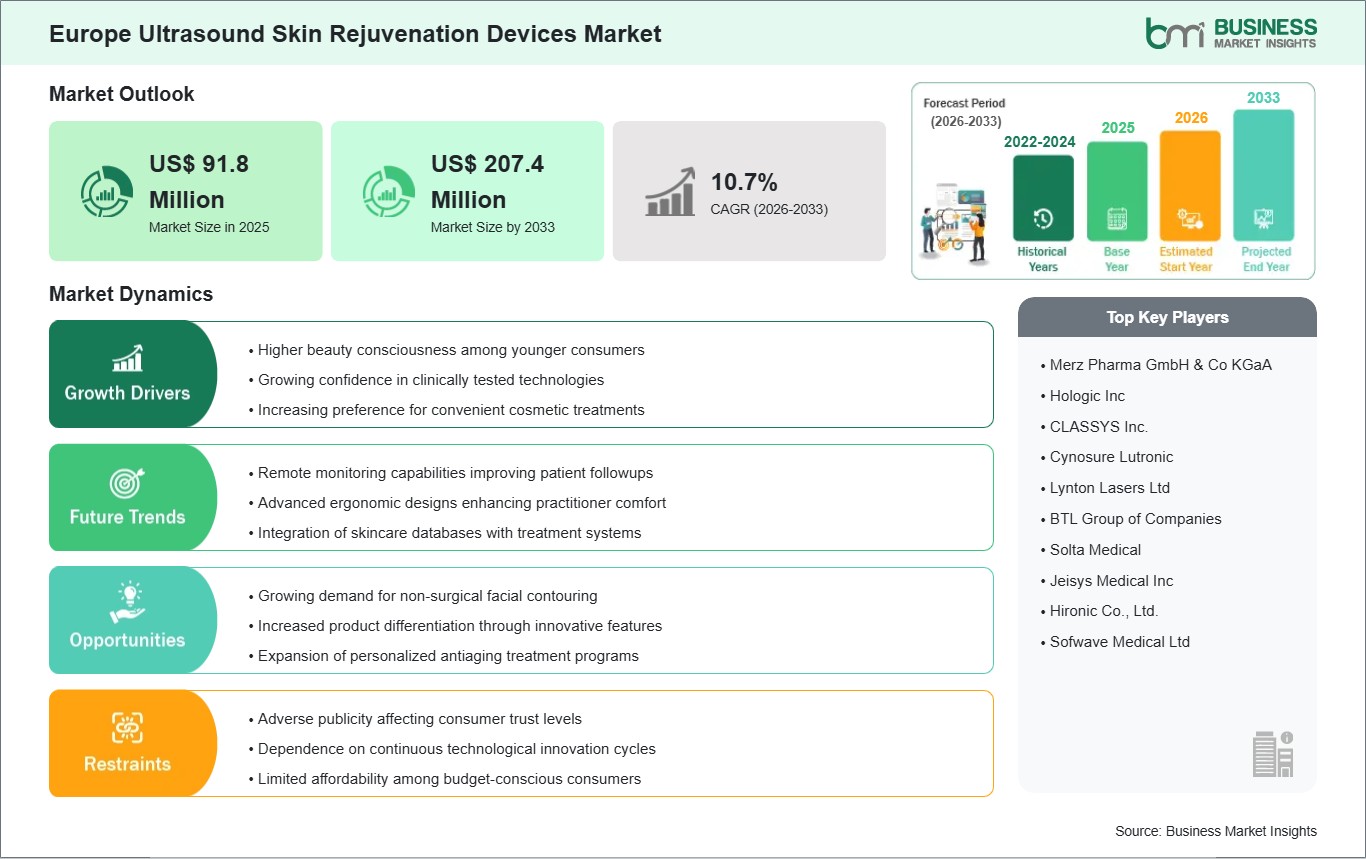
The Europe ultrasound skin rejuvenation devices market size is expected to reach US$ 207.4 million by 2033 from US$ 91.8 million in 2025. The market is estimated to record a CAGR of 10.7% from 2026 to 2033.
The Europe ultrasound skin rejuvenation devices market is experiencing sustained structural growth, underpinned by increasing consumer preference for non-invasive aesthetic procedures and a strong shift toward preventive dermatology across both Western and emerging European economies. Factors driving demand include increased awareness of aesthetics, a growing aging populace who would prefer non-invasive methods of reversing the effects of aging, and the growing impact of dermo-aesthetic wellness culture. Energy-based techniques such as ultrasound are now becoming more common in clinics for use in procedures such as skin tightening, collagen regeneration, and facial shaping. As far as business trends are concerned, there is the consolidation of the industry between well-established medical equipment manufacturers and specialized aesthetic medical companies engaged in fierce competition based on innovation intensity. There are efforts toward creating multi-functional products, depth control and improved accuracy, and intelligent use of algorithms to tailor treatments. Clinics are favoring devices that allow efficient treatment with minimal recovery times and those compatible with laser or radio frequency treatments. Distribution strategies across Europe are evolving toward hybrid models combining direct sales, distributor networks, and clinic partnerships supported by structured practitioner training programs. Regulatory harmonization under stringent medical device compliance frameworks is shaping product design, safety validation, and commercialization timelines, creating a high barrier to entry but ensuring strong product standardization. Additionally, the rise of medical aesthetics chains and franchise-based dermatology clinics is accelerating device penetration across tier-1 and tier-2 cities. Market competition is intensifying as both global and regional players invest in service ecosystems, including maintenance contracts, software upgrades, and consumable integration. Overall, Europe remains a technologically advanced and highly regulated market with steady expansion driven by innovation-led demand and professionalized aesthetic service delivery.

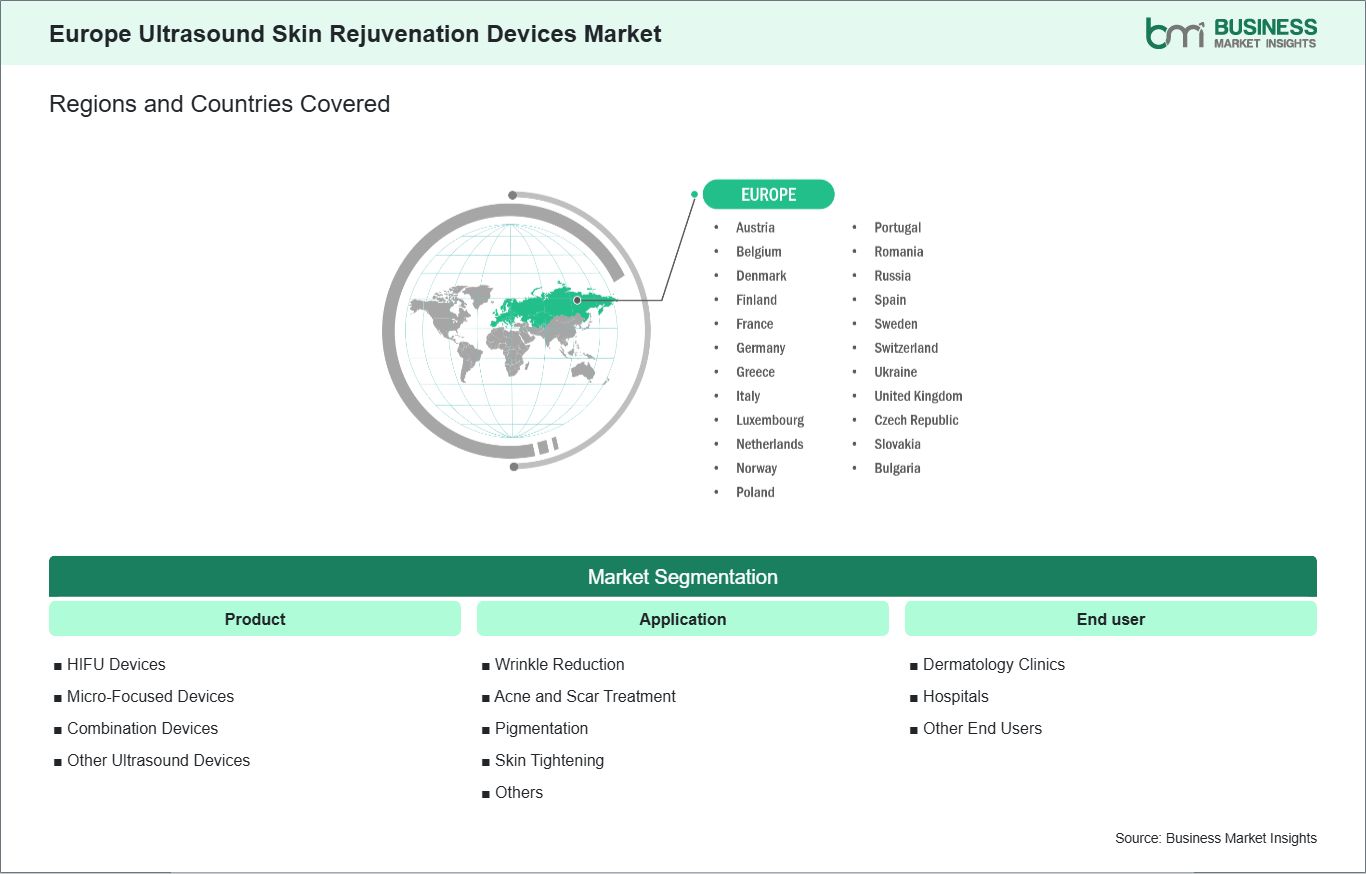
Key segments that contributed to the derivation of the Europe ultrasound skin rejuvenation devices market analysis are product, application, and end user.
The Europe ultrasound skin rejuvenation devices market is being significantly reshaped by continuous technological advancements that are enhancing treatment precision, safety, and clinical outcomes.In popular centers for aesthetic medicine like Germany and France, there is an increased tendency among dermatologists to use the latest generation of HIFU systems with multi-depth energy capability. The new devices enable practitioners to work on both superficial and deeper layers of skin tissue within one treatment session. Patients treated at clinics located in cities like Berlin and Paris have shown increased levels of satisfaction because the procedure provides better tightening and lower levels of pain after the procedure.
Within technologically developed regions such as UK and Italy, innovative ultrasound platforms characterized by being smaller, ergonomically shaped, and portable are currently driving innovations owing to their applicability in fast-throughput aesthetics centers. Modular systems that can be easily calibrated and that take less time for carrying out procedures are increasingly being adopted in private dermatology chains located in cities such as London and Milan, thus making it possible to carry out more procedures in a day. This is especially true in view of the growing demand for non-invasive facelift procedures among professionals who seek lunch-time aesthetic procedures.
In both Southern and Central Europe, progress in consumables, probes, and energy regulation software is allowing greater access to ultrasound skin rejuvenation by mid-range clinics. Small cosmetic clinics in countries like Spain and Portugal can afford equipment that provides professional quality treatment results without necessitating significant capital outlays for clinic infrastructure. These innovations have made ultrasound skin rejuvenation increasingly common outside luxury clinics in Europe’s outpatient centers. With continued advances in pulse precision, depth control, and feedback capabilities, ultrasound skin rejuvenation technology is becoming an essential part of modern non-invasive cosmetic procedures.
The integration of artificial intelligence into ultrasound skin rejuvenation workflows is transforming treatment planning and personalization across Europe. For the sophisticated dermatological markets of Germany and France, skin testing by means of artificial intelligence is used more frequently to assess the thickness of the dermis, collagen quantity, and facial symmetry prior to determining the settings for ultrasonic therapy. This will allow the practitioner to tailor the treatment plan for maximum effect. The AI-based skin imaging technology is being applied in dermatology practices within cities such as Munich and Paris.
The AI-based skin analysis tools are currently incorporated in both stand-alone dermatology clinics and chain cosmetic clinics in the UK and Italy. Cosmetic clinics in both London and Rome are implementing the use of imaging technology whereby the facial mapping in 3D and predictive models are incorporated for the purpose of generating the outcome of treatments before undergoing any procedure. This helps to increase the client’s confidence and at the same time raise the conversion rate for high-end treatments. AI models have further been utilized in the monitoring of patient’s progress in order to adjust ultrasound intensity and depth dynamically.
Furthermore, the gradual uptake of AI in Southern and Eastern European regions is driving increased democratization in terms of AI-supported aesthetics treatments. There have been more cases of cloud-based diagnosis technologies being adopted in Spain, Greece, and Poland. The use of such technologies is proving to be very beneficial to small clinics as they try to outshine their bigger rivals based in urban settings using AI-powered diagnostic techniques for providing personalized care. Moreover, with the continuous development of artificial intelligence, it is expected to see the integration of AI in ultrasound skin revitalizers become the norm in Europe.
The Europe ultrasound skin rejuvenation devices market demonstrates steady growth, with size and share analysis highlighting evolving trends and competitive dynamics among key players. The report examines subsegments categorized within product, application, and end user, offering insights into their contribution to overall market performance.
By product, the HIFU devices segment dominated the market in 2025, driven by rising preference for advanced non-invasive aesthetic systems delivering deeper dermal remodeling and long-term skin tightening results in Europe.
Based on application, the wrinkle reduction segment dominated the market in 2025, driven by strong demand for anti-aging procedures supported by an increasingly aging population and high cosmetic awareness across the region.
In terms of end user, the dermatology clinics segment dominated the market in 2025, driven by widespread availability of specialized aesthetic services and higher consumer trust in professional clinical treatment settings.
| Report Attribute | Details |
|---|---|
| Market size in 2025 | US$ 91.8 Million |
| Market Size by 2033 | US$ 207.4 Million |
| CAGR (2026 - 2033) | 10.7% |
| Historical Data | 2022-2024 |
| Forecast period | 2026-2033 |
| Segments Covered | By Product
|
|
Regions and Countries Covered
| |
| Europe | Belgium, Austria, Finland, Denmark, Greece, Poland, Romania, Russia, Ukraine, Czech Republic, Slovakia, Bulgaria, Italy, Luxembourg, Germany, Switzerland, France, Netherlands, Norway, Portugal, Spain, Sweden, United Kingdom |
| Market leaders and key company profiles |
|
The "Europe Ultrasound Skin Rejuvenation Devices Market Size and Forecast (2022-2033)" report provides a detailed analysis of the market covering below areas:
The geographical scope of the Europe ultrasound skin rejuvenation devices market report is divided into Belgium, Austria, Finland, Denmark, Greece, Poland, Romania, Russia, Ukraine, Czech Republic, Slovakia, Bulgaria, Italy, Luxembourg, Germany, Switzerland, France, Netherlands, Norway, Portugal, Spain, Sweden, United Kingdom. Germany held the largest share in 2025.
Within the Europe ultrasound skin rejuvenation devices market, Germany stands as the dominant force, supported by a highly advanced medical aesthetics infrastructure, strong regulatory compliance culture, and widespread adoption of clinically validated dermatology technologies. German clinics demonstrate strong preference for premium ultrasound systems with high precision energy delivery and integration into structured anti-aging protocols, making the country a key innovation and revenue hub for the region. United Kingdom exhibits strong demand driven by a well-developed private aesthetic sector and high consumer willingness to invest in non-invasive cosmetic procedures, particularly in metropolitan centers such as London. France shows steady adoption supported by a mature dermatological culture and increasing integration of preventive aesthetics into mainstream skincare practices. Italy and Spain demonstrate growing traction, fueled by strong beauty consciousness and expanding private clinic networks, with rising demand for facial rejuvenation and skin tightening procedures. In Northern Europe, Sweden, Denmark, Norway, and Finland show high per-capita adoption of advanced aesthetic technologies, driven by high disposable incomes and early adoption of medical innovations. In Western Europe, Netherlands, Belgium, Luxembourg, and Switzerland are characterized by premium-focused clinic ecosystems and strong demand for high-end aesthetic devices. Southern and Central Europe, including Portugal, Greece, Poland, Romania, Czech Republic, Slovakia, Bulgaria, Russia, and Ukraine show varying stages of adoption, with demand largely driven by expanding private clinics, rising aesthetic awareness, and gradual access to advanced dermatology technologies. Across Europe, Germany remains the clear anchor market, while other countries contribute through differentiated demand maturity, pricing sensitivity, and evolving clinic infrastructure.

The Europe ultrasound skin rejuvenation devices market is evaluated by gathering qualitative and quantitative data post primary and secondary research, which includes important corporate publications, association data, and databases. A few of the key developments in the Europe ultrasound skin rejuvenation devices market are:
The Europe Ultrasound Skin Rejuvenation Devices Market is valued at US$ 91.8 Million in 2025, it is projected to reach US$ 207.4 Million by 2033.
As per our report Europe Ultrasound Skin Rejuvenation Devices Market, the market size is valued at US$ 91.8 Million in 2025, projecting it to reach US$ 207.4 Million by 2033. This translates to a CAGR of approximately 10.7% during the forecast period.
The Europe Ultrasound Skin Rejuvenation Devices Market report typically cover these key segments-
The historic period, base year, and forecast period can vary slightly depending on the specific market research report. However, for the Europe Ultrasound Skin Rejuvenation Devices Market report:
The Europe Ultrasound Skin Rejuvenation Devices Market is populated by several key players, each contributing to its growth and innovation. Some of the major players include:
The Europe Ultrasound Skin Rejuvenation Devices Market report is valuable for diverse stakeholders, including:
Essentially, anyone involved in or considering involvement in the Europe Ultrasound Skin Rejuvenation Devices Market value chain can benefit from the information contained in a comprehensive market report.
Please tell us your area of interest
(Market Segments/ Regions and Countries/ Companies)