Analysis By Device Type (RF-Modulated Light Sources With Phase Detectors, Range-Gated Imagers, and Direct Time-of-Flight Imagers), Vertical (Automotive, Consumer Electronics, Gaming and Entertainment, Industrial, Healthcare, Aerospace & Defense, and Others)
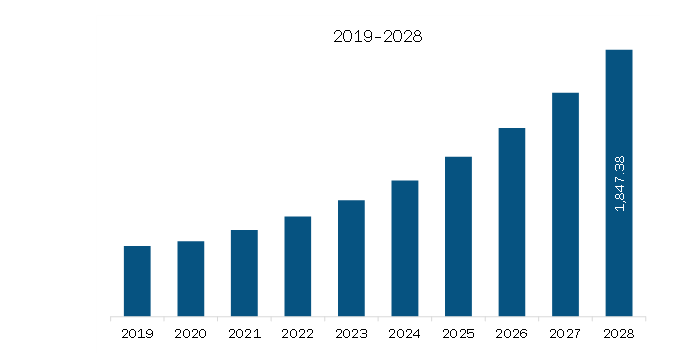
The Europe time-of-flight sensor market is expected to grow from US$ 694.26 million in 2022 to US$ 1,847.38 million by 2028. It is estimated to grow at a CAGR of 17.7% from 2022 to 2028.
Growing Use of Time-of-Flight Sensors for Automotive Applications in Europe Time-of-Flight Sensor Market
The automotive industry is improving rapidly with rising technological developments. Vehicles rely on effective sensing to allow automated systems to assist drivers and provide improved safety, comfort, and convenience. Time-of-Flight (ToF) sensors are used in autonomous vehicles for various purposes, such as localization, obstacle detection, and picking or placing objects. The technology helps detect objects and provides information on their position and movements within the three-dimensional space. It also assists in identifying the object by detecting its size, shape, and orientation. Inside the car, ToF technology is used to monitor the driver's behavior that can significantly contribute to road safety. Most accidents across the region are occurred due to the issue caused by driver's fatigue. The iToF technology helps monitor the behavior of driver and accordingly suggests or enforces break, thus potentially avoiding accidents. The sensors help detect the passengers' size and weight, which can assist in airbag deployment when necessary. Also, in the absence of passengers, the sensors will prevent unnecessary airbag deployment. Furthermore, along with the improvements in vehicle safety, the ToF technology provides comfort and convenience inside the car cabin, which may benefit drivers and passengers. The seats can be moved, and seat belts can be brought closer when the passenger gets into the car. It can also help the driver or passenger by turning on the light of the storage compartments when a hand reaches in that direction. Thus, the growing use of ToF sensors for automotive application is boosting the growth of the Europe Time-of-Flight Sensor market.
Europe Time-Of-Flight Sensor Market Overview
The Europe Time-of-Flight Sensor market is segmented into Germany, France, Spain, the UK, Italy, and the Rest of Europe. The growing automotive sector is driving the market growth in the region. It is one of Europe’s biggest sectors, representing over 7% of the region’s GDP. The presence of established car manufacturers and an increase in the development and sales of electric vehicles will boost the demand for Time-of-Flight Sensors in the coming years. Also, the government of the region is taking various initiatives for the growth of the automotive industry, which will propel the demand for Time-of-Flight Sensors. In 2020, the UK government awarded US$ 57.87 million for various low-carbon automotive projects, including electric vehicle manufacturing. Since 2006 in Europe, NATO (North Atlantic Treaty Organization) defense ministers announced annual spending of 2% of GDP on their military budgets. As a result, the demand for military and defense equipment has increased. Furthermore, in March 2022, Poland passed a law to increase defense spending to 3% of GDP. Also, in February 2022, German Chancellor Olaf Scholz announced a US$ 112.69 billion (€100 billion) injection in defense spending. Thus, the increasing defense spending by the European government will raise the demand for military and defense equipment, which will fuel the Time-of-Flight Sensor market growth in the coming years.
Europe Time-Of-Flight Sensor market Revenue and Forecast to 2028 (US$ Million)
Europe Time-Of-Flight Sensor market Segmentation
The Europe Time-Of-Flight Sensor market is segmented on the basis of device type, vertical, and country. Based on device type, the Europe time-of-flight sensor market is segmented into RF-modulated light sources with phase detectors, range-gated imagers, and direct time-of-flight imagers. The range-gated imagers segment registered the largest market share in 2022.
Based on vertical, the Europe time-of-flight sensor market is segmented into automotive, consumer electronics, gaming and entertainment, industrial, healthcare, aerospace and defense, and others. The consumer electronics segment registered a larger market share in 2022.
Based on country, the Europe time-of-flight sensor market is segmented into France, Germany, UK, Italy, Russia, and the Rest of Europe. Germany dominated the market share in 2022.
Analog Devices Inc, Infineon Technologies AG, InvenSense Inc, Keyence Corp, OMRON Corp, Panasonic Holdings Corp, Sony Group Corp, STMicroelectronics NV, Teledyne e2v (Overseas) Holdings Ltd, and Texas Instruments Inc are the leading companies operating in the Europe time-of-flight sensor market.
Europe Time-of-Flight Sensor Market Strategic Insights
Get more information on this report
Europe Time-of-Flight Sensor Market Segmentation Analysis
Europe Time-of-Flight Sensor Market Report Highlights
Europe Time-of-Flight Sensor Report Scope
Report Attribute
Details
Market size in 2022
US$ 694.26 Million
Market Size by 2028
US$ 1,847.38 Million
CAGR (2022 - 2028)
17.7%
Historical Data
2020-2021
Forecast period
2023-2028
Segments Covered
By Device Type
RF-Modulated Light Sources With Phase Detectors
Range-Gated Imagers
Direct Time-of-Flight Imagers
By Vertical
Automotive
Consumer Electronics
Gaming and Entertainment
Industrial
Healthcare
Aerospace & Defense
Regions and Countries Covered
Europe
UK, Germany, France, Russia, Italy, Rest of Europe
Market leaders and key company profiles
Analog Devices Inc
Infineon Technologies AG
InvenSense Inc
Keyence Corp
OMRON Corp
Panasonic Holdings Corp
Sony Group Corp
STMicroelectronics NV
Teledyne e2v (Overseas) Holdings Ltd
Texas Instruments Inc
Get more information on this report
Europe Time-of-Flight Sensor Market Country and Regional Insights
Get more information on this report
Identical Market Reports with other Region/Countries
The List of Companies - Europe Time-of-Flight Sensor Market
Analog Devices IncInfineon Technologies AGInvenSense IncKeyence CorpOMRON CorpPanasonic Holdings CorpSony Group CorpSTMicroelectronics NVTeledyne e2v (Overseas) Holdings LtdTexas Instruments Inc
Frequently Asked Questions
How big is the Europe Time-of-Flight Sensor Market?
The Europe Time-of-Flight Sensor Market is valued at US$ 694.26 Million in 2022, it is projected to reach US$ 1,847.38 Million by 2028.
What is the CAGR for Europe Time-of-Flight Sensor Market by (2022 - 2028)?
As per our report Europe Time-of-Flight Sensor Market, the market size is valued at US$ 694.26 Million in 2022, projecting it to reach US$ 1,847.38 Million by 2028. This translates to a CAGR of approximately 17.7% during the forecast period.
What segments are covered in this report?
The Europe Time-of-Flight Sensor Market report typically cover these key segments-
Device Type (RF-Modulated Light Sources With Phase Detectors, Range-Gated Imagers, Direct Time-of-Flight Imagers)
What is the historic period, base year, and forecast period taken for Europe Time-of-Flight Sensor Market?
The historic period, base year, and forecast period can vary slightly depending on the specific market research report. However, for the Europe Time-of-Flight Sensor Market report:
Historic Period : 2020-2021
Base Year : 2022
Forecast Period : 2023-2028
Who are the major players in Europe Time-of-Flight Sensor Market?
The Europe Time-of-Flight Sensor Market is populated by several key players, each contributing to its growth and innovation. Some of the major players include:
Analog Devices Inc
Infineon Technologies AG
InvenSense Inc
Keyence Corp
OMRON Corp
Panasonic Holdings Corp
Sony Group Corp
STMicroelectronics NV
Teledyne e2v (Overseas) Holdings Ltd
Texas Instruments Inc
Who should buy this report?
The Europe Time-of-Flight Sensor Market report is valuable for diverse stakeholders, including:
Investors: Provides insights for investment decisions pertaining to market growth, companies, or industry insights. Helps assess market attractiveness and potential returns.
Industry Players: Offers competitive intelligence, market sizing, and trend analysis to inform strategic planning, product development, and sales strategies.
Suppliers and Manufacturers: Helps understand market demand for components, materials, and services related to concerned industry.
Researchers and Consultants: Provides data and analysis for academic research, consulting projects, and market studies.
Financial Institutions: Helps assess risks and opportunities associated with financing or investing in the concerned market.
Essentially, anyone involved in or considering involvement in the Europe Time-of-Flight Sensor Market value chain can benefit from the information contained in a comprehensive market report.





 Get Free Sample For Europe Time-of-Flight Sensor Market