Analysis By Device Type (RF-Modulated Light Sources With Phase Detectors, Range-Gated Imagers, and Direct Time-of-Flight Imagers), Vertical (Automotive, Consumer Electronics, Gaming and Entertainment, Industrial, Healthcare, Aerospace & Defense, and Others)
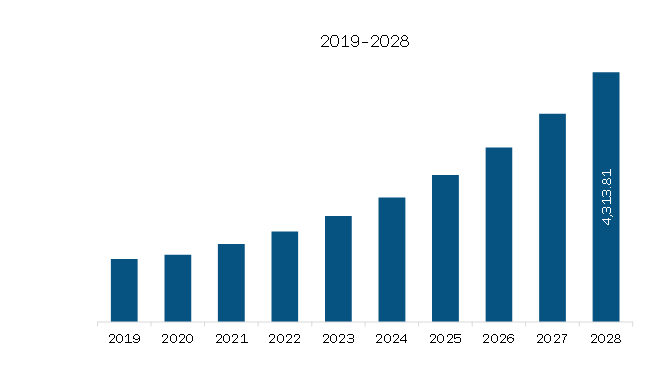
The Asia-Pacific time-of-flight sensor market is expected to grow from US$ 1,564.12 million in 2022 to US$ 4,313.81 million by 2028. It is estimated to grow at a CAGR of 18.4% from 2022 to 2028.
Rising Adoption of Time-of-Flight Technology in Smartphones in Asia-Pacific Time-of-Flight Sensor Market
Image sensor based on time-of-flight technology uses a laser beam to accurately measure the distance to the target object. Therefore, the demand for technology in mobile devices is increasing tremendously, specifically for photography features such as blurring effects and auto-focus. In addition, the demand for 3D facial mapping for features such as facial unlocking of the smartphone is raising the demand for time-of-flight cameras in the market. Owing to the increasing demand for time-of-flight technologies, the market players are working on incorporating the technology into smartphones. In August 2022, Samsung announced that they are working on the ISOCELL Vizion 3D ToF camera sensor. The company will incorporate this technology in its new Galaxy S21 series, which will be released in 2023. Through this technology, the company claims to provide better facial recognition and depth sensing capabilities with an accurate and immersive augmented reality experience. The application supports Android and iOS devices. ToF AR uses the back-illuminated ToF 3D image sensor to obtain real-time high-resolution and high-precision 3D depth information. It is also ideal for 3D face recognition, 3D scanning, autofocus assistance, and the bokeh effect for cameras. Thus, the growing adoption of time-of-flight technology in smartphones will fuel the growth of the Asia-Pacific time-of-flight sensor market in the coming years.
The APAC Time-of-Flight Sensor market is segmented into China, India, Japan, Australia, South Korea, and the Rest of APAC. According to GSMA, the smartphone adoption rate in the region reached 68% in 2020, which is expected to increase to 83% by 2025. Thus, the growing demand for smartphones in the region is raising the requirement for Time-of-Flight Sensors, propelling the growth of the market. The growing demand for other consumer electronic devices such as tablets, PCs, laptops, and others in Asian countries will also boost the growth of the Asia Pacific Time-of-Flight Sensor market in the coming years. In Asia Pacific, China is the largest manufacturer of consumer electronic devices. According to Nikkei Inc., the Chinese government is working on various plans to expand the country's domestic electronic market by investing US$ 327 billion till 2023. In addition, the Indian government is expanding the electronics market in the country. According to the Ministry of Electronics & IT, initiatives by the Indian government and efforts of the industry have led to the domestic production of electronic goods with revenue of US$ 74.7 billion in 2020 and a CAGR of 17.9%. A few government policies for electronics manufacturing include the Production Linked Incentive (PLI) Schemes, the Scheme for Promotion of Manufacturing of Electronic Components and Semiconductors (SPECS) , and the Modified Electronics Manufacturing Cluster (EMC 2.0) Scheme. Furthermore, the electronics sector in Asia Pacific accounts for 20–50% of Asia's total value of exports. As Asia Pacific is the largest electronic manufacturer, the demand for Time-of-Flight Sensors will rise across the region during the forecast period. Sony Group Corp, OMRON Corp, Panasonic Holdings Corp, and Keyence Corp are among the market players that manufacture Time-of-Flight Sensors across Asia Pacific.
Asia-Pacific Time-Of-Flight Sensor market Revenue and Forecast to 2028 (US$ Million)
The Asia-Pacific Time-Of-Flight Sensor market is segmented on the basis of device type, vertical, and country. Based on device type, the Asia-Pacific time-of-flight sensor market is segmented into RF-modulated light sources with phase detectors, range-gated imagers, and direct time-of-flight imagers. The range-gated imagers segment registered the largest market share in 2022.
Based on vertical, the Asia-Pacific time-of-flight sensor market is segmented into automotive, consumer electronics, gaming and entertainment, industrial, healthcare, aerospace and defense, and others. The consumer electronics segment registered a larger market share in 2022.
Based on country, the Asia-Pacific time-of-flight sensor market is segmented into China, Japan, India, South Korea, Australia, and the Rest of Asia-Pacific. Germany dominated the market share in 2022.
Analog Devices Inc, Infineon Technologies AG, InvenSense Inc, Keyence Corp, OMRON Corp, Panasonic Holdings Corp, Sony Group Corp, STMicroelectronics NV, Teledyne e2v (Overseas) Holdings Ltd, and Texas Instruments Inc are the leading companies operating in the Asia-Pacific time-of-flight sensor market.
The List of Companies - Asia-Pacific Time-of-Flight Sensor Market
Analog Devices IncInfineon Technologies AGInvenSense IncKeyence CorpOMRON CorpPanasonic Holdings CorpSony Group CorpSTMicroelectronics NVTeledyne e2v (Overseas) Holdings LtdTexas Instruments Inc
Frequently Asked Questions
How big is the Asia-Pacific Time-of-Flight Sensor Market?
The Asia-Pacific Time-of-Flight Sensor Market is valued at US$ 1,564.12 Million in 2022, it is projected to reach US$ 4,313.81 Million by 2028.
What is the CAGR for Asia-Pacific Time-of-Flight Sensor Market by (2022 - 2028)?
As per our report Asia-Pacific Time-of-Flight Sensor Market, the market size is valued at US$ 1,564.12 Million in 2022, projecting it to reach US$ 4,313.81 Million by 2028. This translates to a CAGR of approximately 18.4% during the forecast period.
What segments are covered in this report?
The Asia-Pacific Time-of-Flight Sensor Market report typically cover these key segments-
Device Type (RF-Modulated Light Sources With Phase Detectors, Range-Gated Imagers, Direct Time-of-Flight Imagers)
What is the historic period, base year, and forecast period taken for Asia-Pacific Time-of-Flight Sensor Market?
The historic period, base year, and forecast period can vary slightly depending on the specific market research report. However, for the Asia-Pacific Time-of-Flight Sensor Market report:
Historic Period : 2020-2021
Base Year : 2022
Forecast Period : 2023-2028
Who are the major players in Asia-Pacific Time-of-Flight Sensor Market?
The Asia-Pacific Time-of-Flight Sensor Market is populated by several key players, each contributing to its growth and innovation. Some of the major players include:
Analog Devices Inc
Infineon Technologies AG
InvenSense Inc
Keyence Corp
OMRON Corp
Panasonic Holdings Corp
Sony Group Corp
STMicroelectronics NV
Teledyne e2v (Overseas) Holdings Ltd
Texas Instruments Inc
Who should buy this report?
The Asia-Pacific Time-of-Flight Sensor Market report is valuable for diverse stakeholders, including:
Investors: Provides insights for investment decisions pertaining to market growth, companies, or industry insights. Helps assess market attractiveness and potential returns.
Industry Players: Offers competitive intelligence, market sizing, and trend analysis to inform strategic planning, product development, and sales strategies.
Suppliers and Manufacturers: Helps understand market demand for components, materials, and services related to concerned industry.
Researchers and Consultants: Provides data and analysis for academic research, consulting projects, and market studies.
Financial Institutions: Helps assess risks and opportunities associated with financing or investing in the concerned market.
Essentially, anyone involved in or considering involvement in the Asia-Pacific Time-of-Flight Sensor Market value chain can benefit from the information contained in a comprehensive market report.





 Get Free Sample For Asia-Pacific Time-of-Flight Sensor Market