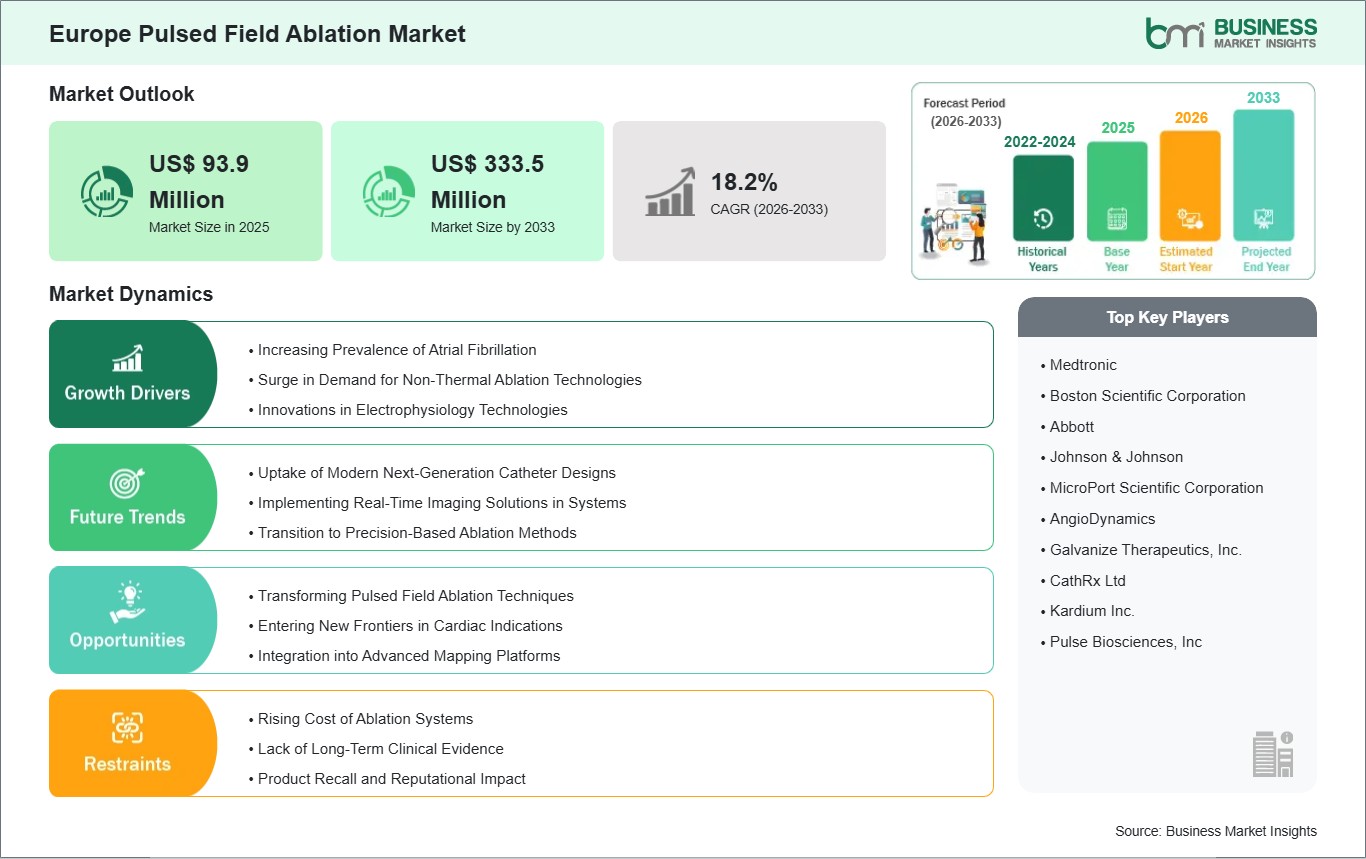
The Europe pulsed field ablation market size is expected to reach US$ 333.5 million by 2033 from US$ 93.9 million in 2025. The market is estimated to register a CAGR of 18.2% from 2026 to 2033.
The European market for pulse field ablation (PFA) is an early adopter amongst advanced healthcare systems, as well as increasing interest in PFA from electrophysiologists seeking safer, more precise treatment for arrhythmias. This market is largely driven by the increasing number of individuals with atrial fibrillation, which is creating a need for less invasive procedures with lower procedural risks and improved outcomes for patients. The rising use of PFA in Europe can be attributed to its non-thermal mechanism that allows for the selective targeting of cardiac tissue, while minimizing damage to surrounding tissues and allowing for reduced recovery time. In addition, PFA technology directly supports Europe’s goals of providing high patient safety, clinical efficiency, and implementing innovative therapies for cardiovascular disease.
Many hospitals across Europe are allocating funds toward building specialized electrophysiology labs and investing in advanced imaging systems to facilitate the use of PFA in their procedures. Furthermore, the establishment of clinician training programs and pilot clinical studies is also helping create a heightened level of confidence surrounding PFA procedures among clinicians. Additionally, the establishment of collaborative research agreements between hospitals and PFA technology vendors will allow for the rapid dissemination of knowledge gained through the early adoption of the technology, allowing early adopters to define procedural protocols and help develop safety standards. However, the overall growth of the pulse field ablation market is being restricted by the high cost of performing PFA procedures in addition to the limited number of hospitals that have access to high-quality pulse field ablation equipment. Additionally, the lack of trained electrophysiologists also prohibits the further adoption of pulse field ablation technologies beyond large medical centers.

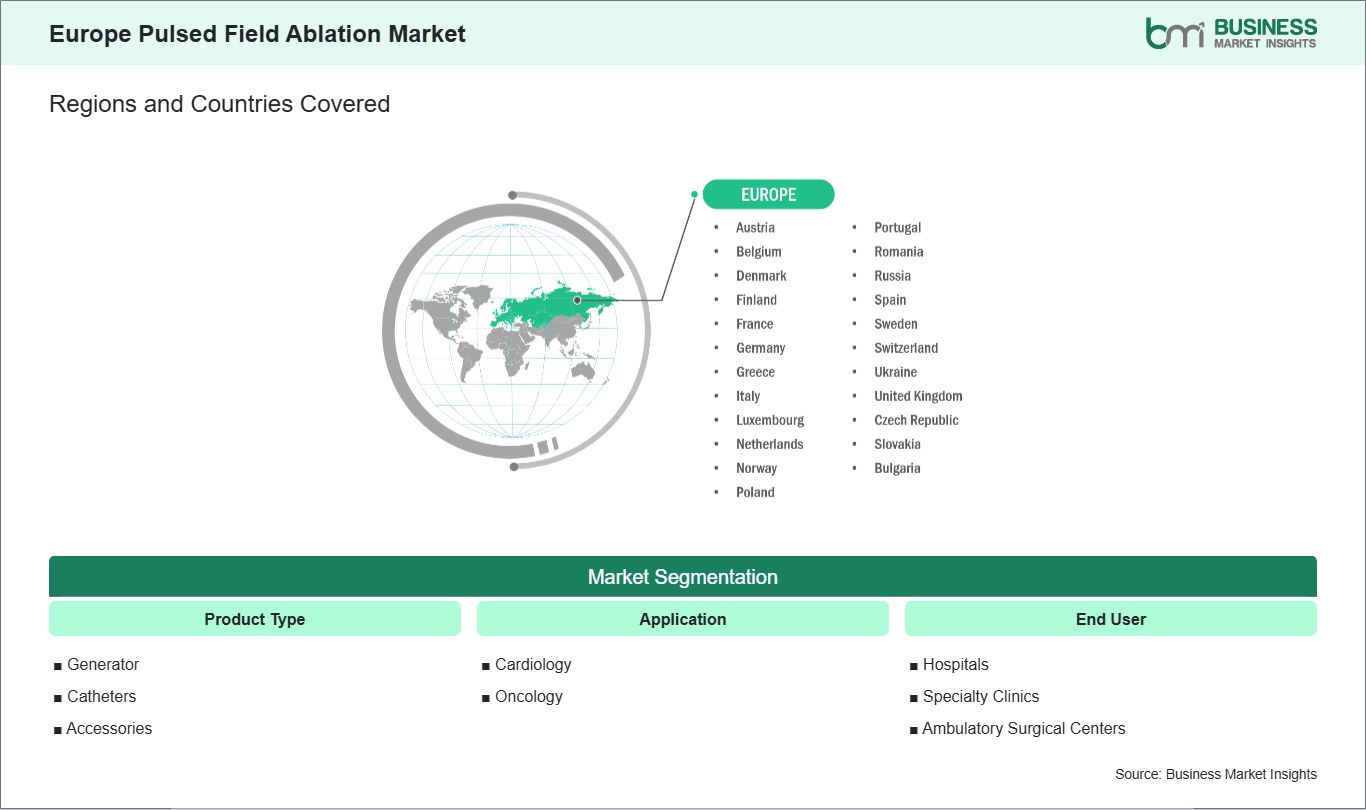
Key segments that contributed to the derivation of the Europe pulsed field ablation market analysis are product type, application, and end user.
Atrial fibrillation (AF) is presenting an increasing challenge across Europe, as aging populations and evolving lifestyle patterns contribute to a higher number of patients affected by arrhythmias. Urbanization, sedentary habits, and dietary transitions are compounding cardiovascular risk, leading to more frequent hospital visits and clinical interventions. Healthcare providers are emphasizing early detection and timely management to prevent complications such as stroke, heart failure, and long-term cardiac morbidity. Hospitals are enhancing diagnostic capabilities and implementing structured care pathways to ensure patients receive appropriate treatment efficiently and safely.
The health systems within Europe are enhancing the provision of cardiology and electrophysiology services with an aim of addressing the increased burden associated with AF. Healthcare professionals have started relying on the use of less invasive but highly accurate techniques, which allow for faster recovery while ensuring reliable results are achieved. The utilization of workflow optimization techniques and dedicated teams makes it possible to attend to more patients without affecting the quality of treatment provided.
The rising prevalence of AF has created a demand for advanced therapies. Pulsed field ablation (PFA) offers a tissue-selective and targeted approach, minimizing collateral damage while reducing procedural risks. Adoption of PFA allows European healthcare providers to deliver faster, safer, and more efficient arrhythmia management. Its integration strengthens cardiac service capabilities, enhances patient outcomes, and aligns clinical priorities with operational performance across the region.
Pulsed field ablation (PFA) is reshaping arrhythmia treatment across Europe, providing a precise, efficient, and safer alternative to conventional thermal ablation. PFA selectively targets cardiac tissue with high-voltage electrical pulses while sparing surrounding structures, reducing procedural complications and supporting faster patient recovery. Innovations in catheter design, energy delivery, and integration with advanced mapping and visualization systems have improved procedural accuracy, reproducibility, and clinician confidence, enabling complex interventions to be performed safely across diverse hospital settings.
Hospitals and specialty centers are investing in PFA infrastructure, clinician training, and standardized workflows to ensure effective adoption. Structured programs equip cardiology teams with operational guidance, reducing the learning curve while maintaining high-quality outcomes. These initiatives allow healthcare providers to manage increasing AF patient volumes efficiently, while strengthening overall cardiac service capabilities and improving procedural reliability.
Ongoing innovation in PFA is expected to drive modernization of arrhythmia care throughout Europe. Improvements in device usability, workflow integration, and mapping technologies enhance both clinical effectiveness and operational efficiency. Adoption of PFA enables hospitals to deliver consistent, high-quality outcomes while minimizing risk, establishing it as a core solution in modern AF management. By integrating advanced PFA techniques, European healthcare providers are better equipped to meet the rising clinical demand for safe, precise, and scalable cardiac care.

The Europe pulsed field ablation market demonstrates steady growth, with size and share analysis highlighting evolving trends and competitive dynamics among key players. The report evaluates important subsegments categorized within product type, application, and end user, highlighting their respective contributions to overall market performance.
By product type, the catheters subsegment dominated the market in 2025. Catheter devices offer improved procedural efficiency, reduced risk of complications, and real-time control for electrophysiologists, making them a crucial component for effective PFA therapy and a key revenue driver for manufacturers.
In terms of application, the cardiology subsegment dominated the market in 2025. The leadership of cardiology applications is attributed to the rising prevalence of atrial fibrillation and other cardiac arrhythmias, growing preference for non-thermal and tissue-selective ablation techniques, and increasing awareness among healthcare providers about the clinical benefits of PFA.
Based on end user, the hospitals subsegment dominated the market in 2025. Hospitals maintain a stronghold due to their established cardiology and electrophysiology departments, access to advanced PFA systems, trained physicians and clinical staff, and the capability to perform specialized cardiac procedures with comprehensive patient monitoring and post-procedure care.
| Report Attribute | Details |
|---|---|
| Market size in 2025 | US$ 93.9 Million |
| Market Size by 2033 | US$ 333.5 Million |
| CAGR (2026 - 2033) | 18.2% |
| Historical Data | 2022-2024 |
| Forecast period | 2026-2033 |
| Segments Covered | By Product Type
|
|
Regions and Countries Covered
| |
| Europe | Germany, Italy, France, U.K., Spain, Belgium, Netherlands, Luxembourg, Norway, Finland, Denmark, Sweden, Switzerland, Austria, Greece, Portugal, Russia, Poland, Romania, Czech Republic, Ukraine, Slovakia, Bulgaria |
| Market leaders and key company profiles |
|
The "Europe Pulsed Field Ablation Market Size and Forecast (2022–2033)" report provides a detailed analysis of the market covering below areas:
The geographical scope of the Europe pulsed field ablation market report is divided into: Germany, Italy, France, the UK, Spain, Belgium, the Netherlands, Luxembourg, Norway, Finland, Denmark, Sweden, Austria, Switzerland, Russia, Romania, Greece, the Czech Republic, Portugal, Ukraine, Poland, Slovakia, and Bulgaria. Germany held the largest share in 2025.
Germany has the biggest market share of pulsed field ablation in Europe, with a strong healthcare infrastructure for treating heart disease and for being an early adopter of new technologies that improve the delivery of healthcare. There is also a high number of patients in Germany who suffer from af and have other complex arrhythmias, which has created a large need for non-invasive, highly accurate treatment options. The unique way PFA works through tissue-selective, non-thermal ablation technology allows for a very precise way to perform an ablation procedure, thus minimizing damage to surrounding tissue, which is in line with Germany's focus on providing safe and efficient care for patients. Significant investment is being made in the development of specialized electrophysiology laboratories and in high-resolution imaging systems to facilitate the widespread use of PFA technology. Comprehensive training programs for interventional cardiologists have been developed to ensure that interventional cardiologists can safely and effectively perform the procedure. Additionally, many hospitals and cardiac centers throughout Germany are working with the device manufacturers to ensure successful adoption of the technology. Clinical pilot programs are beginning to be created to demonstrate the efficacy and safety of the procedure, and will enhance confidence in the use of PFA as a standard of care for patients in Germany.

The Europe pulsed field ablation market is evaluated by gathering qualitative and quantitative data post primary and secondary research, which includes important corporate publications, association data, and databases. A few of the key developments in the Europe pulsed field ablation market are:
The Europe Pulsed Field Ablation Market is valued at US$ 93.9 Million in 2025, it is projected to reach US$ 333.5 Million by 2033.
As per our report Europe Pulsed Field Ablation Market, the market size is valued at US$ 93.9 Million in 2025, projecting it to reach US$ 333.5 Million by 2033. This translates to a CAGR of approximately 18.2% during the forecast period.
The Europe Pulsed Field Ablation Market report typically cover these key segments-
The historic period, base year, and forecast period can vary slightly depending on the specific market research report. However, for the Europe Pulsed Field Ablation Market report:
The Europe Pulsed Field Ablation Market is populated by several key players, each contributing to its growth and innovation. Some of the major players include:
The Europe Pulsed Field Ablation Market report is valuable for diverse stakeholders, including:
Essentially, anyone involved in or considering involvement in the Europe Pulsed Field Ablation Market value chain can benefit from the information contained in a comprehensive market report.
Please tell us your area of interest
(Market Segments/ Regions and Countries/ Companies)