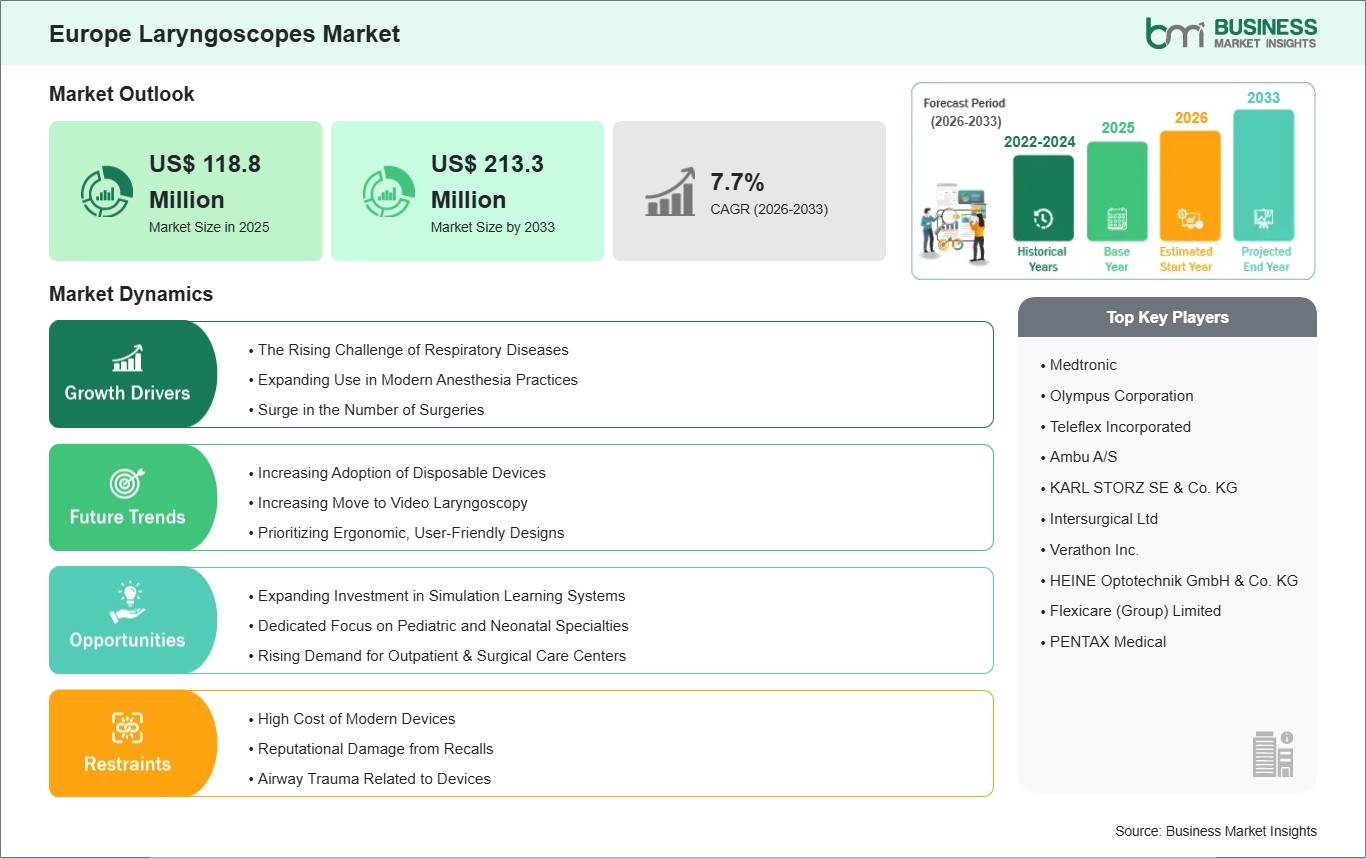
The Europe laryngoscopes market size is expected to reach US$ 213.3 million by 2033 from US$ 118.8 million in 2025. The market is estimated to record a CAGR of 7.7% from 2026 to 2033.
The European laryngoscope market operates within a mature healthcare environment, which is well equipped with sophisticated clinical facilities, high standards of patient safety, and extensive use of technologically advanced medical equipment. Laryngoscopes are used for airway management in anesthesia, emergencies, and intensive care units, and their usage in the European region is directly associated with the continuous volume of surgeries and the complexity of clinical procedures. The trend in healthcare institutions within Europe favors the application of video laryngoscopy and fiberoptic laryngoscopy methods due to better visualization and a high success rate of intubation procedures.
A vital growth factor in the region is the focus placed on high-quality healthcare, coupled with rigorous regulatory compliance and regular investments in hospital upgrades. The rising number of aged patients and cases of respiratory ailments and chronic diseases needing surgery is also fueling the demand for airway management devices in the region. Moreover, the deployment of technology and simulations to enhance clinical education in hospitals has been driving the uptake of advanced laryngoscope devices. However, factors such as high acquisition and life cycle costs associated with laryngoscopy equipment pose a challenge in terms of their adoption by small and resource-limited healthcare institutions. Furthermore, rigorous medical device approval standards in Europe could delay the availability of innovative products in the market.

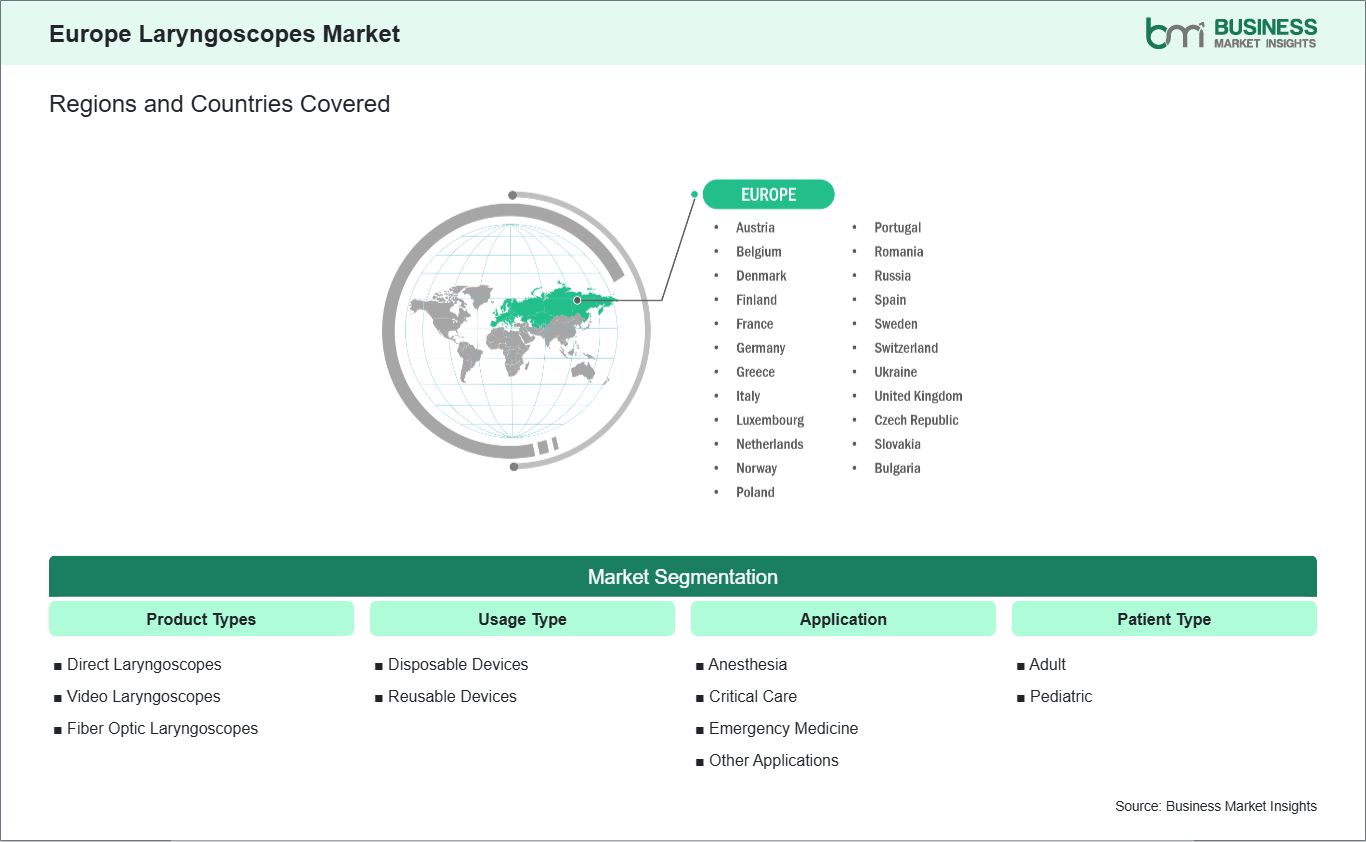
Key segments that contributed to the derivation of the Europe laryngoscopes market analysis are product type, usage type, application, patient type, and end user.
Europe continues to face a significant and growing burden of respiratory diseases, largely driven by ageing populations, urban pollution, and lifestyle risk factors. Chronic conditions such as asthma and COPD remain widespread across Germany, Italy, the UK, and France, where industrial activity and traffic-related air pollution contribute to long-term lung damage. These conditions frequently progress to acute respiratory failure, requiring emergency airway interventions where laryngoscopes are indispensable in hospital and intensive care settings.
Another important structural issue facing Europe involves its aging population, making individuals more susceptible to pneumonia, respiratory infections, and post-operative complications. Countries like Italy and Spain have aged populations that create ongoing strain on their healthcare services, especially in the emergency room and surgery department. This leads to continuous demand for airway management practices, necessitating the use of efficient laryngoscopy instruments in clinical settings.
Environmental and behavioral issues also contribute to the growing burden. For instance, smoking continues to be an essential cause of chronic lung conditions in some Central and Eastern European countries, and changes in climate leading to poor air quality, in addition to respiratory illnesses, persist in causing admissions to hospitals. Together, these factors make respiratory health an integral part of the healthcare sector in Europe, ensuring continued demand for airway management equipment.
The European healthcare system is incorporating simulation technology for medical education to increase proficiency and enhance patient safety when performing high-risk tasks like intubation. Simulation laboratories have been developed in the universities of the Netherlands, Sweden, and Germany for practicing airway management techniques utilizing simulated patients. The process decreases the dependence on real patients and increases the accuracy and proficiency of the procedures being practiced.
In addition to this, government-funded initiatives and those of EU healthcare systems are facilitating the improvement in the training infrastructure of physicians. Airway management modules have been included in residency programs for anesthesiologists and emergency care practitioners in hospitals, whereby the learners receive experience in both traditional and video laryngoscopy before moving to the actual field environment.
Additionally, Europe's emphasis on harmonized medical education is encouraging cross-border training collaboration and knowledge exchange. Simulation centers are increasingly used for continuous professional development, allowing clinicians to refine airway management skills throughout their careers. As a result, the adoption of advanced laryngoscope technologies is being reinforced not only through clinical demand but also through structured training systems that prioritize safety, precision, and consistency in airway management practices across Europe.

The Europe Laryngoscopes market demonstrates steady growth, with size and share analysis highlighting evolving trends and competitive dynamics among key players. The report evaluates important subsegments categorized within product type, usage type, application, patient type, and end user, highlighting their respective contributions to overall market performance.
By product type, the video laryngoscopes subsegment dominated the laryngoscopes market in 2025. This is driven by the increasing demand for enhanced airway visualization, improved first-pass intubation success rates, and reduced complications in difficult airway management, making them a key revenue driver for manufacturers and supporting strong adoption in clinical practice.
In terms of usage type, the disposable devices subsegment led the market in 2025. The dominance of disposable devices is attributed to the growing emphasis on infection control, prevention of cross-contamination, and the operational convenience of eliminating reprocessing and sterilization requirements in high-volume healthcare settings.
Based on application, the anesthesia subsegment held the largest share in 2025. Hospitals and surgical centers widely rely on laryngoscopes during anesthesia procedures for airway management and intubation, supported by the rising number of surgeries and the increasing use of advanced airway management techniques.
In terms of patient type, the adult subsegment dominated the market in 2025. This is driven by the higher prevalence of surgical procedures, critical care admissions, and chronic respiratory conditions among adults, resulting in greater demand for airway management devices in this population group.
By end user, the hospitals subsegment held the largest share in 2025. Hospitals maintain leadership due to their advanced infrastructure, availability of skilled healthcare professionals, high patient inflow, and strong capability to perform complex surgical and emergency procedures requiring laryngoscopy.
| Report Attribute | Details |
|---|---|
| Market size in 2025 | US$ 118.8 Million |
| Market Size by 2033 | US$ 213.3 Million |
| CAGR (2026 - 2033) | 7.7% |
| Historical Data | 2022-2024 |
| Forecast period | 2026-2033 |
| Segments Covered | By Product Types
|
|
Regions and Countries Covered
| |
| Europe | Germany, Italy, France, U.K., Spain, Belgium, Netherlands, Luxembourg, Norway, Finland, Denmark, Sweden, Switzerland, Austria, Greece, Portugal, Russia, Poland, Romania, Czech Republic, Ukraine, Slovakia, Bulgaria |
| Market leaders and key company profiles |
|
The "Europe Laryngoscopes Market Size and Forecast (2022-2033)" report provides a detailed analysis of the market covering below areas:
The geographical scope of the Europe Laryngoscopes market report is divided into: Germany, Italy, France, the UK, Spain, Belgium, the Netherlands, Luxembourg, Norway, Finland, Denmark, Sweden, Austria, Switzerland, Russia, Romania, Greece, the Czech Republic, Portugal, Ukraine, Poland, Slovakia, and Bulgaria. Germany held the largest share in 2025.
Germany, owing to its well-developed health infrastructure that includes hospitals, medical centers, and other establishments, has successfully introduced advanced technologies. As such, the German healthcare system features many hospitals, medical centers, and academic establishments that generate consistent demand for airway management devices used for various purposes. In this case, one of the distinctive features of the market in Germany is the early adoption of high-end laryngoscopy technologies such as video laryngoscope devices, which are actively used in such areas as anesthesiology, emergency medicine, and intensive care units. An emphasis on precision and effectiveness of procedures has contributed to the fast implementation of high-end airway management devices. Besides, clinical training practices help maintain the use of both traditional and innovative devices in hospitals. Even with the advanced technology available, the market operates under a strict regulation and procurement policy. In many cases, hospital purchases may take place after thorough evaluation of the products, where issues like reimbursements have an effect on purchasing choices, especially when operating in public health setups. On the other hand, even though most large hospitals are already fitted with sophisticated machines, small regional hospitals may still utilize traditional laryngoscopes for financial reasons.

The Europe Laryngoscopes market is evaluated by gathering qualitative and quantitative data post primary and secondary research, which includes important corporate publications, association data, and databases. A few of the key developments in the Europe Laryngoscopes market are:
The Europe Laryngoscopes Market is valued at US$ 118.8 Million in 2025, it is projected to reach US$ 213.3 Million by 2033.
As per our report Europe Laryngoscopes Market, the market size is valued at US$ 118.8 Million in 2025, projecting it to reach US$ 213.3 Million by 2033. This translates to a CAGR of approximately 7.7% during the forecast period.
The Europe Laryngoscopes Market report typically cover these key segments-
The historic period, base year, and forecast period can vary slightly depending on the specific market research report. However, for the Europe Laryngoscopes Market report:
The Europe Laryngoscopes Market is populated by several key players, each contributing to its growth and innovation. Some of the major players include:
The Europe Laryngoscopes Market report is valuable for diverse stakeholders, including:
Essentially, anyone involved in or considering involvement in the Europe Laryngoscopes Market value chain can benefit from the information contained in a comprehensive market report.
Please tell us your area of interest
(Market Segments/ Regions and Countries/ Companies)