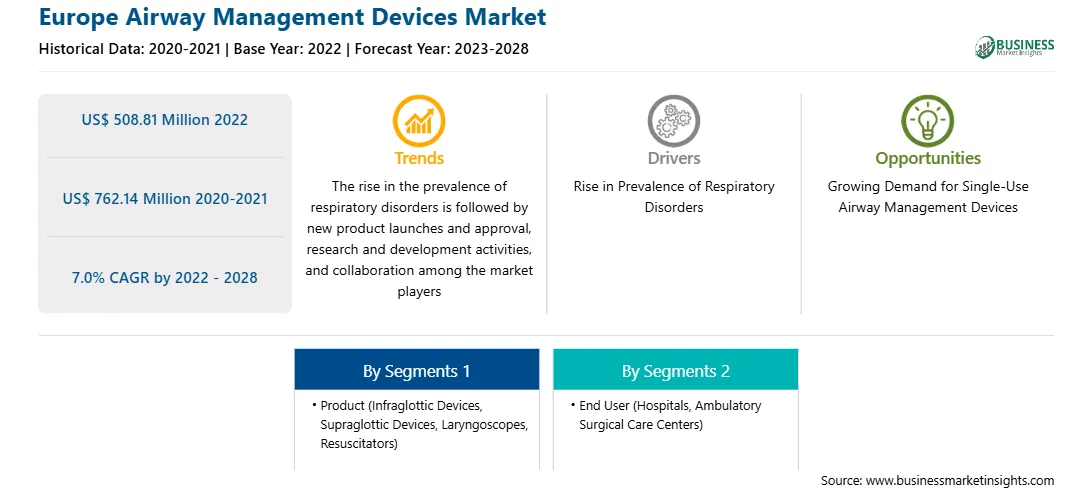
The Europe Airway management devices market size is expected to reach US$ 2,835.1 million by 2033 from US$ 1,927.3 million in 2025. The market is estimated to record a CAGR of 5.0 % from 2026 to 2033.
The Europe airway management devices market is very well established, owing to the country’s well-established health care facilities, strict compliance with patient safety standards, and rapid uptake of latest health care technology. Increased incidences of chronic respiratory ailments, higher rate of surgeries, and growing critical care services have resulted in increased demands for various types of airway management devices such as video laryngoscopes, endotracheal tubes, laryngeal masks, and supraglottic airway devices. European health care professionals prefer to use minimally invasive and precise devices to minimize the risk of surgery-related complications and to maximize their efficiency in operating rooms. Product innovation is another important factor that is influencing the Europe airway management devices market, where manufacturers are making efforts to develop more ergonomic and visual airway management devices as well as single-use airway management devices in order to minimize infection risks. However, there are some constraints to the growth of this market. Advanced airway device systems come at exorbitant costs, as well as having strict guidelines governing their acquisition and usage. Payment methods differ from one country to another and, thus, sometimes impact hospital purchases. Regardless of the foregoing difficulties, the continent’s desire to upgrade the health care system, promote patient safety, and employ innovative technologies in the field ensures consistent growth in the sector.

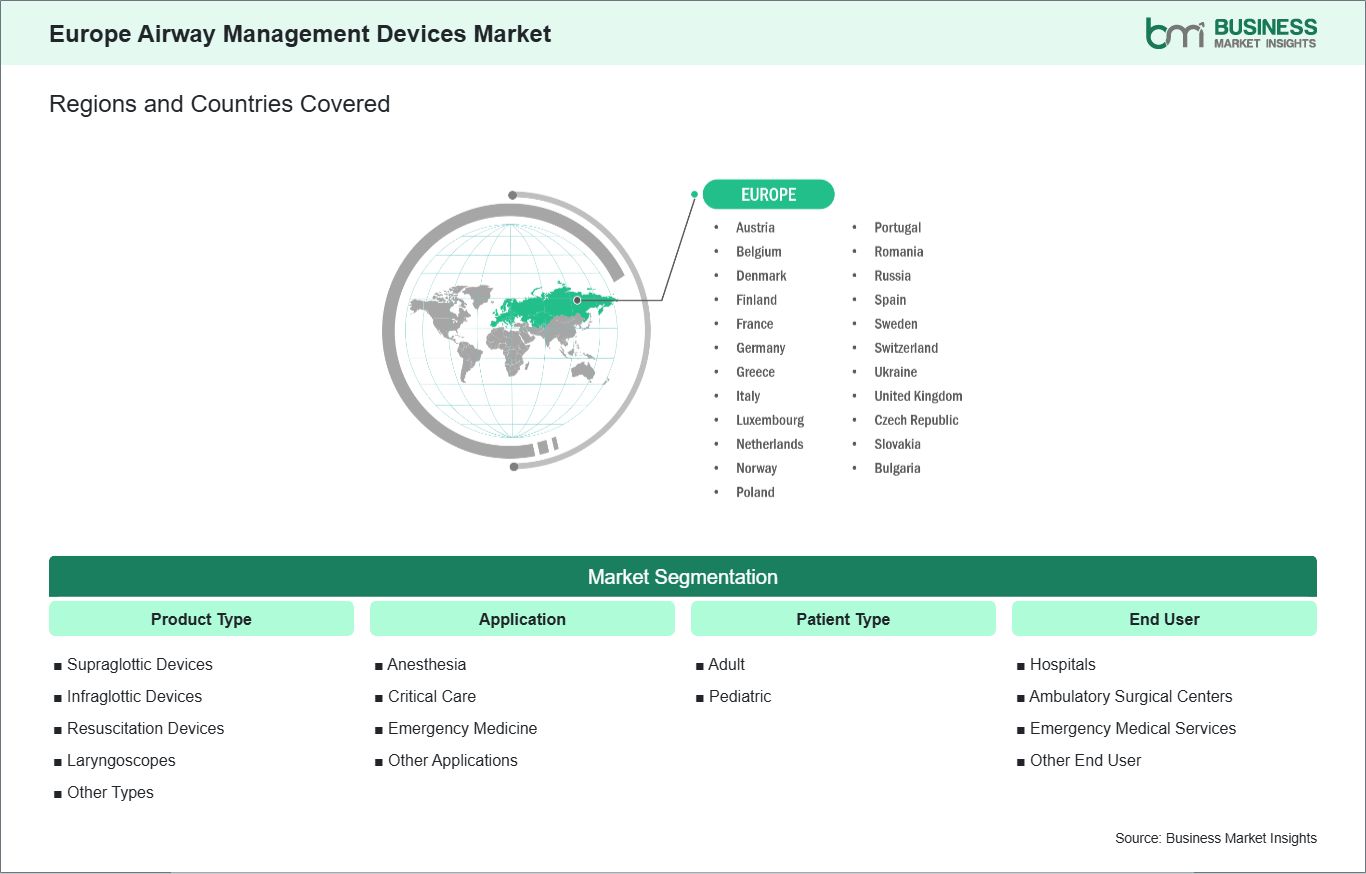
Key segments that contributed to the derivation of the airway management devices market analysis are product type, application, patient type, and end user.
There have been significant developments in terms of increased road mobility and increased number of vehicles across Europe, mostly in the Eastern and Southern parts due to increased economic activities which have led to higher numbers of personal cars. Road accident injuries associated with increased mobility have become common and such injuries are mostly associated with traumatic airway conditions, with many EMS reporting an increase in the number of patients with compromised airways due to either respiratory or facial injuries. There has been increasing importance placed on provision of proper equipment for handling airways during rescue operations.
Hospitals all over Europe are addressing this trend in patient population through the introduction of new airway management equipment. There is increased use of highly sophisticated airway scopes, supraglottic devices, and fast resuscitation kits to increase success rates in the first attempts at intubation. Countries in Central Europe that already have a well-integrated trauma network have been investing in airway equipment due to the emphasis on early airway management procedures. Simulation training in airway management is becoming increasingly common among paramedics and emergency physicians.
Also, there are collaborative efforts among trauma surgeons and EMS directors in Europe to encourage the use of portable airway devices that can be used even before reaching hospital. Such measures recognize the need for good airway management skills in order to reduce injuries associated with delayed airway control and hypoxia. The rising number of severe injuries caused by road accidents is another major driving force behind the growing adoption of airway management solutions in Europe.
In Europe, there is an increase in the number of privately owned hospitals due to increasing demand for elective procedures and specialized services. In western and southern Europe, patients have a growing preference for private hospital care due to shorter waiting times and improved service. Therefore, more investments are made in the acquisition of medical equipment among other ways through which private hospitals differentiate their health service offering and deliver better results.
It is easy for private healthcare systems to introduce new and efficient airway management tools due to various factors such as time saving and greater patient security. Devices such as high-definition video laryngoscope, electronic suction devices, among others, are becoming common in operating theatres and recovering rooms in private hospitals, particularly for complicated surgical operations. The devices play a great role in making it easier for patients to be safely placed under anesthesia and having their airways managed properly. The upgrading of airway management tools in private hospital environments is evident in developed countries such as those in UK and Nordic countries.
Another factor contributing to the demand for advanced airway management solutions is the increase in the number of specialized surgeries bariatric, cardiovascular, and orthopedic surgeries in the private sector. The patients undergoing such surgeries are usually characterized by other health problems that affect the process of airway management; hence, private clinics need to buy more advanced and flexible devices. Moreover, private hospitals are undertaking various steps aimed at ensuring the competence of airway management among health professionals. In summary, the development of the private hospital industry in Europe boosts the demand for innovative airway management devices.
The Europe airway management devices market is experiencing steady growth, with market size and share analysis reflecting evolving treatment preferences and competitive dynamics among key players. The report evaluates important subsegments categorized within product type, application, patient type, and end user, highlighting their respective contributions to overall market performance.
By product type, the infraglottic devices subsegment dominated the market in 2025. In anesthesia practice, infraglottic devices provide protection against aspiration and enable precise airway management, driving higher adoption in operating rooms and critical care settings compared to supraglottic devices.
Based on application, the anesthesia subsegment dominated the market in 2025 due to the need for definitive airway control across a wide range of surgical procedures, from routine elective surgeries to complex interventions. Because infraglottic devices are essential for intubation during anesthesia, this segment experiences consistent, high-volume usage, making it the largest segment compared to emergency or general critical care.
In terms of patient type, the adult subsegment dominated the market in 2025. Most procedural training, device designs, and usage guidelines are optimized for adult anatomy and usage scenarios, reinforcing higher market volume.
Based on end user, the hospital subsegment dominated the market in 2025, as hospitals remain the central hub for airway management, handling scheduled surgeries, emergency admissions, ICU care, and trauma cases. Their larger budgets, need for extensive airway inventories, and availability of multidisciplinary professionals make them the largest purchasers compared to outpatient centers or EMS, where volume and purchasing power are comparatively lower.
| Report Attribute | Details |
|---|---|
| Market size in 2025 | US$ 1,927.3 Million |
| Market Size by 2033 | US$ 2,835.1 Million |
| CAGR (2026 - 2033) | 5.0% |
| Historical Data | 2022-2024 |
| Forecast period | 2026-2033 |
| Segments Covered | By Product Type
|
|
Regions and Countries Covered
| |
| Europe | Germany, Italy, France, U.K., Spain, Belgium, Netherlands, Luxembourg, Norway, Finland, Denmark, Sweden, Switzerland, Austria, Greece, Portugal, Russia, Poland, Romania, Czech Republic, Ukraine, Slovakia, Bulgaria |
| Market leaders and key company profiles |
|
The "Europe Airway Management Devices Market Size and Forecast (2022–2033)" report provides a detailed analysis of the market covering below areas:
The geographical scope of the Europe Airway management devices marketreport is divided into: Germany, Italy, France, the UK, Spain, Belgium, the Netherlands, Luxembourg, Norway, Finland, Denmark, Sweden, Austria, Switzerland, Russia, Romania, Greece, the Czech Republic, Portugal, Ukraine, Poland, Slovakia, and Bulgaria. Germany held the largest share in 2025.
Germany is the leading market for airway management devices in Europe because of the presence of a highly developed health care sector in the country, along with its extensive research capabilities and the application of cutting-edge medical equipment. Airway management devices like video laryngoscopes, flexible fiber-optic endoscopes, and single-use supraglottic devices are currently being deployed in hospitals throughout Germany, especially in major cities like Berlin, Munich, and Hamburg, for improved patient outcomes. There is a comprehensive clinical training program in Germany that includes simulation labs and airway management protocols to ensure that health care professionals can efficiently manage airways using both conventional and novel techniques. German hospitals also focus on incorporating airway management devices within their hospital information technology system, thus making it easier to monitor procedures. Private hospitals tend to be more inclined toward deploying the latest airway management devices, whereas public hospitals are concentrating on providing basic airway management devices. Nevertheless, there still exist difficulties such as the high costs of developing modern technology and obtaining new products from regulatory authorities. Nevertheless, Germany is still at the forefront of Europe in terms of the development of technology, the level of professionalism, and using advanced methods for airways management.

The Europe airway management devices marketis evaluated by gathering qualitative and quantitative data post primary and secondary research, which includes important corporate publications, association data, and databases. A few of the key developments in the Europe airway management devices marketare:
The Europe Airway Management Devices Market is valued at US$ 1,927.3 Million in 2025, it is projected to reach US$ 2,835.1 Million by 2033.
As per our report Europe Airway Management Devices Market, the market size is valued at US$ 1,927.3 Million in 2025, projecting it to reach US$ 2,835.1 Million by 2033. This translates to a CAGR of approximately 5.0% during the forecast period.
The Europe Airway Management Devices Market report typically cover these key segments-
The historic period, base year, and forecast period can vary slightly depending on the specific market research report. However, for the Europe Airway Management Devices Market report:
The Europe Airway Management Devices Market is populated by several key players, each contributing to its growth and innovation. Some of the major players include:
The Europe Airway Management Devices Market report is valuable for diverse stakeholders, including:
Essentially, anyone involved in or considering involvement in the Europe Airway Management Devices Market value chain can benefit from the information contained in a comprehensive market report.
Please tell us your area of interest
(Market Segments/ Regions and Countries/ Companies)