
Endovascular Robotic Systems Market Outlook: Size, Share, Trends, Growth Analysis, Competitive Landscape & Forecast, 2026-2033

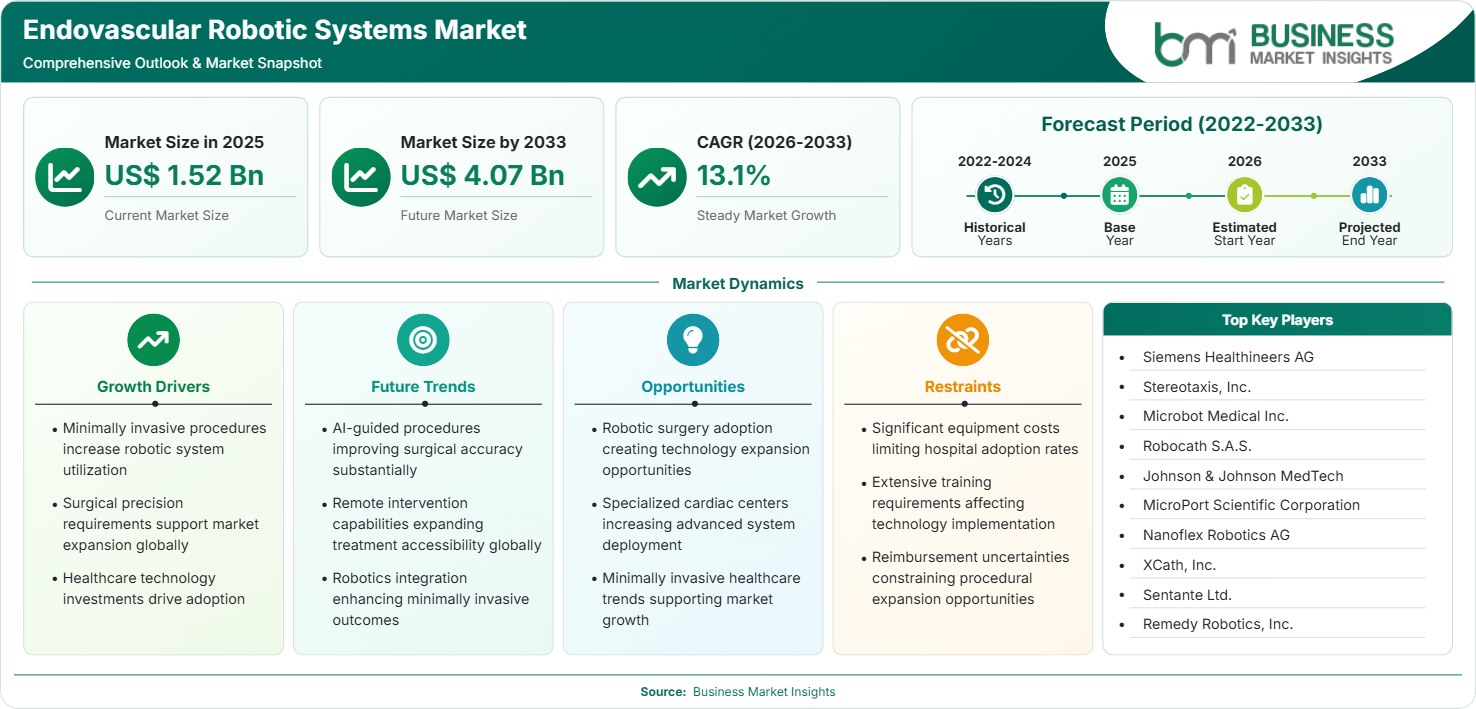
The Endovascular Robotic Systems Market size was valued at US$ 1.52 Billion in 2025 and is projected to reach US$ 4.07 Billion by 2033, growing at a CAGR of 13.10% during 2026–2033, driven by radiation reduction, precision navigation, minimally invasive procedures, and robotic access expansion.

Report Coverage
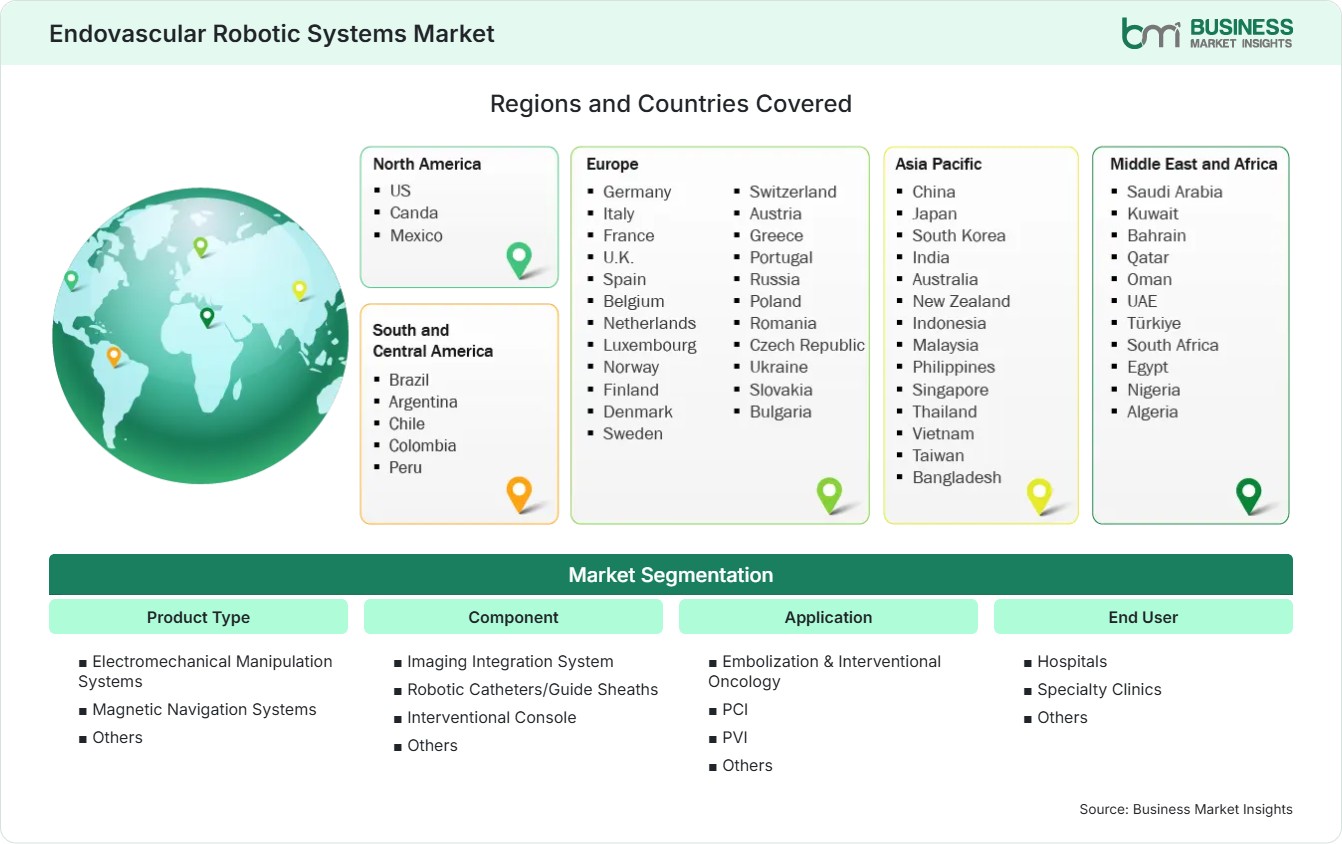
  • Product Type: Electromechanical Manipulation Systems, Magnetic Navigation Systems, Others
  • Component: Imaging Integration System, Robotic Catheters/Guide Sheaths, Interventional Console, Others
  • Application: Embolization & Interventional Oncology, PCI, PVI, Others
  • End User: Hospitals, Specialty Clinics, Others
US$ 1.52 Bn Market size in 2025
US$ 4.07 Bn Market Size by 2033
13.1% CAGR, 2026 - 2033
2026-2033 Forecast Period

AI Overview

Endovascular Robotic Systems Market Summary

  • North America: holds market share of 30%–34% in 2025, growing at a CAGR of 12%–14%, supported by robotic adoption, specialist infrastructure, FDA clearances, high procedure volumes, physician radiation concerns, and strong medtech investment. US adoption is advancing through single-use robotic systems, hospital pilots, and vascular procedure expansion, with a 12.5%–14.5% CAGR supported by commercialization, reimbursement evaluation, and clinical evidence.
  • Fastest Growing Region: Asia Pacific holds a 22%–26% share in 2025 and is advancing at a 15%–17% CAGR, driven by rising cardiovascular disease, expanding catheterization capacity, specialist shortages, healthcare modernization, local manufacturing, and growing investments in robotic intervention technologies.
  • Leading Segment: Electromechanical Manipulation Systems account for a 55%–59% Endovascular Robotic Systems Market share in 2025 and are advancing at a 12%–14% CAGR, supported by established catheter compatibility, intuitive controls, imaging integration, procedural consistency, and expanding use across coronary and peripheral interventions.
  • High Growth Segment: Peripheral Vascular Intervention accounts for a 19%–23% share in 2025 and is advancing at a 15%–17% CAGR, supported by peripheral artery disease burden, complex anatomy, radiation exposure concerns, single-use robotics, and broader outpatient intervention opportunities.
  • Key Market Opportunity: Single-use robotic platforms can lower capital barriers, while remote intervention, AI-assisted navigation, and imaging integration can expand procedural access across peripheral vascular, oncology, and neurovascular care.
  • Major Market Players: Siemens Healthineers AG, Stereotaxis, Inc., Microbot Medical Inc., Robocath S.A.S., Johnson & Johnson MedTech, MicroPort Scientific Corporation, Nanoflex Robotics AG, XCath, Inc., Sentante Ltd., and Remedy Robotics, Inc.
Strategic Insights

Endovascular Robotic Systems Market: Strategic Insights

Endovascular Robotic Systems Market Strategic Framework
FREE PDF
Request your free sample
Request free sample
Stakeholder View

Key Takeaways

  • The value chain is now heading in the direction of integrated ecosystems that combine robotic consoles, disposable catheters, guidewires, imaging, navigation software, procedure data, training, and hospital service contracts rather than relying on standalone robotic hardware.
  • Peripheral vascular intervention has great potential since robotic navigation is able to deal with complicated vessel anatomy while at the same time reducing the amount of radiation to which the operator is exposed and helping to ensure more consistent manipulation of the catheter and guidewire.
  • The development of the product is moving in the direction of magnetic steering, accompanied by haptic feedback, AI-assisted navigation, the integration of digital imaging, remote operation, and possibly eventually becoming fully autonomous in carrying out procedures.
  • Asia Pacific presents a compelling investment case because expanding catheterization laboratories, increasing cardiovascular procedure volumes, specialist shortages, and healthcare infrastructure modernization create favorable conditions for robotic intervention adoption.
  • Strategic consolidation is becoming more important as robotics companies combine complementary technologies. Stereotaxis completed its acquisition of Robocath in July 2026, combining capabilities across interventional cardiology and neurointerventions.
  • By reducing the need for initial infrastructure, single-use robotic systems can change the economics of purchasing so that hospitals are able to assess robotic assistance in terms of expenditure linked to each procedure rather than having to make large capital investments.
Geographic Outlook

Endovascular Robotic Systems Market Regional Highlights

North America Endovascular Robotic Systems Market

North America accounted for a 30%–34% Endovascular Robotic Systems Market share in 2025 and is projected to expand at a 12%–14% CAGR through 2033. The region benefits from advanced catheterization laboratories, established interventional specialties, high procedure volumes, strong medtech funding, and rapid commercialization of robotic platforms.

  • High-density networks in the fields of interventional cardiology and radiology offer appropriate settings for the deployment of robotic systems and for carrying out structured clinical validation.
  • By reducing reliance on large and dedicated capital installations, the use of single-use platforms is expanding the range of purchasing options.
  • The companies are placing a strong emphasis on remote control, magnetic navigation, imaging integration, and automated device manipulation.
  • Funding for start-up ventures and strategic investments in the medical technology sector are still providing support for next-generation endovascular robotics and for technologies used in peripheral intervention.

US Endovascular Robotic Systems Market

The US represented 75%–80% of North America's 2025 value and is projected to grow at a 12.5%–14.5% CAGR through 2033. Endovascular Robotic Systems Market Demand is supported by sophisticated hospitals, high interventional procedure volumes, strong medical-device innovation, and regulatory pathways for robotic technologies.

  • The clearances granted by the FDA are helping to establish more defined routes for the commercialization of specialized robotic endovascular systems.
  • Large health systems are able to test robotic systems in a number of different specialties, which in turn increases the potential for their use on a per-installed or per-disposable platform basis.
  • For interventional specialists, exposure to radiation and musculoskeletal strain are still important factors to take into account.

Europe Endovascular Robotic Systems Market

Europe held a 25%–29% Endovascular Robotic Systems Market share in 2025 and is projected to advance at an 11.5%–13.5% CAGR through 2033. Germany, France, the United Kingdom, Italy, and Spain represent leading markets because of established interventional infrastructure and specialist expertise.

  • Germany has an advanced cardiovascular infrastructure together with specialist hospitals, which provides a favorable environment for robotic-assisted interventional procedures.
  • In France, innovative robotics in the field of cardiovascular surgery forms the basis for wider integration in both coronary and neurovascular procedures.
  • In Switzerland, Nanoflex Robotics is working on magnetic and telerobotic technologies to achieve remote endovascular intervention and better access.
  • In the United Kingdom, specialized vascular centers provide the chance for clinical evaluation, digital intervention, and the modernization of workflows through the use of technology.

Asia Pacific Endovascular Robotic Systems Market

Asia Pacific represented a 22%–26% Endovascular Robotic Systems Market share in 2025 and is projected to register a 15%–17% CAGR through 2033, making it the fastest-growing regional market. China, Japan, South Korea, India, and Australia form important adoption centers.

  • In China, the development of local robotics and the high volume of large cardiovascular procedures present opportunities for both domestic and international technology providers.
  • In Japan, the fact that the population is aging and there is a well-developed hospital infrastructure leads to a demand for minimally invasive cardiovascular and vascular technologies.
  • In India, the growing interventional capacity together with the uneven distribution of specialists is leading to greater interest in technologies that can improve procedural consistency.
  • The geographic spread of Australia makes it a particularly appropriate case for remote intervention and for having specialist-supported vascular care.

Rest of World Endovascular Robotic Systems Market

South and Central America represented part of the 13%–17% Rest of World share in 2025, with Brazil and Mexico serving as principal adoption centers. Regional Endovascular Robotic Systems Market growth of 10.5%–12.5% is supported by private hospital investment, expanding cardiovascular intervention, and modernization of tertiary-care facilities.

  • In Brazil, investment by private healthcare providers and the establishment of specialist cardiovascular centers form the starting point for the adoption of robotic technology.
  • In Mexico, large urban hospitals provide opportunities for the introduction of minimally invasive technology and for modernizing procedures.
  • The Gulf countries state that the advanced hospitals in Saudi Arabia and the UAE are able to support top-tier robotic systems via capital projects that focus on technology.
  • Israel's strong innovation in medical devices presents opportunities for the development of robotic navigation, imaging, and vascular technology.
Global Market Geography
FREE PDF
Request your free sample
Request free sample
Segment Analysis

Endovascular Robotic Systems Market Segmentation

Product Type

Electromechanical Manipulation Systems represented a 55%–59% Endovascular Robotic Systems Market share in 2025 and are projected to grow at a 12%–14% CAGR through 2034. Their installed workflow familiarity and compatibility support adoption, while magnetic systems address complex navigation and emerging remote procedures.

  • Electromechanical Manipulation Systems: Mechanically advance and rotate guidewires and catheters through controlled interfaces, supporting repeatable manipulation, radiation-shielded operation, and compatibility with established interventional workflows.
  • Magnetic Navigation Systems: External magnetic fields steer specialized devices through challenging anatomy, enabling highly controlled distal navigation and supporting complex cardiovascular, neurovascular, and electrophysiology procedures.

Component

Imaging Integration System represented the largest component category within the analyzed ecosystem, while the overall component structure is expanding as robotic platforms become more tightly connected with angiography, navigation, disposable devices, and operator consoles.

  • Imaging Integration System: Connects fluoroscopic and other procedural imaging with robotic control, helping physicians coordinate device position, anatomy visualization, and navigation during minimally invasive interventions.
  • Robotic Catheters/Guide Sheaths: Provide controlled navigation and positioning inside vessels, with development focused on flexibility, steerability, compatibility, and improved access to anatomically difficult targets.
  • Interventional Console: Provides the operator interface for manipulating vascular devices remotely, supporting ergonomic positioning, procedural control, imaging visibility, and radiation-shielded intervention.

Application

Peripheral Vascular Intervention accounted for a 19%–23% Endovascular Robotic Systems Market share in 2025 and is projected to grow at a 15%–17% CAGR through 2034. Peripheral procedures offer attractive adoption conditions because robotics can address long lesions, tortuous vessels, radiation exposure, and procedural complexity.

  • Embolization & Interventional Oncology: Robotic manipulation can improve controlled catheter positioning during embolization and tumor-directed vascular procedures, supporting precision across increasingly complex interventional oncology workflows.
  • Percutaneous Coronary Intervention (PCI): Robotic assistance supports controlled guidewire, balloon, and stent manipulation while allowing operators to work away from direct radiation exposure during coronary interventions.
  • Peripheral Vascular Intervention (PVI): Robotic navigation can improve control during complex peripheral procedures involving long lesions, tortuous vessels, and below-the-knee anatomy requiring precise device positioning.

End User

Hospitals represented the dominant end-user category in 2025 because they combine high procedure volumes, angiography infrastructure, specialist teams, and procurement capacity.

  • Hospitals: Provide multidisciplinary teams, advanced imaging infrastructure, high procedure volumes, and clinical research capabilities that support adoption and validation of robotic intervention systems.
  • Specialty Clinics: Smaller procedural centers can benefit from compact systems that reduce infrastructure requirements while supporting outpatient vascular intervention and specialist-led minimally invasive care.
Market Forces

Endovascular Robotic Systems Market Dynamics

Key Market Drivers

Rising Need to Reduce Physician Radiation Exposure

Radiation exposure remains a central driver because interventional physicians routinely work near fluoroscopic imaging during prolonged procedures. Robotic consoles allow operators to work farther from the radiation source, while shielding and remote manipulation can reduce occupational exposure. Clinical evidence from emerging platforms demonstrates the commercial relevance of this benefit. Microbot Medical reported a 92% relative reduction in physician radiation exposure in its pivotal LIBERTY study. The occupational-health value strengthens the Endovascular Robotic Systems Market growth case because radiation reduction can be linked directly to physician workflow rather than only patient outcomes.

Expansion of Complex Minimally Invasive Vascular Procedures

Endovascular procedures increasingly address complex peripheral, coronary, oncological, and neurovascular conditions that require precise device manipulation through tortuous anatomy. Robotic control can standardize repetitive movements while providing stable positioning of guidewires, catheters, and sheaths. Peripheral artery disease affects more than 200 million people globally, creating a broad clinical need for minimally invasive vascular treatment. The Endovascular Robotic Systems Market trends therefore extend beyond automation and include improved access to difficult anatomy, repeatable device movement, and potential workflow standardization.

Integration of Robotics With Imaging and Digital Workflow

Robotic systems are moving from being simply mechanical manipulators to becoming integrated procedural systems that combine device control, imaging, software, and the digital workflow. Because of this integration, doctors can coordinate device positioning with real-time fluoroscopic data while working at an ergonomic console. As an example, Siemens Healthineers has shown the application of robotic systems with integrated imaging in the context of vascular intervention, demonstrating how robotics can be incorporated into existing catheterization procedures.

Key Market Opportunities

Single-Use Robotic Platforms for Broader Hospital Adoption

Single-use robotics provide an opportunity to change the purchasing model by reducing dependence on expensive permanent installations. Microbot Medical's LIBERTY platform demonstrates this approach through a disposable, remotely operated design intended for peripheral procedures. The commercial logic is particularly relevant for hospitals with meaningful vascular procedure volumes but limited appetite for major capital commitments. Endovascular Robotic Systems Market Forecasts should therefore account for business-model innovation, not only unit installations.

Remote and Telerobotic Intervention for Specialist Access

Remote intervention offers a great opportunity for areas where advanced endovascular expertise is concentrated in large cities. Sentante has shown that a completely robotic remote stroke thrombectomy is possible in an animal study, with the distance between the operator and the site of the procedure exceeding 1,600 kilometers, thus demonstrating the technical feasibility of long-distance control. Nanoflex Robotics is likewise developing telerobotic systems for use in remote endovascular procedures.

AI-Assisted Navigation and Procedural Automation

There is an opportunity arising from artificial intelligence to shift robotic intervention from simple mechanical manipulation to one that is assisted by software navigation. Algorithms could potentially be used to identify routes for vessels, optimize the paths of the devices, recognize anatomical landmarks, and give real-time guidance during the procedure. The advantages of this approach are enhanced when artificial intelligence is used in conjunction with robotics since the software is able to convert imaging data into consistent movements of the device while still keeping the physician in a position of supervisory control.

Market Restraints and Challenges

High Acquisition Costs and Uncertain Economic Payback

The fact that robotic systems involve a large amount of spending on consoles, compatible equipment, training, service facilities, and procedural consumables means that hospitals which have only a small number of endovascular procedures face a financial obstacle. As a result, decisions regarding procurement might be postponed until clinical evidence shows clear reductions in radiation exposure, procedure time, complications, staffing needs, or total treatment cost.

Limited Device Compatibility and Clinical Evidence

The fact that robotic systems might need special catheters, guidewires, interfaces, or specific procedural setups means that they may not be compatible with the devices that physicians usually prefer and with the procedures they currently follow. As a result, limited compatibility can lead to lower levels of use and weaken the economic argument for adopting them, especially in hospitals where doctors treat a variety of vascular anatomies and conditions.

Company Analysis

Competitive Landscape

The competitive landscape is characterized by a combination of established medtech organizations and specialized robotics developers. The Endovascular Robotic Systems Market analysis indicates that competitive differentiation increasingly depends on clinical evidence, device compatibility, regulatory clearances, imaging integration, disposable economics, and the ability to extend robotics into remote intervention.

Company Name

Overview

Products and Services relevant to this market

Siemens Healthineers AG

Global medical technology company with extensive imaging and advanced-therapy capabilities supporting robotic and image-guided intervention.

Vascular robotics heritage through Corindus, advanced imaging, interventional systems, digital workflow technologies, and remote robotics research.

Stereotaxis, Inc.

Specialized surgical robotics company focused on minimally invasive endovascular intervention and magnetic navigation technologies.

Robotic magnetic navigation, robotic catheters, electrophysiology platforms, and expanding endovascular robotics capabilities through Robocath integration.

Microbot Medical Inc.

Commercial-stage medical-device company focused on compact robotic solutions designed to improve endovascular procedural control.

LIBERTY Endovascular Robotic System, single-use peripheral robotic intervention technology, and related procedural development programs.

Robocath S.A.S.

French developer specializing in robotic technologies for interventional cardiology and broader endovascular procedures.

R-One robotic platform and technology for robotic-assisted coronary intervention, now integrated into Stereotaxis following acquisition.

Johnson & Johnson MedTech

Large medical-device organization with broad cardiovascular, surgical, and interventional technology capabilities.

Interventional cardiovascular devices, vascular technologies, procedural systems, and capabilities relevant to robotic endovascular ecosystems.

MicroPort Scientific Corporation

China-based medical technology group with strong cardiovascular and interventional-device capabilities.

Coronary and peripheral intervention technologies, cardiovascular devices, and collaboration opportunities supporting robotic procedural ecosystems.

Nanoflex Robotics AG

Swiss robotics developer focused on magnetic navigation and remote endovascular intervention technologies.

Remote Intervention System, magnetic navigation, robotic catheter advancement, guidewire control, and telerobotic vascular applications.

XCath, Inc.

Emerging medical robotics company focused on remote and robotic endovascular intervention for complex vascular and neurovascular procedures.

Endovascular robotic platform, remote intervention technologies, and systems targeting complex neurovascular procedures.

Sentante Ltd.

Lithuanian medical robotics developer focused on digitally controlled endovascular intervention and remote procedural access.

Sentante robotic system supporting peripheral, neurovascular, cardiovascular, and electrophysiology interventions.

Remedy Robotics, Inc.

Emerging robotics company developing technology intended to expand access to minimally invasive neurovascular intervention.

Robotic neurointervention technologies, remote procedural concepts, and stroke-focused endovascular automation capabilities.

Trust & Transparency

Research Methodology

The market analysis combines proprietary research with secondary data from government agencies, company disclosures, regulatory filings, industry databases and expert interviews. Market estimates are validated through data triangulation, cross-market benchmarking and analyst review.

View Full Research Methodology

Questions Answered

Frequently Asked Questions

What will determine long-term adoption?

The Endovascular Robotic Systems Market Report highlights that Long-term adoption will depend on clinical evidence, regulatory approvals, device compatibility, reimbursement, procedure economics, physician acceptance, cybersecurity, and whether robotic systems deliver measurable improvements beyond radiation reduction alone.

How could remote robotics change vascular care?

Remote robotics could allow specialists located at major medical centers to support procedures at regional hospitals. This approach may reduce patient-transfer requirements where specialist availability and travel time create barriers to urgent treatment.

Which applications offer the strongest expansion potential?

Peripheral vascular intervention, interventional oncology, neurovascular procedures, and remote stroke treatment offer strong opportunities because they combine procedural complexity with a need for precise navigation and specialist expertise.

What makes single-use robotic systems commercially attractive?

Single-use systems can reduce upfront infrastructure requirements and allow hospitals to adopt robotic assistance without committing to a permanent robotic installation. This model may be particularly attractive to centers with moderate procedure volumes.

How does robotic assistance improve endovascular procedures?

Robotic platforms provide controlled catheter and guidewire manipulation from an ergonomic workstation, helping reduce operator radiation exposure and physical strain while supporting precise device positioning during complex vascular interventions.

Access the Full Endovascular Robotic Systems Market Report

Get segment-level forecasts, regional estimates, competitive benchmarking, company profiles and downloadable Excel datasets.

Access the full Endovascular Robotic Systems Market Report
350 pages PDF & Excel | 2026-11-02
Similar Research

Related Market Reports