Market Summary
Executive Summary and Market Analysis
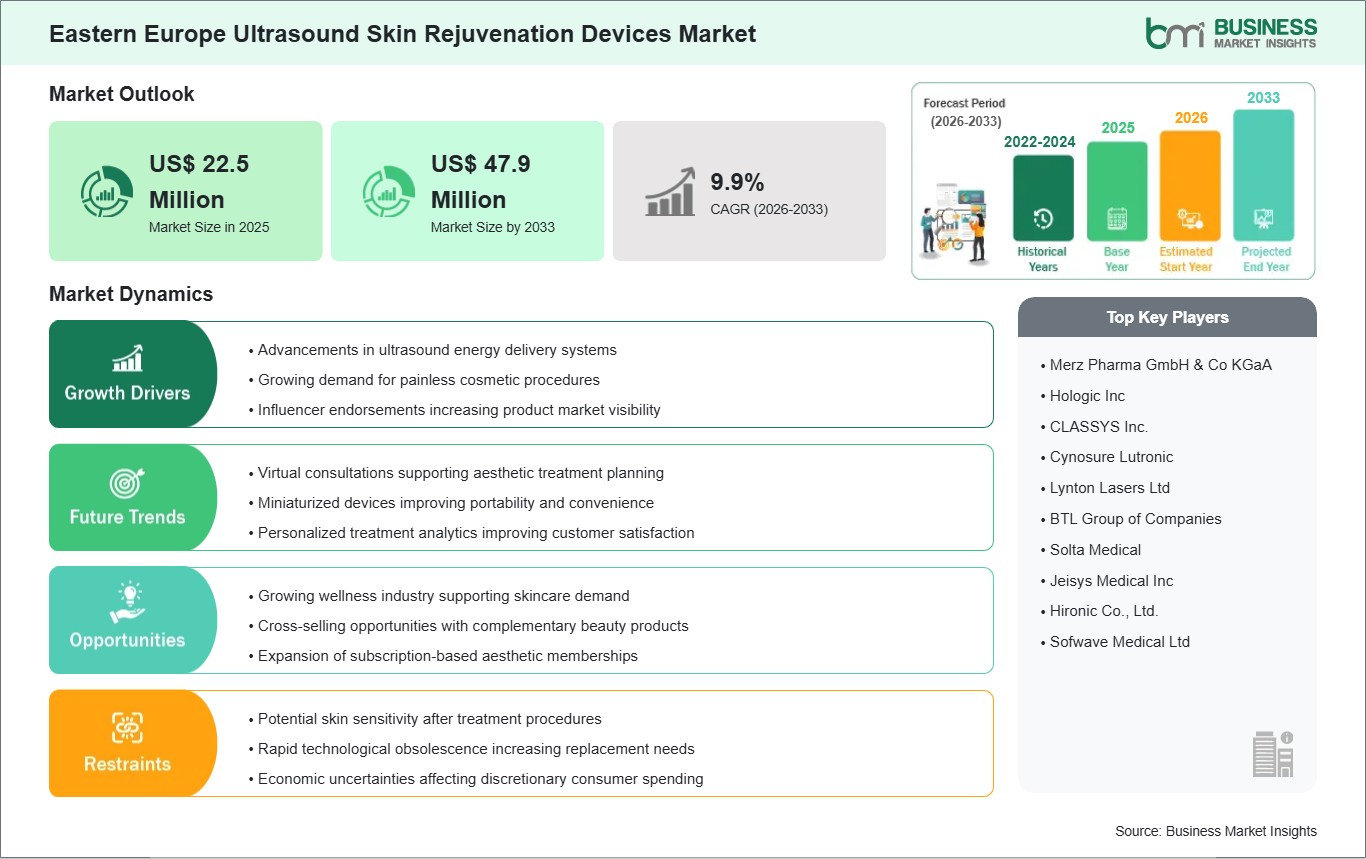
The Eastern Europe ultrasound skin rejuvenation devices market is undergoing steady structural evolution, supported by increasing consumer inclination toward non-invasive aesthetic procedures and gradual modernization of private dermatology infrastructure. The demand for these services is predominantly located in urban clusters, where increasing awareness of aesthetics, shaped by Western beauty standards, is encouraging more people to undergo energy-based facial rejuvenations, including ultrasound face lifting, collagen induction therapy, and treatments for wrinkles. In this context, medical facilities are increasingly broadening their treatment range to offer innovative skin regeneration solutions that can be included in more holistic approaches to aesthetic treatments. In terms of supply, manufacturers from other countries have been focusing on increasing their presence in the region through a network of distributors, training programs, and cooperation with local chains of dermatology clinics and cosmetic surgery centers. Moreover, competition in the market is growing, as companies compete in the design and functionality of their equipment, including the use of multi-mode ultrasound technology and increased safety levels. Additionally, financing models such as leasing and pay-per-use arrangements are facilitating broader accessibility among emerging service providers. Regulatory alignment with European Union medical device standards is influencing product approval cycles and encouraging compliance-driven innovation, although variability in healthcare enforcement across countries introduces operational complexity. Rising medical tourism in select Eastern European hubs is further supporting demand for technologically advanced aesthetic procedures. Overall, the market is characterized by a transition from fragmented service delivery toward more structured, clinic-based aesthetic ecosystems, with increasing emphasis on practitioner certification and standardized treatment protocols. Competitive intensity is expected to rise as both global and regional players expand their footprint across secondary cities and underserved urban markets.
Segment Analysis
Eastern Europe Ultrasound Skin Rejuvenation Devices Market Segmentation
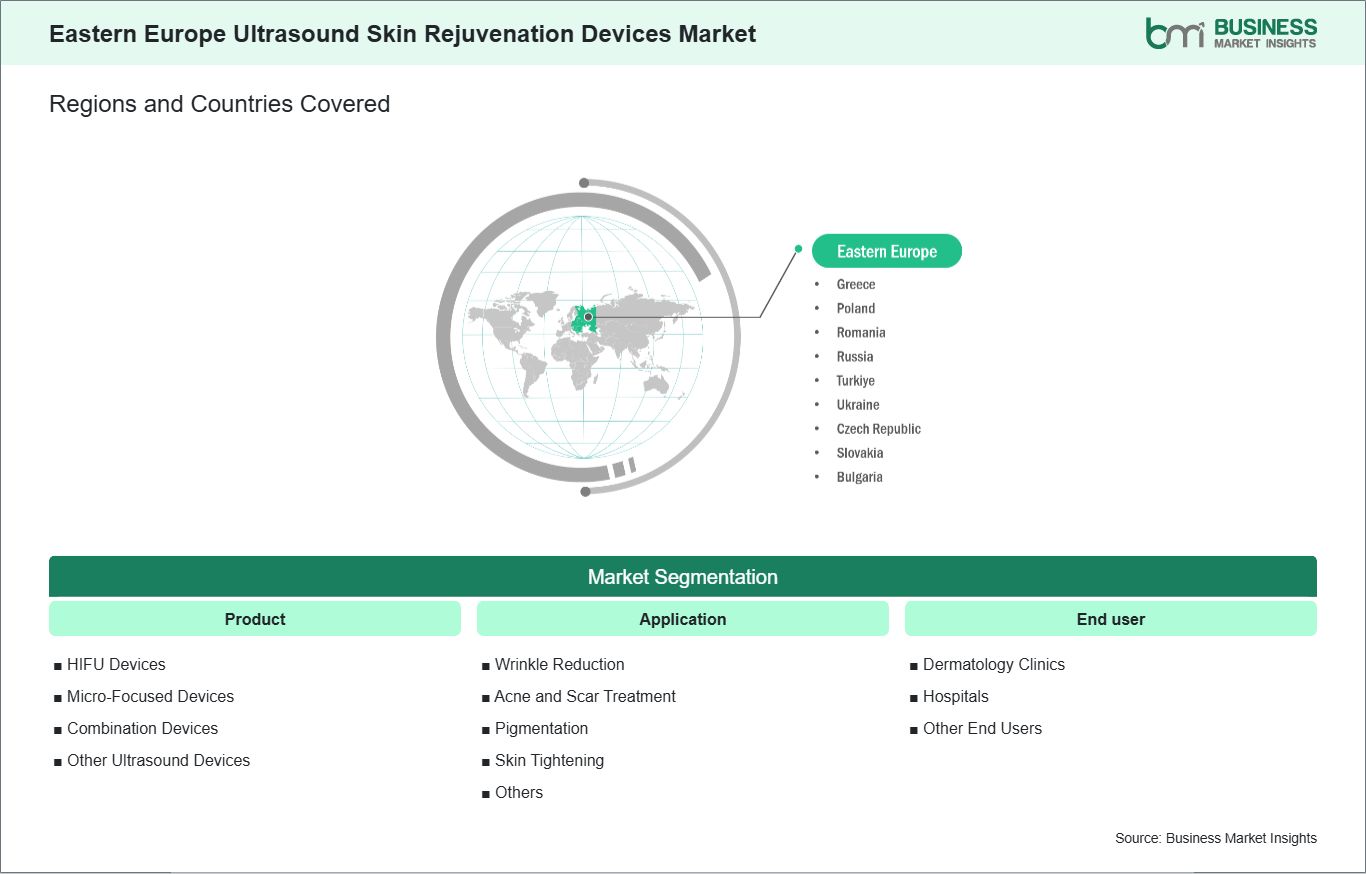
Key segments that contributed to the derivation of the Eastern Europe ultrasound skin rejuvenation devices market analysis are product, application, and end user.
- By product, the ultrasound skin rejuvenation devices market is segmented HIFU devices, micro-focused devices, combination devices, other ultrasound devices. The HIFU devices segment dominated the market in 2025.
- Based on application, the ultrasound skin rejuvenation devices market is categorized into wrinkle reduction, acne and scar treatment, pigmentation, skin tightening, others application. The wrinkle reduction segment dominated the market in 2025.
- In terms of end user, the ultrasound skin rejuvenation devices market is categorized into dermatology clinics, hospitals, other end users. The dermatology clinics segment dominated the market in 2025.
Market Forces
Eastern Europe Ultrasound Skin Rejuvenation Devices Market Drivers and Opportunities
Rising aging population seeking youthful appearance
The ultrasound skin rejuvenation devices market in Eastern Europe is being strongly influenced by a rapidly aging population that is increasingly prioritizing non-surgical aesthetic solutions. A considerable number of people older than 45 are currently searching for ways to treat their problems with loose skin, wrinkles, and reduced volume of the face through methods which do not entail any dangers related to cosmetic surgery. In nations where the average life span is increasing and the understanding of aesthetic medicine is growing, patients from Poland and Czech Republic have become highly interested in HIFU therapy. The urban population from cities like Warsaw and Prague is especially inclined toward “age management.”
In countries like Hungary and Romania, with the development of private healthcare facilities, ultrasound-assisted skin renewal treatments have become available for middle-class customers. The hospitals and clinics based in cities like Budapest and Bucharest have been focusing on upgrading their ultrasound equipment as the demand for non-surgical face lifts and neck lifting procedures rises. Aging population, particularly women between 40 and 65 years old, constitutes an important clientele for aesthetic dermatology. Furthermore, owing to the influence of beauty ideals from across the globe via the internet, individuals have started resorting to cosmetic treatments sooner than before.
Another aspect that contributes to the trend is the growing openness of elderly male consumers to undergoing aesthetic procedures. The old-fashioned views on the use of cosmetics are slowly changing, especially in metropolitan regions, where maintaining a professional image and leading an active lifestyle is highly appreciated. Clinics specializing in dermatology have noted a growing number of requests from male clients to undergo chin contouring and skin tightening thanks to advanced technologies, including ultrasound technology. The development of the target clientele motivates companies to manufacture ergonomically designed fast treatment systems.
Expanding applications in preventive aesthetic care
Preventive aesthetic care is emerging as a key growth driver for the ultrasound skin rejuvenation devices market in Eastern Europe, as younger populations increasingly adopt early-intervention skincare strategies. Younger consumers from late 20s to late 30s years old are interested in the treatment that postpones the appearance of wrinkles rather than solving the existing problem with their damaged skin. Dermatologists working in countries like Slovakia or Croatia have observed an increased number of people who are using low-intensity ultrasound therapy to maintain and increase their skin collagen levels. Major cities of Slovakia and Croatia are experiencing popularity of “lifting without downtime.”
In more advanced aesthetic societies like Poland and Czech Republic, preventative use of ultrasound instruments is being incorporated into their overall regime of health and skincare. In this case, medical spas and dermatology franchises have launched subscription plans whereby their clients have periodic exposure to ultrasound to help retain skin elasticity and avoid surgical operations. This development has been facilitated by rising income levels among citizens, along with the rising trend in proactive health care. Younger consumers are becoming increasingly convinced through social media that ultrasounds can be used for self-care.
Advancement in technology regarding precise and customized machines is another aspect that is contributing to the increased adoption of preventive aesthetics. Present-day ultrasound machines enable the user to concentrate on particular layers of the skin with higher precision, thus allowing the procedure to take place at an earlier stage without pain. The incorporation of ultrasound treatment with other preventive techniques like light-based procedures and cosmeceuticals is becoming popular amongst clinics that provide a variety of treatments. This combination has caught attention in the cities of the area because of the stiff competition amongst service providers.
Size and Share Analysis
Eastern Europe Ultrasound Skin Rejuvenation Devices Market Size and Share Analysis
The Eastern Europe ultrasound skin rejuvenation devices market demonstrates steady growth, with size and share analysis highlighting evolving trends and competitive dynamics among key players. The report examines subsegments categorized within product, application, and end user, offering insights into their contribution to overall market performance.
By product, the HIFU devices segment dominated the market in 2025, driven by growing demand for cost-effective, non-surgical skin tightening technologies with proven clinical efficacy in Eastern Europe.
Based on application, the wrinkle reduction segment dominated the market in 2025, driven by increasing adoption of preventive aesthetic treatments among the expanding middle-aged population in Eastern Europe.
In terms of end user, the dermatology clinics segment dominated the market in 2025, driven by strong preference for medically supervised cosmetic procedures and expanding private dermatology infrastructure across the region.
Report Coverage
Eastern Europe Ultrasound Skin Rejuvenation Devices Market Report Coverage and Deliverables
The "Eastern Europe Ultrasound Skin Rejuvenation Devices Market Size and Forecast (2022-2033)" report provides a detailed analysis of the market covering below areas:
- Market size and forecast at global, regional, and country levels for all the key market segments covered under the scope
- Market trends, as well as drivers, restraints, and opportunities
- Market analysis covering key trends, global and regional framework, major players, regulations, and recent developments
- Market concentration, heat map analysis, prominent players, and recent developments for the Market
- Detailed company profiles, including SWOT analysis
Geographic Insights
Eastern Europe Ultrasound Skin Rejuvenation Devices Market Geographic Insights
The geographical scope of the Eastern Europe ultrasound skin rejuvenation devices market report is divided into Russia, Poland, Ukraine, Romania, the Czech Republic, Slovakia, Bulgaria, Greece. Russia held the largest share in 2025.
Within the Eastern Europe ultrasound skin rejuvenation devices market, country-level dynamics vary significantly, with Russia emerging as the dominant market due to its strong concentration of high-income urban consumers, advanced private aesthetic clinics, and sustained demand for premium anti-aging technologies. Major cities such as Moscow and St. Petersburg serve as key hubs for adoption, where affluent demographics drive consistent uptake of high-end ultrasound-based skin rejuvenation systems integrated into luxury dermatology services. The presence of well-established cosmetic medicine networks and a strong preference for technologically advanced aesthetic solutions further reinforces Russia’s leadership position in the region. Poland represents one of the most mature and rapidly expanding markets outside Russia, supported by a robust private healthcare sector and increasing consumer acceptance of non-surgical cosmetic procedures. Clinics in Warsaw, Kraków, and Wrocław are actively investing in advanced ultrasound platforms to meet growing demand for facial rejuvenation and skin tightening treatments. Ukraine is an emerging market where demand is concentrated in major urban centers, with gradual recovery and rebuilding of private healthcare infrastructure supporting renewed interest in aesthetic technologies. In Romania, rising disposable income and expanding medspa networks are driving steady adoption, particularly in Bucharest and Cluj-Napoca. Czech Republic and Slovakia exhibit stable demand patterns supported by well-developed dermatology practices and increasing consumer awareness of preventive aesthetics. Bulgaria is witnessing gradual uptake driven by affordability-focused clinic expansions, while Greece shows steady demand fueled by wellness tourism and a growing preference for non-invasive beauty procedures in private aesthetic centers. Overall, while adoption levels differ, Russia remains the clear regional anchor, with other countries progressively strengthening their positions through clinic expansion, training initiatives, and rising aesthetic awareness.
Industry Activity
Recent Developments
The Eastern Europe ultrasound skin rejuvenation devices market is evaluated by gathering qualitative and quantitative data post primary and secondary research, which includes important corporate publications, association data, and databases. A few of the key developments in the Eastern Europe ultrasound skin rejuvenation devices market are:
- In September 2023, Beauté Pacifique Medical Skin Care announced that it had launched its globally patented DermaValidator ultrasound skin diagnostic device in South Eastern Europe, enabling clinics to use real-time ultrasound imaging for skin analysis and treatment personalization in aesthetic procedures.
- In March 2024, Classys Inc. announced the European commercial expansion of Ultraformer MPT (Shurink Universe), its next-generation high-intensity focused ultrasound (HIFU) device for skin lifting and rejuvenation, increasing penetration across European clinic networks including Central and Eastern European markets such as Poland, Czech Republic, and Hungary.
Trust & Transparency
Research Methodology
The market analysis combines proprietary research with secondary data from government agencies, company disclosures, regulatory filings, industry databases and expert interviews. Market estimates are validated through data triangulation, cross-market benchmarking and analyst
review.
View Full Research Methodology
Key Sources Referred:
American Society for Laser Medicine and Surgery (ASLMS)European Academy of Dermatology and Venereology (EADV)Bharat Society of Laser Medicine & Surgery (BSLMS)S. Food and Drug Administration (FDA)European Medicines Agency (EMA)International Electrotechnical Commission (IEC)International Organization for Standardization (ISO)Beauty Device Association (BDA)Indian Laser Association (ILA)Association of Industrial Laser Users (AILU)