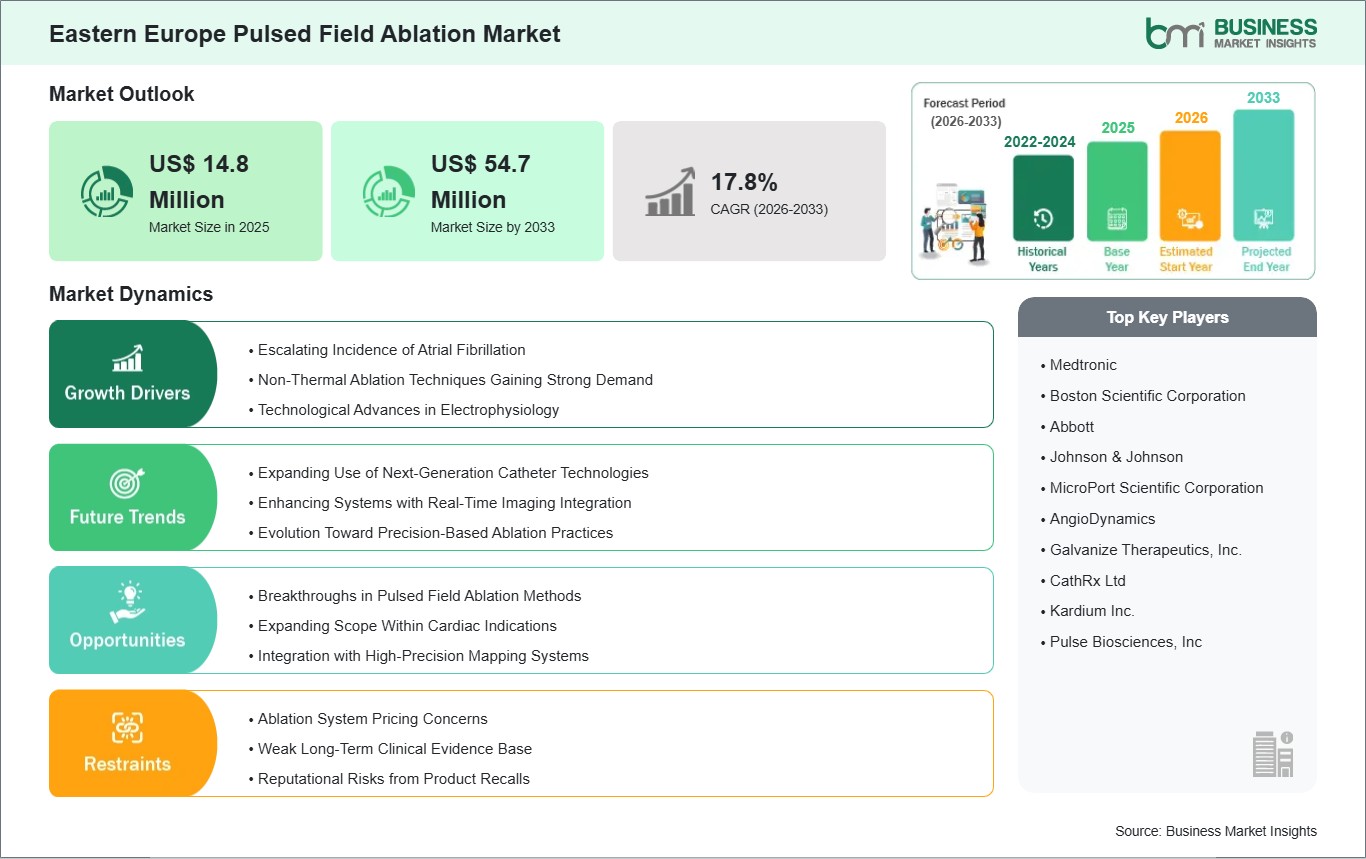
The Eastern Europe pulsed field ablation market size is expected to reach US$ 54.7 million by 2033 from US$ 14.8 million in 2025. The market is estimated to register a CAGR of 17.8% from 2026 to 2033.
Pulsed Field Ablation (PFA) in Eastern Europe is developing its own very specific area within the field of cardiac electrophysiology due to the significant variations in healthcare systems between countries. The demand for PFA is reliant upon increasing incidences of arrhythmias, namely, atrial fibrillation (AF) and the need for therapies that minimize the risk of complications but still provide effective interventions. In comparison to thermal ablation techniques, PFA is a non-thermal ablation method that uses a tissue-specific approach to minimize collateral damage and the risk of complications associated with cardioversion and other treatment modalities due to the complexity of cases. Additionally, increased awareness among cardiology physicians regarding the benefits associated with using PFA techniques has led to early adoption among selected hospitals due to advancements made in the development of electrophysiology facilities.
However, budget constraints are significant in many health care systems, therefore preventing access to expensive PFA products by hospitals located within mid-range or rural areas. The lack of skilled electrophysiologists trained in advanced ablation techniques is also a barrier to expanded use across the region. Regulatory guidelines are evolving across Eastern Europe also; however, differences among individual countries result in varied timeframes for approvals of devices and implementation of procedures using these devices. However, urban-based hospital renovations, clinical training programs, and pilot projects point towards continued growth in the PFA market in Eastern Europe. Additionally, there is a regional emphasis on the enhancement of health care delivery.

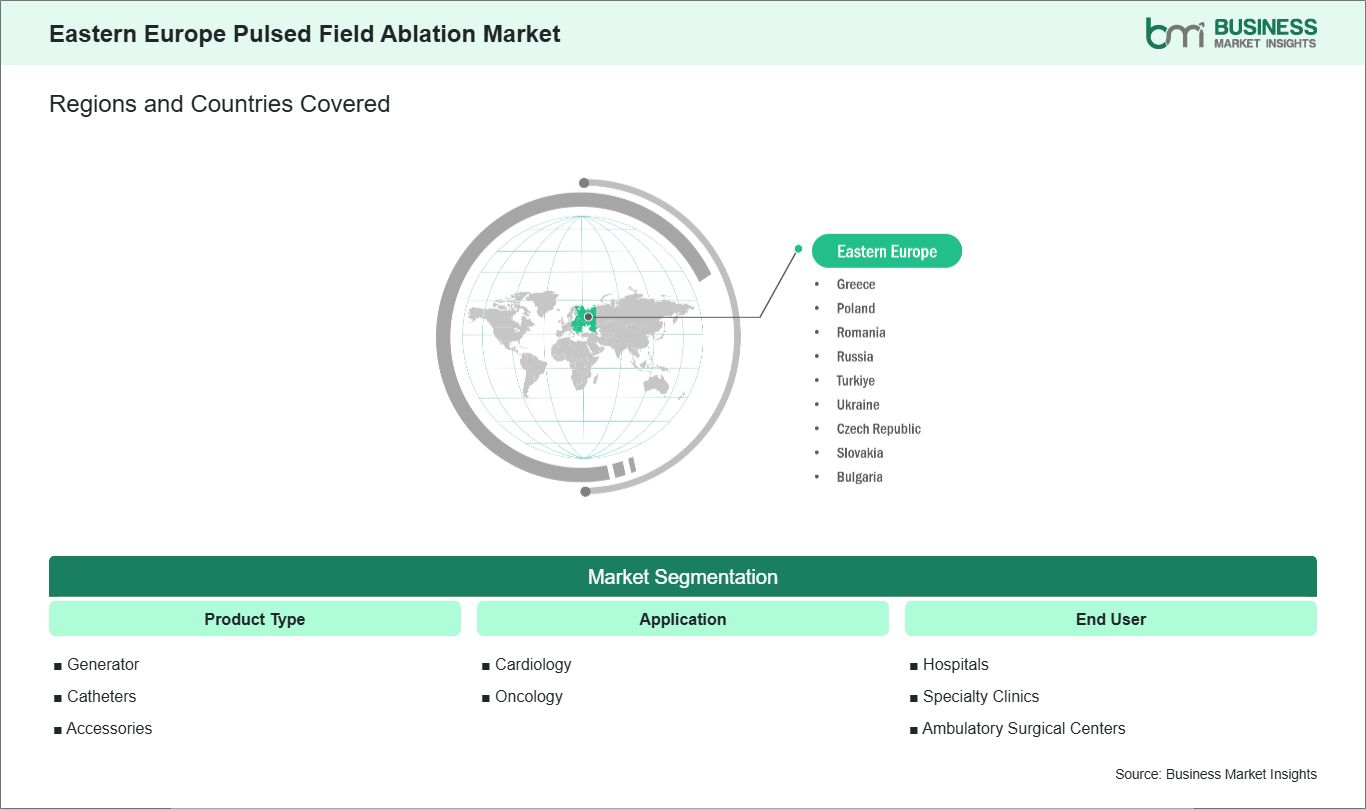
Key segments that contributed to the derivation of the Eastern Europe pulsed field ablation market analysis are product type, application, and end user.
Atrial fibrillation (AF) is placing growing demands on healthcare systems across Eastern Europe as demographic shifts and lifestyle changes contribute to an increasing patient population. Aging populations in countries have led to higher susceptibility to arrhythmias, while urbanization and sedentary behaviors further increase cardiovascular risk. Hospitals and cardiac centers are responding by strengthening screening programs and diagnostic capabilities to identify AF early and manage it effectively, prioritizing timely intervention to prevent complications such as stroke, heart failure, and long-term cardiac issues.
Healthcare providers are expanding cardiology and electrophysiology services to meet the rising demand efficiently. Clinicians are emphasizing minimally invasive procedures that provide reproducible outcomes while reducing procedural risk and recovery time. Hospitals are optimizing workflows and care pathways to manage increasing patient volumes without compromising quality or safety, reflecting a broader focus on operational efficiency and clinical precision.
The growing incidence of AF highlights the need for advanced treatment approaches. Pulsed field ablation (PFA) offers a tissue-selective method that minimizes collateral damage and reduces procedural complications, improving efficiency and patient outcomes. Its adoption in Eastern European healthcare systems enables clinicians to deliver safer, faster, and more precise arrhythmia management, enhancing cardiac care capabilities while addressing the rising prevalence of atrial fibrillation in the region.
Pulsed field ablation (PFA) is transforming arrhythmia care in Eastern Europe by offering a precise, safe, and efficient alternative to conventional thermal ablation techniques. PFA selectively targets cardiac tissue using high-voltage electrical pulses while sparing surrounding structures, reducing procedural complications and supporting faster patient recovery. Advances in catheter design, energy delivery, and integration with mapping and visualization systems have improved procedural accuracy, consistency, and clinician confidence, enabling complex interventions to be performed safely across diverse hospital settings.
Investment into infrastructure, clinician training and standardized procedural workflows will support the adoption of PFA within Eastern Europe. Hospitals are providing their clinicians with intuitive systems and operational guidance that will shorten their learning curve, leading to improved efficiency and consistency of clinical outcomes. Therefore, these improvements will enable healthcare providers to service a greater number of patients while still providing quality medical procedures and ensuring patient safety, thereby enhancing overall cardiac service capabilities.
The advancement of new technologies for PFA will also continue to support the modernization of arrhythmia management within this area. Developments in mapping integration, workflow optimization and the usability of devices will help to create a predictable level of results and operational efficiency for clinicians. By adopting PFA, the clinical effectiveness of care will improve, the risks associated with procedural treatments will be reduced, and the ability of healthcare systems to provide continued access to treating patients with atrial fibrillation, which is increasing at an alarming rate, will further strengthen it as one of the key technologies in Eastern European cardiac care.

The Eastern Europe pulsed field ablation market demonstrates steady growth, with size and share analysis highlighting evolving trends and competitive dynamics among key players. The report evaluates important subsegments categorized within product type, application, and end user, highlighting their respective contributions to overall market performance.
By product type, the catheters subsegment dominated the market in 2025. Catheter devices offer improved procedural efficiency, reduced risk of complications, and real-time control for electrophysiologists, making them a crucial component for effective PFA therapy and a key revenue driver for manufacturers.
In terms of application, the cardiology subsegment dominated the market in 2025. The leadership of cardiology applications is attributed to the rising prevalence of atrial fibrillation and other cardiac arrhythmias, growing preference for non-thermal and tissue-selective ablation techniques, and increasing awareness among healthcare providers about the clinical benefits of PFA.
Based on end user, the hospitals subsegment dominated the market in 2025. Hospitals maintain a stronghold due to their established cardiology and electrophysiology departments, access to advanced PFA systems, trained physicians and clinical staff, and the capability to perform specialized cardiac procedures with comprehensive patient monitoring and post-procedure care.
| Report Attribute | Details |
|---|---|
| Market size in 2025 | US$ 14.8 Million |
| Market Size by 2033 | US$ 54.7 Million |
| CAGR (2026 - 2033) | 17.8% |
| Historical Data | 2022-2024 |
| Forecast period | 2026-2033 |
| Segments Covered | By Product Type
|
|
Regions and Countries Covered
| |
| Eastern Europe | Russia, Poland, Romania, Czech Republic, Greece, Ukraine, Slovakia, Bulgaria |
| Market leaders and key company profiles |
|
The "Eastern Europe Pulsed Field Ablation Market Size and Forecast (2022–2033)" report provides a detailed analysis of the market covering below areas:
The geographical scope of the Eastern Europe pulsed field ablation market report is divided into: Russia, Poland, Romania, the Czech Republic, Ukraine, Romania, Greece, Slovakia, and Bulgaria. Russia held the largest share in 2025.
Russia has a long history of cardiac care using a variety of advanced technologies and has a large number of patients with atrial fibrillation (AF), many of whom require treatment using interventions that are safe and effective compared to traditional ablation techniques. Since PFA (Pulmonary Vein Ablation) employs a non-thermal, tissue-selective method that minimizes collateral damage to surrounding cardiovascular structures, this procedure has high relevance and value given the profile of patients in Russia who are at high risk for complications.
In Russia, hospitals have begun investing heavily in establishing dedicated electrophysiology laboratories and acquiring new mapping and imaging systems; this is done to enhance PFA. The clinical uptake of PFA will continue to develop through the establishment of structured training programs that train cardiologists in the use of complex ablation safely and by forming partnerships with new technology providers to implement timely deployment of new devices to ensure safe procedures and consistency.
Challenges remain concerning access to PFA outside of large hospitals due to the cost of PFA equipment and consumables, which has limited PFA to smaller, less-populous areas. Additionally, the number of trained electrophysiologists continues to be concentrated at large hospitals, thus limiting overall market uptake of the technology. Additionally, regulatory processes continue to impact the timeline for the introduction of new technology, although they have improved significantly. Nonetheless, Russia’s healthcare business continues to thrive.

The Eastern Europe pulsed field ablation market is evaluated by gathering qualitative and quantitative data post primary and secondary research, which includes important corporate publications, association data, and databases. A few of the key developments in the Eastern Europe pulsed field ablation market are:
The Eastern Europe Pulsed Field Ablation Market is valued at US$ 14.8 Million in 2025, it is projected to reach US$ 54.7 Million by 2033.
As per our report Eastern Europe Pulsed Field Ablation Market, the market size is valued at US$ 14.8 Million in 2025, projecting it to reach US$ 54.7 Million by 2033. This translates to a CAGR of approximately 17.8% during the forecast period.
The Eastern Europe Pulsed Field Ablation Market report typically cover these key segments-
The historic period, base year, and forecast period can vary slightly depending on the specific market research report. However, for the Eastern Europe Pulsed Field Ablation Market report:
The Eastern Europe Pulsed Field Ablation Market is populated by several key players, each contributing to its growth and innovation. Some of the major players include:
The Eastern Europe Pulsed Field Ablation Market report is valuable for diverse stakeholders, including:
Essentially, anyone involved in or considering involvement in the Eastern Europe Pulsed Field Ablation Market value chain can benefit from the information contained in a comprehensive market report.
Please tell us your area of interest
(Market Segments/ Regions and Countries/ Companies)