Market Summary
Executive Summary and Market Analysis
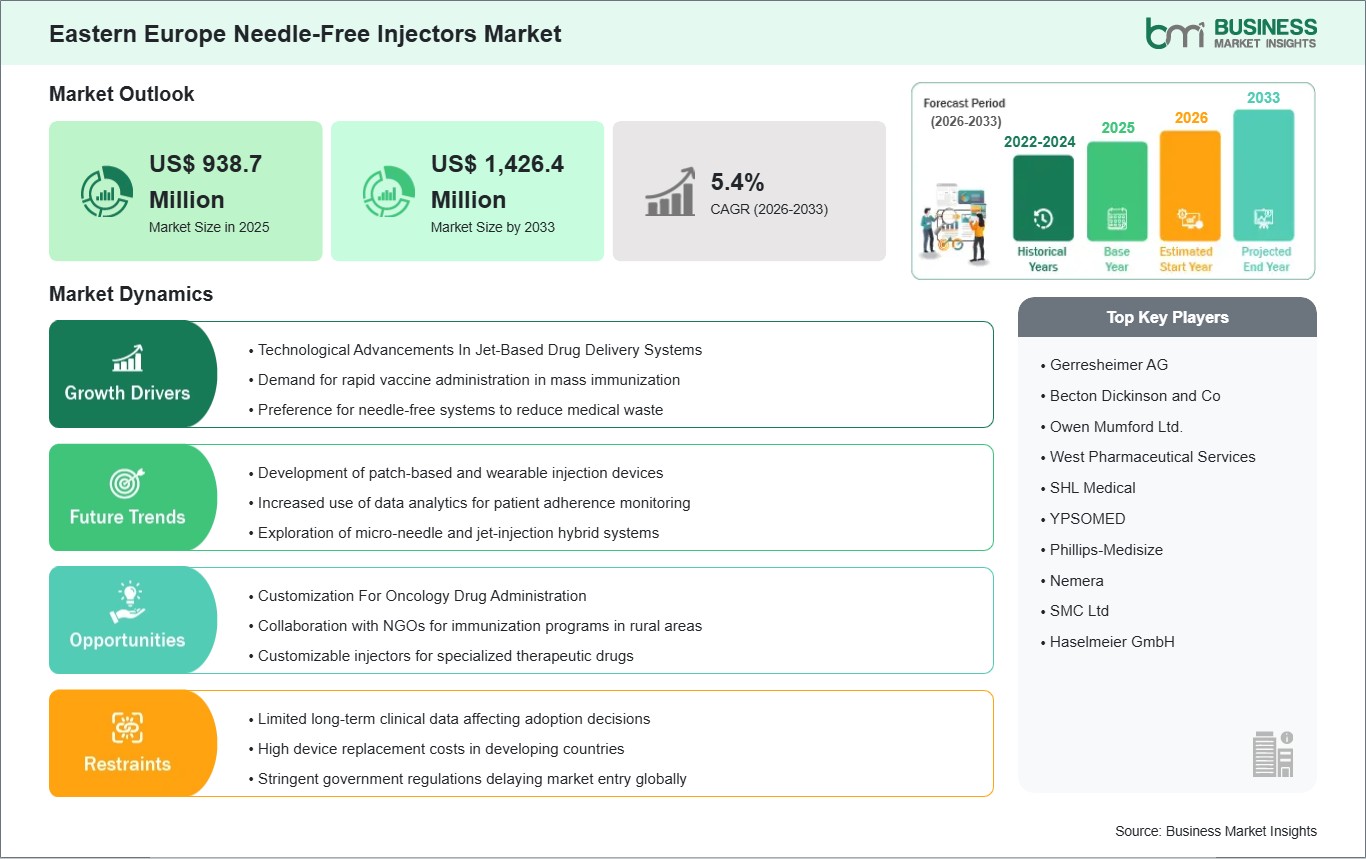
Countries in the region, including Poland, Hungary, the Czech Republic, Romania, and Ukraine, are demonstrating rising interest in alternative drug delivery systems, driven by public health programs and private hospital adoption. The market is shaped by multinational device manufacturers seeking regional distribution partnerships and local suppliers focusing on cost-efficient solutions for immunization and chronic therapy administration. Clinical decision-makers prioritize devices that reduce needle-stick injuries, enhance patient comfort, and support high-volume administration workflows, particularly in vaccination centers and outpatient clinics. Regulatory frameworks across Eastern Europe are diverse, with EU-member states adhering to the European Medical Device Regulation (MDR) and non-EU countries implementing national approval processes that vary in rigor and transparency. Pilot programs, clinical validation studies, and hospital-based demonstration projects help build clinician confidence and drive procurement decisions. Operational considerations, including ease of training, device maintenance, and consumables management, are critical in the evaluation of needle-free injectors. Technological innovation emphasizes single-use and reusable devices, dose accuracy across varying viscosities, and devices designed for professional and patient-administered therapies. Competitive differentiation relies on after-sales support, distributor networks, and integration into existing hospital workflows. Early adoption in urban healthcare centers is expanding into broader institutional use, supported by regulatory alignment, cost-effective distribution strategies, and a growing emphasis on patient safety and operational efficiency.
Segment Analysis
Eastern Europe Needle-Free Injectors Market Segmentation
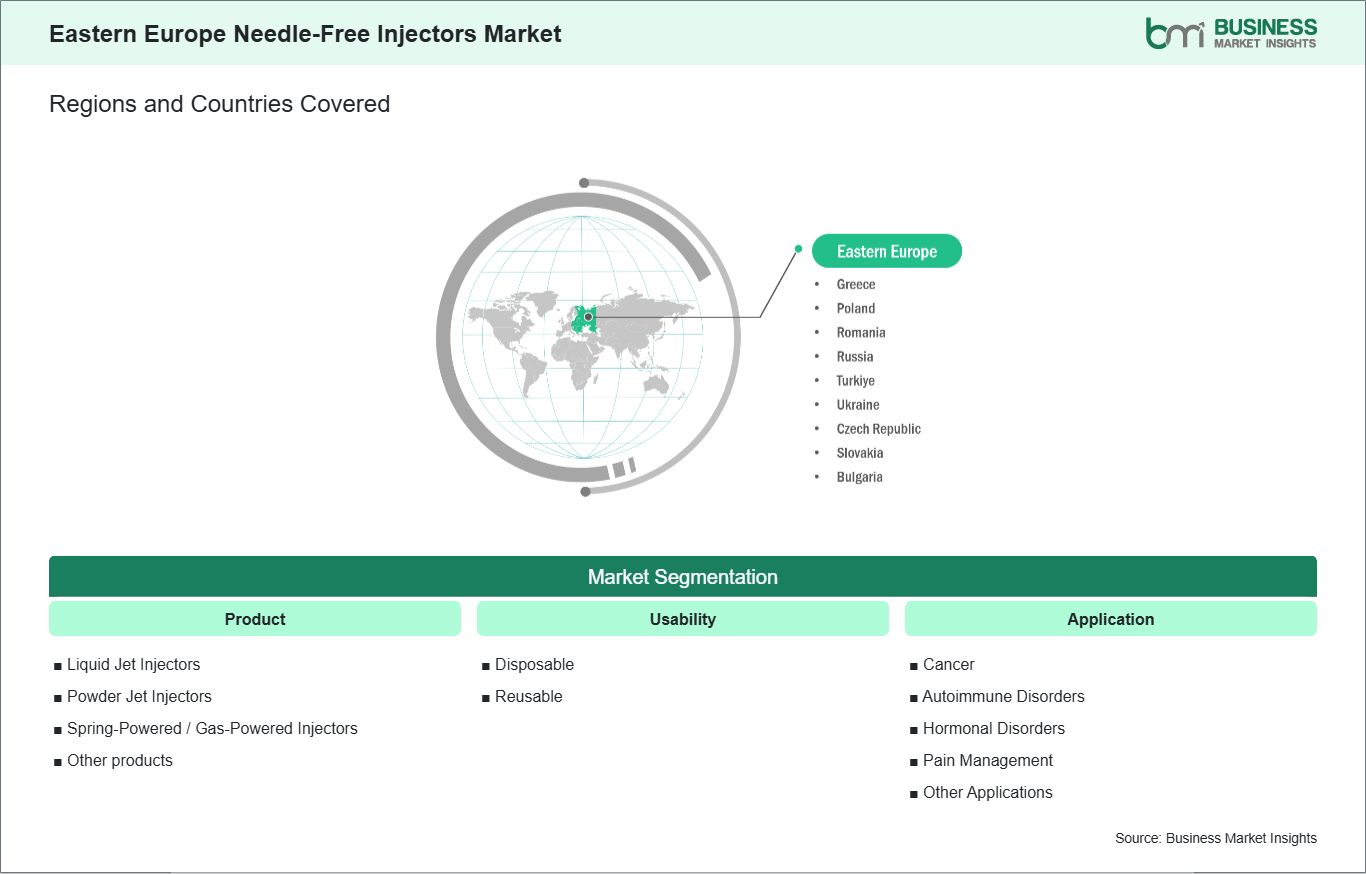
Key segments that contributed to the derivation of the Eastern Europe needle-free injectors market analysis are product, usability, and application.
- By product, the needle-free injectors market is segmented into liquid jet injectors, powder jet injectors, spring-powered / gas-powered injectors, and other products. The liquid jet injectors segment dominated the market in 2025.
- Based on usability, the needle-free injectors market is categorized into disposable and reusable. The disposable segment dominated the market in 2025.
- In terms of application, the market is classified into cancer, autoimmune disorders, hormonal disorders, pain management, and other applications. The autoimmune disorders segment dominated the market in 2025.
Market Forces
Eastern Europe Needle-Free Injectors Market Drivers and Opportunities
Technological Advancements In Jet-Based Drug Delivery Systems
Healthcare providers in countries such as Poland, Romania, and Hungary are adopting jet-based systems due to their ability to deliver precise medication doses rapidly. These systems eliminate the need for needles, reducing pain and anxiety for patients while maintaining high dosing accuracy, which is valued in outpatient care and vaccination programs. Technological improvements have enhanced the safety and versatility of jet injectors. Modern devices are designed with adjustable pressure settings, improved ergonomics, and compatibility with a wide range of liquid medications, allowing clinicians to tailor treatment protocols to individual patient needs. Healthcare facilities are striving to modernize service delivery and incorporate advanced technologies into daily practice. Jet-based systems reduce the risk of needle-stick injuries, which is a growing concern in densely staffed hospitals and clinics. The efficiency and safety of these devices support faster workflows and improved patient throughput, making them attractive for high-demand healthcare settings. As technological innovation continues and local manufacturers invest in research and development, jet-based needle-free injectors are expected to become an integral component of drug delivery strategies across Eastern Europe.
Customization For Oncology Drug Administration
Needle-free injectors are being customized for oncology applications to address the challenges associated with frequent and often painful injections. By providing a less invasive option for delivering chemotherapy and supportive medications, these devices help reduce patient anxiety and improve treatment compliance. The ability to tailor needle-free systems for oncology use—including adjustable dosing, compatibility with viscous drugs, and integration with infusion protocols—is relevant for hospitals and specialized cancer centers. Such customization enables clinicians to safely administer targeted therapies while minimizing the discomfort and logistical challenges traditionally associated with needle injections. Patient-centric oncology programs in countries such as Czechia, Slovakia, and Ukraine are emphasizing home-based care and self-administration where possible. Customized needle-free injectors facilitate these approaches by allowing patients to manage certain treatments outside hospital settings with minimal supervision. As oncology care continues to advance, the demand for devices designed for cancer therapy is expected to grow, making customized needle-free injectors a key segment of the regional drug delivery market.
Size and Share Analysis
Eastern Europe Needle-Free Injectors Market Size and Share Analysis
The Eastern Europe Needle-free Injectors Market demonstrates steady growth, with size and share analysis highlighting evolving trends and competitive dynamics among key players. The report examines subsegments categorized within product, usability, and application, offering insights into their contribution to overall market performance.
By product, the liquid jet injectors subsegment dominated the market in 2025, driven by their ability to deliver accurate doses quickly and efficiently, making them suitable for hospital and outpatient use.
Based on usability, the disposable subsegment dominated the market in 2025, driven by the emphasis on hygiene, infection control, and ease of use in healthcare facilities.
In terms of application, the autoimmune disorders subsegment dominated the market in 2025, driven by the need for frequent, long-term medication administration where patient comfort and adherence are critical in managing chronic conditions.
Report Coverage
Eastern Europe Needle-Free Injectors Market Report Coverage and Deliverables
The "Eastern Europe Needle-free Injectors Market Size and Forecast (2022–2033)" report provides a detailed analysis of the market covering below areas:
- Eastern Europe Needle-free Injectors Market size and forecast at regional and country levels for all market segments covered under the scope
- Eastern Europe Needle-free Injectors Market trends, as well as drivers, restraints, and opportunities
- Eastern Europe Needle-free Injectors Market analysis covering key trends, regional framework, major players, regulations, and recent developments
- Industry landscape and competition analysis covering market concentration, heat map analysis, prominent players, and recent developments for the Eastern Europe Needle-free Injectors Market
- Detailed company profiles, including SWOT analysis
Geographic Insights
Eastern Europe Needle-Free Injectors Market Geographic Insights
The geographical scope of the Eastern Europe Needle-free Injectors Market report is divided into Russia, Poland, Ukraine, Romania, the Czech Republic, Slovakia, Bulgaria, and Greece. Russia held the largest share in 2025.
Russia emerges as the dominant market for needle-free injectors, driven by extensive public healthcare infrastructure, large-scale vaccination programs, and strong government support for innovative medical technologies. Urban hospitals and specialty clinics in Moscow, St. Petersburg, and other metropolitan areas are leading early adoption, emphasizing device reliability, dosing precision, and integration into high-volume clinical workflows. Poland represents a steadily growing market, where private hospitals and research institutions prioritize patient comfort and alignment with EU regulatory standards. The Czech Republic demonstrates moderate adoption, with hospitals favoring devices that combine ease of use with compatibility across multiple therapeutic applications. Romania remains cost-sensitive, with procurement decisions shaped by public tenders and NGO-supported immunization initiatives, emphasizing scalable and affordable needle-free solutions. Ukraine presents a decentralized adoption pattern, with urban medical centers acting as early adopters and rural areas relying on international aid programs or pilot demonstrations. Across the region, distributor networks, after-sales support, and localized clinician training are critical to building confidence and ensuring sustained use. Russia’s market dominance allows it to serve as a reference hub, where successful pilot programs and clinical validations influence adoption trends in neighboring Eastern European countries. Urban healthcare facilities function as centers of best practice, facilitating knowledge transfer and accelerating adoption across secondary hospitals. Russia drives market leadership in scale, and other Eastern European nations require tailored strategies that account for cost sensitivity, regulatory variations, and localized adoption behaviors to achieve long-term market penetration.
Industry Activity
Recent Developments
The Eastern Europe Needle-free Injectors Market is evaluated by gathering qualitative and quantitative data post primary and secondary research, which includes important corporate publications, association data, and databases. A few of the key developments in the Eastern Europe needle-free injectors market are:
- In September 2025, Russia’s State Research Center of Virology and Biotechnology “Vector” reported development of a needle‑free jet‑injected DNA COVID‑19 vaccine, designed to be delivered via high‑velocity fluid streams instead of conventional needles. This represents a scientific and technological advance in needle‑free vaccination methods within Russia. The approach aims to improve immunization speed, safety, and patient comfort, especially important for large‑scale vaccine campaigns. Next steps include clinical stages and regulatory evaluations, positioning Russia among innovators in jet‑injection vaccine delivery technology.
- In April 2025, HIRONIC announced the pre‑market entry of its SYNERJET PRO needle‑free transdermal injector into the Russian aesthetics and medical device market for non‑needle delivery of active ingredients. This initiative represents a market entry and early expansion effort toward offering needle‑free alternatives in cosmetic and therapeutic procedures. The company partnered with a Russian medical distributor to navigate regulatory compliance and lead the local launch strategy. Full commercialization and certification were underway, signaling growing interest in needle‑free delivery technologies in Russia.
Trust & Transparency
Research Methodology
The market analysis combines proprietary research with secondary data from government agencies, company disclosures, regulatory filings, industry databases and expert interviews. Market estimates are validated through data triangulation, cross-market benchmarking and analyst
review.
View Full Research Methodology
Key Sources Referred:
World Health Organization (WHO)Organisation for Economic Cooperation and Development (OECD)The World Bank GroupWorldometerThe LancetInternational Bar AssociationInternational Trade Administration