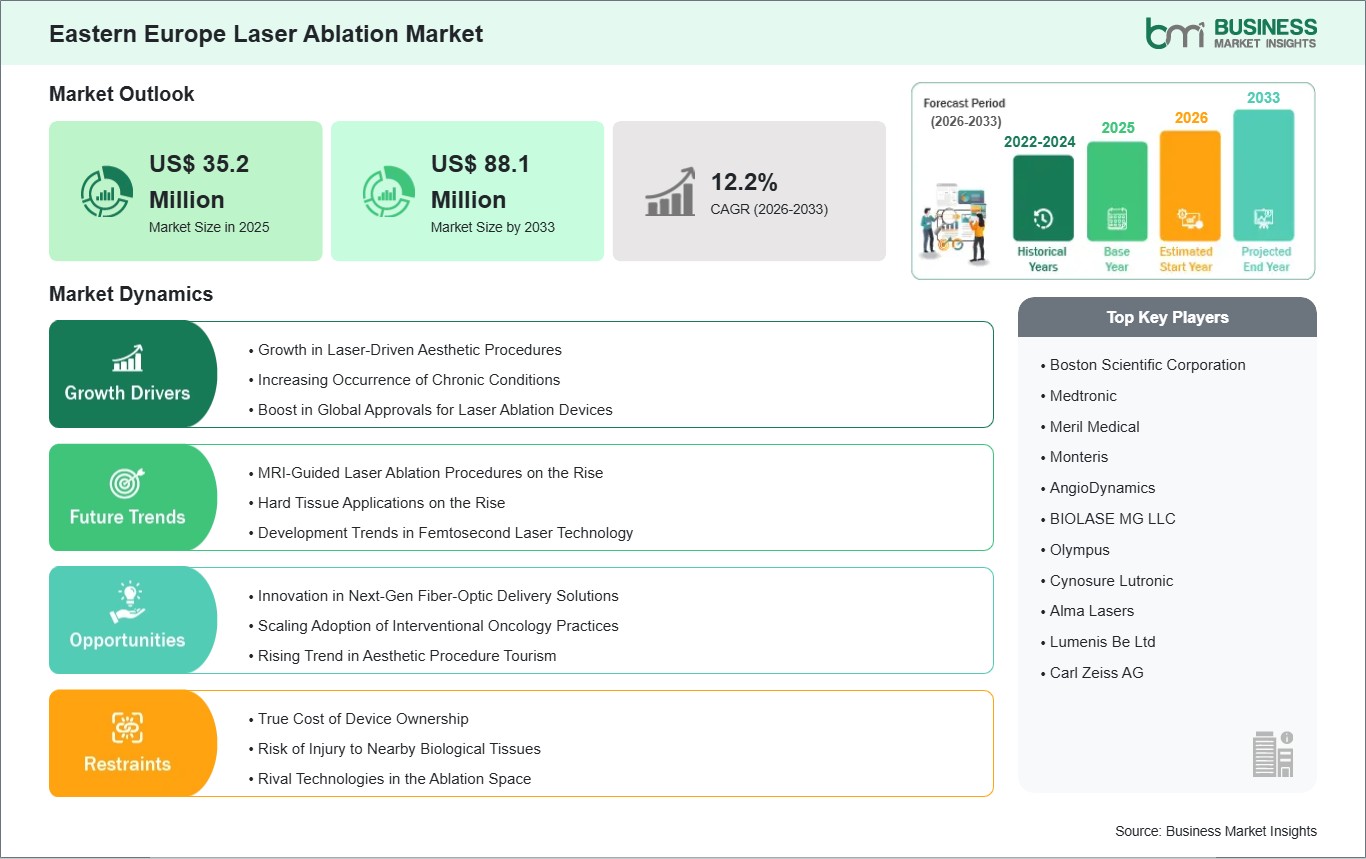
The Eastern Europe laser ablation market size is expected to reach US$ 88.1 million by 2033 from US$ 35.2 million in 2025. The market is estimated to record a CAGR of 12.2% from 2026 to 2033.
The Eastern Europe laser ablation market is gradually developing, driven by increasing adoption of minimally invasive procedures and growing investments in modern healthcare infrastructure. Across the region, countries are incorporating laser ablation technologies in cardiology, oncology, dermatology, and urology, as healthcare providers seek precise and targeted treatment options that reduce recovery time and procedural risks. Urban hospitals and specialized medical centers are the primary hubs for the adoption of these technologies, offering advanced procedures to patients who are increasingly aware of innovative healthcare solutions. Private healthcare networks are expanding in some countries, facilitating the introduction of high-tech devices and supporting the adoption of laser-based interventions.
Research and technological innovation are contributing to market growth, as collaborations between medical institutions and technology providers allow for refinement of procedures, development of new applications, and professional training of healthcare specialists. This has encouraged broader integration of laser ablation into clinical protocols in urban areas.
Despite these positive trends, the high costs of laser equipment and maintenance can limit adoption by smaller hospitals and clinics. Additionally, rural and less-developed regions often lack the infrastructure and trained personnel needed to offer advanced laser treatments. Regulatory inconsistencies across Eastern European countries can also slow standardization and wider deployment of these technologies, creating uneven growth within the region.

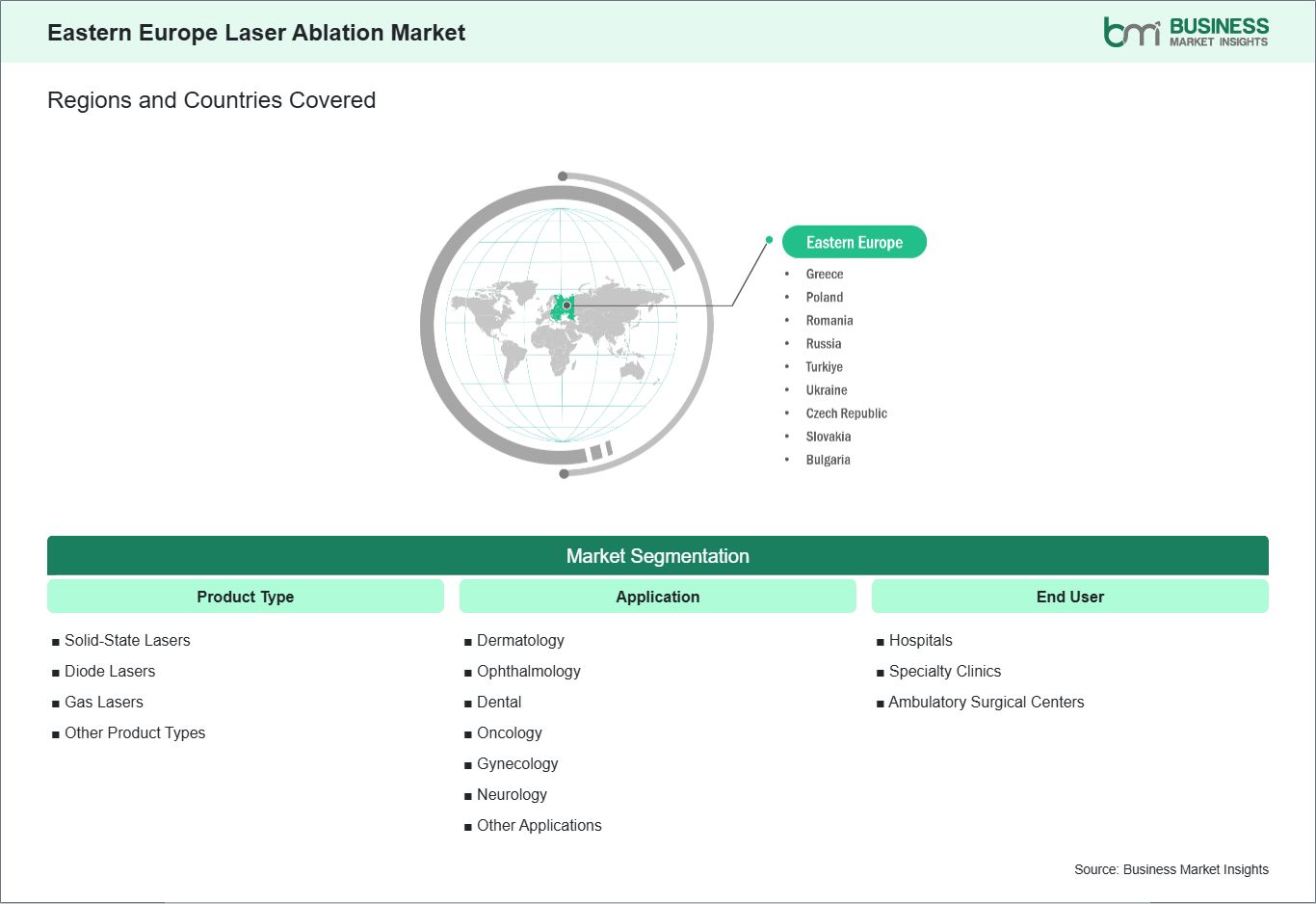
Key segments that contributed to the derivation of the Eastern Europe Laser Ablation market analysis are product type, application, and end user.
The Eastern European laser ablation market, is experiencing steady growth driven by increasing demand for minimally invasive aesthetic procedures. Urban centers like Warsaw, Budapest, Prague, and Bucharest have seen private dermatology clinics and medspas expand services such as fractional skin resurfacing, laser hair removal, pigmentation correction, and scar revision. Patients are attracted to these treatments for their predictable results, reduced downtime, and lower risk compared to traditional surgical interventions. Rising disposable incomes, urbanization, and growing awareness of cosmetic technologies further support adoption.
Cultural preferences favor subtle, natural results, which align well with the precision of modern laser procedures. Consumers often focus on correcting minor imperfections, uneven skin tone, and early signs of aging. Clinics have adopted advanced laser systems capable of targeted energy delivery, ensuring consistent, effective outcomes. Marketing strategies emphasize safety, efficiency, and long-term skin health benefits, reflecting regional expectations for high-quality care.
Accessibility is another key factor. Metropolitan areas now provide clinics that combine dermatology expertise with aesthetic laser treatments, increasing availability and public trust. Skilled professionals and adherence to regulatory standards reinforce confidence, encouraging broader adoption. Together, these factors drive sustained growth in laser-driven aesthetic procedures, establishing them as a mainstream component of personal care and cosmetic wellness in Eastern Europe.
Next-generation fiber-optic delivery systems are transforming the Eastern European laser ablation market by improving precision, control, and safety. These systems allow practitioners to focus laser energy on specific tissue layers while minimizing damage to surrounding areas. Cosmetic applications such as fractional resurfacing, scar treatment, and pigmentation correction benefit from enhanced energy control and predictability. Clinics in Warsaw, Budapest, Prague, and Bucharest are increasingly adopting these systems to meet patient demand for safe, minimally invasive, and reliable treatments.
Beyond aesthetic applications, fiber-optic systems expand into dermatologic, ophthalmologic, and endoscopic procedures. Real-time monitoring and precise energy delivery enhance safety and treatment outcomes. Multifunctional use allows clinics to maximize device utility across cosmetic and medical procedures, improving operational efficiency and broadening treatment offerings.
Portable, modular, and user-friendly designs further increase accessibility in smaller clinics and multi-specialty practices. Compact devices reduce infrastructure requirements, while customizable energy settings allow treatments to be adapted to individual skin types and conditions. By combining precision, versatility, and accessibility, next-generation fiber-optic delivery systems have become a cornerstone of growth in the Eastern European laser ablation market, supporting both aesthetic and therapeutic applications.

The Eastern Europe Laser Ablation market demonstrates steady growth, with size and share analysis highlighting evolving trends and competitive dynamics among key players. The report evaluates important subsegments categorized within product type, application, and end user, highlighting their respective contributions to overall market performance.
By product type, the solid-state lasers subsegment dominated the market in 2025, driven by the superior performance and versatility of solid-state lasers in clinical applications. These devices offer high precision, consistent energy delivery, and compatibility with a wide range of tissues, making them the preferred choice for laser ablation procedures.
In terms of application, the dermatology subsegment dominated the market in 2025, propelled by the increasing prevalence of skin disorders such as acne scars, pigmentation issues, and vascular lesions, coupled with a growing demand for minimally invasive cosmetic procedures.
Based on end user, the hospitals subsegment dominated the market in 2025 due to their well-established dermatology and surgical departments, access to advanced laser ablation systems, and availability of trained physicians and clinical staff.
| Report Attribute | Details |
|---|---|
| Market size in 2025 | US$ 35.2 Million |
| Market Size by 2033 | US$ 88.1 Million |
| CAGR (2026 - 2033) | 12.2% |
| Historical Data | 2022-2024 |
| Forecast period | 2026-2033 |
| Segments Covered | By Product Type
|
|
Regions and Countries Covered
| |
| Eastern Europe | Russia, Poland, Romania, Czech Republic, Greece, Ukraine, Slovakia, Bulgaria |
| Market leaders and key company profiles |
|
The "Eastern Europe Laser Ablation Market Size and Forecast (2022–2033)" report provides a detailed analysis of the market covering below areas:
The geographical scope of the Eastern Europe Laser Ablation market report is divided into: Russia, Poland, Romania, the Czech Republic, Ukraine, Romania, Greece, Slovakia, and Bulgaria. Russia held the largest share in 2025.
Russia is supported by an advanced network of urban hospitals, specialized clinics, and growing private healthcare facilities. The country has increasingly adopted laser ablation technologies across oncology, cardiology, dermatology, and urology, particularly in metropolitan areas where patients have higher awareness of minimally invasive procedures. Hospitals in major cities serve as centers for advanced treatments, attracting patients seeking precision-based therapies that reduce recovery time and minimize complications.
A major growth driver in Russia is the government’s focus on healthcare modernization and investment in advanced technologies. Collaborations between hospitals, research institutions, and technology providers have helped refine laser applications, improve procedural efficiency, and develop skilled specialists capable of performing complex treatments. These initiatives have strengthened Russia’s leadership in the regional market and fostered patient confidence in laser-based therapies.
However, many rural areas and smaller towns face shortages of infrastructure and trained personnel, limiting access to laser ablation treatments. High equipment costs and ongoing maintenance requirements also restrict the deployment of advanced systems in less-equipped facilities. Russia’s strategic investments in urban healthcare centers, research, and training programs ensure its continued dominance in the Eastern Europe laser ablation market.

The Eastern Europe Laser Ablation market is evaluated by gathering qualitative and quantitative data post primary and secondary research, which includes important corporate publications, association data, and databases. A few of the key developments in the Eastern Europe Laser Ablation market are:
The Eastern Europe Laser Ablation Market is valued at US$ 35.2 Million in 2025, it is projected to reach US$ 88.1 Million by 2033.
As per our report Eastern Europe Laser Ablation Market, the market size is valued at US$ 35.2 Million in 2025, projecting it to reach US$ 88.1 Million by 2033. This translates to a CAGR of approximately 12.2% during the forecast period.
The Eastern Europe Laser Ablation Market report typically cover these key segments-
The historic period, base year, and forecast period can vary slightly depending on the specific market research report. However, for the Eastern Europe Laser Ablation Market report:
The Eastern Europe Laser Ablation Market is populated by several key players, each contributing to its growth and innovation. Some of the major players include:
The Eastern Europe Laser Ablation Market report is valuable for diverse stakeholders, including:
Essentially, anyone involved in or considering involvement in the Eastern Europe Laser Ablation Market value chain can benefit from the information contained in a comprehensive market report.
Please tell us your area of interest
(Market Segments/ Regions and Countries/ Companies)